I was in the garage when the first piece of it arrived, though at the time I did not know enough to call it a piece. I only knew it was Sunday, late November, the kind of afternoon that makes a neighborhood look as if someone has rubbed all the color out of it with the side of a thumb. The maples along our street had already given up their leaves, the gutters needed cleaning, and the Steelers game was playing low on the old radio I kept on a shelf above my workbench, even though I had not been listening closely enough to know the score.
I was untangling fishing line from a box of lures I should have cleaned out two months earlier. It was the sort of work a retired man saves for weather that has no use for him. There was a coffee cooling beside a coffee can full of screws, a pair of leather gloves stiff from last winter, and the faint smell of gasoline from the mower I kept promising myself I would drain before the first hard freeze.
My phone rang on the workbench.
Brendan.
I wiped my hand on a rag and picked it up before the second ring.
“Hey, kid.”
For a second there was only the soft rush of breath on the other end. Then my son said, “Dad.”
One word, and I stopped moving.
A father learns certain things about his child’s voice the way a carpenter learns a board by touch. There are tones you can hear once across a crowded room and know exactly what they mean. Brendan had a voice for good news, quick and almost embarrassed by its own happiness. He had a voice for practical things, level and direct. He had a voice for grief, which I had heard too young and too often after his mother died.
This was not quite grief. It was tight. Managed. Like he had rehearsed the first word and was afraid of the second.
“You all right?” I asked.
“Yeah,” he said too quickly. “I’m fine.”
I looked toward the garage window. The sky was the color of wet cement.
“What’s going on?”
Another pause. Shorter this time, but not easier.
“Simone wants to talk to you about the wedding.”
Not we want to talk. Not I want to talk. Simone wants to talk.
I noticed that.
I had spent thirty-four years supervising road crews, bridge repairs, drainage jobs, and the kind of municipal work nobody praises unless something fails. You learn, in that line of work, that the first thing wrong is almost never the thing that brings the structure down. It is only the first visible sign. A seam where there should not be one. A hairline crack no wider than a strand of thread. A measurement half an inch off. Nothing, if you want it to be nothing.
But if you ignore it, the earth keeps moving underneath.
“Put her on,” I said.
There was a muffled exchange, his hand over the speaker, her voice somewhere behind him, light and controlled. Then she came on.
“Lawrence.”
She had never called me Dad. She had never even tried. Not at the first Christmas, not at the first birthday dinner, not when she and Brendan got engaged and I stood in my kitchen with a bottle of grocery-store champagne because it was all I had in the fridge and told them I was happy for them. I had not expected Dad. I was not one of those men who demanded titles as proof of love. But there had always been something careful in the way she used my name, something polished and formal, as if she were keeping me on the other side of a desk.
“Simone,” I said.
Her voice had a smile in it. A good one, too. Warm enough for anyone listening nearby.
“I hope I’m not interrupting anything.”
“Just making a mess in the garage.”
She gave a soft laugh. “That sounds very you.”
I waited.
“We’ve been going over the reception schedule,” she said. “There’s a lot to fit in, and we really want the evening to feel simple. Elegant, but not too long.”
“Sure.”
“So Brendan and I were thinking it might be better if you didn’t give a speech.”
The radio crackled. Somewhere outside, a truck rolled slowly past the house, tires hissing over damp pavement.
I looked down at the lure caught between my fingers. A small silver spoon, bent slightly at the edge from some forgotten rock in a shallow creek. I had been trying to free the hook from a knot for ten minutes.
“Better for who?” I asked.
There was a very small silence.
Then she said, still pleasantly, “For the flow of the evening.”
Behind that, I heard Brendan say something I could not make out.
Simone continued, “We want to keep things light. You know how some speeches can become very emotional, and with his mother not being there…” She stopped just long enough to make the pause seem respectful. “We thought it might be easier for everyone.”
For everyone.
I set the lure down.
“If Brendan doesn’t want me to speak,” I said, “he can tell me.”
Another pause.
This one belonged to him.
“Dad,” Brendan said, his voice farther away now, like Simone had turned the phone toward him without handing it over. “It’s not like that.”
“What is it like?”
“It’s just one night.”
I closed my eyes for one second. Not long. Just enough to put my own feelings somewhere they would not be first in line when I opened my mouth.
“All right,” I said. “That’s fine.”
“Really?” Simone asked.
“Really.”
Her relief came too fast. “Thank you for understanding, Lawrence. We appreciate it.”
We.
I could have said something then. A smaller man in me wanted to. He wanted to ask when my son had started needing permission to speak for himself. He wanted to ask why a father who had buried a wife and raised a boy alone was suddenly too emotional to stand for three minutes with a glass in his hand and say he was proud.
But I did not say any of that.
I had raised Brendan not to mistake volume for strength. I could not abandon that lesson just because my pride had been touched.
When the call ended, I placed the phone beside the coffee, stared at it for a while, then went back to the fishing line. The knot did not come loose. It tightened the more I worked at it. After a few minutes, I cut the whole thing free and dropped it into the trash.
That, I told myself, was the sensible thing to do.
Some knots are not worth saving.
By March, the wedding had become something that lived in the background of every conversation. Brendan mentioned tastings, fittings, hotel blocks, transportation, centerpieces, deposits, schedules. He sounded tired but cheerful in the way people sound when they have decided exhaustion is the price of happiness. Simone sent group texts with neat bullet points and soft exclamation marks. Dinner moved from one Sunday to the next, then to every other Sunday, then to “soon, I promise.”
I did not make an issue of it.
My house had been quiet for a long time. Quiet is not always loneliness. Sometimes it is only the shape life settles into after the hard years have passed. I had my routines. Monday mornings at the diner with Hugh Patterson, who had retired from insurance claims and still noticed everything before anyone else did. Wednesday afternoon at the hardware store whether I needed anything or not. Fridays, laundry and groceries. Sundays, if Brendan came, I made something that required a real plate.
Roast chicken. Chili. Meatloaf the way his mother used to make it, though mine never tasted exactly like hers. Steak when it was on sale and I wanted him to remember that being fed by someone was a language.
When Brendan stopped coming regularly, I told myself he was busy. Wedding planning does that. New life does that. Sons do not remain sons in the same way forever. I understood all of that.
Then one evening in early April, he stopped by to help me update the software on my laptop because the thing had been nagging me with little boxes I did not trust. He came in wearing his work jacket, hair damp from rain, smelling faintly of cold air and coffee. For ten minutes, he was my boy again, sitting at my kitchen table, frowning at my screen.
“Dad, you can’t just ignore updates forever.”
“I don’t ignore them. I study them.”
“You click remind me tomorrow.”
“That’s a form of study.”
He laughed, and the sound loosened something in my chest.
While he worked, I stood at the sink, rinsing two mugs. The laptop screen reflected dimly in the kitchen window above the counter. I could see him, the blue glow across his face, one hand on the trackpad. Then he stood to take a call and left the screen open.
I was not snooping. That matters to me. There are lines a parent should not cross even when worry gives him reasons. But when I turned from the sink, the seating chart was there, spread across the screen in tidy boxes and names.
Head table.
Family tables.
College friends.
Work friends.
Out-of-town guests.
My eyes found Brendan and Simone at the front, of course. Bridesmaids. Groomsmen. Simone’s parents. An aunt of hers I had met once and did not remember. A couple from her company. Her maid of honor. Her brother.
I looked for my name.
Not at the head table. Not with family. Not near the front.
Lawrence Walker. Table 17.
Between Wendell and Patrice, my cousin and his wife, who lived forty minutes away and still called me Larry even though I had not gone by that since 1988.
Table 17 was near the back doors.
It was not an insult exactly.
That was what made it effective.
When Brendan came back into the kitchen, I was drying the same mug I had already dried.
“You okay?” he asked.
“Fine.”
He looked at me for half a second too long. “You sure?”
“Your computer’s done yelling at me?”
“For now.”
“Then I’m better than I was.”
He smiled, but it did not reach his eyes. His phone buzzed again. He glanced at it, turned it face down, then almost immediately turned it back over, as if the act of not checking had been too bold.
“Simone?” I asked.
“Yeah. Florist thing.”
“Everything coming together?”
“Yeah.” He rubbed his jaw. “Mostly.”
Mostly was a door. He had opened it only an inch. I could have pushed.
Instead, I said, “Good.”
He left twenty minutes later, apologizing for not staying to eat. Simone had dinner plans with another couple. He kissed the side of my head in the half-joking way grown sons do when tenderness embarrasses them, then walked out to his car under the porch light.
From the window, I watched him sit behind the wheel before starting the engine. His shoulders lowered. His head tipped back against the seat. For a moment, he looked like a man holding his breath underwater.
Then the headlights came on, and he drove away.
I did not sleep much that night.
Simone had come into Brendan’s life two years after his divorce, at a charity fundraiser for the hospital where her company had sponsored a table and his firm had sent a few managers to shake hands and pretend to enjoy stuffed mushrooms. That was how people in their thirties met when they were too tired for bars and too proud for dating apps, he told me.
“She’s smart,” he said after their third date.
“That’s good.”
“And funny.”
“Better.”
“And she doesn’t make me feel like I’m being interviewed for a position I already failed at.”
That one had stayed with me.
His first wife, Audra, was a good woman. Quiet, kind, more patient than most. Their marriage had not ended with screaming or scandal. It had ended the way certain young marriages do, from weariness and distance and two people realizing they had become gentler as strangers than they were as partners. Audra moved to Oregon for a teaching job, remarried a few years later, and sent a Christmas card every December with a photograph of her children in matching sweaters. Brendan kept those cards in a drawer. He never said so, but I knew.
After Audra left, Brendan became lonely in the way men often become lonely when no one is there to witness it. He did not fall apart. He went to work. He paid his bills. He fixed a loose hinge in my basement. He remembered birthdays. He said he was fine too often and cooked too little. He lost fifteen pounds and told me it was because he had started running, though his sneakers looked new every time I saw them.
So when Simone made him lighter, I wanted to like her.
The first dinner was at an Italian place near King of Prussia with Edison bulbs and a wine list longer than the menu. Brendan arrived early. That told me something. He used to arrive early when he was nervous and wanted time to become casual. Simone came five minutes later, black coat belted at the waist, dark hair smooth around her face, smile bright enough to make the hostess straighten.
She was attractive, but not in a soft way. She had the kind of presence that rearranged a room around her without raising her voice. She knew how to enter, how to pause, how to make people feel briefly selected by her attention.
“Lawrence,” she said, offering her hand. “I’ve heard so much about you.”
“Only the parts that make him look good, I hope.”
She laughed. “He’s very loyal.”
It was a compliment. It was also a measurement.
Over dinner, she asked about my work, my retirement, my late wife, carefully enough not to seem nosy. She laughed at a story about Brendan locking himself out of the house in seventh grade and trying to climb through the kitchen window with a backpack still on. She touched his wrist when he spoke, leaned toward him when he looked away, corrected one small detail about his own story with a smile that made the correction seem like affection.
“No, babe, that was after Labor Day,” she said. “You told me that.”
He blinked. “Was it?”
“It was.”
He smiled. “Right. After Labor Day.”
It was nothing.
That was the problem with all of it.
Everything was nothing by itself.
When the check came, she reached for it at the exact same time Brendan did, then let him take it with a little laugh, as if they had performed generosity together. In the parking lot, she hugged me, and her perfume stayed on my coat all the way home.
I sat in my kitchen that night with a glass of water and told myself I was being ungenerous. I was a widower in his sixties who had built a life around being needed. My son had found someone polished, confident, alive. Maybe what I called control was only competence. Maybe what I called ownership was intimacy. Maybe what I called noticing was just the old habit of a man who had spent too many years looking for cracks before they spread.
I wanted to be wrong.
For a while, I behaved as if I was.
The first change came through Sunday dinners.
Brendan and I had eaten together most Sundays since he moved back within driving distance. Not always fancy. Sometimes pizza. Sometimes burgers on the grill. Sometimes takeout Chinese from the place with the faded red awning and the owner who still asked him if he was studying hard, though he was thirty-six and managed twelve people.
When Simone began joining us, I made an effort. I bought wine though I rarely drank it. I asked about her work. I remembered that she did not like mushrooms and preferred salad dressing on the side. I learned the difference between her polite smile and her pleased one. The pleased one was smaller.
One Sunday in August, they canceled because Simone’s college friend was in town. The next week, they had a tasting. The week after, Brendan said they were exhausted. Then came a month where every invitation received a delayed answer and every answer had the same shape.
We’ll try.
Let me check.
This weekend’s crazy.
Soon.
One night I called him, and Simone answered.
“Hi, Lawrence,” she said. “He’s in the shower.”
“All right. Just tell him I called.”
“Of course. Everything okay?”
“Yes.”
A gentle pause. “You know, he’s been really overwhelmed lately. He carries a lot.”
“I know what my son carries.”
The sentence came out flatter than I intended.
Simone did not react, not openly. “I’m sure you do.”
That was all. I hung up feeling as if I had lost a contest neither of us had admitted we were playing.
In September, Brendan forgot my birthday.
He remembered at 9:47 that night. A text came through while I was watching a baseball game I did not care about.
Sorry Dad. Today got away from me. Happy birthday. Dinner soon.
I stared at it until the screen went black.
I did not need gifts. I did not need a big dinner. But Brendan had never forgotten. Even as a teenager, when boys are made almost entirely of appetite and embarrassment, he would remember. He once rode his bike through rain to buy me a card from the pharmacy because he had spent all his allowance and could only afford the one with a cartoon dog on the front.
I typed, No worries.
Then I erased it.
I typed, Thank you.
Then I erased that too.
Finally, I put the phone down and let the message sit unanswered until morning.
The anniversary of his mother’s death came in October. That one hurt differently.
Every year, we did the same thing. Nothing dramatic. A call. Sometimes a visit to the cemetery if weather allowed. Sometimes just coffee at my table and twenty minutes of quiet conversation about her. Brendan’s mother, Elaine, had been a woman of small rituals. She believed grief needed somewhere to sit. So after she was gone, we kept giving it chairs.
That year, Brendan sent a text at noon.
Thinking of Mom today. Hope you’re okay.
Hope you’re okay.
I called him.
He did not answer.
Twenty minutes later, he called back from his car.
“Dad, I’m sorry. I was in a meeting.”
“It’s all right.”
“I didn’t forget.”
“I didn’t say you did.”
The line went quiet. I heard the turn signal clicking.
“Simone said I should reach out earlier,” he said.
I closed my eyes.
There it was. Small as a splinter.
“She said that?”
“She just knows today’s hard for you.”
“For us,” I said.
“What?”
“Today’s hard for us.”
He exhaled. “Yeah. Of course. That’s what I meant.”
But it wasn’t.
Or if it was, he had forgotten how to say it without being reminded.
The money came a month later.
He called on a Thursday evening. I was standing in the frozen aisle at the Giant, holding two different kinds of peas and wondering why one cost a dollar more when the bag looked exactly the same.
“Dad, you have a minute?”
“For you, sure.”
“It’s kind of a big thing.”
I put both bags into the cart because choosing peas suddenly felt beyond me.
“What’s going on?”
“We found a house.”
I could hear the smile in his voice. I let myself have one too.
“That’s good.”
“It’s in West Chester. Not right downtown, but close enough. Three bedrooms, little backyard, decent school district if…” He stopped. Cleared his throat. “You know. Down the road.”
I smiled at a freezer door.
“Sounds nice.”
“It is. It needs some work, but nothing crazy. New roof maybe in a few years. Kitchen’s dated. Simone hates the cabinets.”
“Cabinets can survive being hated.”
He laughed, then stopped too soon.
“The thing is, the market’s still insane. We got pre-approved, but the down payment’s tight.”
I stood there while a woman in a red coat reached past me for frozen corn.
“How tight?”
“About sixty thousand.”
The freezer hummed.
“That’s not tight,” I said. “That’s sixty thousand dollars.”
“I know. I know it’s a lot.”
“And you’re asking me for it?”
“Not asking exactly. We were thinking you could contribute as an investment. Maybe be named somewhere in the paperwork. Or we could draw something up. Simone has a friend who knows a real estate attorney.”
“Simone has a friend.”
He heard it. “Dad.”
“I’m just repeating what you said.”
“It would help us start our life.”
I gripped the cart handle.
There are sentences that arrive wearing innocent clothes. Help us start our life. What father says no to that without feeling the floor shift under his own feet?
“I need to think about it,” I said.
“Of course.”
“Does Simone know you’re asking?”
Another silence.
“Yes.”
“Was it her idea?”
“It was our idea.”
“Those are different answers.”
His voice tightened. “Why do you do that?”
“Do what?”
“Turn everything into a test.”
I looked down at my cart. Coffee. Bread. Peas. A steak I had picked up out of habit though he was not coming Sunday.
“I’m asking a question.”
“No, you’re making a point.”
“Maybe the point was already there.”
He breathed hard into the phone, and for one second I heard the boy who used to slam his bedroom door and then come out ten minutes later pretending he needed water.
“You don’t trust her,” he said.
“I didn’t say that.”
“You never had to.”
A man can feel anger and grief at the same time. They do not cancel each other out. They stand shoulder to shoulder and wait to see which one you will feed.
“I’ll think about it,” I said again.
“Fine.”
The call ended without goodbye.
I stood in the frozen aisle long enough for my hand to ache from the cold handle of the cart. Then I put the steak back.
For two weeks, I considered the money. Not emotionally, though emotion kept trying to enter the room. I sat at my kitchen table with bank statements, retirement accounts, pension paperwork, the yellow legal pad I used for everything from grocery lists to tax questions. Sixty thousand was not impossible. That was part of the danger. If it had been impossible, I could have said no cleanly. But it was possible in the way a bad decision is often possible. You can do it, and then spend years pretending the damage is normal.
I thought about Brendan’s income. Good. Stable. Better than mine had been at his age. I thought about Simone’s job. Pharmaceutical sales, frequent travel, sharp clothes, a leased car she kept spotless. I thought about the wedding venue, the florist, the photographer whose deposit alone made my eyebrows rise when Brendan mentioned it by accident.
I thought about Table 17.
I thought about the speech.
I thought about the way Brendan had said our idea.
When I called him back, my voice was steady.
“I can’t do it.”
He said nothing.
“I’m sorry. I know that’s not what you wanted to hear.”
A door closed somewhere on his end. Then his voice came back lower.
“You can’t, or you won’t?”
“I’m not in a position to give you sixty thousand dollars.”
“You have money.”
“I have enough to live carefully.”
“You’re my father.”
“I am.”
“And this is what you choose?”
I sat very still.
“Brendan.”
“No, I get it. You don’t approve, so you’re making a point with money.”
“That is not what’s happening.”
“Then what is happening?”
“I’m saying no to a financial request I don’t think is wise.”
“For who?”
“For me. And maybe for you.”
He laughed once, but there was no humor in it. “Unbelievable.”
That word hurt more than the raised voice that followed. He had never spoken to me as if I were someone across a counter refusing him service. He had never made me feel like a stranger holding something that belonged to him.
I let him speak. Not because I agreed. Not because I had nothing to say. Because I understood, even then, that there would come a day when my calm might matter more than my defense.
When he was done, he said, “I have to go.”
“Okay.”
He waited, maybe for me to apologize.
I did not.
“I love you,” I said.
He exhaled, angry and tired. “Yeah.”
Then he hung up.
I sat at the kitchen table for a long time after that. The house made its small evening sounds around me. Refrigerator. Furnace. A branch tapping the back window. The legal pad lay open in front of me, numbers neat in columns.
At the bottom, without planning to, I wrote one sentence.
Something is wrong.
Not with my son. Not with the part of him I knew. But something had been built around him, piece by piece, carefully enough that he had started mistaking the walls for shelter.
I did not know yet who had built them.
But I had a pretty good idea.
The next morning, I drove to the diner where Hugh Patterson and I had been meeting on Mondays since retirement had made both of us restless.
Hugh was already in our booth, as usual, because he considered being early a moral position. He was seventy, lean, white-haired, and dressed in a flannel shirt that looked soft enough to have its own memories. He had spent most of his career investigating insurance claims, which meant he had listened to liars, victims, unlucky fools, and honest people with bad paperwork. He could smell exaggeration in a room before coffee was poured.
“You look like you slept in your own head,” he said when I sat down.
“That obvious?”
“To me.”
The waitress came by. She called both of us hon because she called everyone hon and somehow made it sound personal each time.
When the coffee was poured, Hugh waited.
I told him everything from the phone call in the garage to the seating chart to the loan. He listened the way few men listen, without interrupting to prove he understood. He stirred his coffee though he drank it black. His eyes stayed on me.
When I finished, he leaned back.
“You’re not crazy,” he said.
“I didn’t ask if I was crazy.”
“You were about to.”
I looked out the window at the strip mall across the road. A dry cleaner. A nail salon. A sandwich shop with a help wanted sign taped crookedly to the glass.
“You think I’m seeing what I want to see?”
“I think you’re seeing something. I don’t know what yet.”
“That’s helpful.”
“It’s honest.”
I took a drink of coffee. It had gone lukewarm.
Hugh tapped one finger on the table. “Does she have a past?”
“Everyone has a past.”
“You know what I mean.”
“She was married before. Calgary, maybe Denver before that. She doesn’t talk about it much.”
“What does Brendan know?”
“What she’s told him.”
“That’s not the same thing.”
“I know.”
He looked at me for a long moment. “Be careful.”
“I am.”
“No. Be more careful than you think you need to be. If you go to your son with suspicion and no proof, you’ll become the story. She won’t have to defend herself. She’ll only have to point at you and say, see?”
I hated how much sense that made.
“So what do I do?”
“You do what you’re good at.”
“Which is?”
“You inspect the structure before you condemn the building.”
I smiled despite myself.
He lifted his mug. “And Lawrence?”
“Yeah?”
“Don’t become someone you’ll have to apologize for later.”
That sentence stayed with me.
I began with what was already public, already visible, already lying in plain sight for anyone patient enough to look. Simone’s last name. Her company profile. Old addresses. A wedding announcement from her first marriage archived on a local lifestyle site with a photograph of her smiling beside a man named Daniel Mercer, who had the exhausted eyes of someone trying to look happy in a room full of expectations.
I found no scandal. No dramatic headline. No single document that would let me rush into Brendan’s life and say, There. See.
What I found instead was shape.
A divorce finalized five years earlier. A house sold in a hurry. A small civil dispute over funds from a joint account, settled before trial. A professional profile showing Daniel had moved twice in three years before landing in logistics outside Denver.
I stared at his name for two days before I contacted him.
The message took forty minutes to write.
Mr. Mercer, my name is Lawrence Walker. My son is engaged to Simone. I understand this may be unexpected, and I apologize for the intrusion. I am not looking to cause trouble. I have concerns about some patterns I’ve observed and would appreciate a brief conversation if you are willing.
I read it six times. Removed two sentences that sounded accusatory. Removed one that sounded desperate. Sent it before I could decide not to.
He called three days later while I was raking wet leaves from the side yard.
“Is this Lawrence?”
“Yes.”
“This is Daniel Mercer.”
I stood with one hand on the rake.
“Thank you for calling.”
He gave a small laugh. It had no amusement in it. “I almost didn’t.”
“I wouldn’t have blamed you.”
“No,” he said. “You wouldn’t.”
That was how I knew he understood something before I explained it.
We spoke for forty-five minutes. I did not record it. I did not take notes while he talked. It seemed wrong somehow, turning a man’s old wounds into bullet points while he was still handing them to me.
He described a marriage that had begun like a rescue and ended like a contract he did not remember signing. Simone had made him feel chosen, he said. Seen. Improved. She had taken interest in his work, his friends, his health, his clothes, his habits, his future. At first, it had felt like love. Later, he could not tell where love ended and management began.
“She doesn’t demand,” Daniel said. “That’s the thing. Demands are easy to push back against. She suggests. She worries. She frames everything as what’s best for both of you. Then one day you realize every room in your life has been rearranged and your own chair is missing.”
I sat down on the back step.
“What happened at the end?”
He was quiet.
“Money,” he said finally. “Access. Beneficiaries. Decisions that sounded practical until I saw who benefited from them.”
I did not move.
“She wanted to be named on accounts she had no reason to be named on. Wanted me to update paperwork. Said it was normal for married people. Said my hesitation made her feel unsafe.” He exhaled. “Maybe some of it was normal. That’s what made it hard. You sound unreasonable when you object to one reasonable thing after another.”
“Did you tell anyone?”
“My brother. Too late. By then she’d already convinced me he disliked her because she was successful. He tried to warn me, and I defended her with words she had given me.”
There are moments when a conversation stops being information and becomes warning.
Before we hung up, Daniel said, “She’s charming.”
“I know.”
“No, I mean really charming. Not fake. That’s what people get wrong. The charm is real. It just has a purpose.”
I looked across my yard at the bare trees.
“And what purpose is that?”
“To make you grateful while she takes your place in your own life.”
After the call, I remained on the back step until my hands went cold.
I did not tell Brendan.
Not then.
That was the hardest part of the whole thing, harder even than what came later. A part of me wanted to drive to his apartment, knock until he answered, sit him down, and give him Daniel Mercer’s words like evidence on a table. But I knew my son. I knew the version of him Simone had been shaping. If I came too soon with too little, he would not hear warning. He would hear accusation. He would hear his difficult father, the one who did not approve, the one who refused the down payment, the one who had to be managed at his own son’s wedding.
And Simone would know exactly what to do with that.
So I waited.
Winter deepened. The wedding moved closer. My son moved farther away.
At Christmas, Simone hosted dinner at their apartment. I brought a bottle of wine and a pie from the bakery because I had learned, after Elaine died, that homemade pie invited comments I did not want to hear.
Their apartment looked different. Not worse. Just less like Brendan. The old framed hockey print was gone from the hallway. The ugly recliner he loved because it had belonged to his grandfather had been replaced by a beige chair no one could possibly love. The coffee table held three large art books and a candle that smelled like cedar and money. His baseball glove, once kept by the door for no reason except habit, was nowhere.
“Looks nice,” I said.
Simone smiled. “We’re trying to make it feel grown-up.”
Brendan, standing behind her with a dish towel over his shoulder, looked down.
Dinner was careful. Her parents were there, pleasant people who seemed afraid of their own daughter in the way some parents become afraid of children who have outgrown needing approval. Her mother complimented the table three times. Her father drank two glasses of wine too quickly and asked me about golf though I had never played.
After dinner, Brendan and I stood in the kitchen rinsing plates.
“You doing okay?” I asked quietly.
He did not look at me. “Yeah.”
“You seem tired.”
“It’s been a lot.”
“The wedding?”
“Everything.”
Simone’s voice came from the dining room, laughing at something her mother said.
I lowered my voice. “You can talk to me.”
His hand tightened around a plate.
“I know.”
But he did not.
Later, while I was putting on my coat, Simone walked me to the door.
“I’m glad you came,” she said.
“So am I.”
She adjusted the sleeve of her sweater, though it did not need adjusting. “Brendan worries about you.”
“Does he?”
“He feels responsible for your feelings.”
I met her eyes.
There it was again. Not a statement. A placement. She was setting me gently into a category: burden.
“He’s a good son,” I said.
“He is.” Her smile softened. “I just want him to have room to be a husband too.”
The hallway seemed very quiet.
“I want that for him as well.”
“I’m sure you do.”
She touched my arm lightly. Not affectionate. Not hostile. A signal only.
“Merry Christmas, Lawrence.”
“Merry Christmas, Simone.”
On the drive home, I passed houses lit with white lights, plastic reindeer, wreaths on doors, inflatable snowmen leaning in the wind. I remembered Brendan at eight years old, sitting cross-legged in pajamas, refusing to open the last present because he wanted the morning to last longer. Elaine had stood in the doorway with coffee, hair messy, smiling at both of us like she had made the whole world and found it good.
Grief, when it returns years later, does not always bring tears. Sometimes it brings clarity.
I spoke to Hugh again in January.
“She’s framing me as a burden,” I said.
He nodded. “Of course.”
“You say that like it’s obvious.”
“It is.”
We were in his garage, not mine, because his was warmer and better organized. He was sanding a chair he had found at an estate sale. Hugh liked fixing things that had almost been thrown away.
“What does she gain?” I asked.
“Primary influence.”
“She already has that.”
“No,” he said, running a hand over the chair arm. “She has access. Influence is what happens when everyone else starts asking permission to matter.”
I leaned against his workbench.
“I hate this.”
“I’d worry if you didn’t.”
“I keep thinking maybe I’m wrong.”
“That’s good.”
“Good?”
“Certainty makes people stupid.”
He set down the sandpaper. “You need your son to see the pattern himself.”
“And how do I do that?”
“You don’t do it by shouting pattern at him.”
“I don’t shout.”
“No. You go quiet in a way that makes other people shout.”
That made me smile, briefly.
Hugh’s expression softened. “Invite him to lunch. No Simone. No accusation. Make it about you and him. Give him room to say something he’s been swallowing.”
“He won’t come.”
“Ask anyway.”
I did.
Brendan did not answer for six hours. Then, at 9:15 that night, a message appeared.
Sure. Saturday?
We met at a diner off Route 30 where I had taken him since he was a teenager and could put away two cheeseburgers and a milkshake without consequence. The place had changed owners twice but kept the same cracked red booths and the same pie case by the register. It smelled like coffee, fryer oil, and winter coats.
Brendan arrived in a gray sweater I did not recognize. He looked thinner than he had at Christmas.
“Hey,” he said.
“Hey.”
We sat across from each other. For a few minutes, we talked about nothing that mattered. Work. The weather. A pothole on Lancaster Avenue that had become deep enough to deserve its own address. He smiled at the right places. He checked his phone twice before the waitress brought coffee.
“Busy morning?” I asked.
He looked guilty and turned the phone face down. “Wedding stuff.”
“Ah.”
“She just wants everything to go right.”
“That’s understandable.”
His eyes flicked up.
I had surprised him by not taking the bait. Or maybe by not being baited.
We ordered. He got the turkey club and did not eat the fries. I got eggs though it was noon because retirement lets a man ignore the clock in small ways.
Halfway through the meal, I set down my fork.
“I miss you,” I said.
He froze.
Not dramatically. His hand simply stopped halfway to his water glass.
“I know you’re busy,” I continued. “And I know your life is changing. It should. That’s what life does. But something has changed between us beyond busy, and I don’t want to pretend I haven’t felt it.”
He stared at his plate.
“I’m not blaming you,” I said.
“That kind of sounds like blaming me.”
“I’m telling you what I feel. There’s a difference.”
His jaw moved. He looked out the window at the parking lot where a man in a Phillies cap was helping an elderly woman into a pickup.
“Dad, I can’t be responsible for making sure you’re never lonely.”
The sentence was too polished.
It hurt anyway.
“I don’t ask you to be.”
He looked back at me. “You kind of do.”
“No,” I said carefully. “I ask you to be honest with me. That’s not the same thing.”
He swallowed.
For the first time that day, something unguarded crossed his face. It was gone almost as soon as it appeared, but I saw it. Weariness. Confusion. The face of a man who had been repeating someone else’s map so long he had forgotten where he had meant to go.
“I don’t know how to do this anymore,” he said.
“Do what?”
“All of it.”
I did not move. I was afraid movement would scare the truth back into hiding.
He rubbed both hands over his face.
“The wedding was supposed to be simple at first. Family. Friends. Good food. Music. Then it became… I don’t know. Names. Tables. Optics. Who stands where. Who says what. Who might make things uncomfortable.”
“Who might?”
He looked at his coffee.
“You.”
I let that sit.
“Do I make things uncomfortable?”
“Not on purpose.”
“That’s not what I asked.”
He breathed out through his nose, almost a laugh. “You see too much.”
The words landed between us.
I said, “Maybe you do too.”
His eyes lifted.
For a moment, the diner disappeared. There was only my son and the thing he was trying not to know.
Then his phone rang.
Simone.
The name glowed on the screen.
He stared at it. Did not answer. It stopped. A text followed immediately. He turned the phone over without reading it.
“That happen often?” I asked.
“What?”
“You not answering and feeling like you committed a crime.”
Color rose in his face.
I regretted the sentence as soon as it left me. Too sharp. Too close.
“Sorry,” I said.
He pushed his plate away. “I have to go soon.”
“All right.”
But he did not stand.
Instead, he looked at the phone again, then at me.
“She thinks you don’t like her.”
“What do you think?”
“I think…” He stopped. “I think I don’t know what I think half the time.”
There it was. Not proof. Not confession. But a hand at the edge of the water.
I wanted to grab it.
I did not.
“When you do know,” I said, “call me.”
He nodded once, almost invisibly.
In the parking lot, before getting into his car, he said, “Dad?”
“Yeah?”
“Do you think Mom would have liked her?”
It was the first time he had asked me anything honest about Simone.
The answer mattered.
So I gave him the only one I could live with.
“Your mother would have paid attention.”
His eyes narrowed a little, not in anger. In recognition.
Then he got in his car and drove away.
For three days after that lunch, I felt a cautious hope I did not trust. Brendan did not call, but he sent me a photo of an old fishing rod he had found in his storage closet with the message, Still usable? I wrote back, Depends who’s holding it.
He sent a laughing face.
It was not much.
Sometimes not much is enough to keep a man standing.
Then, two weeks before the wedding, I saw Simone’s car at the Fairfield Inn off the highway at two-fifteen on a Tuesday afternoon.
I had gone to pick up a prescription and buy furnace filters from the Lowe’s next door. The day was bright and cold, with wind dragging plastic bags along the curb. Her white SUV was parked near the side entrance, under a young tree still tied to its support stakes. I recognized the small dent near the back bumper because Brendan had backed into a trash can the previous summer and Simone had been furious in a voice so quiet it made him apologize three times.
I sat in my truck with the bag from the pharmacy on the passenger seat.
There could have been reasons. A work meeting. A client. A friend from out of town. A private errand that was none of my business.
I told myself every reasonable explanation.
Then I remembered Brendan in the hallway, phone pressed to his ear.
No, he doesn’t know anything yet.
Not he doesn’t know.
He doesn’t know anything yet.
The difference mattered.
I did not follow her inside. I did not wait to see who came out. I did not turn myself into a man hiding behind steering wheels in hotel parking lots. I started the truck and drove home with both hands on the wheel.
But that night, I called Hugh.
“There’s a hotel,” I said.
He was quiet for a while.
“And?”
“And a Tuesday afternoon.”
Another pause.
“You have enough to worry,” he said. “Not enough to accuse.”
“I know.”
“You still have the wedding?”
“Thirteen days.”
“Then use them well.”
“How?”
“By staying exactly who your son believes you are when he is not being told otherwise.”
That sounded simple.
It was not.
The days before the wedding moved with a strange double speed. Practical details rushed forward. Emotion dragged behind. My suit came back from the tailor. I bought a new tie because the old one had a stain I had not noticed until the woman at the dry cleaner pointed to it with sympathy. I wrote a speech I would never give, folded it, and placed it in my dresser drawer beneath a photograph of Elaine holding Brendan as a baby.
I told myself I wrote it only to clear my head.
That was not entirely true.
It began, Your mother would have loved the man you became.
I could not get past that line for twenty minutes.
The night before the wedding, Brendan called me at 10:38.
“Everything okay?” I asked.
“Yeah. Sorry it’s late.”
“It’s not late.”
“It is for you.”
“I’m offended, but go on.”
He laughed quietly.
There was noise behind him. Male voices. A television. The hollow clink of bottles. His groomsmen had taken him somewhere, probably a rented house or hotel suite with too much beer and not enough food.
“You ready?” I asked.
A long pause.
“People keep asking me that.”
“I’m not people.”
“I know.”
I waited.
He breathed in, then let it out.
“Dad, do you ever wonder if you made the right decision and the wrong decision at the same time?”
My heart changed rhythm.
“About what?”
“Anything.”
There it was again. The opening. Small. Dangerous.
“Yes,” I said. “Most important decisions have both in them.”
“How do you know which side wins?”
“You don’t always know before you act.”
“That’s not helpful.”
“No. But it’s true.”
A door closed on his end. The background noise faded.
His voice dropped. “I’m tired.”
“I know.”
“No, I mean… I’m tired in my bones.”
I sat down on the edge of my bed.
“Then rest tonight.”
He gave a short laugh. “That easy?”
“No. But it’s a start.”
He was quiet for so long I thought the call had dropped.
Then he said, “I’m glad you’re coming tomorrow.”
My throat tightened.
“I wouldn’t miss it.”
“I know things have been weird.”
“Yes.”
“I don’t know how to fix that before tomorrow.”
“You don’t have to fix everything before tomorrow.”
Another silence.
Then, softer, “Okay.”
When we hung up, I sat there in the dark bedroom for a long time. The suit hung on the closet door. The new tie lay across the chair. Outside, a neighbor’s dog barked twice and stopped.
I thought of Elaine then. Not in the vague way people say they feel the dead watching. I have never trusted easy comfort. I thought of her as she had been: practical, stubborn, kinder than me but not softer, a woman who could make a nurse laugh while dying and still remind me to rotate the tires before winter.
“What would you do?” I asked the empty room.
The empty room gave no answer.
But memory did.
She would have said, Don’t make his choice for him.
Then she would have said, But don’t you dare abandon him to it.
The wedding was held at a renovated barn outside Bucks County, set back from a two-lane road between fields just beginning to green. The kind of place with a gravel drive, white fencing, string lights, and a view of low hills that looked designed for photographs. By late afternoon, the sky had cleared into a pale blue, and the air carried that early spring coolness that makes people insist they are fine while pulling their jackets tighter.
I arrived early because I had nowhere else to put my nerves.
A young woman with a headset checked my name off a clipboard and directed me toward the ceremony chairs on the lawn. She was polite in a way that told me she had dealt with six small emergencies before I got there.
“Bride’s side or groom’s side?” she asked automatically.
“Groom.”
She scanned the chart. “You’re just down this way.”
Not front row.
Second row, far end.
Close enough to look acceptable. Far enough to be understood.
I sat.
Guests arrived in waves. Simone’s family filled the first rows with coordinated ease. Brendan’s friends came in laughing, adjusting ties, slapping one another on the back. A few of my relatives found me and made small talk about traffic, weather, the cost of everything. Wendell told me I looked good. Patrice squeezed my arm and said, “Big day.”
“Yes,” I said.
Across the lawn, Brendan stood with his groomsmen near the arbor. Black tuxedo. White shirt. Hair combed carefully and already resisting it. He looked handsome. He also looked pale.
When his eyes found mine, I gave him a small nod.
He held my gaze for one second longer than necessary.
Then the music changed.
Everyone turned.
Simone came down the aisle on her father’s arm, and even I had to admit she knew how to make an entrance. Her dress was elegant, fitted without being showy, the train held by a small girl who looked terrified of stepping on it. Her dark hair was pinned low. Pearl earrings. Perfect makeup. A bouquet of white flowers and pale green stems.
She smiled at the guests as she passed, but not too much. Enough to appear gracious. Not enough to surrender mystery.
When she reached Brendan, she took his hands. He looked at her, and something in his face softened with hope. That was the part that hurt. Not because I wanted him unhappy. Because hope can make a man stand still while the ground moves.
The ceremony was short. Personal vows. A reading from Simone’s brother. A joke from the officiant that earned polite laughter. Brendan’s voice trembled once, barely. Simone’s did not.
When they were pronounced married, everyone stood and applauded.
I stood too.
Because love, even when it frightens you, deserves respect until the moment it proves otherwise.
During cocktail hour, I kept to the edge of the patio with a glass of ginger ale and watched.
Simone moved through her guests like a conductor. A touch on an elbow here. A laugh there. A glance toward the photographer at exactly the right moment. She introduced Brendan to someone from her company and rested her hand lightly against his back, guiding him a few inches closer. He followed. Not like a weak man. Like a tired one.
A cousin asked me if I was giving a toast.
“No,” I said. “They’re keeping it simple.”
“Oh.” She smiled too quickly. “That’s nice.”
“It is.”
Across the patio, Simone looked over.
Our eyes met.
She smiled.
It meant nothing.
That was when I understood something with a steadiness that surprised me: she knew I knew something. Maybe not what. Maybe not how much. But she had felt the shift, the same way I had. Whatever game she believed we were playing, she thought tonight was the board on which she could finish it.
The reception room was warm, golden, and carefully beautiful. Long wooden tables. Cream flowers. Candles in glass cylinders. A bar in the corner with a chalkboard drink menu written by someone with perfect handwriting. Through the tall windows, the fields darkened slowly. The string lights overhead made everyone look younger and kinder than they were.
I found Table 17.
Wendell was already there, examining the seating card as if it might explain itself.
“Well,” he said, “we’re by the door. Easy escape.”
Patrice gave him a look. “Don’t start.”
I sat with my back partly to the wall. Old habit. Construction sites, diners, meetings with subcontractors who liked surprises. I preferred to see the room.
The head table was far enough away that Brendan looked like someone in a photograph. Simone sat beside him, laughing at something her maid of honor said. Every so often, she leaned toward him and spoke near his ear. Every time, he nodded.
Dinner was served. Salad. Chicken. Green beans tied in little bundles nobody had requested. Wine poured. Speeches began.
Simone’s father spoke first. He was nervous and sweet and said his daughter had always known exactly what she wanted. People laughed warmly. I looked at Simone. She lowered her eyes modestly. Brendan smiled down at his plate.
Her maid of honor followed with a story about college, ambition, missed flights, and Simone making everything happen through sheer will. More laughter. More applause.
The best man, a friend of Brendan’s from work named Matt, stood with his notes shaking slightly.
“I’ve known Brendan for eight years,” he began, “and if you know Brendan, you know he’s the guy who shows up. Early, usually. With tools. Even if you did not ask for tools.”
That got a real laugh.
I smiled.
Matt looked briefly toward me. I saw the hesitation. Something had been cut from his speech. I knew it as clearly as if he had shown me the page. There was a place where a sentence about Brendan’s father should have been. A place where Elaine’s name might have lived. He skipped over it with the clumsy care of a man following instructions he did not respect.
Beside Brendan, Simone’s hand rested on the table, still as a paperweight.
When the speeches ended, music resumed softly. Plates were cleared. People stood to visit other tables. The room loosened.
That was when Simone came to me.
I saw her coming from across the floor, but I did not turn my head. She moved slowly, stopping once to touch someone’s shoulder, once to laugh at a guest’s comment, never breaking the image of a bride graciously circulating through her own perfect evening. When she reached my table, Wendell had gone to the restroom and Patrice was turned away speaking to another cousin.
Simone stood beside my chair, angled toward the room rather than me.
For a few seconds, she said nothing.
Neither did I.
Her perfume reached me first. Something floral, expensive, and cold.
“I hope you’re enjoying the evening, Lawrence,” she said.
“It’s a beautiful venue.”
“It is.”
She smiled toward the head table, where Brendan was speaking with Matt.
Then, still looking away from me, she said, “I know this hasn’t been easy for you.”
I folded my hands in my lap.
“What hasn’t?”
“Letting him go.”
The words were soft enough that no one nearby would hear them over the music. Soft enough to deny if repeated. Soft enough to sound compassionate in any version she might tell later.
“He’s my son,” I said. “Not my property.”
Her smile widened by a fraction.
“Of course.”
She turned her champagne glass slowly between two fingers.
“I only mean that transitions can be hard. Especially when someone has been the center of another person’s life for a long time.”
I looked at the side of her face. She was still not looking at me.
“Is that what you think I am?”
“What?”
“The center of his life.”
Now she turned her head. Her eyes met mine for the first time since she arrived at the table.
There was no warmth in them.
Only assessment.
“No,” she said. “I think you used to be.”
Around us, the room carried on. Laughter, silverware, a burst of applause from somewhere near the bar. The music shifted into an old Motown song Elaine used to hum while cleaning the kitchen.
I felt something inside me go very still.
Simone leaned slightly closer, enough that anyone watching would think she was sharing a tender family moment.
“This is Brendan’s and my life now,” she said. “And if you’re going to continue being part of it, some things will need to change.”
“What things?”
“The doubt.”
I waited.
“The questions. The tension. Whatever you think you’ve been doing behind the scenes.”
There it was.
Not proof, but acknowledgment.
My pulse stayed even. I was grateful for that.
“I’m not sure what you mean,” I said.
Her smile returned. “I think you are.”
Patrice laughed loudly at something behind us. Someone dropped a fork. The room smelled like wine, butter, flowers, candle wax.
Simone’s voice lowered.
“It creates distance between him and me. I won’t have that. Not in my marriage.”
I looked past her toward Brendan. He was smiling at something Matt said, but the smile looked borrowed.
“And what would you like me to do?” I asked.
“Tonight?” She tilted her head, almost tenderly. “Tonight, I need you to be invisible.”
The word did not land like an insult.
It landed like a diagnosis.
Invisible.
Not quiet. Not respectful. Not patient. Invisible.
She had finally named the place she had been moving me toward for two years.
Then she added, still smiling, “If you need to step outside and get some air, that might be best. It’s a beautiful night.”
I looked down at the napkin in my lap.
White linen. Folded neatly. A small embroidered edge.
My hands did not shake.
I thought of Elaine in the hospital, smiling at Brendan through pain because she refused to let fear be the last thing he learned from her. I thought of Brendan at fourteen, standing beside a grave too young to understand how long life could be after loss. I thought of every Sunday dinner, every quiet anniversary, every time I had let silence do the work anger wanted to do.
I thought of Hugh saying, Don’t become someone you’ll have to apologize for later.
And then I thought of Brendan the night before, voice low through the phone.
I’m tired in my bones.
I placed the napkin on the table.
Not thrown. Not dropped.
Placed.
Simone heard the small sound it made against the wood.
Her eyes moved to my hand.
I stood.
Slowly enough that my chair did not scrape.
For the first time since she came to the table, her expression changed. Not much. A tightening near the mouth. A small loss of certainty.
“That’s a reasonable suggestion,” I said.
Her eyes narrowed slightly.
“But I’m going to take someone with me.”
The room did not stop.
Rooms never stop for the moments that change a life. They keep laughing. Keep eating. Keep clinking glasses. That is one of the cruel tricks of being human. Your world can tilt, and the person ten feet away is still asking for more coffee.
I stepped around her.
“Lawrence,” she said.
Not loud.
But sharp enough that I heard the person beneath the polish.
I turned back.
She had recovered her smile, but it sat wrong now.
“This isn’t the time.”
“No,” I said. “It’s exactly the time.”
Then I walked toward the head table.
Every step felt longer than it was. I passed tables of guests who looked up and then away, sensing something but not knowing where to put their eyes. Matt saw me first. His smile faded. Brendan turned a second later.
When he saw my face, the color shifted in his own.
Not fear.
Recognition.
I stopped beside his chair and bent down so only he could hear me. Simone was behind me somewhere. I could feel her attention like a cold hand between my shoulder blades.
“Dad?” Brendan said.
His voice was small enough to take me back twenty years.
I kept mine steady.
“I love you,” I said.
His eyes searched mine.
“I have something that belongs to you,” I continued. “Information. Not a command. Not a scene. Yours.”
His lips parted.
“If you’re ready to hear it,” I said, “I’ll be outside.”
I straightened before he could answer.
I did not look at Simone.
I did not look at the guests.
I walked out.
The evening air hit my face clean and cold. The sky had gone dark blue over the fields, and the gravel drive reflected the soft yellow spill of light from the barn windows. Somewhere beyond the parking area, cars moved along the road, their tires whispering over asphalt. Music thudded faintly through the walls, softened by distance into something almost gentle.
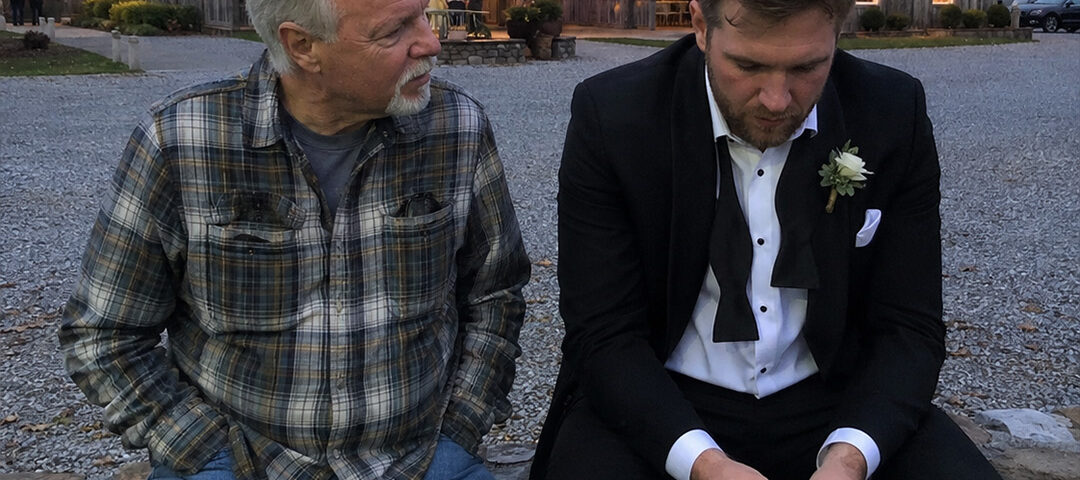
I crossed to a low stone wall near the edge of the lot and sat down.
Only then did I realize my heart was beating hard.
I looked at my watch.
I told myself I would give him ten minutes.
Then I told myself that was a lie. I would give him as long as it took until the answer became clear.
Through the windows, I could see shapes moving inside. Guests standing. A server carrying a tray. A woman in a green dress laughing with her head tilted back. Life continuing, polished and golden, as if a father had not just walked out of his son’s wedding carrying the weight of every silence he had chosen.
One minute.
Then three.
At five minutes, the door opened. A man stepped out, saw me, hesitated, and moved away toward the far side of the building with a cigarette cupped in one hand.
At seven minutes, my phone buzzed.
Unknown number.
I did not answer.
At eight minutes, it buzzed again.
Simone.
I looked at the screen until it went dark.
At ten minutes, I stood because sitting had become unbearable. Then I sat again because standing felt worse.
At eleven minutes, the door opened behind me.
I did not turn right away.
Footsteps crossed the gravel. Slow. Uncertain.
Then Brendan came into view and sat beside me on the stone wall.
His bow tie was loose. His jacket was still buttoned, but wrong, one side pulled slightly higher than the other. His hair had fallen forward the way it did when he had run his hands through it too many times. In the yellow light from the venue, he looked both thirty-six and fourteen.
For a while, neither of us spoke.
Inside, the music changed to something faster. Guests cheered faintly.
Brendan stared at his hands.
“She’s looking for me,” he said.
“I know.”
“She said you were trying to ruin the night.”
I kept my eyes on the dark line of trees beyond the lot.
“And what do you think?”
He laughed once, barely. “I think I walked out here anyway.”
That was the first crack in the wall.
Not collapse.
Not rescue.
But air.
His phone lit up in his hand. Simone’s name again.
He looked at it.
For a second, I thought he would answer.
Instead, he turned the phone face down on the stone between us.
The small sound of it touching rock felt louder than the music inside.
He swallowed.
“What is it?” he asked.
I looked at my son then.
Really looked.
At the tiredness under his eyes. At the fear he was trying to hold like a man. At the boy still buried inside him, the one who used to wake me after nightmares and insist he had only come downstairs for water. At the husband he had just become. At the man he still had time to choose to be.
The truth sat in my chest, heavy and ready.
The hotel. The call. Daniel Mercer. The money. The pattern. The way a life could be rearranged one reasonable request at a time until a man found himself apologizing for wanting room to breathe.
Brendan’s voice dropped to almost nothing.
“Dad,” he said. “Tell me everything.”
I reached into the inside pocket of my suit jacket, where the folded paper had been resting all night against my heart.