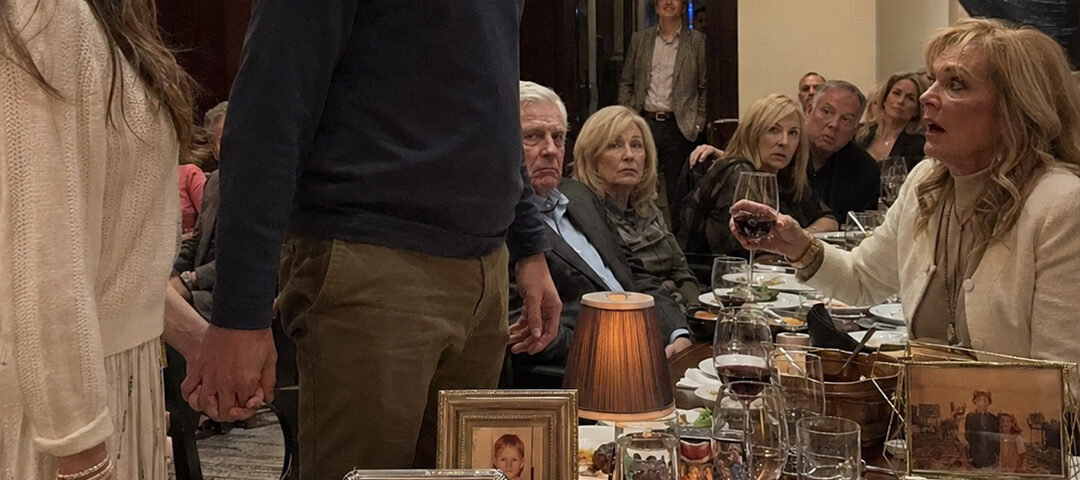
My name is Barney Whitmore. I am thirty-four years old, and last Saturday night, at my own birthday dinner, I said one word that made thirty people go so quiet you could hear the candles flickering on my cake.
But I am getting ahead of myself.
If I started with the ending, you might think I was being dramatic. You might think it was just a tense family moment that got out of hand. You might think I overreacted to a speech, a surprise guest, a mother trying too hard to pull her family back together.
So let me back up.
By the time we get to that one word, you will understand why it carried twenty-eight years of weight behind it.
I grew up in a small town outside Knoxville, Tennessee, the kind of place where everyone knew your business before you did. Church signs changed every Monday. High school football mattered more than the weather. Neighbors waved from pickup trucks and pretended they had not repeated every detail of your life by supper.
My mother, Jolene, fit perfectly into that world.
She was the kind of woman who could host a church potluck, organize a school fundraiser, chair a PTA meeting, and still have time to remind you that your shirt collar looked sloppy before noon. She ran our household like a stage production, and appearances mattered more than anything.
If the neighbors thought we were happy, then we were happy.
That was the rule.
My father, Glenn, was a different kind of person.
He was tall, good-looking, and charming in the way certain men are charming when they have never had to be accountable for it. He had a deep voice, a wide smile, and a laugh that made strangers feel like they had been let in on a private joke.
Women loved him.
His buddies loved him.
Servers at restaurants loved him.
Cashiers at gas stations loved him.
Everyone loved Glenn, except the people who actually had to live with him.
Here is the truth about my father. He was around just enough to technically count as a father, but never enough to actually be one.
He drove long-haul trucks for most of my childhood, which meant he would roll in every couple of weeks smelling like diesel, fast food, and cheap cologne. He would toss some gas station toy onto the kitchen table like he was feeding a stray cat, then spend the next three days either arguing with my mother or disappearing to his buddy Randall’s place to drink beer and watch football.
When I was six, he missed my birthday.
My mother told me he was stuck on a run in Amarillo. She baked the cake herself, put extra frosting on one side because that was the part I liked, and told me Daddy had sent his love from Texas.
Years later, I found out he had been thirty minutes away at a motel with a woman named Sheila who worked at the Waffle House off Exit 47.
Happy birthday to me.
But the real problem was not only that Glenn was absent. Plenty of kids grow up with absent parents and survive.
The real problem was that when Glenn was home, he was cruel.
Not always in a loud, obvious way. Sometimes he crossed lines that no one in a healthy home would excuse, but most of his damage was quieter than that. He had a surgical talent for finding the one thing you were insecure about and pressing on it like a bruise.
I was a soft kid. Not huge. Not unhealthy. Just a little chubby around the edges in that way some boys are before they grow into themselves.
Glenn made sure I knew about it every single day he was home.
He would pat my stomach and say, “Boy, you keep eating like that, they’re going to have to widen the door frames.”
Then he would laugh that big, charming Glenn laugh, and somehow everyone else was supposed to laugh too.
My mother would swat his arm and say, “Oh, Glenn, stop it.”
But she would be half smiling.
Because Glenn was funny.
Glenn was just being Glenn.
I stopped eating lunch at school when I was nine. Nobody noticed for two months.
That is the part people do not understand about homes like mine. The worst things did not always look dramatic from the outside. There were no neighbors calling anyone. There were no police cars in the driveway. There were no scenes that made people whisper, “Something is wrong over there.”
There was just a boy learning to shrink himself so his father would have less to aim at.
And there was a mother who kept calling it peace.
I want to be fair about my mother, because life is rarely simple and people are rarely all one thing.
Jolene was not a monster. I believe she loved me in her own way. She packed my school lunches when I was little. She drove me to baseball practice. She kept my report cards in a shoebox under her bed. She cried at my high school graduation.
But she loved the idea of a complete family more than she loved protecting me from the man who was dismantling my self-worth one joke at a time.
Every time Glenn did something wrong, her response was the same.
Minimize.
Excuse.
Redirect.
“Your father is under a lot of pressure.”
“He doesn’t mean it like that.”
“You know he loves you.”
“He just doesn’t know how to show it.”
I heard those lines so often they became like a prayer she recited to keep herself from facing the truth.
The truth was that Glenn did not love me in any way that mattered.
He loved being admired. He loved walking into a room and being greeted like the fun one. He loved the sound of his own stories. He loved being forgiven before he had even apologized.
But me?
I was mostly evidence of responsibilities he did not want.
When I was fourteen, Glenn left for good.
Not dramatically. Not with a slammed door or some big final fight.
He just stopped coming back from his runs.
One week turned into two.
Two weeks turned into a month.
Then my mother sat me down at the kitchen table with a tight little smile and said, “Your father and I are taking some time apart.”
Taking some time apart.
Like he had gone to a spa instead of moving in with his girlfriend in Memphis.
I remember sitting there and thinking I should feel sad. I should cry. I should ask when he was coming home.
But all I felt was relief.
It was a strange, hollow kind of relief, like when a toothache finally stops and you realize you had gotten so used to pain that you forgot what normal felt like.
For the next few years, Glenn became a ghost.
A birthday card here.
A random text there.
A promise to visit that never turned into an actual visit.
Always just enough contact to keep my mother hopeful.
And she did hope.
She kept his photo on the mantel. She kept some of his clothes in the closet. She talked about him like he was deployed overseas instead of living less than an hour away and choosing not to see his son.
I got through high school mostly on my own. I made decent grades. I played baseball. I worked at a hardware store after school to help my mom with bills because Glenn’s child support was about as reliable as a screen door on a submarine.
I put myself through community college, transferred to a state university, and got a degree in accounting.
It was not glamorous, but when you grow up counting every penny on the kitchen table, being good with numbers starts to feel like armor.
By twenty-six, I had a decent job at a firm in Nashville, a small apartment I was proud of, and a girlfriend named Clare.
I met Clare at a friend’s wedding. She was sharp, kind, and honest in a way that somehow never felt unkind. She had this laugh that could fill an entire room without trying. She also had a family that actually functioned like a family, which was a revelation to me.
The first time I went to her parents’ house for Sunday dinner, her father, Roger, asked me how my week had been.
Then he actually listened to the answer.
I almost did not know what to do with myself.
Clare and I got engaged when I was twenty-nine. We married when I was thirty. My mother came to the wedding and cried the way mothers are supposed to cry.
Glenn was not invited.
That was a boundary I set early, and I held firm.
It was the first time I had ever directly contradicted my mother on anything related to my father. She fought me for weeks. She called me stubborn. She called me unforgiving. She said I was punishing him.
I told her I was not punishing anyone.
I was simply choosing not to have someone at the most important day of my life who had spent most of my childhood making me feel like I was not worth being around.
She did not speak to me for two weeks after that, which honestly was a useful preview of her priorities.
But we patched things up, because that is what you do with family, right?
You patch.
You sand over the rough spots.
You pretend the wood underneath is not rotten.
At least, that was what I had been taught to do.
Fast forward to this year.
I turned thirty-four on a Saturday, and Clare, being the incredible human she is, organized a dinner at a great restaurant downtown. Nothing wild. Just a private room in the back. Good food. Thirty people we actually cared about.
Friends from college.
Coworkers I liked.
Clare’s family.
My mother.
My cousin Reed and his wife Sutton.
A few neighbors we had gotten close with.
It was supposed to be simple. A nice night. Steaks, laughter, a birthday cake, and someone inevitably making a toast that went on too long.
What I did not know was that my mother had been planning something of her own.
And what I really did not know was that she had been talking to Glenn for four months behind my back, organizing what she called a healing moment for our family.
That night did not come out of nowhere.
It came out of twenty-eight years of a woman choosing a fantasy over her son.
And I was done being a character in her story.
The week before my birthday, I noticed my mother acting different. Not bad different. Just strangely enthusiastic.
She called me three times in five days, which for Jolene was practically stalking. She asked what I was wearing to dinner. She asked whether Clare had picked the menu. She asked who exactly was coming.
Then she asked whether there would be a microphone.
“A microphone?” I said. “Mom, it’s not the Grammys. It’s a steak restaurant.”
She laughed, but it was that thin, tight laugh she used when she was holding something back, like a balloon she was afraid would pop if she squeezed too hard.
I should have paid attention.
But I was busy with work, busy with life, and honestly tired of reading my mother’s moods. I had spent too many years watching the weather change on her face and trying to figure out how to survive the storm.
I figured she was excited.
Maybe she wanted to give a toast.
Fine. Let her give a toast.
What was the worst that could happen?
A lot, apparently.
A lot could happen.
The night of the dinner was actually perfect at first.
Clare had done an incredible job. The private room was warm and elegant, with amber lights, dark wood trim, framed black-and-white photos of old Nashville on the walls, and a long U-shaped arrangement of tables so everyone could see each other.
There were little framed photos of me throughout my life scattered among the centerpieces.
Baby pictures.
College graduation.
Our wedding.
A truly horrifying picture of me at fifteen with braces and a bowl cut that Clare specifically chose because she said it “built character.”
The food was phenomenal.
Filet mignon.
Roasted vegetables.
Lobster mac and cheese that I am still thinking about.
People were laughing. Drinks were flowing. The waiters moved in and out quietly. For about ninety minutes, I felt completely happy.
My buddy Trent from college gave a toast that was mostly roasting me for the time I set off the fire alarm in our dorm trying to make ramen at two in the morning.
Clare’s dad, Roger, said something so kind about being proud to call me his son-in-law that I had to stare at the ceiling to keep myself together.
Clare squeezed my hand under the table and whispered, “You deserve this.”
Then my mother stood up.
She was sitting near the middle of the table, and she had a look on her face that I recognized immediately.
It was her event face.
The one she wore when she was about to do something she had rehearsed.
She clinked her glass with a knife. The room settled down. She smiled a big trembling smile and said, “I’d like to say a few words about my beautiful boy.”
So far, so normal.
Mothers give toasts at birthday dinners. That is allowed.
I smiled at her. Clare rubbed my back.
I thought, all right, here we go. She is going to say something sweet, make it a little bit about herself because that is what Jolene does, and then we will cut the cake.
She started off fine.
She talked about the day I was born, how I came out screaming like I was already angry at the world, which got a laugh.
She talked about how proud she was of the man I had become. How I had built a life from almost nothing. How I was the strongest person she knew.
It was actually beautiful.
For a second, just a second, my throat tightened.
I thought maybe I had been too hard on her.
Maybe she really did understand.
Then her voice changed.
It became softer. More deliberate. Like she was shifting from a toast into a sermon.
“But tonight is not just about celebrating Barney,” she said. “Tonight is about healing.”
Clare’s hand tightened around mine.
Across the table, Reed slowly lowered his fork.
My mother looked around the room with an expression of profound gravity, as if she were about to announce the cure for something.
“I have been carrying something on my heart for a long time,” she said. “And I believe, I truly believe, this is the moment God has chosen for our family to come back together.”
The room changed temperature.
I felt it.
A strange stillness moved across the table. People who had been smiling a moment earlier stopped smiling. Someone’s ice shifted in a glass. A waiter paused near the sideboard and then quietly backed away.
My mother turned toward the door of the private room.
“You can come in now,” she said.
And Glenn walked in.
My father, who I had not seen in over four years, who had not been invited, walked through that door in a sport coat and pressed slacks like he was arriving at a job interview.
He had aged.
His hair was thinner. There were more lines around his mouth. He looked smaller somehow than the imposing figure from my childhood.
But that smile was exactly the same.
Big.
Easy.
Practiced.
He smiled at me like we had just run into each other at the grocery store.
Like this was a pleasant coincidence.
Like this was not an ambush at my own birthday dinner.
I did not move.
I did not speak.
I just looked at him standing there in the doorway with his hands in his pockets and that smile on his face.
What I felt was not exactly surprise.
It was the opposite of surprise.
It was a cold recognition, like some part of me had always known this was coming. Like I had been waiting my whole life for my mother to pull exactly this kind of stunt.
And here it was.
Right on schedule.
My mother kept talking.
Her voice had a quiver in it now, an emotional tremor she probably thought made her sound vulnerable. To me, it sounded like an actress reaching for an award.
“Glenn and I have been talking for months,” she said. “He has changed. He has been going to church. He has been working on himself. And he wants nothing more than to be part of his son’s life again.”
She looked at me with tears in her eyes.
“Barney, tonight is about forgiveness. I am asking you, in front of the people who love you most, to forgive your father and let him back in.”
Thirty people were staring at me.
Unless you have been in that exact position, you cannot fully understand what it feels like.
Imagine every person you care about watching you at your most vulnerable moment, waiting for you to perform an emotion you do not feel.
Imagine being put on trial at your own party.
Imagine the person who was supposed to protect you as a child standing there asking you to embrace the person she failed to protect you from.
And imagine her doing it in a setting where saying no makes you look like the villain.
That is what my mother did to me.
On my birthday.
Glenn took a step closer.
He was still smiling, but I could see something behind it now. Nerves, maybe. Or calculation.
“Hey, Barn,” he said. “It’s been a while.”
His voice was softer than I remembered, but the casualness of it hit me harder than anger would have.
It’s been a while.
Like he had been on vacation.
Like the years of absence were a scheduling conflict.
The room was dead silent. I could hear someone’s ice shifting in their glass. I could feel Clare practically vibrating next to me. She wanted to stand up. She wanted to defend me because that is who Clare is.
But she let me have the moment.
She knew it was mine.
My mother was still standing, still crying, still waiting for me to deliver the scene she had written in her head.
She had probably imagined this like a movie.
The estranged son.
The repentant father.
The tearful embrace.
Thirty witnesses clapping and crying.
She had probably rehearsed the moment I would break down and say, “I forgive you, Dad.”
Then they would hug me from both sides and we would be a family again.
And she could finally stop lying to herself about the last three decades.
I looked at my mother standing there in her nice dress with her nice tears and her nice fantasy.
I thought about every single time she chose Glenn over me.
Every excuse.
Every minimized wound.
Every time she told me to be the bigger person when I was literally a child.
Every time she said, “That is just how your father is,” as if cruelty were a personality quirk.
I thought about my wedding and how she tried to guilt me into inviting him.
I thought about the years of therapy I paid for out of my own pocket because she could not be bothered to acknowledge that our family was not just complicated.
It was damaged.
And she had held the door open for the man who did the damage.
Then I looked at Glenn.
He stood there like a guest of honor at a party he had crashed, smiling like he had already been forgiven.
I looked back at my mother.
And I said one word.
“No.”
The silence after that word is something I will never forget.
It was not the polite, waiting silence of a room expecting you to continue. It was the stunned silence of thirty people collectively holding their breath because they could not believe what they had just witnessed.
My mother’s face went through four emotions in two seconds.
Confusion.
Shock.
Embarrassment.
Then a tight-lipped fury I recognized from every argument we had ever had.
Glenn’s smile did not drop exactly. It froze, like someone had paused a video at the wrong frame.
I stood up.
My napkin slid off my lap and fell to the floor.
I did not pick it up.
I looked directly at my mother and said, “You do not get to do this. Not here. Not tonight. Not ever.”
My voice was steady, which surprised me, because inside I felt like a building with the foundation cracking.
But something had snapped into place when I said no.
Something that had been loose and rattling around for years had finally clicked.
And it held me upright.
My mother started to speak. Her mouth was already forming the shape of an excuse.
I held up my hand.
“I’m not finished.”
The room stayed silent.
Through the wall, I could hear kitchen noise. Plates. Voices. The normal rhythm of a restaurant continuing on the other side of a family earthquake.
“You invited him here without telling me,” I said. “You turned my birthday into an intervention I did not ask for. You put me on the spot in front of every person I love so that if I said no, I would look like the bad guy.”
My mother’s eyes filled again.
“That is not healing, Mom,” I said. “That is manipulation.”
Glenn shifted his weight.
“Barn, I think your mother just wanted us to—”
“I am not talking to you.”
I did not even look at him.
I kept my eyes on my mother.
“Why, Mom? I need you to tell me why you thought this was okay. Why you thought ambushing me was the right way to handle this. Help me understand, because I have spent years trying to understand you, and I keep coming up empty.”
My mother’s chin trembled.
“Because you won’t listen,” she said. “I have tried calling. I have tried talking to you, and you shut me down every time. I did not know what else to do.”
“So your solution was a public spectacle.”
I let that sit for a beat.
“You did not do this for me,” I said. “You did this for you. Because you cannot stand the idea that your family is not perfect. And you thought if you put enough pressure on me, with enough witnesses, I would fold. Because that is what I have always done, right? I have always folded for you.”
Clare stood up beside me.
She did not say anything.
She simply stood.
The solidarity of that small gesture almost broke me.
Trent had his arms crossed and was staring at my mother with an expression that could curdle milk. Reed’s wife, Sutton, had her hand over her mouth. Roger looked like he was about three seconds from escorting Glenn out personally.
My mother whispered, “He is your father, Barney. He is trying.”
And I asked the question I had been holding for twenty years.
“Why wasn’t I enough for you to try?”
She blinked.
“When he made fun of me as a kid, where were you? When he scared me, where were you? When he left and did not come back, and I was fourteen years old working at a hardware store to help pay the electric bill because his child support was a joke, where were you?”
She did not answer.
“You were waiting for him,” I said. “You were always waiting for him. And now you want me to wait for him too.”
Glenn cleared his throat.
“I know I made mistakes.”
I finally looked at him.
“You did not make mistakes. Burning toast is a mistake. Forgetting to pick up milk is a mistake. You chose to leave. You chose not to come back. You chose to miss every single thing that mattered. And now you are here in your nice jacket expecting me to hand you a second chance like a party favor.”
I shook my head.
“You do not get that from me. You have not earned it.”
Then I turned back to the room.
Thirty faces were looking at me. Some uncomfortable. Most sympathetic. A few visibly stunned.
“I am sorry, everyone,” I said. “This was not the evening any of us planned. I am going to step outside for a few minutes, and when I come back, I would really like to just eat cake and pretend this did not happen, if that is all right with you.”
There were nods.
A few people murmured, “Of course.”
Trent said, “Take your time, brother.”
Clare grabbed her jacket and followed me out.
We stood in the parking lot behind the restaurant, and that was when the adrenaline drained out of me.
I started shaking.
Not crying. Just shaking, like my body had held itself together through sheer willpower and had finally decided it was done.
Clare wrapped her arms around me.
“I am so proud of you,” she said.
And I said something incredibly eloquent like, “I think I need to sit down.”
So we sat on the curb next to a dumpster, which is not the most dignified place to have a life-altering moment, but you do not always get to choose the scenery.
Clare held my hand.
For a while, neither of us talked.
A busboy came out to toss a trash bag, saw us sitting there, and said, “You guys okay?”
Clare said, “Birthday party.”
Like that explained everything.
Somehow, it did.
When we went back inside about fifteen minutes later, Glenn was gone.
My mother was still there, sitting in her chair, not talking to anyone. Her mascara was smudged, and she looked small in a way I had never seen before.
The rest of the party had reorganized itself around her absence from the conversation. People were eating, talking quietly, doing their best to give the evening a soft landing.
I sat back down.
Reed leaned over and asked, “You good?”
“Getting there,” I said.
Clare’s mother, Diana, came up behind me, squeezed my shoulders, and said, “Happy birthday, sweetheart.”
It was so simple and so genuinely kind that I almost lost it right there.
We cut the cake.
People sang.
It was awkward and warm and imperfect, the way most real moments are.
My mother left before dessert was finished.
She did not say goodbye to me. She slipped out while I was talking to Trent’s wife. When I noticed her empty chair, I felt something I did not expect.
Not sadness exactly.
More like the particular heaviness of realizing that a relationship you had been trying to save might not be savable.
The next few weeks were rough.
I will not pretend otherwise.
My mother did not call. She did not text. Complete radio silence, which was her classic move whenever she did not get what she wanted.
She had used the silent treatment on me so many times over the years that I used to panic when it happened. I used to scramble to fix things. I used to apologize just to get her to talk to me again.
But this time was different.
This time, I let the silence sit.
Clare was incredible during that stretch. She did not push me to talk when I did not want to. She did not avoid the topic when I did. She simply existed beside me with this steady, solid presence that made me feel like I had ground under my feet.
One night, she came home with a book about setting boundaries with family members and left it on my nightstand without saying a word.
I read the whole thing in two days.
I also went back to therapy.
My therapist, Dr. Amara, listened to the entire birthday dinner story without interrupting. When I finished, she sat quietly for a moment and asked, “How did it feel to say no?”
I thought about that for a long time.
Then I said, “It felt like mine. Like it was the first thing I had ever said that belonged entirely to me.”
We spent the next few sessions unpacking the guilt, because there was plenty of it.
I felt guilty for embarrassing my mother.
Guilty for not giving Glenn a chance.
Guilty for making a scene.
Dr. Amara helped me understand that guilt was the operating system my mother had installed in me from childhood. This invisible program that made me feel responsible for everyone else’s emotions.
“Your mother set a trap,” Dr. Amara said, “and you did not walk into it. The guilt you are feeling is not proof that you did something wrong. It is proof that you were trained to carry things that were never yours.”
I held onto that like a life raft.
Slowly and awkwardly, the way you learn to use a muscle you have never exercised before, I started getting stronger.
About five weeks after the birthday dinner, the silence broke, but not the way I expected.
I was at work on a Thursday afternoon, buried in a quarterly report that was about as thrilling as watching paint negotiate with a wall, when my phone buzzed.
It was Reed.
He never texted during work hours, so I picked it up immediately.
His message said, “Hey, you need to call me when you get a chance. It’s about your mom and Glenn. Not an emergency, but it’s something you should know.”
I called him on my lunch break, sitting in my car in the office parking lot with half a sandwich going stale on the passenger seat.
Reed has always been the most straightforward person in my family. He does not sugarcoat. He does not play games. And he married Sutton, who is even more direct than he is.
So when Reed told me what he had found out, I knew he was not exaggerating.
Apparently, my mother and Glenn had not just been talking for four months before the dinner.
They had been fully back together.
Dating.
Seeing each other multiple times a week.
Glenn had been staying at my mother’s house on weekends.
And the birthday dinner stunt was not some spontaneous act of maternal desperation.
It was planned.
Strategized.
My mother and Glenn had designed that moment together. They discussed which guests would be there, how to time his entrance, even what he should wear.
The sport coat was my mother’s idea.
She thought it would make him look respectable.
Reed knew all of this because Sutton had run into my mother at the grocery store the week after the dinner. My mother, apparently thinking Sutton would be sympathetic, had unloaded the whole story while standing in the cereal aisle.
She told Sutton that Glenn was the love of her life, that they were getting a second chance, and that I had humiliated both of them at the dinner.
She said she did not understand why I was so angry.
She said Glenn had done his best as a father.
Then she said I was holding on to the past for attention.
Holding on to the past for attention.
My own mother said that about me.
Sutton, God bless her, told my mother that ambushing someone at their birthday party was not how you rebuild a relationship. She also suggested that maybe Jolene should consider how Barney felt instead of how she looked.
My mother apparently got very quiet and changed the subject to a sale on laundry detergent.
Classic Jolene deflection.
When Reed finished telling me all this, I sat in my car for a long time.
I was not angry.
Not yet.
I was just tired.
Bone-deep tired.
Tired of being the mature one. Tired of being the one who was supposed to understand. Supposed to forgive. Supposed to make room for people who had never made room for me.
I called Clare and told her everything.
She listened.
Then she asked, “So what do you want to do?”
That question mattered more than she probably realized.
For the first time, someone was asking me what I wanted instead of telling me what I should do.
What I wanted was clarity.
I wanted to set a boundary so clean and final that there would be no ambiguity about where I stood.
Not out of revenge.
Not out of anger.
Out of necessity.
Because I had spent thirty-four years letting my mother blur the lines between love and control. If I did not draw those lines myself, no one else was going to draw them for me.
I drafted a letter.
Not an email.
Not a text.
An actual handwritten letter on paper, because I wanted it to feel deliberate. I wanted my mother to hold it in her hands and understand that every word had been chosen with care.
Clare sat with me at the kitchen table while I wrote it. Dr. Amara reviewed a draft during our next session.
It took me three versions to get it right.
The letter was two pages.
I will not recite the entire thing, but I will tell you the key parts.
I told my mother that I loved her, because I did, and I wanted that on the record.
I told her that the birthday dinner was a violation of my trust and my boundaries, and that learning it had been premeditated made it worse, not better.
I told her that her relationship with Glenn was her business and that I would never try to control who she chose to be with.
But I also told her that Glenn was not welcome in my life.
If she continued to push him on me, she was choosing him over me, and I needed her to understand that choice had consequences.
I wrote, “I have spent my entire life trying to earn something from you that should have been given freely. I am done performing for your approval. If you want a relationship with me, it has to be with me as I actually am, not as a prop in the family story you wish you had.”
I also told her I knew they had planned the dinner entrance together.
I did not say how I knew.
I simply wanted her to understand that I was not operating on assumptions.
I ended the letter by saying the door was open if she was willing to come through it honestly, but I was done opening it for people who kept slamming it in my face.
I mailed it on a Monday.
Certified.
Signature required.
I wanted proof she received it.
While I waited for a response, something unexpected happened.
People from the birthday dinner started reaching out.
Not everyone, but enough.
Trent called and said, “Dude, I have been thinking about that night for weeks. What your mom did was messed up, and I just want you to know I’ve got your back.”
My coworker Paige, who had been at the dinner with her husband, sent a thoughtful text saying she admired how I handled myself and that she had been through something similar with her own father.
Even Roger took me aside at Sunday dinner and said, “You know, I was not sure about you when Clare first brought you home. But watching you stand up for yourself like that, in front of a room full of people, with every reason to fold, told me everything I needed to know about the kind of man you are.”
I am not going to lie.
That one got me.
I had to excuse myself to the bathroom for a few minutes.
The letter arrived at my mother’s house on a Wednesday.
I know because the tracking confirmation told me she signed for it at 11:14 in the morning.
I stared at that delivery notification for a long time, wondering what she was doing at that exact moment.
Was she reading it?
Was she angry?
Was Glenn there?
She did not respond for nine days.
When she finally did, it was a text.
Not a letter.
Not a call.
A text.
“I got your letter,” she wrote. “I think you are being very unfair, and I hope one day you will understand what I was trying to do. I only wanted our family to be whole.”
I read it three times.
Then I showed it to Clare.
She read it and said, “She still does not get it.”
And she was right.
There was no acknowledgment of what she had done. No apology. No recognition that she had hurt me.
Just the same refrain she had been singing my entire life.
I was the problem for not going along with her program.
I did not respond immediately.
I took it to Dr. Amara, who helped me craft a reply that was brief and clear.
I texted back, “I understand that is how you see it. I love you, Mom, but I need you to respect my boundaries. When you are ready to do that, I am here.”
That was five weeks ago.
She did not respond.
But this is the part of the story where things got interesting.
While my mother was choosing silence, life was choosing something very different for Glenn.
I need you to understand that I did not plan what happened next. I did not orchestrate anything. I did not go digging for revenge.
Sometimes consequences simply put on a sport coat of their own and walk through the door at exactly the right moment.
Remember how I said Glenn had been staying at my mother’s house on weekends?
It turned out Glenn was not just rekindling a romance.
He was setting up camp.
Reed called again about three weeks after I sent the letter. This time, the news was bigger.
Glenn had moved in with my mother.
Fully moved in.
His truck in the driveway.
His recliner in the living room.
His boots by the front door.
My mother had let him back into the house like the last twenty years had been a commercial break.
But here is where it got spectacularly bad for Glenn.
Sutton works at a real estate title company. She was processing a batch of lien searches in the county database when a familiar name appeared.
Glenn Whitmore.
My father had three outstanding liens, two from federal tax issues and one from a creditor in Memphis.
The total was just north of $140,000.
The man who could not reliably pay child support had also neglected major financial responsibilities for the better part of a decade.
And by moving into my mother’s house, a house she owned free and clear, he was dragging his problems right to her doorstep.
I want to be clear. I did not go looking for this information.
Sutton brought it to Reed.
Reed brought it to me.
Glenn was not coming back to my mother because he had found faith, maturity, or a sudden passion for family.
He needed somewhere to land.
And my mother, with her paid-off house and her desperate need to believe in the fairy tale, was the softest landing he could find.
I had a choice to make.
I could let it play out and watch my mother risk everything for a man who had already taken so much from her.
Or I could do the thing I swore I would stop doing, which was saving her from herself.
I chose something in the middle.
I called my mother.
She picked up on the fourth ring, and her voice was cautious, almost defensive, like she was bracing for another argument.
“Mom,” I said, “I am not calling to fight. I am calling because I have information you need to hear, and what you do with it is your business.”
She was quiet.
Then she said, “Okay.”
I told her about the liens.
I told her the amounts.
I told her that Glenn living in her house could create serious risks depending on how creditors pursued collection. I told her she needed to talk to a lawyer, not me, not Glenn, but an actual attorney who could explain her exposure.
I kept my voice calm and factual, the way I would present a financial report to a client.
No emotion.
No “I told you so.”
Just the numbers.
She did not speak for a long time.
Then she asked, “How do you know this?”
“It does not matter how I know,” I said. “What matters is that it is true, and you can verify it yourself. The county records are public.”
Another long pause.
Then, so quietly I almost missed it, she said, “He told me he had gotten everything sorted.”
I closed my eyes.
Of course he had.
“Mom, I am not going to tell you what to do,” I said. “But I am asking you to please protect yourself. Talk to a lawyer. This week.”
She hung up without saying goodbye.
I sat in my home office staring at my phone, thinking about how exhausting it is to love someone who keeps walking into traffic and getting angry at you for pointing out the cars.
Over the next two weeks, I got most of the updates from Reed and Sutton, because my mother still was not speaking to me directly.
She did talk to a lawyer.
A good one.
A woman named Cassandra, recommended through Reed’s firm.
Cassandra laid out the situation in terms my mother could not spin, soften, or minimize. If Glenn remained in the home and certain creditors moved aggressively, there were scenarios where her property could become entangled in his financial mess.
My mother had options.
But all of them involved Glenn leaving.
That was when the mask finally came off.
When my mother told Glenn what she had learned and asked him to explain, he did not apologize. He did not come clean. He did not sit down with paperwork and try to make things right.
He got angry.
He told her she had been talking to the wrong people. He claimed the liens were being handled. He said someone, meaning me, was trying to sabotage their relationship.
He actually said I was jealous of their happiness.
Jealous.
Of his happiness.
The man who missed my childhood because he was too busy chasing comfort wherever he could find it was accusing me of jealousy.
My mother, for all her flaws, is not stupid.
She told Glenn he had to leave until the financial situation was resolved.
Glenn did not take it well.
There was yelling. There was blame. There was his usual performance of making himself the injured party in a situation he created.
Then he loaded his truck and left on a Thursday afternoon.
That night, he texted my mother calling her ungrateful.
She did not respond.
First smart move she had made in years.
About a week later, my mother called me.
This time, her voice was different.
It was not defensive.
It was not performing.
It was simply tired.
Tired in the way I had felt in that parking lot after the birthday dinner.
“I think I owe you an apology,” she said.
I did not say anything.
I just let her talk.
“I have been so afraid of being alone,” she said, “that I let myself believe things I knew were not true. About your father. About what happened when you were little.”
Her voice cracked.
“I told myself you were fine. I told myself I did my best. But I did the easiest thing, which was pretend.”
I still did not speak.
“The birthday dinner,” she said, “I keep replaying it from your side, and every time it looks worse. You asked me why I thought it was okay, and the truth is I did not think about you at all. I was thinking about me.”
She took a shaky breath.
“I am sorry, Barney. For the dinner. For all of it.”
I let the silence hang for a moment.
Then I said, “Thank you for saying that.”
She asked if we could see each other.
I said yes, but on my terms.
Not at her house.
Not with an audience.
Just us.
We met at a coffee shop the following Saturday.
It was awkward and raw. The kind of meeting where both people hold their coffee cups too tightly because they do not know what to do with their hands.
But she looked me in the eye and said it again.
The apology.
This time, it felt real.
Not rehearsed.
Not performed for a crowd.
Just a mother admitting she had failed her son.
I told her forgiveness was not a switch I could flip. I told her it would take time, effort, and consistency.
I told her Glenn was a permanent no.
I told her if she ever tried anything like the birthday dinner again, we were done.
She nodded.
She did not argue.
She did not deflect.
She simply said, “I understand.”
We are not fixed.
I want to be honest about that.
We meet for coffee every couple of weeks. It is slow. Careful. Some days I am not sure it is going to work. But she is trying.
And for the first time in my life, she is trying for me instead of for the idea of me.
As for Glenn, his financial problems have not magically disappeared. His Memphis girlfriend also found out about the situation and showed him the door, which means the man who spent his whole life searching for soft places to land is running out of cushions.
I do not wish anything bad on him.
I just do not wish anything for him at all.
He is not my project.
He never should have been.
Clare and I are doing great. Better than great.
She told me the other night that she fell in love with me the first time because I was kind, but she fell in love with me a second time when she saw that my kindness had a backbone.
I am going to cross-stitch that onto a pillow.
Last Saturday was exactly two months since the birthday dinner.
Clare brought home a small cake. Just the two of us. She put a single candle on it and said, “Make a wish.”
I blew it out.
She asked what I wished for.
I told her I did not wish for anything.
For the first time in as long as I could remember, I already had everything I needed.
One word.
One syllable.
Two letters.
And it changed everything.
No is a complete sentence.
You do not owe anyone an explanation for protecting yourself, especially not the people who should have protected you all along.
And if someone corners you at your own birthday dinner with thirty people watching, expecting you to fold, do not fold.
Stand up.
Look them in the eye.
And say the one word that belongs entirely to you.