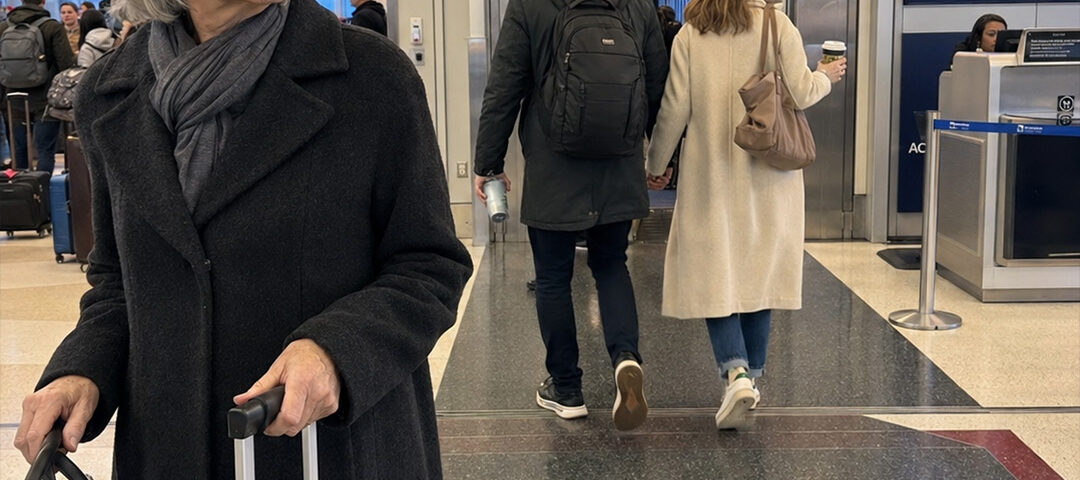
They boarded the plane, and I was left standing there at Chicago O’Hare with a canceled ticket arranged by my own family. That same night, my daughter-in-law texted, “You should get used to being left behind.” I sent back one short reply. When they came home, their phones would not stop ringing, and everything they had taken for granted began to come apart.
The cold wind pressed against the big glass windows of Terminal 3, but the real chill settled right in my chest. Travelers hurried past with rolling suitcases, children in puffy coats, paper coffee cups, and the soft panic of holiday travel. I stood at the counter with my purse tucked under my arm while the gate agent kept looking from her screen to my face as if she wished the answer would change.
“I’m so sorry, Mrs. Haron,” she said gently. “But this ticket has been canceled.”
I stared at the little screen. Not delayed. Not rebooked. Not moved to another flight. Just gone.
Through the security ropes, I could see my son Ryan and his wife Brooke laughing near the boarding lane, sipping their expensive lattes and walking toward the jet bridge like they had the whole world arranged exactly the way they wanted it. My six-year-old granddaughter Sophie stood beside me in her pink snow boots, clutching the little stuffed moose she had bought for the Canada trip. She had been counting down the days for snow, cocoa, and northern lights.
She waved toward her parents with the kind of excitement only a child can carry after weeks of looking at pictures online. Nobody waved back. Ryan glanced over his shoulder, saw me standing at the counter with the agent, and quickly looked away. Then he picked up his pace.
That was when it landed. This was not a mix-up. It was not a computer mistake. It was not one of those airline problems people complain about while standing in long lines with tired eyes and boarding passes in their hands. This had been planned.
I had wired my share for the trip back in October. Brooke had handled the entire booking because she always talked about being better with apps, travel sites, passwords, and all the modern little systems that made me feel older than I liked to admit. I had trusted her because she was my son’s wife, because she was Sophie’s mother, and because I still believed that family did not arrange a vacation around you and then quietly erase your seat.
As the jet bridge swallowed them up, I did not fall apart. I did not raise my voice. I did not beg the airline to fix what another person had chosen to do. A strange, almost clean clarity moved through me, the kind that comes when a truth you have avoided for years finally stops whispering and stands right in front of you.
Sophie looked up at me with those huge eyes and whispered, “Grandma, aren’t we going too?”
I brushed her hair back from her forehead. “Not today, sweetheart. We’re heading home. But I promise you, this New Year’s is one you’ll never forget.”
On the cab ride back to our quiet suburb outside Chicago, I did not cry. I sat beside Sophie while she leaned against my coat, still confused, still trying to understand why the airport lights were moving away from us instead of toward an adventure. The highway glowed in streaks of red and white. The driver had a local news station murmuring softly from the dashboard, and outside, the winter sky looked low enough to touch.
When we got home, the duplex was silent. Their side of the building was dark, of course. Their suitcases were gone, their car was missing from the driveway, and the little wreath Brooke had bought from a boutique in Oak Park swung on their door like a decoration on a house that had forgotten how to feel warm.
I made Sophie grilled cheese and tomato soup because that was what she asked for. She ate only half and carried her stuffed moose upstairs. I tucked her into the guest room, turned on the night-light shaped like a moon, and sat beside her until her breathing slowed.
Only when the house went completely still did my phone buzz. A text from Brooke lit up the screen.
“You should be used to us needing our space by now. Don’t be so sensitive.”
I stared at those words until my anger cooled into something solid and steady. For years, I had mistaken silence for grace. I had mistaken swallowing disappointment for keeping the peace. I had let Brooke call selfishness “space,” and I had let Ryan pretend not to see it because it was easier than disagreeing with his wife.
I typed back one line.
“Don’t worry. Your New Year’s is going to be unforgettable.”
Then I opened my laptop. I knew exactly what needed to happen. The days of doing favors were over.
I sat at the kitchen table with a glass of water, my reading glasses, and the thick folder of papers I kept in the second drawer beside the oven. Ever since my husband, Martin, passed away, I had been the one handling nearly everything. Not because anyone forced me to, but because I loved my family, and I had always believed love meant making life easier for the people around you.
Ryan and Brooke lived in the other half of the duplex I owned. They paid a token rent that often arrived late and sometimes came with excuses. I was the one who scheduled the furnace tune-ups, watched the property taxes, managed the insurance for the whole building, and called the plumber when the upstairs bathroom on their side started making strange noises.
My eyes landed on the spreadsheet. There it was in black and white: $1,800 for the Canada trip wired on October 15. Brooke had taken my money and erased my seat. They probably wanted extra room for her brother, who had suddenly “needed” to come along. They figured I would swallow it. They figured I would be embarrassed enough to stay quiet.
For a long time, they had treated me like the solid ground beneath their lives while acting as if I were extra baggage they could push aside whenever it suited them. I started making a list. Not a revenge list. A responsibility list.
Over the years, I had managed Brooke’s login for the property portal. I had set up Ryan’s automatic payments because he always said he lost track. I paid for the family grocery delivery account and the monthly cleaning service for their side of the house. I had even kept my credit card on file for their internet extender because Ryan claimed the signal was better from my side.
I had been the invisible engine keeping their daily life running smoothly. Every time a bill came that should have been theirs, I covered it to keep the peace. Every time they said, “We’ll pay you back,” I nodded, even though the money almost never returned.
Martin used to say, “Renee, whoever pays for the music gets to pick the song.” I had been paying for far too long without ever hearing the tune I wanted.
So I began separating my bank information from their contracts. I did not cancel their services. That would have been small and messy. I simply removed my payment method from accounts that did not belong to me. If they wanted to live freely, they could do it on their own budget.
I changed the password on my Wi-Fi because they had been using my signal through a repeater tucked behind a bookshelf in their living room. Not out of spite. Not to make a scene. I did it because my side of the duplex was my private space, paid for by me, maintained by me, and respected by almost no one.
The first step felt like taking a deep breath after years of holding one in.
The next morning, my phone was suspiciously quiet. In the family group chat, Brooke posted pictures of snowy pine trees, a stone fireplace, and a rental cabin that looked expensive in the way people make sure other people notice. Under one photo, she wrote, “Finally, just us.”
Not one word about me. Not one mention of the empty seat. Not one thought for the child sitting at my kitchen table drawing an airplane flying into a sunset she had not reached.
Sophie’s picture had four passengers in the windows at first. Then I watched her erase two of them and draw a little house underneath the clouds. She did not say anything while she worked. Children often understand more than adults want them to.
I made pancakes and warmed maple syrup in a tiny pitcher. I let her sprinkle powdered sugar across her plate. I did not mention Canada. I did not mention Ryan. I did not mention Brooke. Instead, I asked if she wanted to go ice skating later at the outdoor rink near the village hall.
Her face brightened just enough to remind me that one canceled ticket did not get to own the whole holiday.
After breakfast, I straightened up around the house. In Illinois, property records are clear, and the duplex was legally mine. I had let Ryan and Brooke use the big basement storage area for Ryan’s camping gear, Brooke’s castoff furniture, seasonal decorations, and boxes they had not opened in years. I decided I needed that space for myself now.
I sent them a short, plain email.
“I’m reorganizing my personal finances and the property management. I also need the basement for my own projects. Please clear out your stored items by January 15. I’ve transferred access to shared accounts to your individual emails. No drama. Just facts.”
Two hours later, the first response came. Ryan tried calling. I let it ring. Then a text appeared.
“Mom, what’s this about? We’re on vacation. I can’t deal with the basement right now.”
I did not answer. Ryan was a thirty-five-year-old man. If he had time to hike, sightsee, and smile in front of a rented fireplace, he had time to figure out his own belongings.
That afternoon, Sophie and I went ice skating. She held both my hands at first, her little skates wobbling beneath her, then slowly began to trust the ice. We laughed the whole time. The sky was pale blue, the air smelled like roasted nuts from a nearby holiday cart, and for a few bright hours, nobody had to keep Brooke happy.
When we got home, my inbox was full. Bank alerts showed three automatic payments for their side had been declined because I had revoked the authorization. The insurance and utility companies would be reaching out to them directly soon. The first crack in their perfect vacation was already showing.
On their second night up north, exactly what I expected happened. Brooke called. This time I picked up, but I stayed calm in the living room while Sophie slept upstairs.
“Renee, why can’t I log into the property portal anymore? And the cleaning service just messaged that the payment for this month didn’t go through.”
Her voice was tight and demanding. I could picture her standing in that pretty rental kitchen, surrounded by glossy cabinets and other people’s dishes, furious that the invisible systems beneath her life had suddenly asked for her own card number.
I answered evenly. “Good evening, Brooke. Like I told you yesterday, I’m no longer handling your personal payments. The login information is with Ryan now. He just needs to add his own bank details.”
There was a short pause. “We’re in the middle of nowhere. Ryan doesn’t have his list or whatever with him. How are we supposed to fix this?”
“That’s on you two,” I said matter-of-factly. “You’re adults. You wanted your space, and that includes owning your bills. Enjoy the rest of Canada.”
I ended the call before she could turn the conversation into a performance. It felt incredibly freeing not to be the person scrambling for the fix anymore.
A little later, Ryan called. He sounded more confused than angry.
“Mom, Brooke’s upset. Can’t you just cover this one more month? We’ll pay you back.”
I almost smiled. “We’ll pay you back” was a line I had heard many times over the years. I had shelves full of invisible IOUs and not much else to show for them.
“No, Ryan,” I said. “I’ve already budgeted for the year. Since I have to write off that $1,800 for the trip I never took, I need to tighten up elsewhere. I’m sure you’ll figure it out.”
I ended the call politely. I knew back at the duplex the first notices were probably landing in their mailbox. Nothing dramatic. Just the usual automated letters and reminders. But for two people used to everything magically working, it must have felt like sand in the gears of a luxury watch.
They had left me standing at the gate like old luggage. Now they were learning that the luggage had actually been carrying the tools.
New Year’s Eve at home was peaceful. I cooked a nice dinner just for Sophie and me: roasted chicken, mashed potatoes, green beans with butter, and apple pie from the little bakery on Main Street. We played a silly paper-fortune game, watched the countdown on television, and stood on the balcony wrapped in blankets while neighbors set off bright little bursts of color in the winter sky.
No arguments about which restaurant to choose. No pressure to smile for pictures. No guessing who expected me to pay for the extras. Just calm.
Around eleven, my phone buzzed. A photo popped up in the group chat. The mood up in Canada had clearly shifted. Brooke’s brother looked annoyed. Ryan stared into his mug. Sophie’s empty chair was visible near the corner of the frame, tucked under a heavy wooden table as if the cabin itself knew someone was missing.
No caption this time. I knew why. Without my quiet support system, they suddenly had to handle all the little daily things themselves. Who had the login for the ski resort portal? Who was paying the surprise cleaning fee at the cabin? Who remembered the grocery delivery password? Who knew where the travel insurance details were stored?
I sent back a picture of Sophie and me clinking glasses of sparkling cider.
“Happy New Year. We’re really enjoying the quiet.”
Brooke’s reply came long after midnight, messy and emotional.
“You’re so selfish. You’re making everything difficult just because you didn’t get your way. Ryan is stressed.”
I read it the next morning over coffee. In the old days, I would have felt guilty. I would have wondered whether I was being too harsh. I would have picked up the phone, apologized for having boundaries, and put my card right back where it had always been.
But then I pictured Sophie’s disappointed little face at the airport. I pictured Ryan’s back as he walked onto that plane. I pictured Brooke’s message telling me I should get used to being left behind.
No. I was not selfish. I was finally being honest.
I started preparing the next step. When they returned, they would find I had upgraded the locks on my private areas: the attic, my office, and the basement section that belonged to my side of the property. I had let them store things there before, but that arrangement was done. I needed order. I wanted my home back.
Not to push them out. Not to punish them. To make the roles clear. I was their landlord and Ryan’s mother. I was Sophie’s grandmother. I was not their unpaid assistant, backup wallet, emergency password manager, cleaning scheduler, grocery account, or silent extra adult they could ignore until useful.
Drawing a clean line between finances and feelings was the best New Year’s gift I could give myself.
When they came back, I heard their car pull into the driveway late in the afternoon on a gray, drizzly day. I watched from the kitchen window as they got out. Any vacation glow had been buried under exhaustion and bad moods. Brooke shut the car door too firmly. Ryan hauled suitcases like they were filled with bricks. Her brother stood beside the trunk, looking ready to be somewhere else.
Nobody came over to say hello. That was fine by me. Less than ten minutes later, there was loud knocking at my door. It was Ryan. He looked pale, tired, and younger than thirty-five for a moment.
“Mom, why is the Wi-Fi in the house so weak? And why can’t I get into the basement? My key doesn’t work.”
I opened the door just enough to speak comfortably. He was still wearing his heavy winter coat.
“Hi, Ryan. Glad you’re back,” I said warmly. “The Wi-Fi is now limited to my side. You’ll need to set up your own connection. That’s standard for a duplex. As for the basement, I changed the lock because I’m organizing my old files in there now. Your things are packed neatly under a heavy tarp on the patio.”
He stared at me. “On the patio? It’s raining.”
“That’s why the tarp is extra thick,” I said. “I emailed you that I needed the space. Since I didn’t hear back, I had to take care of it.”
Just then, Brooke appeared behind him, her eyes bright with anger. “You can’t just lock us out.”
I looked her straight in the eye. “Brooke, this is my property. I’m the owner. You rent the other half. I gave you years of extras that went far beyond any lease. Those extras are over. If you want a place where everything is handled for you, you’re free to arrange that somewhere else.”
They started raising their voices, but I held up my hand.
“Not in front of Sophie. We can talk calmly tomorrow. Right now, I’d like some peace.”
I closed the door. My heart was beating fast, but my hands were not shaking. I had not taken anything that belonged to them. I had only stopped giving away what I used to hand over for free.
The next day was Sunday. In the past, I would have been over in their kitchen making breakfast while Brooke slept late and Ryan read the paper on his phone. Today, I stayed in my own place. I could hear muffled voices next door, arguments about money, passwords, and who forgot to switch the insurance.
Around noon, my daughter from my first marriage, Clare, stopped by. She knew what had happened because she was the one person in the family who could always hear the part of my voice I tried to hide.
“Mom, you’re really doing this, huh?” she asked, sounding impressed.
I nodded. “It’s time, Clare. If I don’t do it now, I’ll become the tired old woman who cleans up after her children while they pretend she doesn’t exist.”
Clare sat across from me at the kitchen table, the same table where she used to do homework while Ryan built Lego towers on the floor. She looked toward the shared wall, then back at me.
“You know Brooke is going to turn this into a story where she’s the injured one.”
“She already has,” I said. “But I’m not editing myself to fit her version anymore.”
That afternoon, Ryan came over alone. He looked defeated. His shoulders were rounded, and he kept rubbing his thumb over the edge of his wedding ring as if the metal had suddenly grown too heavy.
“Mom, can we talk without Brooke?”
I let him in. He sat at the kitchen table, the same spot where I used to help him with spelling words and science projects. For a moment, I could still see the little boy he had been, the one who used to run across the yard with grass stains on his knees and ask me to watch him jump from the porch steps.
“We bit off more than we could chew,” he admitted. “The trip cost more than we planned, and now all these bills are hitting at once. Brooke thought you still had some cushion for us.”
I looked at him for a long moment. “Ryan, this isn’t really about the money. It’s about you leaving me at Gate C18. You saw Sophie crying and kept walking. You erased me as a person, but you still wanted my money and my help.”
He stared at the floor. There was no apology good enough for that, and I think he knew it.
“I’m not going to bury you in bills,” I continued. “But from now on, you pay fair market rent. No more discounts. All utilities go in your name. All services on your side are your responsibility. I’m not your bookkeeper anymore.”
He nodded slowly. “What about Sophie?”
“Sophie is my granddaughter. I love her,” I said firmly. “But I am not your free twenty-four-hour babysitter so you can go out and complain about me in the group chat. If you want me to watch her, we ask her first, and then it is a date between grandma and granddaughter. Not a favor you order up.”
Ryan left with his shoulders slumped. He was starting to understand. The old Renee was gone.
A week passed. Life in the duplex felt different, more distant, but also more honest. Brooke tried a new angle: social pressure. She invited friends over, held loud gatherings in the yard, and ignored me completely when we crossed paths in the shared entryway. She told the neighbors I was making family life impossible and acting unfairly toward my own son.
One afternoon, our longtime neighbor, Mrs. Bennett, stopped me by the fence. She had lived next door for twenty years and had seen enough family cars come and go from my driveway to know that I was not the dramatic one.
“Mrs. Haron, is it true?” she asked. “Brooke said you put their things out of the basement. She sounded really upset.”
I smiled kindly. “You know, Mrs. Bennett, I’m just reorganizing my house to make room for new hobbies. Ryan and Brooke are old enough to manage their own finances now, so I handed that responsibility over to them. I think that’s how life goes sometimes, don’t you?”
Mrs. Bennett looked surprised, then nodded slowly. “You’re probably right. The younger folks sometimes forget we have lives too.”
When Brooke heard about that, she came into my garden while I was working with my roses.
“You think you’re so clever,” she said. “But wait until you actually need us. When you need help in the yard or a ride somewhere, we’ll see who’s there for you then.”
I took off my gardening gloves and looked at her calmly. “Brooke, that is the same line you have always used. But at the airport, you showed me that when it really counts, you will choose convenience over care. You walked away over one ticket. Why would I believe you would show up when something bigger mattered?”
Her mouth opened, then closed. She was used to me softening first. She was used to me looking away. I did neither.
“You’re a hard old woman,” she said.
I nodded. “If being hard means I stop paying for people who resent me, then yes, I suppose I am. Now, please leave my side of the garden.”
She turned and went back inside. In that moment, I knew I had won something important. Not by arguing. Not by proving every detail. By standing still and letting the truth do its own work.
A couple of days later, an envelope showed up in my mailbox. No return address, but I recognized Ryan’s handwriting. Inside was a check for $1,800, exactly the amount for the Canada trip. A short note was tucked behind it.
“Here’s your money. Hopefully, things can be normal now. Ryan.”
It was not real remorse. It was a payment meant to buy back the old arrangement. They wanted me to cash the check, go quiet, and return to being the convenient grandma. I could practically hear Brooke saying, “We gave her the money, so now she has to fall in line.”
They were still thinking in terms of debts and payoffs, not respect or love.
I sat with that check by the window for a long time. In the old days, I might have taken it, called Ryan, thanked him, and pretended everything was fine just to keep the peace. I might have tucked it away for Sophie and acted like it made the airport disappear.
But that would have been a lie. The $1,800 was not payment for what happened at the gate. It was payment for their convenience.
I flipped the check over and wrote in clear handwriting, “You can’t repair a bridge with money from the people who damaged it. Keep this for your utilities.”
I put the check back in the envelope. The next morning, I did not hand it to them. I dropped it in the blue mailbox on the corner, properly addressed to Ryan, stamped and everything. I wanted no personal handover. No doorway scene. No chance for “How could you?” arguments. I wanted the gesture to land as calmly and distantly as possible.
That afternoon, Sophie came over wearing her pink snow boots, the same ones from the airport.
“Grandma, can we go to the park today? Just you and me? No Mom and Dad?”
I smiled and took her hand. “Yes, sweetheart. Today, we belong to each other completely.”
We walked proudly through the neighborhood. For the first time in years, I did not feel like a shadow in my own children’s lives. I felt like Renee again.
A few weeks after the airport, things quieted down in the duplex. Ryan had actually started handling matters himself. He set up his own internet, took over the insurance policies, and scheduled a handyman without calling me three times first. Brooke stayed cool toward me, but she held back from any more public scenes. They had realized their old lines did not land anymore.
I made a decision. I booked a trip for late February. I did not ask anyone. I did not send links to the group chat. I did not wait for permission from people who had left me at an airport counter. I picked a cozy little inn on the Maine coast just for me.
I wanted to see the ocean, feel the cold breeze, and know I could go wherever I pleased.
Before I left, I gave Ryan a list of trusted handymen I had used for years.
“If anything breaks, call these folks,” I told him. “They have my okay to work on your side as long as you pay them directly.”
It was my final small act of help, not solving his life for him, but handing him the reins of his own independence.
As I got into my little car, I saw Sophie waving from the window on their side. This time, I waved back long and with a real smile. Ryan stood behind her and gave a small wave too. It was not warm, exactly, but it was respectful. That was more than I had received at the airport.
The drive to the coast felt freeing. I played my favorite music, the old songs Brooke always called outdated. Snow sat along the shoulders of the highways in gray-white piles. Gas stations blurred past. Small towns appeared and disappeared with their diners, churches, school signs, and flags lifting in the cold wind.
I thought about the last few years. I had learned that kindness without boundaries is not love. It is self-abandonment. I had learned you cannot force someone to value you, but you can stop giving them the tools to treat you carelessly.
When I arrived at the inn, I set my suitcase down, stepped onto the balcony, and looked out over the wide gray Atlantic. My phone stayed silent. No crises. No password questions. No demands. Just the sound of waves folding into themselves below the bluff.
I took a deep breath. The price of this peace had been steep, but it was worth every penny.
I was not the woman left behind at the gate anymore. I was the woman walking her own path. And that path was just getting started.
The inn was owned by a widow named Margaret who wore silver hoop earrings, kept fresh blueberry muffins under a glass dome in the lobby, and knew how to talk without asking too much. On my first morning there, she handed me a mug of coffee and said, “People come here for the view, but most of them are really looking for a place where nobody expects anything from them.”
I laughed because it was true, and because I had not realized how badly I needed someone to say it.
I spent that morning walking along a public beach with my coat zipped to my chin. The sand was firm and dark from the tide. Seagulls moved low over the water. A retired couple from Vermont asked me to take their picture near a weathered fence, and after I did, the wife insisted on taking one of me. I almost refused. For years, I had been the person behind the camera, the one capturing everyone else’s memories while appearing in almost none of them.
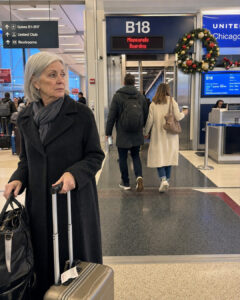
But I stood there, the Atlantic behind me, my hair pushed by the wind, and smiled.
That evening, I ate clam chowder in a little restaurant with wooden booths and framed photographs of fishing boats on the walls. Nobody rushed me. Nobody asked what my credit card limit was. Nobody expected me to split a bill that was never mine. I sat by the window, watched snow begin to drift over the streetlights, and wrote Sophie a postcard.
“Dear Sophie, the ocean is very big and very loud, but it also knows how to be calm. I think people can learn from that. Love, Grandma.”
I mailed it the next morning from a tiny post office where the clerk had known Margaret since high school. Then I drove to a small bookstore and bought myself a notebook with a blue linen cover. I had not written in a journal since Martin passed, but suddenly I had things to say.
The first sentence I wrote was simple: “I am allowed to build a life that does not revolve around being needed.”
I stayed three nights. On the last night, my phone finally rang. Ryan’s name appeared on the screen. I let it ring once, twice, three times. Then I answered.
“Hi, Ryan.”
His voice was quiet. “Mom, I got your postcard for Sophie. She carried it around all afternoon.”
“Good. I hoped she would like it.”
There was a pause. I could hear the hum of his kitchen in the background, the same kitchen I had cleaned more times than I could count.
“Brooke thinks you’re trying to make us look bad,” he said.
I looked out at the dark water. “Ryan, I’m on the Maine coast by myself. I’m not performing for your wife.”
He sighed. “I know.”
That was new. Not an apology, not yet, but something quieter and more honest. A small crack in the wall he had built between what happened and what he preferred to call it.
“Sophie asked why you didn’t go to Canada,” he said. “I didn’t know what to tell her.”
“The truth is usually easiest,” I said.
Another silence. This one lasted longer.
“I told her there was a mistake with the ticket.”
I closed my eyes. “That was not the truth.”
“I know,” he whispered.
I did not rescue him from that moment. For the first time, I let my son sit inside the discomfort he had created. I had spent decades rushing in to soften consequences for him. That night, I let the quiet do its work.
When I returned to Illinois, the duplex looked the same from the street, but it felt different when I pulled into the driveway. The old maple tree stood bare over the walk. Mrs. Bennett’s porch flag moved gently in the winter wind. Brooke’s SUV was parked crookedly, as usual. But my shoulders did not tighten the way they once had.
There was a certified letter waiting in my mailbox. At first, I assumed it was something from the insurance company or property taxes. Then I saw the return address: a small real estate office two suburbs over.
I opened it at the kitchen table. Inside was a polite note from a realtor named Allison Price, thanking me for “considering the sale of the Haron duplex” and enclosing a preliminary market estimate based on “the family’s timeline.”
I sat very still.
I had never considered selling the duplex. I had never spoken to Allison Price. I had never mentioned a family timeline to anyone. Yet there it was, printed on cream paper, with glossy photos of comparable properties and a cheerful line about “helping your family transition smoothly.”
The surprise was not that Brooke wanted something. The surprise was how far she had already begun arranging the world as if my consent were a formality.
I called the number on the letter. Allison Price answered in the bright professional tone of someone who had no idea she was about to step into a family mess.
“This is Renee Haron,” I said. “I received your packet about the sale of my duplex. I believe there has been a misunderstanding.”
There was a pause, followed by the sound of papers moving. “Mrs. Haron, I’m so sorry. I was under the impression your daughter-in-law had spoken with you. She said the family was exploring options because you were thinking about downsizing.”
There it was. Not a direct lie spoken to my face, but a careful story placed where it might grow roots before I could pull it out.
“I am not selling,” I said. “I am not downsizing. No one has authority to discuss my property on my behalf.”
Allison sounded embarrassed. “I understand. I’ll close the file immediately.”
“Please send me a brief email confirming that,” I said. “And include the date Brooke contacted you.”
She agreed. When the email arrived, I printed it and placed it in my folder. My responsibility list had become something else now. It had become a record.
That night, I did not call Ryan. I did not knock on their door. I made tea, sat at the kitchen table, and looked at the walls of the house Martin and I had saved to buy. We had chosen that duplex because we believed in practical love. One side could help pay the mortgage. Later, it could house family if someone needed a start. It had been a good plan. The problem was not the house. The problem was that I had let other people confuse access with ownership.
The next morning, I called my attorney, Daniel Meyers. He had handled Martin’s estate and once told me, with great patience, that generosity should always have paperwork if property was involved. I had laughed then. I was not laughing now.
Daniel listened while I explained the canceled ticket, the payment changes, the basement, the returned check, and the realtor letter. He did not interrupt. When I finished, he asked only one question.
“Renee, do you want family peace, or do you want legal clarity?”
I looked through the kitchen window at the shared driveway. Brooke was loading Sophie’s backpack into the car, her movements sharp and hurried. Ryan stood nearby, looking at his phone.
“I want both if possible,” I said. “But if I have to choose, I want clarity.”
“Good,” Daniel said. “Because clarity is what makes peace possible.”
He prepared a formal lease for Ryan and Brooke with fair market rent, clear due dates, defined access to shared spaces, maintenance responsibilities, and language explaining that utilities and services on their side were their responsibility. He also helped me create a trust that protected the duplex from casual family pressure. The property would remain mine during my lifetime. After me, it would be handled according to terms I chose, not according to whoever spoke the loudest at a holiday table.
I made one decision that surprised even Daniel. I did not leave Ryan out. I loved my son. I did not want to punish him for being weak at the worst moment. But I also did not hand him control. Any future benefit connected to the property would be structured carefully, with Sophie protected first and with no spouse, partner, or outside family member able to pressure their way into it.
Daniel looked over the documents and said, “This is generous.”
I smiled faintly. “It is generous with a fence around it.”
He laughed. “That is the best kind.”
I invited Ryan to meet me at a diner near the train station instead of at my house. I chose a public place, not because I expected a scene, but because I wanted the conversation to belong to neither side of the duplex. The diner had red vinyl booths, chrome edges, and waitresses who called everyone honey whether they meant it or not.
Ryan arrived five minutes late, wearing his work jacket and the worried expression of a man who had begun to understand that his mother had stopped absorbing the impact of his choices.
“Where’s Brooke?” I asked.
“At home.”
“Good.”
I slid the envelope across the table. “This is the new lease. You and Brooke can review it. You may have an attorney look at it if you wish. It begins next month.”
Ryan opened the envelope, read the first page, and swallowed. “This is a lot more than we’ve been paying.”
“It is still fair for the neighborhood,” I said. “You know that.”
He nodded slowly. “Brooke is going to say you’re forcing us out.”
“No,” I said. “I’m inviting you to live like adults. If you prefer a different arrangement, you can find another home.”
He rubbed his forehead. “Mom, about the realtor—”
I held up one finger. “So you knew.”
His face changed. That was answer enough.
“Not at first,” he said quickly. “I found out after Canada. Brooke said she was just gathering information. She said you were getting older and it made sense to talk about the future.”
I looked at him until he stopped talking.
“Ryan, I am allowed to get older without being managed behind my back.”
His eyes dropped. “I know.”
“Do you? Because at the airport, you saw what was happening, and you boarded anyway. With the realtor, you learned what she had done, and you still waited for me to bring it up. You keep treating silence like neutrality. It is not neutrality when someone is being pushed aside.”
The waitress came by with coffee. Neither of us spoke until she left.
Then Ryan said the sentence I had waited weeks to hear.
“I was ashamed.”
I wrapped both hands around my mug.
He continued. “At the gate, Brooke told me your ticket had a problem and that you’d probably be able to catch another flight. Then I saw you at the counter, and I knew something was wrong. I knew Sophie was confused. I knew I should stop. But Brooke kept walking, and her brother was already ahead of us, and I just… I chose the easier second.”
His voice broke slightly, not in a dramatic way, just enough to show the weight of it.
“That easy second cost more than you understood,” I said.
“I know.”
“And the realtor?”
“She wants the duplex sold,” he said. “She thinks if we sell, you can move into a condo and we can use part of the money to buy something bigger. She said it would be better for everyone.”
I gave a small laugh, though there was no humor in it. “Better for everyone, or better for Brooke?”
Ryan did not answer.
“Here is what will happen,” I said. “You will review the lease. You will decide whether to sign it or move. You will tell Brooke that no one discusses my property again without me in the room. And you will tell Sophie the truth in a way a child can understand. Not a cruel version. Not a version that makes her afraid. Just the truth: Grandma’s ticket was canceled, and the adults did not handle it well.”
Ryan nodded. “Okay.”
“And you will not use Sophie as a bridge when you are unwilling to do the walking yourself.”
That one hit him. I saw it in his face.
“Okay,” he said again, softer.
When I left the diner, I did not feel triumphant. I felt tired, but clean. Some conversations do not give you joy. They simply remove a weight you were never meant to carry.
Brooke did not take the lease quietly. That evening, I heard voices through the shared wall, sharp enough that I turned down my television and then turned it back up because I refused to become a listener in my own home. A little later, she knocked.
I opened the door with the chain still fastened.
“This is unbelievable,” she said. “You’re treating us like strangers.”
“No,” I said. “I’m treating the rental like a rental and the family like family. The problem is that you preferred it mixed together because it benefited you.”
Her face flushed. “We have Sophie to think about.”
“So do I,” I said. “That’s why I’m making sure she grows up seeing that love does not require one person to disappear.”
Brooke looked past me into my hallway, at the framed photo of Martin, the umbrella stand, the little table where Sophie liked to leave drawings. For the first time, she seemed to understand that my life had rooms she did not control.
“You’re going to regret pushing us away,” she said.
“I’m not pushing you away,” I replied. “I’m stepping back. There is a difference.”
I closed the door gently.
The lease sat unsigned for nearly a week. During that time, Ryan grew quieter, Brooke grew colder, and Sophie came over every Wednesday after school because she asked to. We baked banana bread, worked on a puzzle of the United States, and watched an old movie with a dog in it. I never questioned her about her parents. Children should not be used as messengers.
One Wednesday, while she was coloring at the kitchen table, Sophie looked up and asked, “Grandma, did Mommy make your airplane seat go away?”
I froze for only a second. Then I sat down across from her.
“Some grown-up choices were made that were not kind,” I said carefully. “But you did nothing wrong. And I will always tell you the truth in a gentle way when I can.”
She pressed her crayon too hard against the paper. “Daddy said he should have stayed.”
My throat tightened. “Daddy is right.”
“Are you still mad?”
I thought before answering. “I am still careful. That is not the same as being mad.”
She nodded as if that made perfect sense. Maybe children understand boundaries better than adults because they have not yet learned to dress selfishness in pretty language.
On the seventh day, Ryan brought the signed lease to my door. Brooke had signed too, though her signature looked like it had been carved into the paper. I thanked him and put the envelope on the entry table.
“Mom,” he said, “I told Sophie the truth.”
“I know.”
“She asked me why I didn’t stay.”
I waited.
“I told her I made the wrong choice.”
For a moment, I saw my son again. Not the man who walked onto the plane, not the husband hiding behind his wife’s confidence, but the boy who used to cry when he disappointed himself more than anyone else.
“That was a good start,” I said.
He nodded. “Brooke is angry.”
“Brooke is allowed to be angry,” I said. “She is not allowed to make her anger my responsibility.”
Spring came slowly to our suburb. The snow melted into gray piles along the curb. The maple tree in front of the duplex began showing tiny red buds. Mrs. Bennett put fresh pansies in her porch boxes, and Sophie started leaving chalk flowers on the sidewalk between our two doors.
The new rent arrived on time. The utility bills no longer came to my email. The cleaning service stopped contacting me because Brooke either paid them herself or stopped using them. The world did not end. Their lives did not collapse. They simply had to carry what had always belonged to them.
One Saturday morning, I opened the basement for the first time since I had cleared it. Sunlight came through the little window near the ceiling, catching dust in the air. Instead of boxes of Brooke’s old décor and Ryan’s camping gear, the room held my sewing machine, shelves for paint, Martin’s old workbench, and three clean plastic bins labeled “Sophie,” “Documents,” and “Renee.”
I stood in the middle of that basement and realized I had reclaimed more than square footage. I had reclaimed possibility.
Clare came over that afternoon with two folding chairs and a ridiculous amount of enthusiasm. She helped me turn one corner into a small craft space. We hung pegboard, arranged jars of buttons and brushes, and put a little American flag in a ceramic cup beside the window because Martin had always liked seeing one in the house.
“This looks like you,” Clare said.
I looked around at the room: bright, organized, useful, and finally mine. “I think I forgot what that looked like.”
“You’re remembering,” she said.
A few days later, Brooke’s brother came by to pick up the last of his things from their patio. I happened to be watering the front planters when he cleared his throat.
“Mrs. Haron,” he said, looking uncomfortable. “For what it’s worth, I didn’t know they canceled your ticket until we were already boarding.”
I turned off the hose. “But you took the seat.”
His face reddened. “Brooke said you decided not to come.”
There it was. Another version. Another soft little lie placed under someone else’s feet so they could walk comfortably over the truth.
“Now you know I didn’t,” I said.
He nodded. “Yeah. I’m sorry.”
I accepted the apology because it cost me nothing and because he was not the center of the story. But I also understood something important. Brooke had not only excluded me. She had rewritten me in real time. To her brother, I was the fussy older woman who backed out. To the realtor, I was the aging mother preparing to downsize. To the neighbors, I was the difficult landlord. To Ryan, I was the person who would eventually smooth it all over.
The real change was that I had stopped letting her descriptions become my life.
That evening, I wrote one more note for my folder. “When people benefit from your silence, your truth will feel rude to them.” Then I closed the folder and put it away.
Summer arrived with warm evenings and the smell of cut grass. Sophie spent more time with me, not because Ryan and Brooke dropped her off whenever convenient, but because we planned our days together. We went to the library, fed ducks at the park, made lemonade, and planted tomatoes in two big pots near my back steps.
One afternoon, while we were tying the tomato vines to little stakes, Sophie said, “Grandma, this plant needs help standing up.”
I smiled. “Most growing things do.”
She looked at me seriously. “But not too much help, right? Or it won’t learn.”
I nearly laughed at the wisdom of it. “Exactly.”
Ryan came outside then, carrying a toolbox. He had bought it himself. It still had the price tag on the handle. He walked over to the loose porch rail on his side and began tightening screws with the awkward focus of a man learning a skill later than he should have.
He glanced over and saw me watching.
“I looked it up,” he said.
“Good,” I replied.
That was all. No lecture. No rescue. Just a mother watching her grown son finally turn a screw that belonged to him.
Brooke changed too, though not in the way people change in stories when one speech magically opens their heart. She did not become warm. She did not apologize with tears. She did not suddenly invite me to Sunday dinner and admit she had been wrong. Real life is rarely that tidy.
But she became more careful. She stopped making assumptions in my name. She stopped speaking for my property. She stopped sending little texts designed to make me feel small. When we passed each other in the driveway, she nodded. Sometimes I nodded back. That was enough.
The biggest shift came on Sophie’s seventh birthday. Brooke planned a backyard party with paper lanterns, cupcakes, a bubble machine, and a rented bounce house. In previous years, I would have paid half, arrived early to set up, stayed late to clean, and then been cropped out of most of the photos.
This year, I brought one wrapped gift and a bowl of fruit salad because Sophie had asked for my “rainbow fruit.” I arrived ten minutes before the party and left twenty minutes after cake. I did not arrange the chairs. I did not refill the ice bucket. I did not wash trays in Brooke’s sink while guests complimented her hosting.
At one point, Brooke stood beside me near the picnic table, watching Ryan struggle to light the candles in the breeze.
“You’re really not helping?” she asked.
I kept my eyes on Sophie, who was laughing with frosting on her chin. “I am helping. I’m being her grandmother.”
Brooke said nothing.
Later, Sophie opened my gift. It was a framed copy of the postcard I had sent her from Maine, placed beside a small photo of the two of us at the park in our winter coats. Under it, I had written, “The ocean can be big and loud, but it also knows how to be calm.”
Sophie held it like treasure. “I’m putting this by my bed.”
Ryan looked at me from across the table. His expression was quiet, almost grateful. Brooke looked away, but she did not make a comment.
That night, after the party, I sat on my balcony with a cup of tea. The yard below was messy with ribbons, paper plates, and deflated balloons. On their side, I heard Ryan and Brooke cleaning up together. Not me. Them.
It was a small sound, but it felt like justice in its most ordinary form.
Months after the airport, another envelope came in the mail. This one was from Ryan again, but it felt different before I even opened it. Inside was not a check. It was a letter, handwritten on lined paper, three pages long.
He wrote about the airport. He wrote that he had replayed that moment more times than he wanted to admit. He wrote that seeing Sophie ask him why he left Grandma had stayed with him. He wrote that he had confused being a good husband with never questioning his wife, and that he had confused my patience with permission.
At the end, he wrote, “I don’t expect things to go back to normal. I’m starting to understand that normal was costing you too much. I’m sorry I made it so easy for you to disappear.”
I read the letter twice. Then I folded it carefully and placed it in my folder, not with the realtor email or the lease, but in a different section. The section for things that mattered.
I did not rush to forgive him out loud. Forgiveness, I had learned, is not a button you press so everyone else can stop feeling uncomfortable. Sometimes it is a slow turning of the soil. Sometimes it begins with believing that the apology might be real and still keeping the fence where it belongs.
The following weekend, Ryan invited me to breakfast at the same diner near the train station. This time, Sophie came too. Brooke did not. We sat in a red booth, and Sophie ordered pancakes shaped like a bear. Ryan paid the bill without looking at me, without reaching for a performance, without making a joke about me being the family bank.
Outside, he walked us to my car.
“Mom,” he said, “I know I have a lot to rebuild.”
“Yes,” I said.
He nodded. “I’m going to try.”
“Trying is visible,” I told him. “I’ll know.”
He almost smiled. “Fair.”
That autumn, I took Sophie to a pumpkin farm in Wisconsin, just the two of us. We rode a hay wagon, drank hot cider, and picked a pumpkin so round and heavy that I had to ask a teenage employee with muddy boots to help us carry it to the car. Sophie laughed the whole way home, her cheeks pink from the cold.
When we got back, Ryan was waiting in the driveway. He lifted the pumpkin from my trunk without being asked.
“Where do you want it, Mom?”
Such a small sentence. Such a different one. Not “Can you cover this?” Not “Can you fix that?” Not “Why are you making things hard?” Just, “Where do you want it?”
I pointed to my porch. He set it there carefully. Sophie placed two small gourds beside it and announced that my house looked like a magazine. I told her it looked better because she had helped.
Brooke watched from their doorway. For once, she did not interrupt the moment. She simply turned and went back inside.
By Thanksgiving, the duplex had settled into a new rhythm. Ryan and Brooke paid on time. I hosted Clare for lunch the day before the holiday and spent Thanksgiving Day at a restaurant with a view of the river, because I wanted to and because no law required older women to spend holidays washing roasting pans for people who barely noticed.
Ryan asked if Sophie could call me after dinner. I said yes. At seven, my phone rang, and Sophie’s face appeared on the screen, bright and close.
“Grandma, I made place cards,” she said. “Yours had a pumpkin sticker even though you weren’t here.”
My heart softened. “Thank you, sweetheart. That sounds beautiful.”
Ryan leaned into the frame behind her. “Happy Thanksgiving, Mom.”
“Happy Thanksgiving, Ryan.”
Brooke’s voice came from somewhere off camera, polite but distant. “Happy Thanksgiving, Renee.”
“Happy Thanksgiving, Brooke,” I said.
It was not perfect. It did not need to be. Perfect had never saved me. Clear had.
When winter came again, the airport memory returned in little flashes. The smell of coffee in paper cups. The shine of the gate agent’s screen. Sophie’s mittened hand in mine. Ryan’s back disappearing into the jet bridge. Brooke’s text arriving in the quiet house.
But the memory no longer felt like a wound. It felt like a doorway. A hard one, yes. A cold one. But a doorway all the same.
On New Year’s Eve, one year after the canceled ticket, I did not wait for an invitation from anyone. I invited Sophie for dinner in advance, with Ryan’s agreement and Sophie’s choice. Clare came too. We made soup, cornbread, and a chocolate cake that leaned slightly to one side but tasted wonderful.
At midnight, we stepped onto the balcony with sparkling cider. Fireworks flickered above the neighborhood. Mrs. Bennett waved from her porch. Somewhere on Ryan and Brooke’s side, a television counted down.
Sophie raised her plastic cup and said, “To Grandma’s house.”
Clare laughed. “To Grandma’s house.”
I lifted my glass. “To knowing where we belong.”
My phone buzzed just after midnight. A text from Ryan.
“Happy New Year, Mom. Thank you for still letting us learn.”
I looked at the message for a long time. Then I typed back, “Happy New Year, Ryan. Keep going.”
I did not send hearts. I did not send a long speech. I did not promise that everything was repaired. Some bridges are rebuilt plank by plank, and only foolish people run across them before checking the boards.
After Clare left and Sophie fell asleep on the couch under a quilt, I walked through my quiet rooms. The kitchen was clean. The bills were mine and only mine. My folder was organized. My basement smelled faintly of paint and sawdust. My calendar had three things on it that were not favors for anyone else: a pottery class, lunch with Margaret from Maine, who was visiting Chicago, and a weekend drive I had planned just because I wanted to see where the road went.
I stood by the front window and looked at the other half of the duplex. A light was on in Ryan’s kitchen. I could see him moving around, rinsing dishes, wiping counters, doing the simple work of his own life. For years, I had confused being needed with being loved. Now I understood that love feels different when it is not leaning its whole weight on you.
The woman at the airport had been left behind. The woman at the window was not.
Sometimes you do not need a dramatic speech to get your respect back. You do not need to raise your voice, beg for fairness, or explain your worth to people who have grown comfortable spending it. Sometimes you simply stop doing what everyone took for granted.
And suddenly, the phones start ringing. The bills start asking the right people for answers. The doors that were always open become doors with keys. The family that thought you would always be waiting learns that you have places of your own to go.
I was Renee Haron. I was a mother, a grandmother, a homeowner, a widow, a woman with a blue notebook and a car full of music. I had been left at a gate once, but I did not live there.
My path was still ahead of me. This time, my name was on the ticket, my hand was on the suitcase, and nobody else was deciding whether I got to board.