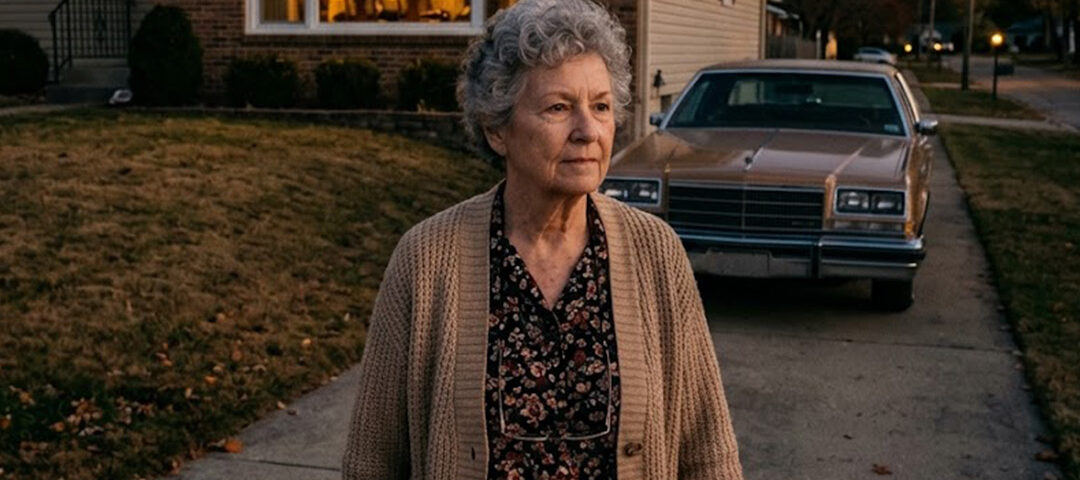
At Thanksgiving, in the house my husband built with his own two hands, my daughter stood up and said, “Mom, you can eat in the kitchen. The real family sits here.” 16 people heard her. Not one of them said a word. So, I set down my plate. I didn’t argue. I didn’t cry. I walked out the front door of my own home, got in my car, and drove away while the gravy was still warm. 3 hours later, my phone lit up. It was her husband, and his voice was shaking. Please come back, he said. The lawyer just called about the house. I poured myself a cup of coffee. I sat down at my own kitchen table and I waited because whatever the lawyer had just told them, I already knew. I’d been the one who picked up the phone first. My name is Marian Sawyer. I’m 70 years old and I have spent 44 Thanksgivings in the same house on Maple Street. My husband Raymond built that house. Not bought, built. He framed it in the summer of 1979 with his brother and a cooler of lemonade and a borrowed level. And he carried me over the threshold before the kitchen even had a floor.
We raised our daughter in it. We folded a lot of years of joy and trouble into those walls. Raymond had been gone for six years, since a quiet March morning in the back bedroom, and I kept the house exactly as a place keeps the people it has loved. I am not, I’ll admit, an impressive woman to look at. I kept the books for a plumbing supply company for 31 years. I wear cardigans. I drive an old Buick. I say thank you to the cashier, and I mean it. People look at a woman like me and they fill in the rest: sweet, simple, past her usefulness. My daughter started filling it in years ago and I let her because correcting people is exhausting and I had other things to do. But here is something 31 years of bookkeeping teaches you. The quietest line on the page is usually the one that decides everything. People skip right over it. They look at the big, flashy numbers and they miss the small entry at the bottom that the whole thing actually rests on. I’d become in my own family that quiet line at the bottom of the page. They were about to find out what it was holding up.
My daughter is named Vanessa. She’s 42 and she has spent the last decade climbing. I don’t say that harshly. Climbing is part of our family history. Raymond and I climbed our whole lives, just up a shorter ladder. But Vanessa married into the Cole family, and the Coles have money that came from somewhere far enough back that they’ve forgotten it ever had to be earned. Her mother-in-law, Lorraine, wears it like a temperature she keeps the room at. And Vanessa decided somewhere along the way that to belong up there, she had to leave down here behind. Down here being me. The cardigans, the Buick, the plumbing supply books. She started correcting me at dinners. Mom, it’s not supper. It’s dinner. She started introducing me with a little apologetic laugh. This is my mother. She’s very old-fashioned. When I’d offer to bring my green bean casserole to a gathering, she’d say the caterer had it handled in a voice that meant, “Please don’t.” I let it go. That’s what mothers of climbers learn to do. You tell yourself she’s just finding her footing up there, and the day she’s secure, she’ll reach back down for you. I told myself that for 10 years.
What I didn’t tell her, what I hadn’t told anyone was that I had already decided to reach up to her in the biggest way I had left to give. I was going to hand her the one thing Raymond and I had that was worth anything at all. I just hadn’t done it yet. Thank God, as it turned out, I hadn’t quite done it yet. You have to understand what the Maple Street House is to this family because everything that happened turns on it. It’s where everyone comes. Every Thanksgiving, every Christmas, every christening and graduation party for 44 years. My sisters come, the cousins come, Vanessa and Derek and my grandson come. The house has a long oak table Raymond built to match the floors, and it has fed this family through every season we’ve had. Here is the thing people had quietly forgotten. The house is mine, just mine. Raymond left it to me free and clear. No mortgage, no liens, paid off the year he retired. My name alone on the deed.
But because I host, because I’m in the kitchen before dawn with the turkey, and I’m the last one washing pans at midnight, the house had stopped feeling like mine to everyone but me. It had become the family house, a sort of public utility that I happened to maintain. Vanessa had started talking about it like weather, something that simply existed and would always be there for her. “When we have the house someday,” she’d say to Derek, not lowering her voice. The first thing we’re doing is opening up this kitchen someday. As if it were already written, as if I were a formality between her and a renovation. She wasn’t entirely wrong to assume it would come to her. That’s the part that still aches because she was my only child and of course the house was going to be hers. I was in fact about 3 weeks from giving it to her outright. She just didn’t know that yet. And she was about to do the one thing that would make me change my mind. Here’s what nobody at that table knew. That fall, I’d made up my mind. The house was too big for one widow. My knees didn’t love the stairs anymore.
And I wanted, while I was still alive, to enjoy watching it, to give Vanessa and Derek the gift Raymond and I had always dreamed of giving, the family home, free and clear, to raise my grandson in. So, I’d gone to see Harold Beck, the attorney who’d handled Raymond’s affairs for 30 years. We’d drawn up a transfer-on-passing deed with Vanessa and Derek as the beneficiaries. And more than that, I decided to move out early. I’d quietly put a deposit on a little one-bedroom condo across town, the kind of place with no stairs and a coffee shop on the corner. The plan was to hand them the keys on Christmas morning to watch my daughter’s face. I’d even bought the paper for it. A heavy cream envelope, the good kind, sitting in my desk drawer with the deed copy and a note in my own hand for Vanessa and Derek and Caleb. Your father built this for a family. Fill it with one. Love, Mom. Raymond’s old house key was tucked inside on the worn leather fob he’d carried for 40 years. Derek knew a piece of it. I’d had to loop him in.
There were logistics, a moving date, the condo deposit, and Derek, whatever his faults, is the practical one. I’d sworn him to secrecy. Let me surprise her, I’d said. He’d agreed. I tell you all this so you understand. I wasn’t a resentful old woman looking for an excuse. I was 3 weeks and one envelope away from giving my daughter everything. And then she sent me to the kitchen. I want to be fair to Vanessa because the easy version of this story makes her a villain and she isn’t one. She’s something more ordinary and more sad than that. When Vanessa married Derek, she walked into a family that measures people. The Coles are polite about it. They’d never say a harsh word, but they have a way of asking where you summered and what your father did that lets you know precisely where you’ve been filed. The first time I met Lorraine, Derek’s mother, she looked at my shoes for exactly 1 second too long, smiled, and asked if I’d had far to travel. I’d driven 20 minutes. Vanessa felt all of that. And instead of letting it roll off, she decided to win it. She would outshine the Coles.
She would have the right house, the right kitchen, the right mother. And since she couldn’t trade me in, she’d do the next best thing and quietly tuck me out of frame. It came from a wound. I know that a girl who grew up in a plumbing supply family and got looked at like that spends the rest of her life terrified of being found out as common. And the harsh trick of it is that the person who reminds her most of where she came from is the person who loves her most, me. Understanding all of that is why I stayed quiet for so long. It is not, it turns out, why I’d stay quiet forever. Because there’s a line between a daughter managing her insecurities and a daughter humiliating her mother at the head of a table full of witnesses. For 10 years, Vanessa stayed on one side of that line. At Thanksgiving, she stepped clean over it. There was one person in that family who never made me feel like furniture. My grandson, Caleb. Caleb is 17. He’s all elbows and earnest opinions.
The kind of boy who still hugs his grandmother in front of his friends and doesn’t seem to know he’s supposed to be embarrassed by it. He comes to my house on Sundays sometimes, just him. And we do the crossword and he tells me about the girl he can’t work up the nerve to talk to. He’s the only one who ever asks about Raymond. “Tell me the one about Grandpa and the canoe,” he’ll say, even though he’s heard it 40 times. He likes that I keep his grandfather’s reading glasses in the drawer by the good chair. He’s the only one in that family, frankly, who I look at and see Raymond looking back. When I planned to give the house away, Caleb was the whole reason it felt right. Your father built this for a family. I’d written fill it with one. I pictured Caleb growing up in those rooms, his kids someday running on the floors Raymond laid. I tell you about Caleb now because you need to know he was at that table on Thanksgiving, 17 years old in a button-down his mother made him wear, sitting near the head of the table with the real family.
Remember that when we get there, remember that of all the people in that warm, full, ungrateful room, exactly one of them was about to do the decent thing. And remember that I was watching. The week of Thanksgiving, I was happier than I’d been in years. I had a secret and it was a good one. Every time Vanessa was short with me on the phone, and she was short with me a lot that week, stressed about the Coles coming, about the table settings, about whether her caterer’s gravy was elevated enough. I just smiled and thought about Christmas morning, about the cream envelope in my drawer, about handing her Raymond’s old key and watching 10 years of distance fall off her face. I thought the gift would fix it. I really did. I thought when she understood what I was giving her, she’d remember who I was. That was my mistake and I’ll own it. I thought generosity could buy back respect that was never really gone. That was just folded. I’ve since learned you can’t. Respect isn’t something you can hand someone in an envelope. They either carry it for you or they don’t. And you find out which on the days it costs them something.
I found out on a Thursday in November with my husband’s turkey platter in my hands. But I’m getting ahead of myself. Let me take you to that table. I want you to see it the way I saw it so that when my daughter says the words, you understand exactly what she threw away. It was going to be the best Thanksgiving in years. I’d made sure of it. The trouble started small, the way it always does. Two weeks before Thanksgiving, Vanessa came by the house, not to see me, it turned out, but to take some measurements. She walked through my rooms with her phone out, photographing, murmuring to herself. This wall could come down. The cabinets are obviously the first thing to go. Planning a project? I asked from the doorway of my own kitchen. Just dreaming, she said, not looking up. You know, for when the time comes. For when the time comes. She said it lightly, the way you’d talk about a season changing. She was standing in my kitchen, the kitchen Raymond built, mentally demolishing it, and she didn’t think she needed to lower her voice because in her mind it was already hers.
I was just the current occupant, a tenant on a short lease that nature would shortly terminate. I should have said something then. I want you to know I considered it. But I had that cream envelope in my drawer, not 10 ft away, and I thought, let her dream. In a month, she’ll know it’s real. Let her have this. So, I made her a cup of tea, and I let my daughter photograph my home for the renovation she was already planning. And I felt underneath my happiness, the first cold thread of something I didn’t have a name for yet. It wasn’t that she wanted the house. I wanted her to have it. It was the way she wanted it, like it was owed, like I was a formality, like the only thing standing between her and her future was an old woman who hadn’t had the courtesy to get out of the way yet. I told myself I was imagining it. Then I found the folder. It was an accident, the way the worst discoveries usually are. Caleb had left his tablet at my house that Sunday, and Vanessa asked me to email her a document off it, a permission slip for some school trip.
I’m not as helpless with these things as my family believes. I opened the tablet to find the file and a shared family folder was sitting right there on the screen, synced from Vanessa’s account. I shouldn’t have looked. I looked. There was a design board, dozens of images, gutted kitchens, white marble, a wall of glass where Raymond’s bookshelves stood. The folder was labeled Maple Reno. There was a contractor’s preliminary quote dated 3 weeks earlier, $41,000 for phase 1. And there was a text thread screenshotted into the folder like a trophy. Vanessa to a friend. Once we’re in the Maple House, we’ll finally have room to entertain properly. Mom’s moving to some little condo, which honestly is for the best. She rattles around in that big place. Mom’s moving to some little condo. She knew somehow. Derek, I realized Derek must have let it slip or she’d pieced it together. She knew about the gift. She knew the house was coming to her. And instead of gratitude, instead of even surprise, she’d skipped straight to the renovation, the entertaining, the relief of finally getting me tucked away in some little condo. The gift wasn’t a gift to her. It was an inheritance she was impatient to collect.
I was a delay. I sat at my kitchen table for a long time with that tablet. The way you sit when a doctor has just said a word you weren’t ready for. I didn’t cry. I just got very, very quiet. And somewhere underneath the quiet, for the first time, a small voice asked, “Marion, are you sure you want to give it to her?” I told the voice to hush. There was a turkey to brine. I spent the next few days talking myself out of what I’d seen. She’s excited, I told myself. Young people are tactless when they’re excited. The little condo comment was thoughtless, not harsh. She doesn’t know I saw it. And the gift isn’t about her gratitude anyway. It’s about Caleb, about Raymond’s wish, about doing the generous thing because it’s right, not because it’s repaid. All of that was true. I’m good at finding the true thing that lets me keep loving someone. Mothers usually are. But there’s a difference between forgiving a person and not seeing them clearly. And I’d been confusing the two for a decade. I forgave Vanessa the way you’d forgive Weather by deciding it wasn’t personal.
And in doing that, I’d stopped requiring her to be decent to me. I’d made my own respect optional and then acted surprised when she treated it as optional, too. I decided to go ahead with the gift anyway. I want you to know that even after the folder, even after some little condo, I was still going to give my daughter that house, I’d resolved to set the herd aside, hand her the envelope at Christmas, and trust that having the thing would soften her toward the woman who gave it. That was where my head was on Thanksgiving morning. Wounded but resolved. Generous to a fault, Raymond used to say, and he didn’t always mean it as a compliment. I pulled the turkey out at dawn. I set it on Raymond’s platter, the big oak one he’d carved by hand the first winter in the house with a turkey and a sheath of wheat worked into the rim. I’d served every Thanksgiving on that platter for 44 years. I had no idea it would be the last one I would serve in that house under the old arrangement. The morning was beautiful. I’ll give it that.
I was up at 5, the way I always am on Thanksgiving, moving through the dark kitchen by feel. There’s a particular piece to it. The house quiet, the oven warming, the smell of sage and butter. 44 years of the same morning layered one on top of the next like coats of paint. I could feel Raymond in it. I always can on Thanksgiving. He’d come down in his robe and take a piece of skin off the bird and I’d swat his hand and he’d kiss my temple and call me his girl. I talked to him a little the way widows do. Big day, Ry, I said, sliding the turkey in. We’re giving them the house. Can you believe it? I set out his platter on the counter to warm, ran my thumb over the wheat he’d carved into the rim. I thought about how pleased he’d be. He loved nothing more than giving things to people. He’d have wrapped the whole house in a bow if he could have. By noon, the food was a small miracle, and the house smelled like every good memory I had. I put on my nice blouse, the blue one.
I set the long oak table for 16 with the good china. Raymond’s platter at the center where it always went. I stood back and looked at it. My husband’s table, my husband’s house, my husband’s platter, all of it laid out to feed the people we’d made and loved. It was, I thought, perfect. The last perfect hour I’d have in that house. Then the doorbell rang and the Coles came in on a draft of cold air and expensive perfume. And the afternoon began to turn. Lorraine Cole arrived like she was inspecting a property. She came in first in camel cashmere and she did the thing she always does, a slow, smiling sweep of the room, pricing it. What a cozy little house, she said, which is what Lorraine says instead of small. So much character. You don’t see this kind of older construction much anymore. My husband built it, I said. Did he? She said in the tone you’d use for a clever child. How resourceful. Derek came in behind her, kissed my cheek, and had the grace to look slightly ashamed, the way he often did around his mother and me in the same room. He caught my eye, and there was a flicker.
He knew about the gift, remember, knew this was meant to be their last Thanksgiving as guests here before it became theirs. I think part of him wanted to say something kind. He didn’t. Derek’s whole life is a study in the kind thing he doesn’t quite say. Then Vanessa swept in, already in hostess mode, already rearranging. Mom, you didn’t use the gold chargers. Oh well. She moved my centerpiece. She moved Raymond’s platter 6 in and frowned at it like it was clutter. This old thing. We should really get you a proper serving platter, Mom. That old thing is staying right there, I said pleasantly and moved it back. She gave me a look. The look that said, you’re being difficult. And then the doorbell rang again and the cousins arrived and the house filled up with coats and casserole dishes and noise and Vanessa swept off to play Lady of a Manor that wasn’t yet technically hers. I stood in my own front hall and watched my family flow past me into my house like I was the help who’d held the door. It’s a strange thing becoming a guest in your own home.
It happens by inches and each inch is too small to object to without seeming petty. Vanessa had taken over the kitchen, my kitchen, directing the caterer’s two staff she’d hired, just to make it special this year. When I went in to check my gravy, she steered me out by the elbow. Mom, relax. Let us handle it. Go sit. Go sit. In my own house on Thanksgiving, the one day of the year that has always, always been mine to run. So I went and sat useless in the living room while strangers plated my food in my kitchen and my daughter played director. The Coles had brought their own energy and the room had reorganized around it. Conversations I wasn’t in references I didn’t have. Lorraine holding court about her cruise. I tried twice to join and both times the talk just sort of closed back over the spot where I’d spoken like water. Caleb found me though. He came and sat next to me on the arm of the chair and showed me a photo of a robotics thing he’d built for school. And for 10 minutes, I had my grandson and I wasn’t furniture. I was grandma.
“It’s wonderful, sweetheart,” I told him, and meant it more than anything I’d say all day. “You okay, Grandma?” he asked quietly, in that way kids have of seeing the thing the adults are all pretending not to. “I’m just fine, baby,” I said. I wasn’t quite. But I still thought the worst of the day was a little loneliness. I still thought I’d hand them an envelope at Christmas and all of this would melt. Then Vanessa called everyone to the table. If you’ve ever sat at a table full of family and felt yourself becoming invisible, felt the conversation skip over you, felt yourself shrink to fit the small space they’d left you, then you already know the loneliest room in the world is a crowded one. If this is landing somewhere real for you, stay with me. There’s a reason I’m telling you all of it. The table sat 16, and there were that year 17 of us. I counted the chairs while Vanessa was seating people, directing them like a wedding planner. Lorraine, you’re here by me. Derek, head of the table. My husband’s seat, but I let it go. Cousins down here. Caleb, you’re up here with the grown-ups this year.
And on and on, placing everyone until the long oak table Raymond built was full of people, and there was, I realized, no chair left with my name on it. It wasn’t an accident. I knew Vanessa. She’d counted. She’d known there’d be one too many, and she’d decided in advance who the one would be. Lorraine, ever helpful, supplied the cover. “Oh, is it tight? You know, she said, turning to me with a warm, terrible smile. Older folks are often more comfortable away from all the bustle. The kitchen’s so much cozier. Less noise for the nerves. Less noise for the nerves. As if I were 90 and fragile instead of 70 and standing in the house I owned. I opened my mouth to say what? I don’t know. That this was my house. That I’d set this table. That Raymond carved the platter they were about to eat off of. But before I could, my daughter stood up and she made it official. Actually, let me slow down because I don’t want to rush past the moment just before, the one I keep returning to. Before she said the words, Vanessa picked up her water glass to make a toast. She was glowing. This was the afternoon she had staged so carefully.
Her in-laws impressed, her table beautiful, her caterer’s gravy sufficiently elevated. She had the whole room’s attention and she lifted her glass and she said, “I just want to say thank you to everyone who made this house a home, to family, to new traditions.” She smiled at Lorraine. To the next chapter for all of us, to everyone who made this house a home. I had made that house a home. Me and Raymond in 44 years of Thanksgivings, exactly like this one, before she was born and every year since. I had been up since 5. The food she was about to praise was on the platter my husband carved. And in her toast to everyone who made this house a home, there was no room for the woman who actually had. I stood at the edge of the dining room, a plate in my hand because I’d been about to sit. And I felt something I’d never quite felt toward my daughter before. Not hurt. I was used to hurt. This was clarity. Cold and clean and final. like the moment the anesthesia lifts and you can suddenly see the whole room. I thought, “She doesn’t know who I am.
She has genuinely forgotten.” And on the heels of that thought came another quieter one that I would not fully understand until I was in my car. Then perhaps it’s time I reminded her. Vanessa set down her glass. She looked at me standing there with my plate and she said it. “Mom, bright, carrying, designed to be heard. You can eat in the kitchen. The real family sits here. The real family sits here. I want to describe the silence that followed because it told me everything. It wasn’t a shocked silence. Nobody gasped. Nobody dropped a fork. 16 people heard my daughter tell her 70-year-old mother to go eat in the kitchen in that mother’s own home. And the silence that followed was the silence of people deciding not to get involved. Lorraine examined her napkin. The cousins found their plates very interesting. Derek looked at the table. They weren’t horrified. They were embarrassed. For me, a little the way you’re embarrassed for someone who’s wandered into the wrong room, but not one of them was going to risk Vanessa’s afternoon to defend me. That silence hurt worse than the words. The words were one woman’s cruelty. The silence was a verdict.
16 people quietly agreeing that yes, that was roughly where I belonged. I stood there with my plate, Raymond’s plate, actually, the everyday one, with the chip he’d always meant to fix. And in that long, awful, telling silence, I understood with total clarity that I had spent 10 years buying my way back to a table where I was no longer wanted, and that the price had just gone up one humiliation too far. That’s when the boy stood up. Caleb pushed his chair back so fast it nearly tipped. “Grandma can have my seat,” he said. His voice cracked in the middle of it. The way a 17-year-old does when he’s frightened and doing the brave thing anyway. I’ll sit in the kitchen. Or here, Grandma, take mine. I don’t mind. He was already standing, already pulling his chair out for me. This gangly boy in the button-down his mother had made him wear. The only person at a table of 16 adults who’d looked at what was happening and known in his bones that it was wrong. For one second, I loved him so much I couldn’t breathe. And then Vanessa stopped it. “Caleb.” Sharp, a mother’s command, the kind that doesn’t get argued with.
Sit down. Don’t make this a thing. Don’t make this a thing. As if her son’s decency were the disruption. As if the problem in the room were the one person trying to fix it, Caleb froze, half out of his chair, caught between his mother and his grandmother, and the whole weight of being 17 and powerless. He looked at me overwhelmed, asking with his eyes what to do. I couldn’t let them turn his kindness into a conflict he’d lose. So, I gave him the only gift I had in that moment. I smiled at him, a real smile just for him. And I said softly, “It’s all right, sweetheart. Sit down. You’re a good boy. The best one here.” He sat slowly, miserable. And I looked one last time at the table my husband built, full of people eating off his platter who had just watched my daughter send me to the kitchen and decided it was fine. Then I made my decision. I did not raise my voice. I want you to understand that because the temptation must have been enormous and I don’t actually remember feeling it.
What I felt was that 4 in the morning calm Raymond used to say I had the stillness that came over me whenever a thing was finally completely clear. The same stillness I’d felt when the doctor told me about Raymond. When there was nothing left to decide only to do. I looked at my daughter standing at the head of my husband’s table in my house and I felt the last 10 years rearrange themselves into a single simple fact. She did not respect me. She had never really respected me. And no envelope, no house, no gift on earth was going to buy what she decided years ago I wasn’t worth. So I stopped trying to buy it. I set my plate down. Not slammed. Set gently on the sideboard. The way you set down a thing you’ve decided you’re finished carrying. The small everyday plate with Raymond’s chip in it. You’re right, Vanessa, I said. The room went still in a different way now because something in my voice had changed and even people not paying attention could feel it. The real family sits there, I said, nodding at the table. I’ll get out of the way.
And I turned and I walked out of the dining room, through the front hall, past the coats, and out the door of the house my husband built into the cold, bright November afternoon. Without my coat, without a word more, leaving 16 people and a steaming turkey and 44 years behind me, I have never before or since felt so completely calm. I sat in my Buick in my own driveway for a moment, hands on the wheel, and I waited to fall apart. I didn’t. I kept waiting for the tears, the shaking, the second guessing. None of it came. What came instead was the strangest lightness. Like setting down a suitcase you’ve carried so long you’d forgotten it had a weight. For 10 years, I’d been hauling around the work of being acceptable to my own daughter. And somewhere on the walk from the dining room to the car, I’d simply put it down. I started the engine. Through the front window, I could see them. The warm gold light, the full table, my family resuming their dinner. Nobody had come after me. Not Vanessa, not Derek, not the cousins. 16 people, and not one had followed me into the cold to say, “Wait, this isn’t right.
Come back.” Only one face was turned toward the window, watching me go. Caleb. He had his hand pressed flat against the glass. I lifted my own hand to him. Then I backed out of the driveway and drove away. I didn’t go far. I drove to the little condo across town, the one I’d put a deposit on, the one that was supposed to be my downsizing surprise, the one Vanessa had called some little condo she was relieved to be rid of me into. I had a key already. I let myself in. The rooms were empty and clean and quiet and entirely mine. I stood in the middle of the bare living room of the rest of my life, and I made two decisions in order. The first was that I would not be giving my daughter that house. The second was that I needed to call Harold back. But first, before any phone call, I did the thing I always do when I need to think clearly. I made coffee. The condo’s little kitchen had nothing in it yet but a kettle, a jar of instant, and a single mug I’d brought over weeks ago. I boiled the water. I made a cup.
I sat down at the card table that was the only furniture in the place in the late gold light coming through bare windows. And I drank my coffee. And I let myself think. I thought about whether I was being rash. A woman makes a decision in the heat of an insult. She should hold it up to the light before she acts. So, I held it up. Was I getting even with my daughter for one bad moment? No. The moment was just the place where 10 years finally became visible. The folder, the little condo, the renovation quote, the toast, the kitchen, Caleb’s chair, and don’t make this a thing. It wasn’t one cruelty. It was a pattern I’d been calling weather so I wouldn’t have to feel it. Would Raymond want me to give her the house anyway? I sat with that one a long time because it was the only argument that could have stopped me. And I knew the way I knew his face what he’d say. Raymond built that house for a family. Fill it with one, I’d written. And the people at that table today were not a family. They were a hierarchy with me at the bottom of it.
But there had been one person, one boy, halfway out of his chair. I finished my coffee. I rinsed the mug and set it in the empty sink. And I picked up the phone and called Harold Beck at home on Thanksgiving and he answered on the second ring. Marion, Harold said, surprised. Happy Thanksgiving. Everything all right? No, I said, but it’s going to be. I need to change some things, Harold. And I’d like to start tonight if you’ll let me. Tell me. The transfer-on-passing deed, the one naming Vanessa and Derek. I kept my voice as level as a ledger line. I want to cancel it. A pause. Harold had known me 30 years. He didn’t ask if I was sure. He asked what I wanted instead. Can it be done? I said, I always wondered if those were really as easy to change as you said. They are, he said. A transfer-on-passing deed is changeable anytime you’re alive, Marian. No matter what it says on its face. You can cancel it or record a new one naming someone else and it overrides the old one. It’s your house.
It stays your house until the end of your life and you decide where it goes. That’s the whole point of them. Then I want to cancel the one naming my daughter, I said. And I want to record a new one. Naming. I looked out the bare window at the lights coming on across the town where my whole life had happened. My grandson, I said, Caleb in a trust. So his parents can’t touch it. Held until he’s 25. The house goes to Caleb and to no one else. And Harold. My voice caught just once, then steadied. I’m not moving anywhere yet. I’m keeping the house. I’ll live in it. I just needed to know whose it is after me. And it isn’t hers. I can have the revocation drafted tonight and the new deed ready Monday, Harold said gently. Marion, are you all right? I will be, I said. Do me one favor. When it’s done, let Derek know. He’s the practical one. He’ll need to be the one to tell her. After I hung up with Harold, I sat in the dark a while. And I’ll be honest with you about my heart because I don’t want you thinking it had turned to stone.
It hadn’t. I grieved at that card table. Not for the house. I was keeping the house. I grieved for the Christmas morning I’d been picturing for months. the one where Vanessa opened the envelope and remembered who I was. That Christmas was gone now. I’d been carrying it like a held breath and I had to let it out and it hurt going. But here’s what I want to say to you. If you’ve ever been the one who keeps giving and giving to someone who’s decided you don’t count, generosity is a beautiful thing. But generosity to a person who has no respect for you isn’t love. It’s a tax you’ve agreed to pay on their bad behavior, and it never ever buys what you’re hoping it’ll buy. You cannot purchase your way back into the heart of someone who’s already decided where to file you. You can only stop paying. I just stopped paying. What I did not tell Derek on that call was that I had already spent the quietest hour of my life making sure my decision was not just a reaction to one ugly sentence.
I took an old yellow pad from the drawer beside the card table and wrote two columns the way I used to do at work when an account would not balance. On the left, I wrote what I had given. On the right, I wrote what had been returned. I did not do it to keep score. I had spent most of my motherhood refusing to keep score. But there are moments when the numbers have to be put where you can see them, because feelings will keep making excuses long after the facts have stopped cooperating. On the left side were easy things at first: the house, the holidays, the meals, the extra checks slipped quietly into birthday cards when Vanessa said money was tight, the months I kept Caleb after school when she and Derek were building their careers, the doctor appointments I drove to, the clothes I pressed, the casseroles I left on their porch after long workdays.
Then came the softer entries, the ones no bank would count: letting Vanessa correct my words in front of strangers, letting her laugh at my Buick, letting her call my kitchen charming when she meant dated, letting her treat my life as something she had survived instead of something that had held her up. On the right side, I tried to be fair. Caleb was there, of course, though he was not Vanessa. A few phone calls. Some flowers on Mother’s Day. A scarf last Christmas with the tag still tucked in because she had forgotten to remove the price. Then came the blank space. A long, honest blank. That blank space did more for me than anger ever could have. Anger makes you loud. Truth makes you steady. I sat with that yellow pad and saw, with a bookkeeper’s plain eye, that I had confused access with love. I had given my daughter access to my home, my time, my patience, my history, and finally to the future of the house itself. Somewhere along the way, she had mistaken that access for a permanent right. And I had let her. That was the part that stung the most because it gave me work to do inside myself.
It is comforting to say someone simply treated you poorly. It is harder to admit you trained them to believe there would be no real consequence. Around nine o’clock that night, after Derek’s first call and before the second, I drove back to the little condo I had put a deposit on. I still had the temporary key in my purse. The building was quiet, the hallway smelling faintly of new carpet and lemon cleaner. I let myself into the unit and stood in the doorway without turning on the lights. Moonlight from the parking lot cut a pale rectangle across the empty living room. The place was nice enough. Clean. Sensible. One bedroom, one bath, no stairs, no old table with dents from Caleb’s toy trains, no pencil marks hidden in the pantry doorway where Raymond had measured Vanessa every September until she left for college. No creak in the third step. No hook by the door where Raymond’s key belonged. I had told myself the condo represented freedom. And maybe, for another woman, it would have. For me, that night, it looked like a place I had chosen because everyone else had already begun acting as if I should be grateful to disappear politely.
I walked from the little kitchen to the little bedroom, then back again. I imagined Christmas morning if nothing had happened. Vanessa opening the envelope, Derek looking relieved, Caleb smiling because everyone else was smiling. I imagined myself standing to the side, pretending the ache in my chest was pride. I imagined going home to that condo afterward with one box of ornaments and a lamp, while contractors measured my kitchen before the coffee smell had even left the walls. That was when the last small thread holding the old plan together loosened. Not with a dramatic snap. Just a soft release. I turned on one lamp and took the condo folder from my purse. Inside were the forms, the deposit receipt, the welcome letter, and a handwritten note from the leasing manager saying how happy they were to have me. I sat on the floor and wrote across the top of the folder in neat block letters: CANCEL MONDAY. Then I put it back in my purse. I was not moving because my daughter was impatient. I was not shrinking my life to make her feel taller. The house was not a stage set waiting for its younger lead. It was my home.
When I returned to Maple Street the next morning before they arrived, I did something I had not planned. I went from room to room and said the names out loud. Not people’s names, room names. Front hall. Dining room. Kitchen. Back bedroom. Sewing room. Raymond’s workshop. It may sound silly, but every room had been claimed by someone else’s future in my head. Vanessa’s open-concept kitchen. Lorraine’s Easter table. Derek’s practical renovation schedule. The contractor’s quote. Even Caleb’s future trust. I needed, before facing them, to remind myself that the house did not become meaningful only when I handed it to somebody else. It was already meaningful because I was still living in it. In Raymond’s workshop, dust lay soft on the bench because I had not used the space much since he had been gone. His tools were still arranged in that precise way he had, not fancy, just faithful. A square. A plane. A coffee can full of screws. The old level he borrowed when he framed the house and somehow never returned. I picked it up and set it on the bench. The bubble floated between the two lines, calm and centered.
I laughed then, just once, because Raymond had always said a level tells the truth without raising its voice. That morning, I needed that kind of truth. I took the cream envelope from my desk and opened it again. The old note looked almost innocent now. Your father built this for a family. Fill it with one. I did not tear it up. I am glad I did not. Instead, I folded it behind a fresh sheet and wrote a second note, not to Vanessa this time, but to Caleb. I did not write that the house was his because he deserved a prize. A house is too heavy a thing to be a prize for one decent moment. I wrote that houses remember how people behave inside them. I wrote that his grandfather had built the place board by board, and that one day, if the house became his, I hoped he would understand that ownership was not the same as entitlement. Ownership meant care. It meant showing up. It meant making room at the table before anyone had to ask.
By the time Vanessa, Derek, Lorraine, and Caleb arrived, I had made coffee, put Raymond’s platter back in the center of the dining table, and placed the yellow pad in my desk drawer. I did not need it as evidence. It had already done its job. The house felt different under my feet, and not because anything visible had changed. The rugs were the same. The curtains were the same. The smell of leftover sage still hung faintly in the kitchen. But I was no longer moving through it like a guest whose invitation could be questioned. I was moving through it like the person whose name was on the deed, whose hands had polished the rail, whose life had filled the rooms, whose generosity had finally acquired a spine. I made one more decision at that table, the practical kind. I wasn’t going to sneak. I wasn’t going to let Vanessa find out about the deed from a cold lawyer’s letter and then spin it to the family as her resentful old mother lashing out. The truth had been made public today at that table in front of 16 people so the truth would be set right in public too.
I would tell them all of them to their faces once calmly and then I would go on with my life. I rinsed my coffee mug and I waited for the phone to ring because I knew it would. It rang at 7:40, 3 hours almost to the minute after I’d walked out. It was Derek. I let it ring twice while I poured myself a fresh cup of coffee, my second of the night, and carried it to the card table and sat down before I answered. There’s a power in not being in a hurry, I’d learned that keeping books for 31 years. The person who isn’t rushing is the person who already knows how the numbers come out. Marian. Derek’s voice was tight, frightened. The practical man with the ground gone out from under him. Please come back. Please, I’m the lawyer just called. Harold Beck. He called about the house. A shaky breath. He said you’re canceling the deed that you’re putting it in. Marian, is that true? Did you change the house? I took a sip of my coffee. It was good and hot. Hello, Derek. I said calmly. Yes, it’s true. I could hear it behind him then.
The party still going or trying to. And under it, Vanessa’s voice climbing, demanding to know who was on the phone, what was happening, what did the lawyer want? The afternoon she’d worked so hard to stage was coming apart in the background like a tent in a wind. Marian, please, Derek said. Just can you come back? Can we talk about this tonight? No, I said, not tonight, but come to the house tomorrow morning, 10:00. Bring Vanessa. I paused. And bring Caleb. I’d like Caleb there especially. And I hung up and I drank my coffee and I waited for morning. They called four more times that night. I didn’t answer. It was not harshness. I’d said what I had to say. Tomorrow 10:00. And there was nothing to add by phone that wouldn’t just become an argument I’d be having alone in an empty condo. So, I turned the ringer off and I unrolled the sleeping bag I’d brought over for measuring days. And I slept on the floor of my new life better than I’d slept in a year. In the morning, I drove back to Maple Street. I want to describe how it felt to walk back through that front door because it’s the whole point.
The night before, I’d left as a woman they’d sent to the kitchen. I came back as the woman who owned the floor they were all standing on. Same house, same me. The only thing that had changed was that the quiet line at the bottom of the page had finally been read aloud. They were waiting in the living room. Vanessa, white and furious, 10 years of careful composure, gone. Derek, gray and exhausted like he hadn’t slept. Lorraine, Lorraine had stayed over, of course, and wasn’t about to miss this. Perched on my sofa with her coffee like she was at the theater. and Caleb on the stairs, half in and half out, watching me with those Raymond eyes. The extended family had mostly gone home, but a few lingered. Two of my sisters, a cousin, drawn by the feeling that something important was happening. Good. I’d wanted witnesses. The slight had been public. The correction would be too. I didn’t sit. I stood in the center of my own living room in front of the fireplace Raymond built and I waited until the room was quiet. Then I told them the truth. I want to tell you all something.
I said that I was going to keep as a surprise until Christmas. Plans change. I took the cream envelope out of my purse. I’d brought it. I set it on the mantle where they could all see it. This house, I said, is mine. Just mine. Raymond left it to me. Paid off free and clear. My name alone is on the deed. I know everyone in this family had stopped thinking of it that way. Had started thinking of it as a sort of family heirloom I was babysitting. But legally and every other way that matters, it has been my house for 6 years. Vanessa opened her mouth. I lifted one hand gently and kept going. In that envelope, I said, is a deed and a key and a note in my own handwriting. Because this fall, I decided I was going to give this house, the whole thing, free and clear, to you, Vanessa, and to Derek, as a gift. This Christmas, I’d put a deposit on a condo. I was going to move out and hand you the keys to your father’s house and watch your face.” My voice held steady. That was the surprise. That’s what some little condo was.
That’s what I was doing while you planned the renovation. The room had gone completely silent. Vanessa’s face was doing something complicated. The fury draining. Something worse coming in behind it. You knew, didn’t you? I said quietly. You’d figured out the house was coming to you. And knowing that, knowing I was about to give you everything. You still stood up at my table yesterday in this house and sent me to the kitchen because the real family sits there. I let that hang. So, I made a phone call, I said. Mom, Vanessa started, and her voice had gone high and thin. Mom, you can’t. That was a joke. The kitchen thing. You’re being dramatic. You can’t just I already have, I said. I didn’t raise my voice. I found you almost never need to. If you actually have the thing you’re talking about. I called Harold Beck last night and I canceled the deed that would have given you this house. I said, “It’s done. ” and this morning he’s drawing up a new one. I looked at her and then deliberately I looked past her to the staircase to the boy sitting on the third step.
You told me yesterday that the real family sits at that table, I said. And you were right, Vanessa. That’s exactly the problem. Because of everyone at that table, 16 grown people who watched you send your grandmother to the kitchen, only one person stood up. I held out my hand toward him. Caleb, the only one who offered me his chair. The only one who’s ever asked me about the man who built this house. Caleb’s eyes were huge. So the house goes to Caleb, I said. In a trust held until he’s 25, where his parents cannot touch it, mortgage it, or renovate it. Your father built this house for a family. I’m giving it to the one member of this family who acted like one. The sound Vanessa made I will not forget. It wasn’t heartbreak. It was the sound of someone watching a future she had already claimed slip out of reach. “You’re getting even with me,” she breathed. Over a seat. “No, sweetheart,” I said. “I’m finally believing you. You’ve been telling me for 10 years that I’m not really part of your family. I just finally took you at your word.” Then Vanessa came apart the way I’d somewhere known she would.
Not an apology. People like Vanessa almost never apologize at the moment they’re caught. They counterattack. Do you have any idea what you’ve done? Her voice trembled and rose. We gave notice on the rental, Mom. We told everyone. Derek and I have been planning. The contractor scheduled for January. We put down a deposit. We told the Coles we’d host Easter here. She turned to the room to Lorraine, looking for an ally. She’s doing this to humiliate me. After I’ve spent years after you’ve spent years what? I asked genuinely curious. She didn’t have an end to the sentence. Because the honest end was after I’ve spent years climbing away from you. And even Vanessa couldn’t say that out loud in front of her son. And here is where the afternoon’s true shape showed itself. Lorraine, grand cashmere Lorraine, who’d helpfully suggested the kitchen, stood up, smoothing her slacks, and said coolly, “Well, this all sounds like a family matter. Vanessa, dear, we should go.” And just like that, the moment things stopped being glamorous. The Coles began edging toward the door. The very people Vanessa had humiliated me to impress couldn’t get away from her fast enough now that there was no house, no entertaining, no Easter.
I watched my daughter understand it. The whole reason she’d sent me to the kitchen, to belong to those people, and those people were already reaching for their coats. The notice on the rentals not my doing, Vanessa, I said, not unkindly. Neither is the contractor’s deposit. You spent money on a house that was never promised to you in writing, because you assumed an old woman would simply hand it over and disappear. That assumption was the mistake, not my phone call. When the room had thinned, the Coles gone, the cousins suddenly remembering somewhere to be, it was just us. The family that was left when the audience went home, Vanessa crying on the sofa, Derek standing helpless by the window. Caleb still on the stairs who hadn’t said a word. “Here’s how it’s going to be,” I said. And I kept my voice gentle now because the hard part was done, and I’m not a harsh woman. I’m keeping this house and I’m living in it. When my time comes, it goes to Caleb. That’s settled and it isn’t changing. So, please don’t waste your energy. Derek nodded numbly. Vanessa wouldn’t look at me. And I’m still your mother, Vanessa, I said. That doesn’t change either.
I will love you for as long as I am here. But I am done being the seat you assign and reassign depending on who’s watching. I am done being sent to the kitchen in the house. I built a family in. I will come to your gatherings when I’m invited as your mother. Not as an inconvenience you tuck away so the Coles don’t see where you came from. I picked up the cream envelope from the mantle. You don’t get the version of me that buys your respect anymore. That woman left out the front door yesterday and she isn’t coming back. I crossed the room to the staircase and I sat down next to my grandson who was crying too quietly. The good boy. You stood up. I told him, “When it cost you, you stood up. Don’t ever stop doing that, Caleb. It’s the whole thing. It’s the entire ball game.” He put his head on my shoulder. And for the first time in 2 days, I felt completely at home. There was a moment after I named Caleb when nobody moved at all. Even Lorraine’s cup stayed halfway to her mouth, as if the room had taken a breath and forgotten what came next.
Caleb looked frightened, not pleased, and that told me again that I had chosen correctly. A greedy person would have leaned forward. Caleb leaned back, as if the idea of receiving something that large made him want to make himself smaller. He looked at his mother first, then at me, then at the floor. That boy had not asked for a family crossroad. He had simply offered a chair. I turned to him before Vanessa could turn the moment into theater. Caleb, I said, this is not a burden I am putting on you today. You do not have to answer for adults. You do not have to fix your mother. You do not have to choose between people who should know better than to make you choose. The trust means the house will be protected until you are old enough to decide what kind of man you want to be inside it. Until then, it is still my house, and you are still my grandson. That is all you have to carry right now. His shoulders dropped a little, and I saw Derek close his eyes, ashamed and relieved at the same time. Vanessa heard only the word protected. Protected from whom? she asked.
Her voice was clear enough to make the room tighten. From decisions made in panic, I said. From pressure. From plans drawn up before permission exists. From anyone who sees this house as a solution to their image problem instead of a place with a soul. I did not look at Lorraine when I said it, though everyone knew exactly where the sentence landed. Lorraine set her cup down with careful dignity and looked toward the foyer, already calculating the cleanest exit. Derek tried to step in then. Marian, he said, maybe we should all slow down. I turned to him, and the room went so quiet that I could hear the old refrigerator hum in the kitchen. Derek, I said, I have been slowing down for ten years so everyone else could stay comfortable. Yesterday, your son stood up faster than any adult in the room. So no, I am done slowing down the truth. You knew about my plan. You knew what that envelope meant. You knew I was preparing to hand you a home without asking for a dollar. And when your wife put me out of my own place at my own table, you folded your hands and watched the tablecloth.
He flinched, but he did not argue. That mattered. Derek was weak in that room, but he was not dishonest. I could work with weak if it wanted to become better. I could not work with dishonest pretending to be refined. He looked at Vanessa and then back at me. You’re right, he said quietly. It was the first clean sentence I had heard from him in years. Vanessa spun toward him as if he had stepped off her side of a stage. Derek, don’t, she said. But he only shook his head. Your mother was going to give us the house, he said. She had already put money down on another place. She asked me to keep it a surprise. I should have told you to stop planning like it was already ours. I should have told you that yesterday. I should have stood up when Caleb did. For all the drama of the house, that was the sentence that changed the room. Not because it fixed anything. It did not. But it shifted the weight. Vanessa had been able to frame me as emotional, old-fashioned, overly sensitive, dramatic. She could not frame Derek as all of those things without exposing how thin her defense was.
The same husband who had spent years smoothing things over was finally placing one fact on the table and leaving it there. Vanessa sat down slowly. Not gracefully. Not like a woman having a noble realization. She sat like someone whose knees had lost interest in appearances. The anger was still there, but under it I saw something more complicated: fear, embarrassment, and a small flicker of recognition she was not ready to name. She looked around the room for support and found only people studying their coffee cups, the carpet, the window, anything but her face. That is the thing about public humiliation when the audience changes sides. The room you used as a spotlight becomes a mirror. I did not enjoy watching it. I need you to understand that. Satisfaction is a sharp little thing, and it does come at first. I would be lying if I said there was no part of me that felt the balance shift and thought, finally. But underneath that was a mother’s heartbreak, wide and tired.
I could see my little girl in the woman on the sofa, the same girl who once cried because a classmate said her lunch smelled funny, the same girl who came home from college determined to sand the edges off herself until nobody could tell where she had started. I had compassion for that girl. I still do. But compassion does not require you to keep handing over your keys. Lorraine stood then, smoothing her sweater, and announced that she felt the conversation had become too personal. I almost smiled. Too personal. In my house. About my house. After she had helped suggest where I should sit at my own holiday table. But I let her have the sentence because some people need a polished doorway to leave through. She kissed the air near Vanessa’s cheek, gave Derek a nod, and told Caleb, rather stiffly, to be good. Caleb did not answer. He was looking at the platter on the table, at the carved wheat around the edge, as if he had just understood that objects are not old because they failed to become new. They are old because they stayed. After Lorraine left, the room became less expensive and more honest.
My sisters stopped pretending they were only there by accident. One of them, Ruth, cleared her throat and said, Marian, I should have said something yesterday. I looked at her for a long second. Yes, I said. You should have. Her eyes filled, and she nodded. That was all. I did not need a speech. I needed the truth acknowledged in the open air. One by one, the remaining relatives did the small uncomfortable work of admitting what they had seen. Nobody called Vanessa names. Nobody needed to. The facts were enough. Vanessa listened with her arms folded so tightly I thought she might leave marks in her sleeves. When Ruth said, We all heard it, honey, and it was wrong, Vanessa finally looked up. You all sat there, she said, and there it was, the sentence that could have saved her if she had followed it to the end. Yes, I said softly. They did. And so did you. The room did not give you permission. It only showed you who was willing to be quiet. Those are not the same thing. That was when she finally cried without performing it. Her face folded, not prettily, not for sympathy.
She covered it with both hands and bent forward over her knees. I did not rush to her. That may sound cold, but it was one of the hardest and most loving things I did that day. All my life, I had rushed in the second Vanessa hurt, even when she had created the very pain she was feeling. I had cleaned it up, softened it, explained it, paid for it, absorbed it. This time, I let her feel the full shape of what she had done without turning myself into the cushion beneath it. Caleb moved before anyone else. He came down the stairs and stood in the middle of the room, uncertain. Then he did something that told me more about his future than any trust document ever could. He did not go to the envelope. He did not ask a question about the house. He walked to his mother, sat beside her, and put one hand on her back. Vanessa leaned into him for exactly two seconds before she seemed to remember who was comforting whom and pulled herself upright. But the two seconds were real. I saw them. So did Derek. So did everyone.
Later, when the room had emptied and only the four of us remained, Vanessa asked if she could see the envelope. I said no. Not because I wanted to twist the point, but because the envelope had become a symbol too large for the conversation. She did not need to hold the thing she had lost. She needed to understand the person she had overlooked. So I handed her something else instead. I went to the hallway table, took down the framed photo of Raymond in front of the unfinished house, and placed it in her lap. He was young in that picture, shirt sleeves rolled, hair full, one hand resting on a stack of lumber. Behind him there was no dining room, no kitchen, no warm holiday light. Just beams, mud, and intention. Your father did not build this place so anyone could use it to feel superior, I said. He built it because he wanted us to have somewhere no one could make us feel small. Vanessa stared at the photo for a long time. Her thumb moved over the frame, not touching his face, just the edge around it. When she spoke, her voice was different. Smaller, but not in the old way.
I was embarrassed, she said. Of what? I asked. She swallowed. Of being from here. Of being from us. The sentence landed harder than the kitchen sentence because this one finally told the truth. I sat across from her. That embarrassment is yours to deal with, I said. I cannot love it out of you by giving you a house. I cannot cook it out of you. I cannot grandmother it out of you. You have to decide whether the life that raised you is something to hide from or something to stand on. And I need you to hear me clearly, Vanessa. I will not keep paying the price for your shame. She nodded once, but I could tell she was not ready to apologize. Some people need a long hallway between understanding and saying they are sorry. Vanessa was standing at the far end of that hallway. For the first time, I was not going to drag her down it by the wrist. She would walk it or she would not. My life could no longer be arranged around waiting at the door. The weeks after were not neat.
People like stories to turn on one sentence, one phone call, one dramatic revelation, and then they want the credits to roll with everyone changed. Real families do not work that way. Real families leave voicemail messages that are too long. They send texts that start politely and end with old complaints. They forget what they admitted when the room was quiet and remember only how embarrassed they felt. The day after the confrontation, my phone became a little weather system of its own. Ruth texted first: I love you. I am sorry I stayed quiet. Then a cousin sent a paragraph that used the word misunderstanding three times, which told me he still did not understand much at all. Lorraine sent nothing, which was the kindest thing she could have done. Vanessa waited four days. When her name finally appeared on my screen, I let the phone sit for a while before opening the message. It was not an apology. It was a list. The rental. The contractor. The deposit. The embarrassment with Derek’s parents. The way Caleb was acting strange. The way the family was talking. The way I had made everything so public.
I read it twice, then wrote back one sentence: We can talk when you are ready to talk about what happened at my table, not only what happened to your plans. She did not respond for three more days. That, too, was information. In the meantime, I met Harold at his office on Monday morning. He had the new paperwork stacked neatly on his desk and two pens laid parallel beside it, because Harold believes order calms people. He explained everything again in plain language: the old transfer was canceled, the new one would place the house in a trust for Caleb when my time here was complete, and no one could use it as collateral, sell it, or remodel it for their own benefit before he reached the age I had chosen. I asked more questions than I had the first time. Not because I doubted him, but because the decision deserved the dignity of full attention. Generosity had been easy. Protection required precision. When I signed, my hand did not shake. That surprised me. I expected some final wave of regret, some last-minute image of Vanessa as a toddler in footed pajamas standing on that same oak floor. The image came, but it did not stop me.
It simply joined the others: Vanessa at twelve rolling her eyes at my station wagon, Vanessa at thirty asking me not to bring my casserole, Vanessa at forty-two sending me to the kitchen while her son tried to stand. Love does not require you to choose only the sweetest memory. Love can look at the whole ledger and still sign the right line. Afterward, Harold walked me to the lobby. Marian, he said, I have seen families argue over homes for thirty-five years. Most people wait until everything is already broken. You did something while you were still here to explain it. That matters. I thought about that all the way home. Maybe that was the gift I was still giving Vanessa, though she could not see it yet. Not the house. The explanation. The chance to understand the consequence while there was still time to become someone who would not earn it again. Caleb came over the next Sunday. He arrived with a backpack, three grocery bags, and the solemn expression of a young man trying to act casual while carrying too many feelings. I asked what was in the bags. He said, Supplies.
Supplies turned out to be dish soap, coffee, a pumpkin pie from the supermarket, and a package of paper napkins with gold leaves on them. I raised an eyebrow. He blushed and said, I figured Thanksgiving got weird, so maybe we could have a normal dessert. That boy. I put the pie on Raymond’s platter, because sometimes the sacred thing is not the turkey. Sometimes it is a store-bought pie offered by someone trying. We ate it at the kitchen table with too much whipped cream. Caleb asked if the house meant he was supposed to live there someday. I told him no. The house meant he would have choices. He asked if his mom hated him now. That one took the breath out of me. I told him the truth carefully. Your mother is upset because she is facing herself, and people do not enjoy that. But she loves you. This is not your fault. You did not take anything from her. You showed me something about who you are, and I made an adult decision from there. He nodded, but he looked unconvinced in the way teenagers do when they want to believe you but have already heard too many arguments through walls.
So I took him to Raymond’s workshop and showed him the level. I told him what Raymond used to say about truth. Caleb held it flat on the bench, watched the bubble settle, and smiled for the first time that afternoon. Then he asked if his grandfather had been brave. I said yes, but not in the loud way people imagine. Raymond’s courage was quieter. He went to work when he was tired. He apologized when he was wrong. He stayed gentle when life gave him reasons not to. He built things straight. Caleb listened like he was storing each sentence somewhere important. Vanessa came by two weeks later without calling first. I saw her car from the kitchen window and had just enough time to decide I would not hide in my own house from my own child. She stood on the porch holding a bakery box. Not homemade, of course. Vanessa has never trusted flour with her reputation. I opened the door and waited. She said, I brought lemon bars. It was such a small, awkward offering that I nearly smiled. I let her in. We sat at the table. The same table. That mattered, and we both knew it.
She looked at the chair she had tried to deny me and then looked away. For a while we talked about neutral things: Caleb’s school, Derek’s work, the weather, a neighbor’s new fence. Then she said, I keep hearing what I said. I did not rescue her from the silence. She continued, I keep trying to make it sound different in my head. Like I was stressed, like I meant the kitchen was more comfortable, like I was joking. But I know what I meant. Her eyes filled. I wanted them to see me as one of them. I wanted them to see you as separate from me. There it was. Not a full apology yet, but the door had opened. I said, And did they? She gave a miserable little laugh. For about ten minutes. Then your lawyer called and nobody wanted to be near me. The honesty of that answer did something good in the room. It did not heal everything, but it cleared the air enough for both of us to breathe. She pushed the bakery box toward me. I know lemon bars do not fix it, she said. No, I said. They do not. But they can sit on the table while we talk.
So we did. Not perfectly. Not tenderly the whole time. But truly. That was the beginning of the slower part, the part nobody claps for because it is not dramatic enough. Vanessa came again the next month and helped me take down boxes from the attic. She asked before opening them. That was new. She found her old school art projects and did not make a joke about how sentimental I was for keeping them. That was new too. When she saw the pencil marks in the pantry doorway, she touched the one from third grade and said, I remember Dad making me stand straight. I said, You kept trying to cheat on your toes. She laughed, and for one second the years between us loosened. I am not telling you this so you think the house became a magic cure. It did not. Vanessa still has pride clear enough to snag on everything. I still have habits of silence I have to watch carefully. Derek still sometimes chooses peace before honesty, though he catches himself more often now. Caleb still looks between the adults in his life as if checking the floor for cracks.
But the difference is that everyone knows I will not pay for false peace with my dignity anymore. That knowledge changed the way the family moves around me. It changed the room before anyone spoke. The following Thanksgiving, I hosted only eight people. Eight is a beautiful number after sixteen has taught you something. I set the long oak table anyway, not because we needed every seat, but because I liked seeing the empty ones. Empty chairs are not always sad. Sometimes they are proof that only the people willing to sit with respect were invited back. Vanessa arrived early, wearing a plain sweater instead of something chosen for Lorraine’s approval. She brought green beans in a dish I recognized from my own cabinet. I looked at it. She said, I borrowed it last year and forgot to return it. Then she added, I should have asked. Small sentence. Large door. When dinner was ready, Caleb reached for the chair beside me, then paused and looked at his mother. Vanessa looked at him, then at me, and in a voice steady enough for the whole room to hear, she said, Grandma sits at the head. Caleb, you sit beside her. Nobody made a speech. Nobody needed to.
I sat down at the head of Raymond’s table with the platter in front of me, and for the first time in many years, the room did not feel like a performance. It felt like a meal. That is what people miss when they talk about standing up for yourself. They imagine the big moment: the phone call, the lawyer, the stunned room. Those moments matter, yes. But the real victory is quieter. It is the first morning you wake up and do not rehearse an argument in your head. It is the first family dinner where you are not bracing for the little correction, the little laugh, the little instruction about where you belong. It is drinking coffee in your own kitchen and realizing that nobody has to approve the chair you choose. I still keep the yellow pad. It is folded inside the desk under the cream envelope. I do not look at it often. I do not need to. But I keep it because it reminds me that love and accounting are not enemies. Sometimes love requires an honest account. Not a petty one. Not a resentful one. An honest one. What has been given? What has been returned? What has been assumed? What has been ignored?
And what line, quiet at the bottom of the page, has been holding up the whole house? There was one more conversation I have never been able to forget, because it did not happen in the living room with witnesses or at Harold’s desk with papers. It happened in the driveway three weeks later, when Vanessa came to pick up Caleb after one of our Sunday afternoons. She arrived early and found him on the porch with me, both of us wrapped in old sweaters, both of us looking at the maple tree Raymond had planted the year Vanessa started kindergarten. The tree had lost most of its leaves by then. A few held on at the highest branches, bright and stubborn against the gray sky.
Vanessa got out of the car but did not come up the steps right away. Caleb saw her first. His face changed in that careful way children learn when adults have made the air complicated. He stood, brushed crumbs from his jeans, and said he would get his backpack. But Vanessa stopped him. No, she said. Stay a minute. Her voice was not polished. It sounded like she had practiced in the car and then forgotten the script the moment she saw us.
She stood at the bottom of the steps and looked at Caleb, not at me. I owe you something, she said. Caleb stiffened, because at seventeen, an apology from a parent can feel like a door opening onto a room you did not know existed. Vanessa swallowed and tried again. That day at the table, when you stood up for Grandma, I made you sit down because I was embarrassed. Not because you were wrong. You were right. I was the one who was wrong. The words came out plain, almost flat, but plainness can be beautiful when someone has spent years decorating the truth.
Caleb did not know what to do with his hands. He looked at me, and I gave him the smallest nod I could. This was not mine to answer. He looked back at his mother. I just didn’t like it, he said. The way everybody got quiet. Vanessa’s eyes filled, but she kept herself steady. I know, she said. I have been thinking about that quiet too. I used it like permission. I should not have. Then she turned to me for the first time. Mom, I should have said this before. I am sorry for what I said. I am sorry for where I told you to sit. And I am sorry I made you feel like your own house was something you had to earn a place inside.
It was not perfect. Real apologies almost never are. There were no violins, no instant embrace, no sudden return to the mother and daughter we might have been if pride had not been allowed to grow so tall between us. But it was direct. It named the thing. It did not ask me to comfort her before I had even received it. So I accepted it. Thank you, I said. Vanessa nodded, and for a moment the three of us stood there under the thinning maple, each holding our own corner of the truth.
After Caleb went inside for his backpack, Vanessa stayed. She looked toward the front windows, then down at the porch boards. I used to think this house made me look small, she said. I thought if I changed it enough, if I made it brighter and cleaner and more impressive, it would prove I had become someone else. I said nothing, because she was finally speaking to the real wound and I did not want to cover it too quickly. She gave a short breath that was almost a laugh. The funny thing is, every nice room I ever walked into after marrying Derek, I was still me inside it. Still waiting for someone to notice I did not belong.
That is the trap, I told her. You can spend your whole life redecorating shame and still have to live with it. She looked at me then, really looked, and I saw the little girl again, not in a sentimental way, but in the way pain sometimes preserves a younger face underneath the adult one. I wish I had known how to stop, she said. I wish I had known before I made Caleb watch it. That was the sentence that mattered most to me. Not before I lost the house. Not before everyone talked. Before I made Caleb watch it. Motherhood had finally entered the room.
I told her something I had not planned to say. Vanessa, the house going to Caleb is settled. That will not change. She nodded quickly, wounded but not arguing. I know. I continued, But you and I are not settled. We are not finished unless you decide we are. I am not giving you the house, but I am willing to give us time, if you are willing to use it honestly. She wiped her cheek with the back of her hand in a way that would have embarrassed her at Lorraine’s table. I can try, she said. It was not a grand promise. It was better than that. It was small enough to be real.
That winter, trying looked ordinary. It looked like Vanessa calling before she came over. It looked like her asking, Do you want help, instead of taking over. It looked like me saying yes sometimes and no other times, and not explaining my no as if I were submitting an application. It looked like Derek correcting himself when he started to smooth over a hard topic. It looked like Caleb getting louder at the table again, trusting that the adults could hold a conversation without making him responsible for the floor under it.
One evening in January, Vanessa brought over a box of old photographs she had found while packing yet again, because the rental situation had turned into a long lesson in humility. We spread the photos across the dining table. There was Raymond with sawdust in his hair. Vanessa missing two front teeth. Me in a dress I had sewn myself, standing beside a stove that looked ancient even then. Vanessa picked up that picture and smiled. You were younger than I am now, she said. I was, I told her. Did you feel old? she asked. I looked at the photo, at the woman I had been, tired and hopeful and unaware of how much life would ask of her. No, I said. I felt busy. Vanessa laughed, and it was the first laugh between us that did not have an edge on it.
She asked if she could keep one photo of the unfinished kitchen, the one where Raymond had written measurements directly on the studs. I said yes. A week later she sent me a picture of it framed in her apartment, propped on a shelf beside a small lamp. Under it she had placed a handwritten note: Before it was beautiful, it was built. I stared at that message for a long time. It did not erase what happened. Nothing should erase it. But it told me she was beginning to understand that the parts of a life she once wanted to hide were the very beams holding her up.
That is why I do not regret changing the deed. If I had handed Vanessa the house that Christmas, she might have thanked me, cried, renovated by spring, and called it healing. But nothing in her would have had to change. Losing the assumption forced her to look at the hunger underneath it. Keeping the house forced me to look at the fear underneath my giving. And Caleb, poor sweet Caleb, learned earlier than I wanted him to that decency sometimes asks you to stand before you know whether anyone will stand with you. I wish the lesson had cost him less discomfort. I am grateful he learned it surrounded, eventually, by adults trying to become worthy of what he showed them.
Here’s how it shook out in the weeks after. Because I know you want the ledger and not just the feeling. The renovation never happened. Obviously, the contractor kept the deposit. The rental they’d given notice on was already promised to someone else. So, Vanessa and Derek spent a frantic month finding a new place and a good deal less house than they’d planned, because it turned out their lifestyle had been leaning on an inheritance that was never actually theirs. A slow truth, but a clarifying one. The Coles cooled considerably. There was no grand Maple Street to host Easter in. No impressive address to fold Vanessa into the family with. And Lorraine, I’m told, found other things to do. Vanessa learned the hard way that people who will only have you for your house were never really going to have you at all. I could have told her that. I’d learned it from the other side of the same lesson the day before at my own table. I won’t pretend the whole thing didn’t cost me. I lost the easy fiction of a close family.
Thanksgiving the next year was smaller and stranger and quieter, but it was honest and honest turned out to be something I could actually live inside, which the old arrangement never had been. And the house stayed mine. I’m in it right now, telling you this. Raymond’s platter is back in the center of the table where it belongs. His key is back on its hook by the door. The cream envelope, though, I kept that. I gave it to Caleb finally, but not at Christmas and not the way I’d planned. Derek came to see me alone about a month later. He sat at my kitchen table, my real kitchen, the one I’d been sent to, which I found a little funny and didn’t say so. And he turned his hat in his hands. I should have stood up, he said finally, at the table. When she said it, I knew it was wrong. I knew about the gift. I knew what you were planning, and I just sat there. I’ve been sitting there my whole marriage, Marion, not making it a thing. He looked up. Caleb’s braver than me. He’s 17 and he’s braver than me. It was the truest thing Derek had ever said to me.
And I did not make him pay for it. You can start standing up anytime you decide to. I told him, “It’s never too late to become the kind of man your son already is.” He nodded. He’s been better since then. Not transformed, but trying. He brings Caleb by on Sundays now. Vanessa and I are slower. She’s never quite apologized. She’s the kind that finds it almost physically impossible. But she came to dinner last month and she sat at the table. And when I got up to clear, she said quietly, not quite meeting my eye, “I’ll do it, Mom. Sit. You sit. It isn’t everything, but a woman who once sent me to the kitchen telling me to sit while she cleared the plates. I’ll take it. It’s a start. It’s her standing up an inch at a time. I gave Caleb the envelope on his 18th birthday. Not the house. He won’t have that till he’s 25, until my time here is complete. And I intend to make him wait a good long while for the second part. But the envelope, the deed copy, the note in my hand, and Raymond’s old key on its worn leather fob.
This was going to be a Christmas present for your mom and dad, I told him. It’s yours now. The key doesn’t open anything you can’t already walk into. You’re always welcome here. You know that. But I wanted you to have your grandfather’s key. He carried it 40 years. He’d have liked you to have it. Caleb held that key like it was made of something rarer than brass. Then he hugged me, this not so gangly anymore boy, and he said, “I’ll take care of it, Grandma. The house, all of it. I promise.” I know you will, baby, I said. “You already proved it. You proved it for the price of one chair.” He didn’t know what I meant. Not all of it. Someday he will. Someday when he’s older, somebody will try to make him feel small and he’ll remember that the smallest, most ordinary act of decency. Standing up, offering your chair, refusing to look away, turned out in his grandmother’s life to be worth an entire house. That is the part I hope he keeps: not the house, but the standing up. It’s quiet here now on Maple Street. Quieter than it used to be.
I won’t pretend I don’t sometimes miss the loud, crowded, dishonest version of my family. The way you miss a warm room even after you find out the door was locked from the outside. But I sleep well. I have my husband’s house, his table, his platter, his key on the hook. I have a grandson who calls on Sundays and a son-in-law learning to stand up and a daughter who slowly an inch at a time is finding her way back to a mother she’d written off. And I have my mornings. I get up early the way I always have. And I make a pot of coffee in the kitchen Raymond built. The kitchen they tried to send me to as if it were a punishment when it’s the warmest room in the house and always has been. I take my cup to the table and I sit in the gold light and I drink it slow. If there’s one thing I’d hand you from all of this, it’s this. Your worth is not a chair other people assign you. Generosity to those who scorn you isn’t love. It’s a bill you’ve agreed to pay. Set it down. Keep your own keys.
And never ever let anyone send you to the kitchen in a house your love built. That’s the whole of it. The platter is in the center of the table, the keys on its hook. And on the first cold morning of every November, I make the turkey on Raymond’s oak platter, set it in the middle of the table he built, and I sit at the head of it. Not because I’m fighting anyone for the seat, but because it was always mine, and I’d simply forgotten for a while to take it. It took my daughter sending me to the kitchen to remind me where I actually belonged. I suppose I owe her that much. The rest I’m keeping. That’s my story. One Thanksgiving, one empty chair, and a phone call I made before they ever did. If it reminded you of a seat you’ve let someone take from you, take it back today.
If you came here from Facebook because of this story, return to the Facebook post, tap Like, and comment exactly “Amazing” to support the storyteller. That small action means more than it seems and gives the writer genuine encouragement to keep sharing more stories about family pressure, firm boundaries, and finally protecting what you worked so hard to build.
Disclaimer: This story is a work of fiction created for entertainment purposes. Any resemblance to real persons, events, or places is coincidental.