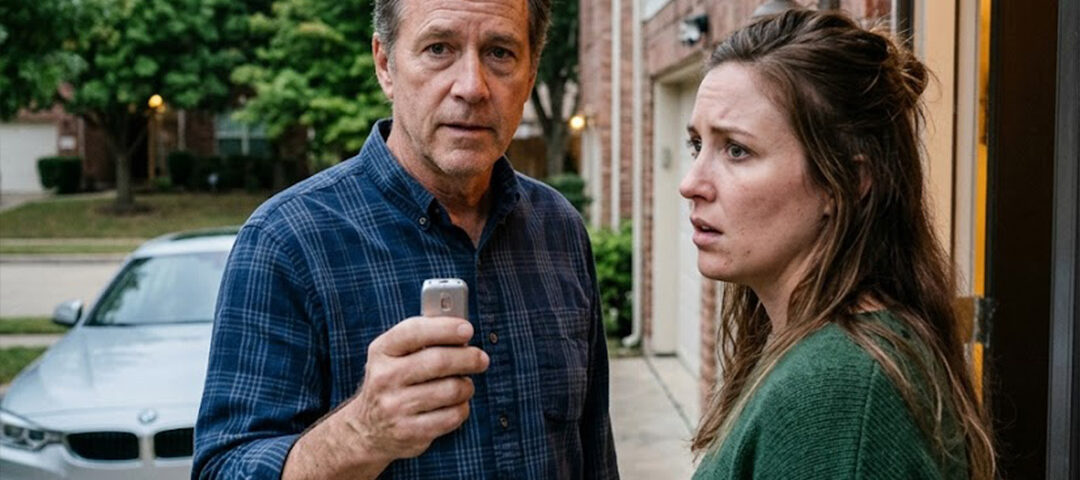
The call came on a Thursday evening in September, just as I was locking up the last of our three Dallas showrooms for the night.
My daughter almost never called during the week unless something was wrong. And when I heard the brightness in her voice, that particular kind of brightness that hides nervousness underneath, I sat down on a display couch that cost more than most people’s first car and listened carefully.
“Dad, I need you to meet someone.”
Her voice wobbled slightly on the next word.
“His name is Dominic. We’ve been together for about three months. I know that isn’t long, but I really need you to meet him. Can we do Sunday dinner?”
I told her, of course. I told her I would cook the lamb chops she had loved since childhood. I told her I could not wait.
After we hung up, I sat in the empty showroom surrounded by furniture nobody was buying at that hour and thought about the last time Clare had sounded like that. Like she was walking toward something she was not entirely sure of, but could not stop herself from approaching anyway.
The last time had been the job in Chicago she eventually turned down. The time before that had been a road trip to Colorado with friends I never quite trusted.
I hoped this was different.
It was not.
Sunday arrived the way late-September Sundays do in Dallas, warm enough to keep the windows open but cool enough in the evening to remind you that summer was finally conceding.
I had the lamb chops ready by six. Clare arrived at 6:15, wearing a dress I had not seen before, her dark hair pinned up the way she wore it when she wanted to look professional. She had turned thirty that summer, an architect at a firm downtown, careful and precise in her work and in most of her decisions.
She had her mother’s eyes and, unfortunately for both of us, her mother’s tendency to fall completely before she looked.
The man behind her was tall, somewhere in his mid-to-late thirties, with the kind of jawline that photographs well and a handshake just firm enough to signal confidence without crossing into aggression.
He introduced himself as Dominic Webb. He wore a blazer over a shirt with no tie, the calculated casualness of someone who had practiced looking relaxed.
His smile arrived exactly on schedule.
“Mr. Callaway. Clare talks about you constantly. Everything you’ve built here is impressive.”
His eyes moved around my dining room the way a contractor estimates square footage.
“The furniture is incredible. Obviously, she told me you source everything yourself.”
I watched his gaze settle on the credenza my wife, Eleanor, had picked out two years before she got sick. He photographed it with his phone before I had offered a tour.
During dinner, I learned that Dominic described himself as a venture capital partner focusing on early-stage tech startups. He mentioned a fund he had co-founded, clients in Austin and San Francisco, and a deal he had recently closed with a logistics company that was, in his words, about to change everything in last-mile delivery.
He mentioned it all easily, fluently, the way people speak about things they have rehearsed so many times the rehearsal has replaced the memory.
Clare watched him talk with an expression I recognized, and that worried me.
She was not seeing him.
She was seeing the version of him she had already decided on.
I noticed the questions start around the second glass of wine. He asked about my expansion plans, whether I had considered going national with the showrooms, and what my thoughts were on commercial real estate as an investment class.
He complimented my taste and immediately followed the compliment with a question about what I had paid for the house.
He asked about estate planning in the context of praising Clare’s future.
He asked about my liquidity in the context of discussing the economy.
He asked about my business partners in the context of asking nothing at all that was actually about my business partners.
Every question was wrapped in something that sounded like admiration.
Every probe came dressed as curiosity.
When they left that night and I stood at the front door watching Dominic’s silver BMW pull out of my driveway, Clare was already on her phone before they had cleared the gate.
I went back to the dining table and sat with my second glass of wine and thought carefully about what I had just observed.
Forty years of buying and selling. Forty years of reading rooms and reading people. Forty years of knowing within five minutes of a conversation which way a deal was going to go.
Forty years of that.
And every nerve I had was telling me the same thing.
Something was wrong with Dominic Webb.
I called my old friend Patricia Simmons the next morning. We had known each other since the nineties through a business association, and she now ran a corporate due diligence firm out of Houston.
I gave her Dominic’s name, the fund name he had mentioned, his description, and asked for anything she could find.
She called it a favor.
I called it the best investment I would make that month.
She called back on Wednesday. Her voice was careful in the way that meant what she had found was worse than expected.
“His real name is Dominic Whitfield,” she said. “He legally changed it to Webb four years ago. The VC fund he mentioned does not exist. There is an LLC registered in Nevada under that name, but it has no assets, no portfolio companies, and no co-founders on record.”
I stayed very still.
“He has outstanding judgments against him from three creditors totaling just under ninety thousand dollars. His credit is essentially destroyed. He was investigated by the Texas Securities Board in 2021 for soliciting investments in a company that did not exist, but the complaint was dropped when the victim declined to pursue it.”
She paused.
“There is more. Do you want the rest?”
I told her I did.
The rest was worse.
Two separate women in their late twenties had dated him in the past four years. Both were from families with significant assets. Both relationships had ended abruptly with no clear explanation from Dominic. Both women had reportedly been left emotionally destabilized in ways that took time to understand.
Patricia had spoken informally with a contact who knew one of them. The pattern she described was textbook.
Gain access through the daughter. Assess the father’s wealth. Escalate the relationship quickly. Extract.
I sat in my office for a long time after that call.
I looked at the framed photo on my desk. Eleanor and Clare at the lake house in Colorado, both laughing at something off camera, taken the summer before Eleanor got sick.
Clare had been twenty-four in that photograph. She had looked exactly like that when she walked through my door Sunday with Dominic behind her, like someone who thought she had found something real.
I called her that evening.
I kept my voice level. I told her I had had Dominic looked into and that what I found concerned me. I told her about the fake fund, the debt, the legal history, the pattern Patricia had described.
The silence on the other end lasted long enough that I thought the call had dropped.
Then she said, “Dad, you hired someone to investigate my boyfriend.”
I told her I had.
I told her it was not about trust or control. I told her the specific things I had learned. The names of the creditors, the Nevada LLC with no assets, the Texas Securities Board complaint.
She did not hear any of it.
Or she heard it and chose not to.
I could tell from the quality of her silence. Not the silence of someone processing information, but the silence of someone deciding how angry to be.
“You have done this before,” she said. “You did it with Brandon. You did it with Jeff. You find something, anything, and you use it as a reason to push people away from me. You have been doing it since Mom died, and I am tired of it, Dad. I am so tired of it.”
“Clare, those are not comparable situations. Brandon had a—”
“I do not want to hear it.”
Her voice had gone flat and quiet, which was worse than shouting.
“I am thirty years old. I am not asking for your approval. I am asking you to trust my judgment for once.”
I told her I did trust her judgment. I told her this was not about her judgment. It was about his history, which she had not had access to until now.
I told her I loved her and that I was telling her because of that, not in spite of it.
She told me not to call her until I was ready to apologize.
The line went silent.
I set the phone down on my desk next to Eleanor’s photo and looked at the two of them laughing at something I would never know.
And I thought about how Eleanor would have handled this.
She had always been the one Clare came to. She had always been the one who knew exactly how much to say and when to stop.
Without her, I was navigating blind.
And I had apparently just walked into a wall.
The weeks that followed were quiet in the way empty houses are quiet.
I worked. I drove between showrooms. I had dinner with Patricia twice and talked about everything except what was actually on my mind.
I tried calling Clare three times. Three times the call went to voicemail. I left messages that I tried to make sound casual and probably did not.
Then Patricia called again.
“There is a development.”
She kept her voice steady, but I could hear something underneath it.
“He just moved in with Clare. And there is a joint bank account. She has already deposited money into it. About forty thousand dollars from what I can tell.”
I closed my eyes.
“Richard, there is also a new LLC filed in Delaware. A consulting company. He is the sole managing member. Clare’s name is not on it.”
Forty thousand dollars.
I asked if she was sure.
She was sure.
I sat with that for the rest of the day.
The sole-ownership LLC. The offshore-adjacent structure. The forty thousand dollars from Clare’s savings going somewhere she probably did not fully understand.
This was not just a man living beyond his means.
This was someone who had engineered access to my daughter specifically to reach whatever he thought was behind her.
And the answer to that question was everything I had spent forty years building.
The engagement announcement appeared on Instagram two weeks later.
A photo of Clare’s hand with a ring that looked like it cost twenty thousand dollars, probably on credit he did not have, and Dominic grinning beside her at a restaurant I recognized as being well outside what his fictional venture fund could support.
The caption said something about forever, the right person, and God’s timing.
It had over eight hundred likes by morning.
I tried calling.
Voicemail.
I tried texting.
No response.
I wrote an email with the subject line, “Clare, please just read this.”
It bounced back the next day.
She had blocked my address.
The formal invitation arrived by mail the following week, printed on heavy card stock with gold embossing.
An engagement dinner at the Stonley Hotel in Uptown Dallas. Private dining room. Cocktail hour at seven. Dinner at eight. Formal attire requested. RSVP by October 10.
Sixty guests.
My daughter’s engagement party, and I had been invited by mail because she had blocked every other way I might reach her.
I put the invitation on my desk and stared at it for a long time.
Then my phone buzzed with a message from a number I did not recognize.
Richard, this is Dominic. We should speak privately before the dinner. Just the two of us. I think we can come to an understanding that works for everyone, especially Clare. Can you meet me at your office Friday at four?
I read it twice.
I read it a third time.
I thought about the fake fund, the ninety thousand in judgments, the Delaware LLC with Clare’s forty thousand already in it, and the phrase come to an understanding.
I typed back, Friday at four works. I will be there.
His response came in under a minute.
Perfect. Do not mention this to Clare. I want this to be a surprise for her.
I set the phone face down on my desk and sat very still for a moment.
Then I opened my laptop and searched for electronic stores near my office.
The young man at the store in Addison was patient and thorough. He showed me three options. The one I chose was roughly the size of a shirt button, with a magnetic backing, thirty-six hours of battery life, and voice activation within a twenty-five-foot radius.
He told me that in Texas, one-party consent meant I could record any conversation I was personally part of without informing the other party.
He said it so matter-of-factly that I wondered how often he had that particular conversation.
I tested it twice in my car before Friday.
The audio was flawless.
Friday at four, Dominic arrived in my showroom wearing the same calculated casual blazer, but without Clare beside him, his performance was different. Looser. More direct.
He accepted the coffee I offered, looked around my office with undisguised assessment, and got to it faster than I expected.
“I appreciate you meeting me.”
He settled into the chair across from my desk like he owned it.
“Clare has been struggling with this situation between you two. It is affecting her at work, affecting her sleep. I know you care about her, so I know you do not want that.”
I told him I did not want that.
I kept my voice neutral and my hands still on the desk.
He nodded.
“Good. Then I think we can resolve this simply.”
He paused, recalibrating.
“You know, I have been doing some research into your business. The Callaway Collection. Three showrooms. Real estate holdings. The warehouse property in Irving. Very impressive portfolio for a self-made operation.”
I told him, “Thank you.”
He smiled.
The smile did not involve his eyes.
“Starting a marriage is expensive. Building the kind of life Clare deserves requires real capital, especially when you are also building a business simultaneously. Our consulting firm is at a critical growth stage. The right investment now could mean everything.”
I asked him how much he was considering.
He tilted his head slightly, pleased at the directness.
“Two hundred fifty thousand would get us through the first phase. Consider it a wedding gift. An investment in our future. You would see returns within eighteen months.”
He slid a folder across my desk.
A business plan. Glossy, well designed, full of projections that assumed revenue from clients I was already certain did not exist.
I told him I would need to review it carefully.
I told him I would want to discuss it with my accountant.
His expression tightened almost imperceptibly.
“Of course. Though the engagement dinner is next Saturday. Having your support confirmed before then would mean the world to Clare. Even a commitment in principle. Say one hundred thousand to start.”
I told him I understood the timeline.
He left twenty minutes later, frustration smoothed over with practiced warmth.
I sat in my office and played back the recording.
Every word was crystal clear. The business plan. The amount. The pressure around the timing of the dinner.
It was not what I needed yet.
But I was closer.
Patricia called that evening with one more piece.
She had been tracking what she could through legal channels available to her firm, and she had found something that changed the shape of everything.
Dominic had a phone number he used separately from the one Clare knew about.
That number had been in contact with two other women in the past six months. Both with fathers in the same general wealth bracket as mine. Both relationships at varying stages of development.
He was running multiple operations simultaneously.
Something I had not fully considered.
He was not just targeting Clare.
He was rotating through options, accelerating whichever one showed the most promise.
I asked Patricia to document everything she could.
She told me she already was.
The engagement dinner was held on the last Saturday of October.
The private dining room at the Stonley was the kind of space that knows it does not need to try hard. Dark wood, low lighting, white linens, the quiet confidence of money that has been comfortable with itself for generations.
Sixty guests filled it easily.
Clare’s friends from college and from her firm. A few of Dominic’s associates, who I would later learn were largely acquaintances he had cultivated for appearances. Some family friends who had known me since Eleanor was alive.
I arrived at seven and made my way through cocktail hour with a glass of sparkling water, watching.
Clare had not spoken to me directly since our last phone call, though she acknowledged my presence at the door with a hug that was brief and careful, like touching something she was not sure was safe.
Dominic shook my hand with both of his, told me he was glad I was there, and held my gaze a beat too long.
At 7:45, my phone buzzed.
The message was from Dominic’s number.
Step out to the east corridor. Now. We need to finalize our arrangement before dinner is served. Do not make a scene.
I excused myself from the conversation I was half having with one of Clare’s colleagues, set my water glass on a passing tray, and pressed the small button on the device I had transferred from my jacket pocket to the breast pocket of my suit that morning.
The indicator blinked once, barely visible.
The east corridor was a narrow hallway connecting the private room to the hotel’s main passage, lined with framed photographs of old Dallas and lit with sconces that kept everything in amber.
Dominic was waiting near the far end, hands in his pockets, wearing the performance of calm that I now recognized as something he had practiced in mirrors.
“I am going to be direct,” he said, which is something people say when they have been calculating for weeks. “The two-fifty we discussed is not going to work anymore. Circumstances have changed, and I need to be realistic with you about what it is going to take to keep this family together.”
I waited.
His voice dropped, not because he was nervous, but because he was enjoying the architecture of the moment.
“The number is one point five million. Wire transfer by Wednesday of next week. Routed to the LLC.”
His tone was the tone of someone reading from a document he had already approved.
“If that does not happen, I will be making some calls to the Texas Securities Board about irregularities I have identified in your business filings. I have a contact there from a previous matter. I also have testimony prepared from a former business associate of yours who is willing to say that certain transactions in 2019 were not properly disclosed.”
I kept my face exactly as it was.
He continued.
“Clare does not know about this. She will not, as long as we come to an arrangement. But if this goes the other way, I will make sure she understands that her father’s entire business is under federal scrutiny and that any assets she stands to inherit could be tied up for years. She will spend years watching you fight investigations instead of watching you walk her down the aisle.”
His pause was theatrical.
“You have until the end of dinner to give me your answer. I need a verbal commitment tonight and the wire instructions by Monday.”
The corridor was quiet.
Somewhere down the hall, I could hear the low register of sixty people having the kind of conversations people have before they sit down to eat at places like this.
Clare was in that room.
So were people who had known Eleanor.
So were people who had watched me build something from nothing over four decades, who had watched me lose my wife and keep going, who were here tonight because they cared about my daughter.
I reached into my breast pocket.
Dominic’s eyes followed my hand, expecting a phone, expecting capitulation, or at least the beginning of it.
What I pulled out was the recorder.
I held it up between us in the amber light.
The indicator was still on.
“Every word,” I said. “From the moment I stepped into this corridor.”
His face did something complicated.
Color left it and came back wrong.
“What is that? That is not—you cannot—”
“Texas is a one-party consent state,” I said. “I am a party to this conversation. I have been recording it.”
I pressed stop.
The light went dark.
He lunged forward. His hand caught my forearm.
“Give me that.”
His voice had lost all its architecture.
“Give me that right now. This is entrapment. You set me up. You cannot use that.”
I pulled my arm back and walked toward the dining room.
He followed, still talking, his voice dropping into something urgent and hissing.
“Richard. Richard, listen to me. We can still work this out. There is no reason this has to—stop walking. I need you to stop walking.”
I pushed open the door to the private dining room.
Sixty people looked up.
I crossed to where the hotel’s AV system was set up near the head table. A Bluetooth speaker connected to a small panel for background music during dinner.
I knew it was there because I had called the hotel Thursday morning to confirm.
The young man managing the system looked up at me with the expression of someone who had never been in a situation like this and knew it.
“I need to play something through your speakers,” I said quietly. “It is important.”
He looked uncertain.
“Sir, we have a—”
“Please,” I said. “It will only take a minute.”
Something in my face must have convinced him. He handed me the auxiliary cable.
Behind me, I heard Dominic’s voice at full register now, cracking.
“Clare, your father is trying to—this is a setup. He has been trying to destroy us from the beginning.”
Clare was standing near the head table, her face moving through expressions too fast to catalog.
“Dad, what is happening? What are you doing?”
I connected the cable to the recorder, found the playback, and pressed play.
Dominic’s voice filled the room.
“The number is one point five million. Wire transfer by Wednesday of next week. Routed to the LLC.”
The room went perfectly still.
The kind of still that is not quiet because everyone has stopped talking.
It is quiet because everyone has stopped breathing.
The recording continued, his voice describing the false Securities Board contact, the prepared testimony, the threat about Clare watching her father spend years in investigation.
Every sentence calibrated for maximum damage.
Every word captured clearly in the amber corridor ten minutes ago.
“If that does not happen, I will be making some calls to the Texas Securities Board about irregularities I have identified in your business filings.”
Somewhere to my left, someone set a glass down on a table harder than they meant to.
Somewhere behind me, Clare said something that was not quite a word.
When the recording ended, the silence held for what felt like a long time.
Dominic stood near the doorway.
His face had undergone a transformation I imagine most faces in that room had never seen in person. The complete and instantaneous collapse of a constructed identity.
What was left underneath was not rage exactly.
It was exposure.
The specific look of someone whose architecture had come down all at once.
“Clare,” he started. “That is not the context. That is—”
“You asked my father for one point five million dollars.”
Her voice was very quiet.
“That is your voice. That is your voice saying my father would spend years fighting investigations instead of walking me down the aisle.”
“It is more complicated than—”
I opened my email on my phone and forwarded the full unedited recording to my attorney, to Patricia, and to three witnesses in the room, all with full metadata and timestamps.
I turned to face sixty people, most of whom were still frozen in the positions they had been in when the recording started.
“There is more you should know,” I said, “but some of it is better discussed with fewer people present.”
The engagement dinner dissolved in under forty minutes.
Guests left in the careful, quiet way people leave when they have witnessed something they are still processing. A few stopped to touch my arm or Clare’s.
Nobody said much.
Dominic left before the room was half empty, probably calling someone, probably running a calculation about what came next.
Clare and I sat at the head table after the last guest was gone, in a room full of untouched dinner service and cooling food, and I told her everything.
Not the version I had tried to tell her over the phone, compressed and urgent and poorly timed.
The full version.
Patricia’s investigation. The fake fund. The ninety thousand dollars in judgments. The separate phone used for the other women. The Delaware LLC with her forty thousand already inside it.
The timeline that made clear he had known exactly what he was doing from the first Sunday dinner.
She listened to all of it without interrupting.
Somewhere in the middle, she started crying in the quiet way that does not involve much sound, just her hands pressed flat on the white tablecloth and her eyes steady on the space in front of her.
When I finished, she said, “He was never going to marry me.”
“No,” I told her. “I do not think he was.”
She was quiet for a moment.
Then she said, “The ring is fake, isn’t it?”
“I did not know that specifically,” I told her. “But it was possible.”
She laughed once, a single exhale that was not really a laugh.
“I picked it out. I went to the jewelry store with him and I picked it out. I thought the reason it looked so perfect was because he knew my taste.”
She looked up at me.
“He had done research. He knew what I would like because he had studied me like a project.”
I told her I was sorry.
I told her I was sorry I had not found a way to make her hear it sooner. Before the forty thousand dollars. Before the ring. Before the room full of people who had just watched her engagement come apart in real time.
I told her that was on me as much as it was on him.
She shook her head.
“You tried. You tried and I blocked your email.”
We sat in the empty dining room at the Stonley until the hotel staff very gently began clearing around us.
Then we went downstairs and sat in the lobby and kept talking.
Not just about Dominic.
About the years since her mother died. About the distance that had grown between us that neither of us had fully named. About the ways grief makes people reach for things that feel solid, even when they are not.
We talked until close to midnight.
When I finally drove home, I sat in my driveway for a few minutes before going inside, looking at the dark house.
And I thought that the feeling I had was not quite victory and not quite relief, but something adjacent to both of them.
More like a specific weight leaving you, one you had been carrying so long you had forgotten it was there.
The lawsuit arrived five weeks later.
Dominic, through an attorney in Houston, filed a civil complaint alleging invasion of privacy, intentional infliction of emotional distress, tortious interference with a business relationship, and defamation.
Damages sought: eight hundred thousand dollars.
His attorney’s filing constructed a narrative in which I was a controlling, grief-stricken father who had manufactured a blackmail scenario to destroy my daughter’s relationship using illegally obtained recordings and fabricated financial records to humiliate a man who had done nothing but love her.
My attorney, a woman named Gail Reyes, had handled my business affairs for fifteen years, and I would trust her with my life without hesitation.
She reviewed the complaint over coffee in her office on a Tuesday morning, made notes in three different colors of ink, and looked up at me when she was done.
“This is ambitious,” she said. “It is also deeply flawed. The recording is legal. The financial records are documented through a licensed due diligence firm. The witnesses are credible.”
She paused.
“He is hoping you will pay to make it go away.”
I told her I was not going to pay to make it go away.
She said she was glad to hear that.
Then she told me there was something else I should know, something her investigator had found in the course of preparing the defense.
Patricia had found the two other women he had been communicating with.
But Gail’s team had found something more.
A man in Phoenix, a sixty-two-year-old real estate developer whose daughter had dated Dominic in 2020 under a different name.
The relationship had ended abruptly after the father refused to invest in the same non-existent consulting structure. The developer had paid Dominic forty thousand dollars to end what had been described to him as exposure of a business irregularity, then chose not to pursue it further.
He had spent three years assuming it was an isolated incident.
There was a woman in Denver whose father was a retired surgeon. That was 2021. He had paid sixty-five thousand.
Same structure. Different name. Same outcome.
There was a couple in Nashville, both parents this time, whose son had been the entry point. That was 2022. They had paid fifty thousand before their son ended the relationship on his own.
Four families.
One hundred fifty-five thousand dollars extracted.
All of them choosing silence because silence felt safer than the alternative.
All of them not knowing someone else was sitting in the same silence somewhere else.
I was the first one who had recorded him.
Gail submitted a formal response to the complaint, attaching the financial documentation, the authenticated recording with forensic verification, a signed affidavit from Patricia’s firm, and statements from all four families who had agreed to cooperate.
The Phoenix developer flew to Dallas for a deposition.
He sat across a conference table and spoke with the careful steadiness of someone who had waited three years to say something out loud.
What he said was precise and damaging and exactly consistent with what had happened in that corridor at the Stonley.
The case was heard before a judge in Dallas County in January.
Dominic’s attorney presented the narrative with full commitment. I sat beside Gail and watched it and thought about the distance between what the attorney was describing and what I knew to be true.
I thought about how many times in forty years I had been in rooms where someone was presenting a version of events that bore no relationship to reality.
Those situations always resolved the same way eventually, as long as you were patient.
The forensic audio expert testified that the recording was unaltered and unedited, with verified metadata confirming time, date, and location.
Dominic’s attorney objected four times.
The judge overruled each objection with the polite efficiency of someone who had heard a great deal of objections in her career.
The Phoenix developer testified.
Then the Denver surgeon.
Then the couple from Nashville, who sat side by side at the witness stand and took turns answering questions with the particular exhaustion of people who are relieved to finally be in a room where the truth is allowed to be spoken at full volume.
Dominic took the stand, and his attorney guided him through a narrative that I will say this for: it was technically coherent.
But coherence and credibility are not the same thing.
By the time he finished his prepared account, the judge had the financial records, the authenticated recording, the forensic analysis, and four separate witnesses describing four separate incidents that were structurally identical to what had happened in October.
Whatever Dominic’s attorney had built, it was not enough to hold against that.
The judge dismissed the case with prejudice on a Thursday afternoon. She ordered Dominic to pay our legal costs of seventy-one thousand dollars.
She referred the matter to the Dallas County District Attorney’s Office and to the federal financial-crimes division, noting specifically the interstate nature of the pattern of conduct.
I walked out of the courthouse into January air that was sharp and dry, the way Dallas January can be when it decides to actually feel like winter.
Gail was beside me, going over next steps, the DA referral, the civil recovery options for the four families, the timeline for the financial-crimes investigation.
I listened to all of it and nodded at the right moments and thought about Clare.
She had been in the courtroom.
She had sat through all of it.
The forensic analysis. The four families. The full documented history of what Dominic had done and how long he had been doing it.
She had heard the Phoenix developer describe the conversation with his daughter that preceded meeting Dominic, the way he had been introduced at a gallery opening, the careful way the relationship had been constructed from the first moment.
She had heard the Nashville couple describe their son’s face when they showed him the evidence.
After the ruling, when Gail had finished her summary and gone back inside to collect her files, I found Clare standing by the fountain at the courthouse entrance.
She was looking at it with the expression of someone who was very carefully not crying in public.
She turned when she heard me.
“He profiled me,” she said.
She said it like she was still deciding whether to believe it.
“Before we ever met, he found me because of you, because of what you have. And he built a version of himself that he knew I would fall for.”
“I think so,” I said.
Her voice was very even.
“He researched what I liked. My design preferences. My aesthetic. The things I had posted online. He wore what I would respond to. He said what I needed to hear.”
She looked at me directly.
“Dad, I deleted your emails. I blocked your number. I stood in a hotel ballroom and listened to him threaten you for one point five million dollars. And the look on his face when your recording started…”
She stopped.
I waited.
“He was not even surprised,” she said. “He was calculating. He was already calculating what to do next. That was the most frightening part. There was no moment where he looked like he had lost. He just moved to the next position.”
I told her that was what people like him did.
I told her it was not about her specifically. Not her judgment. Not her perception. Not some failure of intelligence or instinct.
She had been a tool in a calculation.
And being deceived by someone who has spent years perfecting the deception is not the same as being foolish.
She was quiet for a moment.
Then she said, “You knew within a week of meeting him.”
“I knew something was wrong. I did not know what yet.”
“How?”
I thought about it honestly.
“Because he was performing,” I said. “He was very good at it. But performing for an audience always has a slightly different texture than just being. And I have been in enough rooms with enough people over enough decades to feel that texture even when I cannot name it exactly.”
She looked at the fountain.
“Mom would have known too.”
“Yes,” I said. “She would have.”
We stood there for a while in the January cold, not talking exactly, just standing near each other the way you can only stand near someone you have known your whole life, in the particular comfort of shared silence that does not require anything.
The months that followed were quieter in the way things go quiet after something large has passed through them.
Clare took two weeks off work and then went back. She threw herself into a project she had had on hold for a year. She started seeing a therapist she liked, rebuilding a sense of her own instincts that Dominic had very systematically worked to undermine.
She called me most Sundays.
Sometimes we talked for an hour.
Sometimes we talked for ten minutes, and that was enough.
The DA’s office moved on the case in March.
Three serious financial charges were filed: wire fraud, extortion, and conspiracy to commit financial crimes.
Dominic’s attorney negotiated a plea agreement in May that included eighteen months in federal custody and mandatory restitution to the four families.
He was photographed leaving the courthouse looking smaller than he had in any room he had ever occupied in my presence.
I heard about it from Gail and told Clare over Sunday dinner at my house.
She absorbed it and said, “Good.”
Then she said, “More lamb chops, please.”
It was the most ordinary thing she had said to me in months, and it was exactly right.
I did not find anything unexpected afterward.
No new relationship. No dramatic turn.
What I found was the version of ordinary life that you do not notice properly until you have spent a significant period of time in fear of losing it.
Dinners with Clare.
The showrooms doing well.
A weekend at the Colorado lake house in August, the first time I had been back since Eleanor died.
It was not as hard as I expected, because Clare was there, and Eleanor was there too in the particular way people remain in the places that mattered to them.
One evening in September, exactly a year after the phone call that started all of this, Clare came to Sunday dinner and arrived early for the first time in years.
She helped me in the kitchen the way she used to when she was young.
At some point, she turned to me over the lamb chops and said, “I have been thinking about what you said. About performing versus being. About how you can feel the difference even when you cannot name it.”
I told her I remembered.
She said, “I have started noticing it everywhere. At work. With clients. With people I meet. I can feel it now.”
She looked at me with something that was not quite a smile but was close to one.
“You gave me that by going through all of this and being right, and being patient about being right when I was not ready to hear it. You gave me the ability to feel that.”
I told her I thought she had always had the ability.
I thought she just had not had reason to use it.
She considered that.
“Maybe,” she said. “But you are the one who stood between me and the reason to use it while I was still figuring that out.”
She raised her water glass.
“I am not good at saying this kind of thing, so I am just going to say it. Thank you, Dad, for not letting go. Even when I was the one letting go.”
My throat did the thing it does now when Clare says something I was not prepared for.
I raised my glass to meet hers.
The last I heard, Dominic reported to a federal facility in Colorado in June. The civil recovery process was ongoing for the four families, slow and uncertain the way civil recovery processes are.
Somewhere out there, his methods were probably being copied by people with similar calculations and similar patience.
There was not much I could do about that except what I had already done.
Document everything.
Trust your instincts.
And when someone you love cannot hear you, find the kind of patience that outlasts the reason they stopped listening.
That is not bitterness.
That is just what it costs sometimes.
What it bought me was this.
My daughter at my kitchen counter on a Sunday evening, laughing at something on her phone.
The lamb chops ready.
The Colorado photo of her and Eleanor on the counter, where I had moved it from my office desk because it belonged somewhere I would see it every day.
A house that felt like something again instead of just a structure I happened to sleep in.
Some things you cannot protect people from directly.
You can only do the work, hold the evidence, and wait for the moment when the truth is finally allowed into the room.
The moment always comes.
That is what I have learned.
And it is enough.
Disclaimer: This story is a work of fiction created for entertainment purposes. Any resemblance to real persons, events, or places is coincidental.