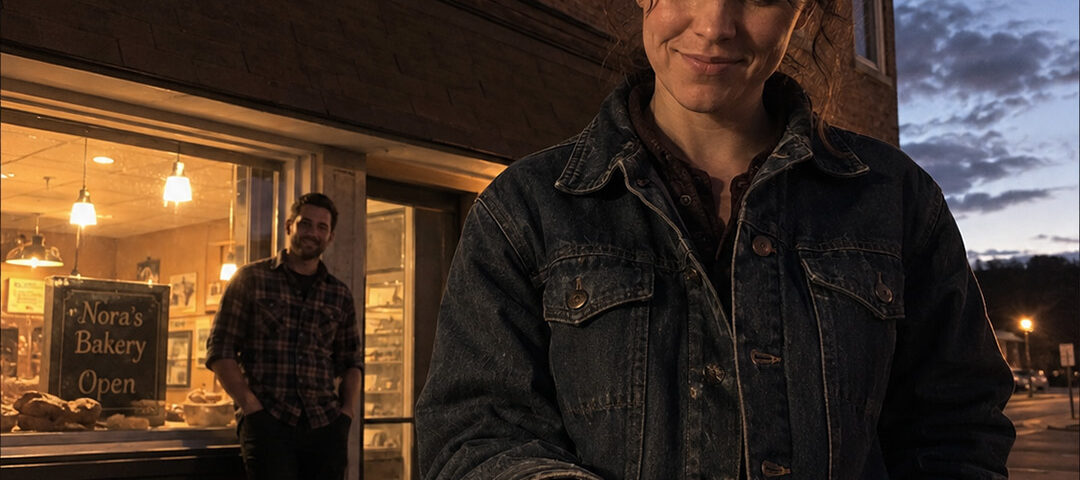
My name is Lucia Reynolds. I’m 28, and for a little while I finally had a place where no one corrected the way I existed. It wasn’t much, just a one-bedroom perched above a print shop that smelled like ink and hot paper at sunrise. The stairs complained every time I climbed them, and the window latch needed a nudge like an old friend’s shoulder.
I loved it anyway. I had painted the walls myself, the kind of white that pretends to be brave, and I’d fixed the bathroom leak with a patch kit and more faith than instructions. I’m an HVAC tech by trade, electrical certified, the person people call when their air coughs in July. Nothing glamorous. But the keys in my hand were mine.
Some families have golden children. Mine built a shrine. Emily, four years younger, prom queen without the crown, future everything if you believe her captions. The glow in our family stuck to her like a filter. Me, I was useful. The person who could mount a shelf straight or find studs in a wall by knocking, the one they called when the garbage disposal screamed.
It started small. “Lucia, the natural light in your place is to die for,” Emily sighed, drifting in with a Pomeranian named Machi, who believed all carpets were negotiable. “Two weekends,” she said. Then two more. A ring light bloomed in my living room like a second sun.
I came home from a 12-hour shift to find her in my chair glossing her lips at a camera. “The dorms are not it right now,” she said, sparing me a glance like I was set dressing. Bills shuffled, complaints collected. My debit card did a magic trick. Emergency translated to nearly $200 in foam and lashes.
I let it go. Being quiet had always been my role: calm, responsible, absorbent. My boyfriend Jordan brought over takeout and heard me swallow the parts I didn’t say. He’s a carpenter with hands that remember shapes wood prefers and eyes that notice what people try to hide.
“You don’t have to let her live here,” he said gently, not pushing. “I know,” I lied. The knock came on a Monday, not Emily, not a neighbor. Mr. Callahan, my landlord, holding a manila envelope like a verdict. “I’m sorry, Lucia,” he said. “It’s not personal.”
My chest cooled a degree. The paper inside had too many capital letters. Eviction. 30 days. I blinked hard like that would rearrange the words into something kinder. “There must be a mistake,” I said. “I have never missed a payment.”
“You haven’t.” He scratched his neck. “But the lease was bought out. Six months.” “By who?” A throat clear, a nod toward the street, and then he left me standing in the doorway of a home that had already been spoken for without me.
The silence after a slammed door is a particular kind. It vibrates. I stared at the wall where I’d painted over a crack the wrong shade, the tiny bruise of mismatched color I’d always meant to fix. It looked suddenly like a bruise I’d learned to ignore.
My phone rang. Mom, cheerful like the edge of a knife. “Sweetie, don’t be mad,” she chirped, the tone she used when she accidentally donated my childhood trophies. “We had a little chat with Mr. Callahan.”
“You what?” “Emily really needs her own space. Finals are stressful, and that building has such lovely light. You’re always working and you don’t use half the…” “You paid off my landlord to give my apartment to Emily.”
A pause. “We just thought it made sense.” “You didn’t think to tell me.” “Oh, honey, we didn’t want to upset you.” Too late, but I didn’t say it. My anger didn’t come loud. It came cold and slow, a tide pulling back so far you know something is about to break.
I looked at the shelves I’d secured, the chair I’d fixed three times, the door I had painted in the exact right shade because I wanted to love seeing it when I came home. I hung up without goodbye.
Packing took two days and all the steadiness I had. Boxes, tape that stuck to itself, labels written with a shaky hand. I left the patchy wall. Emily would call it distressed chic. When you go quietly, there’s a power in it, the kind that doesn’t need witnesses.
Jordan didn’t ask for explanations. He tossed me the keys to his unfinished garage studio behind the small house he rents. “The water heater screams like a demon,” he warned. “You’ll get used to it.”
The insulation was theoretical. The bed was a cot pretending to be brave. No Wi-Fi, just a dog named Pickles in the yard who mistook me for a tree and loved me anyway. It wasn’t comfortable, but it was my oxygen for a minute.
We ate noodles from the carton under a dangling bulb that hummed. “Say it,” Jordan said finally. “They changed the locks without changing the locks,” I said. “They always knew I’d survive, so they decided I could be the one to lose things.”
I picked up a napkin, drew a rectangle, then stairs, then a line for plumbing. Not revenge, literal blueprints. I’d been saving for a fixer-upper, slowly, for years. Jordan’s smile was a small, respectful thing. “What do you want, Lou?”
“Paper,” I said. He frowned, and I clarified, “Not apologies. Deeds, contracts, the kind of paper that changes who answers the door.” Emily, meanwhile, moved into my old apartment, now her content studio, filming tours of a life she manifested.
Mom and Dad called every few days as if nothing had happened, which, because I didn’t scream, meant nothing had. That’s the secret currency in families like mine. Silence counts as consent.
Jordan found it almost funny. “They have no idea you’re two blocks away,” he said, sipping beer on the garage steps. “You’re like a benevolent ghost of HVAC past.” “Not benevolent,” I said, not quite smiling. “Just done.”
Weeks shifted. I worked overtime, took weekend calls, fixed other people’s summers. The garage’s water heater shrieked nightly. I learned to hum back. On breaks, I pored over listings harder than I ever had. No more rentals, no more someone else’s mercy. Structures, mixed-use, motivated sellers. I ran numbers until the napkins ran out.
One afternoon, a listing found me back. Three-story corner building, closed bakery on the ground floor, two units above, a seller who’d had enough of repairs. The price, brutal but breathing. I’d have had more if I hadn’t once paid an emergency tuition deposit when Mom’s card acted up. I ran the math three more times, then I ran it again. It balanced by a thread.
When I signed, nothing swelled. No orchestral swell, no victory pose, just a stillness so complete I heard the pen pull away from the paper. I didn’t tell my parents. I didn’t tell Emily. I didn’t even tell Jordan until the second pizza box fell open and I blurted, “I bought a building.”
He choked. “Like a Lego one?” “Brick, roof, mortgage, the works.” He blinked, then handed me another beer. “You’re insane,” he said with awe. “I love it.”
I rewired half the place with a headlamp and a playlist that sounded like courage in steel-toed boots. Leased the bakery to a man who makes sourdough people line up for. The top unit rented fast. I kept the middle one. My walls, my locks, my name on the paper.
A week later, my old landlord called, voice careful like the floor might creak. “Lucia, odd thing. Your family wants to renew the lease for your sister, long-term.” “Oh?” I asked, stirring soup on a hot plate. “Here’s the thing,” he said. “I sold the building a few months ago.”
“Yeah?” I flipped a piece of bread in the broth. “Who’s the new owner?” A pause. “You are.” I smiled into the steam. “Tell her the new owner’s reviewing all applications,” I said. “No promises.”
When I hung up, I opened a spreadsheet. Under current occupant, I typed Emily. Application pending. Under notes, slanted shelf, loud dog, ring light usage questionable. I imagined Emily’s captions about women in media being punished by landlords and felt, for the first time in months, something like oxygen.
I didn’t want her groveling. I wanted rules, applications, not exceptions, names on paper that meant what they said, locks that turned because I turned them. Somewhere down the block, a wind chime argued with itself. I looked at the keys in my palm, the same metal, new weight, and knew what came next wouldn’t need a raised voice. It would just need a signature.
The bakery downstairs smelled like new beginnings and burnt sugar. I used to wake up at 6, not because of alarms, but because of the sound: trays clanging, a mixer roaring to life, the faint hum of someone trying. That sound used to mean other people’s success. Now it was mine, too.
Owning the building didn’t make me invincible. It just meant I had more broken things to fix, and I liked that. Fixing gave me language when words failed. I spent the next few months patching, rewiring, learning codes I’d only heard contractors whisper about.
I painted the hallway a warm cream that looked like sunlight on good days and candlelight on bad ones. I built a bookshelf with Jordan over two long Sundays. When he brushed sawdust from my cheek, I realized how foreign it felt to be touched without expectation.
“You ever think you’ll tell them?” he asked, tightening a screw on the door frame. “Tell who?” I teased. “Your family, about this place.” I stared at the half-finished trim. “They’d only find a way to say it was theirs, too.”
Jordan didn’t argue. He just nodded, the kind of quiet understanding that meant more than any promise. Three months after the purchase, I’d found a rhythm. Tenants were steady. The bakery’s sourdough was a local legend, and my upstairs renter always paid early with a thank-you note folded in half.
The middle unit, mine, became a workshop of half dreams and scattered tools. And then, because life likes its timing cruel, I got the notification. Emily Reynolds, new video uploaded. Manifesting my dream apartment.
The thumbnail hit like static: my old walls, pink now, and that same patch of paint I’d miscolored years ago. She’d turned it into a creative accent. She twirled on my old rug with her ring light glowing behind her. The caption read, “From dorm life to designer vibes. Sometimes the universe gives you exactly what you deserve.”
Jordan found me frozen at my desk. “You okay?” he asked. “She called it manifesting,” I said flatly. “Not manipulation, manifesting.” He exhaled through his nose. “People rewrite stories to make them feel better.” “I just wish she’d stop using mine.”
Two weeks later, I got a call from a real estate agent named Sophia Park. Her voice was smooth, too smooth. “Hi, Lucia. I heard you’ve been investing. Congrats on the building. Jordan mentioned it.” My spine straightened.
“Jordan mentioned it?” “Did he?” I asked, keeping my tone light. “Oh, just in passing,” she said quickly. “I’m helping a client who might be interested in one of your upper units if you ever expand.”
Sophia was Jordan’s ex, the kind who somehow always stayed nearby. Realtor, neighbor, reminder. The kind who said, “I’m so happy for you,” but meant, “I want to see how long this lasts.” I told her politely the building was fully occupied, thanked her, and hung up. But her voice lingered like humidity.
When Jordan came home that night, I asked casually, “You tell Sophia about the building?” He blinked mid-bite. “I ran into her at the hardware store. Didn’t think it mattered.” I nodded, smiling without smiling. “It doesn’t. Just curious.”

The silence stretched, then dissolved. He reached across the table and squeezed my hand. “Hey, I’m proud of you, Lou. Don’t let ghosts eat your peace.” I wanted to believe that was all she was, a ghost.
That night, I stood on the balcony outside my unit. The street was quiet, except for the low thrum of the bakery’s refrigeration system. In the distance, I could see the faint outline of my old building, her building now. A strange calm settled over me. I wasn’t angry anymore, just aware.
My parents had built a world where silence meant obedience, where “You’re the strong one” was code for “You’ll take the hit.” But not this time. I was learning that control didn’t always mean confrontation. Sometimes, it was simply refusing to explain yourself.
The wind picked up, brushing hair across my cheek. I whispered to no one, “This time, they can knock.” And for the first time in my life, I didn’t feel like a guest in my own story.
Three months later, the story came full circle, though not the way my parents expected. It started with an email titled “Lease Inquiry, Unit Two.” The sender’s name glowed like a ghost from my old life: Emily Reynolds.
I opened it. “Hi, just checking if I can renew my lease. Love this place so much. It’s honestly home now.” Smiley face. Pink font. No acknowledgement, no memory, just entitlement with an emoji.
I could almost hear her voice through the screen, that sing-song tone she used whenever she wanted something and thought a compliment would erase context. So I replied with three words. “Application under review.”
A few days later, my parents called. I let it ring out once, twice, until the voicemail filled with my mother’s sugar-dipped sigh. “Lucia, sweetie, please call us. We heard there’s been some confusion with Emily’s lease. Her landlord is being difficult.”
Difficult. That word sat on my tongue like metal. Jordan found me pacing the kitchen that night, my phone lighting up every few minutes with new missed calls. He watched me quietly for a while, then asked, “You going to tell them?” I leaned against the counter, arms folded. “Not yet.”
The next weekend, they showed up unannounced. I was outside repainting the front trim of the bakery entrance when I heard my mother’s voice float up the street, that bright tone she used for church socials and manipulation.
“Oh my goodness, this building looks so fancy, so professional.” My hand froze mid-stroke. Jordan stepped out beside me, saw my expression, and muttered, “Showtime.”
Dad, Mom, and Emily stood on the sidewalk, squinting up at the sign above the bakery. Emily had her sunglasses on and a matcha latte in hand, clearly annoyed to be outside her filter zone.
“Lucia!” Mom beamed, pretending surprise. “We were just in the neighborhood and thought we’d stop by your… what do you call it? Project?” Dad chuckled, patting his belly like this was casual. “Heard there’s a new owner. Maybe you know the guy. Emily’s been trying to reach him.”
I set the paintbrush down, wiped my hands, and leaned on the railing. “You want me to help Emily reach the new owner?” They all nodded. Jordan, suppressing a grin, glanced at me.
I reached into my pocket, pulled out my key ring, and spun it slowly on my finger, the same silver keys that used to open my old apartment. Three faces froze like a paused sitcom.
“That’s… wait,” Emily stammered, lowering her drink. Dad blinked. “You’re the new owner?” I smiled. “Surprise. Turns out the HVAC girl can read contracts, too.”
The silence after that was delicious. Mom tried to recover first. “Well, honey, that’s… wow, that’s impressive, really. You should have told us. We would have celebrated.” “Like you celebrated evicting me?” I asked softly.
No one spoke. Emily’s jaw hung open, her sunglasses slipping just enough to reveal panic in her eyes. I stepped down the stairs, brushing past them as casually as if I were late for coffee.
“If she wants to stay, she can apply like everyone else,” I said. “Market rate, no family discounts.” Mom gasped. “Lucia, she’s your sister.” “You’re right,” I said. “She is. That’s why I’m giving her the same chance I never got.”
Then I turned and walked inside. Jordan was leaning on the bakery counter, holding two mugs of coffee, eyes dancing with pride. “You just dropped the mic,” he said. I took a sip. “Mic drop’s heavier when it’s backed by property deeds.”
He laughed. “Remind me never to get on your bad side.” I looked out the window, where the three of them still stood, stunned and small. “I don’t have a bad side,” I said, “just one that finally stopped being walked on.”
The fallout arrived within hours. First came Emily’s Instagram story. “When your own family turns into your landlord. #BetrayalVibes.” Then came Mom’s texts. “Sweetheart, can we talk? This bitterness is tearing us apart. Please don’t let money come between family. We raised you better than this.”
And finally, Sophia. She texted out of nowhere. “Hey, just heard about the whole lease drama from Jordan. If you ever need a neutral third party to smooth things over, I’d be happy to help.”
I stared at her message for a long second, then typed back. “Appreciate the offer, but I’m not looking for smooth. I’m looking for boundaries.” Jordan read it over my shoulder and chuckled. “That’s my girl.”
Days passed. Emily’s online pity parade turned into poetic rants about toxic success and sisters who forget where they came from. I didn’t respond. I didn’t have to. I had my paperwork. I had my silence. And that was louder than any speech she could live stream.
But karma wasn’t done. One morning, as I sorted mail in the office, I found an envelope forwarded from the old HOA, their suburban neighborhood one. I still appeared as an emergency contact from when I’d helped them with property taxes years ago.
Inside was a polite but overdue notice for unpaid community fees. I smiled. Then, with deliberate neatness, I wrote across the front in block letters, “Forward to building’s new owner, two blocks away.” I dropped it in the mailbox on my way to the hardware store.
Two days later, Jordan burst into the apartment laughing so hard he couldn’t breathe. “Oh my God, Lou,” he gasped. “Your mom just had a meltdown at the community mailbox, dropped her latte. Neighbors clapped.”
He showed me a video a neighbor had posted. Mom waving the letter around like it was evidence of witchcraft. Someone off camera yelled, “Check the envelope, Susan!” And there it was, my handwriting, bold as truth.
Jordan wheezed with laughter. “Petty queen.” I shrugged, smiling faintly. “Not petty, just factual.”
Two days later, another email appeared in my inbox. Subject: I messed up. No emojis, no hashtags, just that. It was from Emily. She wrote about pressure, panic, how she didn’t realize how much the apartment meant to me, how she missed when things weren’t so weird. She even mentioned that Machi had separation anxiety now, as if the dog was mourning the loss of my patience.
I reread the line twice, then laughed quietly. This was new, not the words, but the tone. For once, she wasn’t demanding. She was asking. Jordan found me still holding the phone, unreadable.
“You going to reply?” he asked. “No,” I said. “But I’ll answer.” I slid a crisp envelope into the outgoing mailbox the next morning. Inside, a printed tenant application. No note except a yellow sticky that said, “Apply like everyone else. No shortcuts. P.S. The shelf is still crooked.”
By Friday, the guilt campaign shifted gears. Mom: “You used to be so kind. What happened to you?” Dad: “You’re taking this too far. Emily’s your sister.” Group chat: “We raised you better than this.” I didn’t answer.
I had stopped being their emotional translator. That Saturday night, right on cue, came the voice memo. Emily’s voice, soft and teary over gentle piano music. “I just wanted a home,” she whispered. “Is that so terrible? You don’t understand how hard it is to be compared to you all the time.”
There it was, not apology, just performance. I realized then she still didn’t get it. She thought this was revenge, but it wasn’t. I wasn’t punishing her for getting more. I was refusing to keep getting less.
Sunday morning, 11:58 a.m., my inbox chimed. Subject: Lease application. Emily Reynolds. Attached, the form filled, signed, no message, just silence. Jordan leaned over my shoulder. “She did it.” “Barely,” I said.
“Going to approve it?” “Not yet.” I closed the laptop. “I’ll let time make her wonder.” He smirked. “You’re terrifying in the calmest way possible.” I smiled. “I learned from the best.” He tilted his head. “Your parents?” I met his eyes. “Exactly.”
That night, I poured myself a drink, opened the muted group chat, and typed one simple message. “Lucia support expired. Application pending.” Then I muted the thread indefinitely.
The next morning, I finally felt what peace was supposed to feel like. Not absence of conflict, but absence of control. They couldn’t use guilt anymore because I’d stopped paying the emotional rent. Outside, the city hummed. Inside, my silence held the weight of a hundred unspoken no’s. And for the first time in my life, I didn’t flinch when my phone lit up with their names. I just let it ring.
Monday came quiet, too quiet. For once, there were no messages, no guilt-laced voicemails, no posts tagged #FamilyFirst, just stillness, the kind that doesn’t scare you anymore. Emily’s lease application sat in my inbox, unopened for a full day.
Jordan joked that I was torturing her. “Maybe,” I said, stirring my coffee, “but it’s not punishment. It’s reflection.” When I finally opened the file, everything was there. Name, address, income, references, basic, clinical, detached. Her signature looped across the bottom in the same pink font she used to sign yearbooks with.
Jordan leaned over my shoulder. “She actually listed content creator as employment.” I chuckled softly. “At least it’s honest.” But what struck me most wasn’t the form. It was the silence that followed it. Emily had never waited for anything in her life, not an answer, not a consequence, and now she was waiting on me.
Two days later, I sat across from my banker finalizing paperwork for a second purchase, the small duplex two streets over. The elderly owner wanted to retire to Florida, and after weeks of negotiation, the deal closed. When I signed, the pen didn’t shake, not like the first time. This time, it felt earned.
I called the new holding company what it deserved to be: Reynolds Holdings LLC. Jordan whistled when he saw the name. “You’re bold.” I smiled faintly. “They spent years making that name mean guilt. I’m just rewriting its definition.”
On Wednesday, I drafted a formal email. Subject: Application Review, Unit Two. “Thank you for your submission. After review, we’ve decided to proceed with another tenant whose background better suits the lease terms. We appreciate your interest. L. Reynolds, Managing Director, Reynolds Holdings LLC.”
Jordan watched me click send, then raised his glass of ginger ale. “To poetic justice.” I clinked mine against his. “To closure with signatures.”
By Friday, Emily’s Instagram went silent. No tears, no statements, no cryptic quotes about betrayal. Just one story, a half-packed suitcase, a stack of ring lights, and a caption that read, “Lessons learned.”
A week later, a new tenant moved in, a soft-spoken teacher named Nora who baked banana bread every Sunday and paid rent three days early. The first time I stopped by to check the smoke detectors, she offered me a slice still warm from the oven. “It’s nice here,” she said. “Feels safe.” “Good,” I replied, meaning it more than she could ever know.
That evening, Jordan and I sat on the stoop of my building. The bakery’s lights below glowed soft amber. People drifted past holding loaves still steaming in paper bags. The air smelled like cinnamon and calm.
“You know,” he said, “I still can’t believe you named a company after them.” I smiled, looking down at the brass plate on the door, Reynolds Holdings LLC. “It’s the first time they’ve ever had to earn the right to carry my name.”
Jordan laughed quietly, wrapping an arm around me. “You think they’ll ever apologize?” “Maybe,” I said, “but I don’t need it anymore. I stopped waiting for what they won’t give.”
The city hummed, steady and kind. Above us, the window of my apartment reflected two people who built something real, not out of revenge, but out of survival, peace, and pride.
For years, they taught me that love meant sacrifice, that quiet meant agreement, that strength meant letting them win. But I finally understood boundaries aren’t walls. They’re doors with locks that finally turned from the inside.
I leaned my head against Jordan’s shoulder and watched the last light fade across the bakery sign. “Ready for the next project?” he asked. “Always,” I said, smiling. “But this time, I build for me.”
And as the night settled around us, I whispered the promise that had carried me this far. No anger, no vengeance, just truth. Applications, not exceptions, because some families teach you how to love. Mine taught me how to own the ground I stand on.