“Don’t come home this Christmas. You’ll ruin it like you always do.”
That was my mother.
3 days before the holiday, she said it the way you’d cancel a dentist appointment. So, I didn’t go home. A friend took me in.
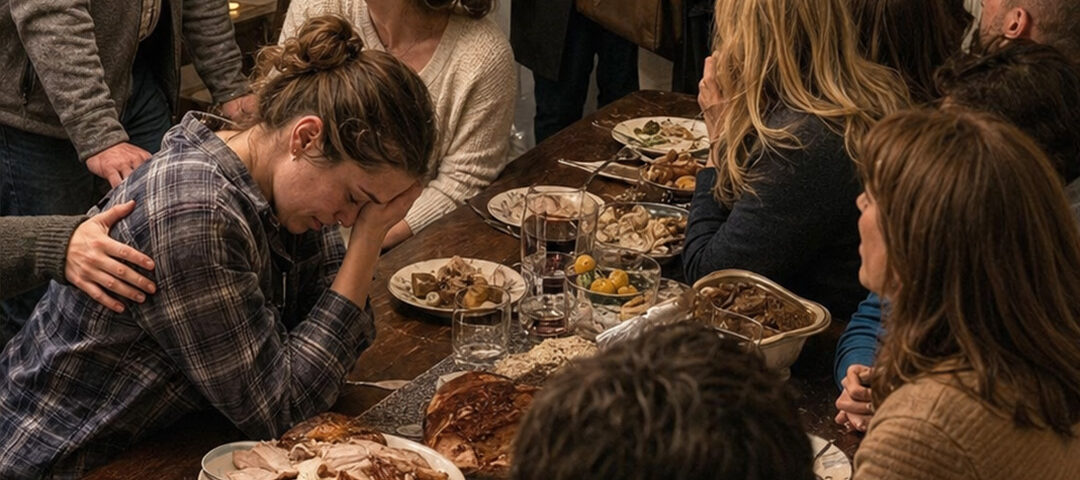
On Christmas Eve, I was passing potatoes at her family’s table when headlights swung up the driveway. My parents had come to drag me home. Apparently, once they realized I was spending Christmas with strangers, they decided this was the last place they’d ever expect to find me.
Then they saw the man carving the turkey. And the color drained from their faces. My father couldn’t get a word out.
They knew him. They’d spent a year and a half praying I never would because that man held the one secret that could burn their whole story down. And tonight, in a stranger’s dining room, it finally caught fire.
My name is Marilyn Brooker. I’m 31. And for 31 years, I was the one who ruined everything.
[snorts] This is the story of the Christmas my own family locked me out. And the stranger at the table who knew exactly why.
Let me take you back.
It started 3 days before Christmas. My mother called at 9 at night, which she never did unless she wanted something or wanted me gone.
“Marilyn,” she said. “About the holiday.”
I already knew. I always knew.
“Brett’s bringing Ashley. We’d like it nice this year. Calm.”
A pause. Long enough to land.
“You understand?”
I understood.
In my family, calm was just the polite word for without you.
In the background, I could hear Brett laughing at something on the television, comfortable in the house I wasn’t welcome in.
My mother lowered her voice the way she does right before she slides the knife in soft.
“Remember two years ago, the gravy and Aunt Carol’s tablecloth?”
A sigh performed for an audience of one.
“We just can’t have a repeat. Not with Ashley here to meet everyone.”
I remembered. I also remembered it wasn’t me who knocked the gravy over.
But that was 30 years of training talking back at the truth, and there was no point. I didn’t argue. I learned a long time ago that arguing was only volunteering for the next accusation.
I said, “Okay.”
I said, “Tell Dad.”
I said, “Merry Christmas.”
Then I hung up and went back to what I’d been doing before the phone rang.
Spreadsheets.
I keep the books for Dunore Hardware over on Maine. Payroll, invoices, the quarterly taxes. Old man Dunore won’t even open the envelope for 12 years.
I have never lost a receipt. I have never been a dollar off.
That’s the part that always sat wrong with me. Half this town hands me their money without blinking.
The diner, the lumberyard, the church building fund counts its Christmas collection and then drops the box on my desk because they trust me with it down to the penny.
Dolores at the food pantry calls me a godsend. The man who owns the diner once tried to pay me extra because he said I was the most honest person he’d ever met.
The people who raised me called me the one who ruins everything.
Both of those things were true at the same time. And for most of my life, I never let myself sit with how strange that was.
Chloe found out about Christmas the way Chloe finds out everything. She asked. I’m a bad liar. She’s my closest friend.
We met 3 years ago, the winter she moved up here, when she found me eating lunch alone behind the register and decided that was personally unacceptable.
When I told her my big plans were leftovers and whatever was on TV, she set her coffee down on my counter.
“No,” she said. “You’re coming to my parents.”
“Chloe—”
“It’s already decided. My mom’s been cooking since Tuesday.”
I said I didn’t want to walk in on a family thing. She looked at me like I’d said something that hurt her.
“You’re not walking in on anything. You’re invited.”
There’s a difference.
I honestly didn’t know the difference. I’d been related to people my whole life. I had never once felt invited.
Christmas Eve, I drove out to the Ashford place with a pie I’d baked at midnight because I didn’t know how to show up to a table empty-handed.
I’d made it twice, actually. Threw the first one out because the lattice tore.
As if a perfect enough pie might earn me a seat at a table I hadn’t been born into.
That’s a thing 30 years in my family does to you. You start trying to buy your way into ordinary kindness.
It was a big old house out at the end of the lake road. Every window gold.
I could hear them before I hit the porch steps. Laughing. A dog losing its mind. Something with cinnamon in it cutting through the cold.
I stood on the steps holding my pie and almost turned around.
I want to be honest about that part.
I almost left. Not because they weren’t kind, because kindness was the one thing I’d never grown a callous for.
Then the door opened, and Chloe pulled me in by the wrist, and the warmth closed over my head like water.
I had no idea that in 2 hours headlights would come up that same driveway, that the same door would open again, and that the two people who told me not to come home were about to walk straight through it.
Chapter 2: A lifetime of blame
To understand why my parents could say a sentence like that to me and why I’d just take it, you have to go back to when I was 14.
It was Christmas. My grandmother’s house. The whole family crammed into the front room.
Nana had a music box she loved. A little painted thing that played a carol when you opened the lid. It had been her mother’s.
Brett was 11. He picked it up off the mantle when no one was watching, wound it too hard, and the spring snapped with a sound like a tooth breaking.
Then, because the dog was barking at the noise, he opened the back door to shoe it, and the dog bolted into the snow and was gone for 2 hours in the dark.
I watched him do both things. I was standing in the doorway with a plate of cookies.
When the adults came running, Brett pointed at me.
“She did it. She always does.”
And here is the thing I still can’t fully explain.
They believed him instantly.
Not one of them paused.
My mother took the broken music box out of my grandmother’s hands like it was evidence. And my father sent me to sit in the car while they searched the road for the dog.
I sat in that cold car for 2 hours.
That was the Christmas the story got written down somewhere permanent.
Marilyn is the one who ruins things.
After that, it stopped needing proof.
That became the rule of the house. Every spill, every broken thing, every fight, it had my name on it before anyone asked.
Brett was the good one, the easy one, the one they bragged about. I was the explanation for whatever went wrong.
I have a family photo from that era. One of those staged studio ones.
My mother is holding Brett. My father has a hand on Brett’s shoulder. I’m standing slightly to the side, half a step out of the frame, like the photographer wasn’t sure I belonged in it.
There was a teacher once, fourth grade, Mrs. Albreight, who pulled my parents in for a conference because I’d gone quiet in class.
She used the word withdrawn.
She asked gently if everything was all right at home.
My mother gave her the company smile and explained that I was simply a difficult, attention-seeking girl and that they were doing their best with me.
My father nodded along.
On the drive home, neither of them said a word to me.
The message landed anyway.
Don’t make outsiders ask questions.
Meanwhile, Brett could do no wrong. He got a participation trophy for a baseball season he barely played, and it went up on the mantle where Nana’s music box used to sit.
They told that trophy’s story at every dinner for a year.
My honor roll certificates went in a drawer, if they went anywhere. I stopped bringing them home.
The “you ruin everything” line had an origin story they all agreed on, even if it wasn’t true.
The year I turned 12, my parents threw Brett a big birthday party and let me invite two friends as an afterthought.
Brett got jealous of the attention my friends paid me, knocked the cake off the table, and then cried that I’d bumped it.
My mother spent the rest of the party apologizing to the other parents for her older daughter who couldn’t let her brother have one special day.
My two friends watched the whole thing happen. They were quieter around me at school after that.
By 13, I had a reputation I’d never earned. Built one staged accident at a time, and the architect was an 11-year-old who had figured out that all he ever had to do was point.
When I was 20, money went missing from the drawer in the kitchen where my parents kept the grocery cash.
$80.
My mother found the envelope empty and looked at exactly one person.
I hadn’t touched it.
It didn’t matter.
I paid it back out of my own paycheck, $80 I didn’t have, just to make the silence stop.
Years later, at a cousin’s wedding, drunk and laughing, Brett admitted he’d taken it.
He thought it was funny. A story.
Everyone at the table laughed.
I didn’t say anything. I just did the math in my head, the way I always do when something hurts.
$80. Years of interest.
The exact cost of being believed about by people who never once believed me.
When I was 22, Brett backed my father’s truck into a parked car in town and crumpled the fender.
He told my dad I’d grab the wheel as a joke while he was driving.
I wasn’t even in the truck.
My father didn’t ask me a single question. He just said, “Your brother would never lie to me.”
Like that settled it. Like that had ever once been true.
That was the day something in me went quiet for good.
I stopped expecting to be defended.
You can only stand in front of a closed door so many times before you stop knocking.
So I got small, and I got careful.
I started keeping a notebook the year I turned 15. A cheap spiral thing from the drugstore.
I wrote down what actually happened. Who said what. Who did what.
Not because I ever planned to show a soul, but because I needed one place in the world where the record couldn’t be rewritten by whoever was angriest that day.
Numbers were the only place no one could edit the truth.
I’d add up grocery receipts in the margins to calm down. I balanced my babysitting money to the scent.
When my chest went tight, I counted stairs, ceiling tiles, the coins in my pocket.
2 plus two stayed 2 plus two.
No matter who was shouting in the kitchen, I could lose every argument in that house.
I could never lose at arithmetic.
By the time I was a teenager, I had already learned the lesson that would run the rest of my life.
If you take up enough space to be seen, you take up enough space to be blamed.
So, I took up less and less until I had almost disappeared entirely.
Chapter 3: Nana’s legacy
I left the day I turned 19.
There was no dramatic fight. I just packed two bags, signed a lease on a single room over the laundromat, and walked out while everyone was watching television.
My mother said, “Close the door. You’re letting the heat out.”
That was the goodbye.
That little room was the first quiet I ever owned.
I’d lie there at night and listen to the dryers thumping downstairs and feel something I didn’t have a word for.
It took me years to figure out the word was safe.
I took the bookkeeping job at Dunors. I was good at it immediately.
There was something healing about a column of numbers that simply asked to be made true and then you balancing.
But the part of those years I’d live a hundred times over had nothing to do with my own apartment.
It was Nana, my grandmother, my father’s mother, the one who’d owned the broken music box.
As I got older, she was the one person from that family who looked at me like I was a whole person and not a problem to be managed.
She called me sweet girl.
No [snorts] one else in my life had ever made my name sound like something good.
When her health started slipping about four years ago, I was the one who showed up.
Not a choice really, just the obvious thing.
I drove her to every appointment. I set up her pill organizer on Sundays. I sat in waiting rooms reading her the crossword clues because her eyes had gone.
I learned the names of all her nurses and which ones she liked.
She had a place on Birch Lake, an old cedar house her husband built, the one good thing she had left from a long life.
We’d sit on that porch in the summer and watch the water go flat at dusk, and she’d tell me the same three stories, and I’d let her every time.
She taught me gin remy on that porch and cheated shamelessly and laughed when I caught her.
She kept butterscotch candies in her sweater pocket and pressed them into my hand like contraband.
When I’d had a bad week, she never asked me to explain it.
She’d just say, “Sit, sweet girl,” and pour two cups of coffee, and that was the whole medicine.
She was the only adult in my life who ever apologized to me once for not seeing sooner how that house treated me.
“I should have done more when you were small,” she said. “I’m going to make it right while I still can.”
I told her she had nothing to make up for.
I didn’t understand then that she meant it as a plan.
“You’re the only one who ever shows up, sweet girl,” she said to me another afternoon out of nowhere, holding my hand on that porch. “Don’t think I don’t see it.”
I told her not to talk like that.
She squeezed my hand and didn’t let go.
And the whole time, the years of appointments and pill organizers and crossword clues, I want you to know where the rest of them were.
Gone.
My father visited his own mother maybe twice a year on holidays for an hour to be seen doing it.
Brett came around only when he needed something, and what he needed was money, and she gave it to him because she was tired and it was easier.
I sat there once while he hit her up for $3,000 for a truck repair I’m fairly sure didn’t exist.
She wrote the check with a hand that shook, and he kissed her cheek and was gone in under 10 minutes.
She looked at the door after he left with an expression I’ll never forget.
Not hurt exactly, just tired.
Like she’d finished a book she already knew the ending to.
They only called Nana when they wanted something.
I was there because I wanted her.
She saw all of it.
I know that now.
She saw exactly who came and who didn’t. And somewhere in that quiet head of hers, she was keeping her own kind of ledger.
The last winter, she got very small.
One afternoon near the end, she gripped my wrist with that papery strength old hands get.
And she looked at me hard, like she was trying to make me hear something through the fog.
“I’ve taken care of you,” she said. “It’s all with Mr. Ashford. You remember that name. Whatever they say to you, you remember it.”
I thought she was confused.
I told her to rest. I kissed her forehead.
She left me a voicemail that same week.
I never listened to it all the way through. Not then. I couldn’t.
The next June, on an ordinary bright morning, my grandmother died.
And that was when my family finally went after—
Chapter 4: The stolen inheritance
—the one thing they’d been circling her whole decline.
They cried at the funeral. I’ll give them that.
My mother wore black and dabbed at her eyes for the people watching.
Brett gave a little speech about how close he and Nana had always been.
And I stood in the back and felt something cold and clear settle over me because I knew exactly how many times he’d visited her in four years.
And the answer was almost never.
He told a story at that funeral about fishing off Nana’s dock with her every summer.
People nodded and wiped their eyes.
I stood there knowing he hadn’t set foot on that dock since he was a teenager.
I’d been the one on that dock with her. I had the sunburns and the lost Jin Rummy hands to prove it.
But he was the one at the podium, and I was the one in the back.
And that was the shape of my whole life inside a single church.
I was the one who’d picked the casket, called the relatives, written the obituary, chosen the hymns she liked.
I did all of it, and they accepted it the way they’d always accepted my work.
Without seeing it.
Two weeks after we buried her, they handled the house.
My mother called me to her kitchen, the same kitchen, the same drawer, and slid a stapled document across the table to me like she’d been looking forward to it.
“We’ve sorted out Nana’s estate,” she said. “I want to be fair, so I’m telling you in person.”
The lake house was going to my father, then to Brett.
Nana’s savings, whatever they were, the same.
“And me?”
“There’s nothing for you, Marilyn.”
She said it gently, which was worse.
“I know that’s hard, but honestly, even Nana knew you couldn’t really be trusted with anything. This is the will. It’s all legal. It’s done.”
I sat there, and I didn’t cry because crying in that kitchen had never once helped me.
But I’m a bookkeeper. I read documents for a living.
And even sitting there gutted, my eyes did what they always do.
They went to the numbers.
The lakehouse. Lakefront. Cedar. An acre of frontage.
They had it valued on that paper at $95,000.
I’d done enough books in this county to know that house was worth close to $400.
Not 95.
Nowhere near 95.
And Nana’s savings account, the one at the bank I used to drive her to. The one I knew had real money in it.
More than 100,000.
Wasn’t on the inventory at all.
It just wasn’t there.
Two numbers.
Both wrong.
Both wrong in the same direction.
I did the arithmetic without meaning to, sitting at that table.
Under report, a $400,000 house as 95. Make a $100,000 account disappear entirely. And you’ve quietly moved something like $400,000 out of view.
Nobody fat-fingers a house by 300 grand.
You only get numbers like that on purpose.
My mother watched me read it and mistook my silence for defeat.
“I know it stings,” she said, almost kind. “But this is what’s fair.”
She’d practiced that word.
Fair.
She said it like it was a gift she was handing me.
I noticed all of it. I filed it away the way I file everything.
And then I told myself to let it go because what was I going to do? Call my grieving mother a liar over evaluation?
I’d spent 30 years learning that pushing only made the door slam harder.
That night, alone, I played Nana’s voicemail, the one I’d never finished.
Her voice came through small and certain.
“Marilyn, it’s your nana. I talked to my lawyer, Mr. Ashford. The lakehouse. Sweetheart, it’s yours. I made sure of it. Don’t you let them tell you any different.”
I sat on my kitchen floor at 2 in the morning and listened to it four times.
I almost called Mr. Ashford that night.
I had my phone in my hand. I got as far as the search bar.
Then the old voice took over.
The one they’d installed in me before I could fight back.
Who do you think you are?
They’re the family.
You’re the problem.
You’ll embarrass yourself.
You always do.
So, I put the phone down.
I am still angry at myself for putting the phone down.
That’s what 30 years of it does. It doesn’t just make other people doubt you.
It makes you doubt the one person who never lied to you.
So, I let it go.
Because letting go was the only skill they ever really taught me.
I didn’t hire a lawyer. I didn’t ask a single question.
I packed a box of Nana’s things, the repaired music box, some photos, and I never opened it.
A year and a half went by like that.
Quiet.
Smaller and smaller.
And then it was December again, and my mother was on the phone telling me not to come home.
The name Mr. Ashford was sitting in a voicemail on my phone, and I had no idea it was about to walk across a living room and shake my hand.
Chapter 5: A shift at the table
Walking into the Asheford house was like stepping into a photograph of a family I’d only ever heard described.
There were 11 of us there that night. I’d count later.
Khloe’s parents, her brother Daniel and his wife Renee, a grandmother in a good chair by the fire, an aunt, an uncle, a couple of cousins my age, and the dog who decided I was his now.
I had forgotten families could sound like that.
The talking over each other. The teasing that didn’t have a blade in it. The way someone refilled my water before I noticed it was empty.
Daniel argued with Renee about a board game with the kind of theatrical outrage that meant they adored each other.
The grandmother by the fire kept calling me the bookkeeper like it was a title of nobility.
Somebody put a paper crown from a cracker on the dog.
It was loud and chaotic and completely without menace.
And I kept waiting for the turn.
The moment someone’s mood would drop and the room would go careful around it.
It never came.
That was the strangest part.
The room never once braced.
Khloe’s mother, Patricia, hugged me at the door like she’d known me for years and said the pie was beautiful and I was sweet to bring it.
And I had to look at the floor for a second.
Then Khloe took my elbow and steered me toward the kitchen.
“Come meet my dad. He’s carving. He’ll talk your ear off.”
A tall man in a sweater with the sleeves pushed up stood at the counter, working a carving knife through a turkey with the patient precision of someone who’d done it 40 times.
Silver hair. Reading glasses pushed up on his forehead.
“Dad, this is Marilyn. My friend I told you about. Marilyn, my dad. Walter.”
He wiped his hand on a towel and shook mine.
Warm grip.
Kind eyes.
“Marilyn,” he said. “And the last name?”
“Brooker.”
His hand paused just slightly in the towel.
“Brooker,” he repeated, slower. “Now that’s a name I haven’t heard in a while.”
I didn’t think anything of it.
People know each other in a small town.
I smiled and said something about how everyone knows the Brookers, for better or worse, and he gave a small laugh that didn’t quite reach his eyes.
He went back to carving, but he was quieter now.
I caught Chloe glancing at him. The way you do when a parent acts a little off.
“You’re not from here originally, are you?” I asked to fill the space.
“No, no. Practiced law downstate for 30ome years. Estates, mostly. Wills, trusts.”
He set down the knife and looked at me directly.
“Retired. Appear to be useless and happy.”
Estates.
Wills.
The word brushed past something in me, but I was 3 years out of practice at hoping, so I let it slide right by.
“Your grandmother,” he said, and his voice had changed. Careful now. Deliberate.
“Would that be Vivien? Vivien Brooker out on Birch Lake?”
I felt the room tilt a half degree.
“Yes. That was my nana. She passed a year and a half ago.”
Chloe, drying a glass beside him, gave her father a look.
“Dad, you okay?”
He waved it off.
“Fine, fine.”
But he wasn’t, and she knew it, and she filed it away the way good daughters do.
Walter Ashford put both hands flat on the counter.
He didn’t say anything for a moment.
He looked at me like a man turning over a card he’d set down a long time ago and forgotten he was still holding.
“I see,” he said quietly. “I didn’t know she’d passed. I’m very sorry.”
What I didn’t know, standing there with a dish towel between us, was what was happening behind that man’s eyes.
He was remembering an afternoon two years before, an elderly woman who’d come into his office, sharp as attack, no fog, no confusion, and told him plainly that her son couldn’t be trusted with a dime, that her grandson was worse, and that the one person who’d shown up for her was a granddaughter named Marilyn.
He was remembering drawing up the documents, watching her sign, watching two witnesses sign, the notary stamp, and the instruction she gave him at the end.
“Keep the original here in your vault where they can’t get to it.”
Some clients you never forget.
He was remembering that the original was still sitting in his old firm’s vault 2 years later because no one had ever told them Vivian Brooker died.
He didn’t say any of that.
Not yet.
He just picked the knife back up, and his jaw had set, and he said, “Why don’t you go sit down, Marilyn? Let me finish here.”
I went and sat down at the long table between Kloe and her grandmother.
And for a little while, I let myself be happy.
Then the doorbell rang.
Chloe frowned.
“Who’s that on Christmas Eve?”
Patricia glanced toward the hall.
“We’re not expecting anyone.”
Walter set down the carving knife.
I remember that he set it down before the door even opened.
Like some part of him already knew the night was about to need both his hands free.
Chloe got up to answer it.
A gust of cold air rolled into the dining room.
And from the front hall, clear as a bell, I heard a voice I’d spent my whole life flinching from.
My mother’s voice, bright and performing.
“We’ve come to take our daughter home.”
So, before I tell you what happened when that door opened all the way, stop for a second and guess for me.
Who do you think the man at the head of that table really is?
And why are my parents about to go white the instant they see his face?
Drop your prediction in the comments.
I promise you, you’re closer than you think.
Here’s what I need you to understand about the 10 minutes before that doorbell rang.
Chapter 6: The unexpected arrival
Because it’s the reason the rest of the night broke me open instead of just making me angry.
When I’d first sat down at that table, Walter had pulled out the chair himself, the good chair near the head.
And when the food came around, Patricia had said, “Marilyn, tell us about yourself. We want to hear it.”
Not a polite throwaway.
She meant it.
The whole table actually turned to listen.
I didn’t know what to do with that.
I’d never been asked.
In my family, “Tell us about yourself” was a trap. An opening to be corrected, to be reminded of something you’d done wrong.
So, I started small, careful, waiting for the catch.
I told them about the books I kept, the hardware store, the quarterly taxes, and nobody used it against me.
Daniel asked what the strangest thing I’d ever found in someone’s books was, and I told him about a man who’d expensed his own divorce lawyer as consulting.
The whole table laughed with me, not at me.
Renee said her sister was a bookkeeper, and it was the only reason their family business hadn’t gone under.
The grandmother by the fire declared that bookkeepers were the last honest people left.
Patricia told me I had kind eyes, which was such a small thing and undid me a little because no one in my own family had ever told me I had anything good.
I kept doing the thing I always do in a new place.
Scanning for the exit. Watching for the shift in the air that means a mood is about to turn and I’ll need to make myself small.
In my family, a good moment was only ever the setup before somebody found a reason to wreck it.
And the reason was always somehow me.
It kept not happening here.
Nobody’s face dropped.
Nobody went cold.
The warmth just stayed warm, steady, like these people simply lived at this temperature all the time.
I didn’t know you could do that.
I didn’t know a table could just be safe start to finish, with no bill at the end.
They passed me the warm dish first before themselves.
Like that was just what you did for a guest.
Somewhere in there, I caught a smell of cinnamon from the kitchen, and it was Nana’s kitchen.
And for one second, I missed her so much I had to put my fork down.
Nana used to bake at Christmas with too much cinnamon every single year.
And every year she’d say, “Tell me if it’s too much.”
And every year I’d say no.
And it was.
And I loved it.
I would have given anything to be on her porch instead of anywhere else on earth.
And the closest I’d come to that feeling in a year and a half was right here, at a table full of people I’d known for 3 hours.
Across from me, Walter wasn’t really eating.
He’d push food around his plate and then go still whenever the talk drifted near my grandmother.
When the grandmother by the fire mentioned the lake, his eyes came up to mine and held there a half second too long.
When I said the word nana, I watched his jaw tighten.
I thought, if I thought anything, that he was just a quiet man at the end of a long holiday.
I had no idea he was a man standing at the edge of a decision, doing the same arithmetic I do, waiting for the last number to drop so he could finally say the thing out loud.
He found his last number when I told the table honestly that I’d probably spend New Year’s alone, too.
And Patricia made a small wounded sound, and someone said, “Not if we have anything to say about it.”
Walter set his fork down for good.
Then he’d decided.
I watched the decision settle into his shoulders, and he drew a breath to speak.
And then the cold air hit the back of my neck, and the warmth drained out of the room.
There they were.
My mother and father, standing in the archway of the dining room in their good coats, with snow still on the shoulders, smiles bolted onto their faces for the benefit of strangers.
“There you are,” my mother said to me in the voice she used for company. “We felt just terrible. We couldn’t let you spend Christmas alone like some orphan. Get your coat, sweetheart. Come home.”
She hadn’t looked at the head of the table yet.
Neither of them had.
They had no idea who was standing there with a carving knife in his hand.
For a second, my mother ran her whole performance.
She put a hand to her chest. She told the table how worried they’d been.
She said, warm as pie, that family was everything to them, that they’d never in a million years let one of their own eat Christmas dinner among strangers.
“No offense to these lovely people.”
Her hand landed on my shoulder and squeezed a little too hard.
A signal I’d known my whole life.
Stand up.
Stop embarrassing us.
Come.
“Half the town already knows you’re out here,” she added, lower, just for me, the smile never moving. “Playing the poor little orphan at the Ashfords. How do you think that looks?”
And there it was.
The tell.
Not “We missed you.”
Not “We were wrong.”
How does it look?
My mother had heard, through whatever wire carries these things on Christmas Eve in a small town, that her daughter was being fed and fussed over by the Ashfords, a respected family, a retired attorney’s house.
While the Brookers sat down a man short, and she could not bear the picture.
The whole drive over had been about repainting it.
Get the daughter home. Sit her in a chair. And the town can go back to believing the Brookers were fine.
She’d brought my father along as a prop, and Brett apparently waiting out in the car.
She’d come to collect me like a coach she’d left behind somewhere embarrassing.
My father stood half a step behind her, the way he always did, ready to nod along to whatever she decided was true.
Then he looked up past me at the man by the counter.
And my father’s smile died first.
It didn’t crack.
It died.
I watched it go.
The practiced holiday smile sliding off his face like something melting, leaving behind a slack, open-mouthed expression I had never once seen on my father in 31 years.
My father is a man with an answer for everything.
A way to make every wrong thing fine.
He had no answer for this.
He had no face for it.
He took a step back, bumped the door frame, and didn’t seem to feel it.
My mother saw his face change and followed his eyes to the head of the table.
And stopped.
Just stopped.
Chapter 7: The truth exposed
The hand on my shoulder went slack and slid off.
Walter Ashford set the knife down on the cutting board, slow and deliberate, wiped his hands one finger at a time, and stepped forward into the light.
“Garrett,” he said pleasantly.
“Rosalind, it’s been a while.”
My father made a sound that was supposed to be a word.
“Walter Ashford,” he said, holding out his hand to a man who did not take it.
“I handled your mother’s estate. Vivian’s. You remember?”
My father stared at the offered hand like it might burn him.
He did not shake it.
He couldn’t.
To take that hand was to admit in front of everyone that he knew exactly who Walter Ashford was and exactly what that meant.
My mother found her voice first because she always does.
“I think,” she said too brightly, “there’s been some confusion.”
“I don’t think there has,” Walter said, and lowered his unshaken hand.
The word estate dropped into that warm room like a stone into still water, and the rings went out to every corner of it.
Down the table, I watched the family register it.
Patricia’s eyes moved from my parents to her husband and back.
Daniel went still with his fork halfway up.
The grandmother by the fire, who’d missed none of it, set her teacup down in its saucer with a small, deliberate click.
Like a woman settling in for a show she’d waited a long time to see.
Chloe came back into the room behind my parents, read the temperature in 2 seconds flat, and quietly crossed to stand beside my chair.
Not saying anything.
Just there on my side before she even knew what sides there were.
I looked at my parents’ faces.
I had spent 31 years being afraid in rooms with these two people.
[snorts] And for the very first time in my entire life, the fear in the room was not mine.
My mother’s hand was around the back of a chair now, holding on.
The wine in the glass on the table closest to her trembled. A tiny ring of motion, though no one had touched it.
Nobody at that table was laughing anymore.
And Walter Ashford turned very calmly and looked at me.
It wasn’t over.
It was just starting.
My mother recovered first.
She always did.
She had a lifetime of practice turning a bad moment into someone else’s fault.
She laughed, a thin, bright, terrible laugh, and waved a hand like she was clearing smoke.
“Oh, well, isn’t this a small world?”
She turned to Patricia, to the table, performing for the jury.
“I’m so sorry. You’ll have to forgive my daughter. Marilyn has a way of collecting people, telling stories. She twists things. She always has. Bless her. Even her own grandmother knew you couldn’t take what she says at face value.”
She turned the full wattage of it on Patricia.
Mother to mother.
Woman to woman.
“Surely you understand. Surely you’ve got a difficult one, too.”
Patricia did not smile back.
She looked at my mother for a long second, then looked at me, and something in her face hardened into a decision.
“Marilyn,” Patricia said quietly, “has been nothing but lovely all evening.”
It wasn’t much, but it was the first time in my life a grown woman had taken my side against my mother in a room.
And I had to breathe through it because that was the lie said out loud in front of 11 witnesses in the home of an estate attorney.
I felt the old reflex rise up in me.
The urge to shrink, to apologize, to make it all stop.
30 years of muscle memory telling me to fold.
I didn’t fold.
Three years ago, three months ago, I would have.
I would have said, “Mom, please,” and gathered my coat and apologized to the Ashfords for the scene and let her walk me out to the car.
And the lie would have stood because I always let it stand.
The folding was automatic.
It had kept me alive in that house.
But I was sitting in a different house now, with a girl standing at my shoulder and a grandmother’s voice in my pocket.
The reflex came up and met something it had never once met before.
It met people who weren’t going to let it happen.
Walter Ashford folded his napkin instead, set it beside his plate, and spoke very quietly, which somehow made the whole room go quieter to hear him.
“That’s strange,” he said. “Because I drafted Vivian Brooker’s will myself. She came to my office two years ago. She left the house on Birch Lake to her granddaughter.”
He looked at me.
“To Marilyn.”
The room did not make a sound.
My father’s denial came out fast and panicked, the way denials do when they’re scrambling.
“No, no, that’s—you’re mistaken. Mother’s will left everything to me. It went through probate. We probated it. It’s settled. It’s done.”
He’d done it without thinking.
He’d told a retired estates lawyer exactly which will he’d put through the court.
Walter didn’t raise his voice.
He just turned a few degrees toward my father and let the temperature do the work.
[snorts] “You probated a will?” he said. “Tell me, Garrett, what was the date on the one you probated?”
My father’s mouth worked.
“I don’t—it was Mother’s old will from years back.”
“From years back.”
Walter nodded slowly.
“Here’s my difficulty. The will Vivien signed in my office is dated after that. Signed in front of two witnesses, notorized, and the first line of it revokes every prior will she ever made.”
He let that sit.
“The original is in my firm’s vault, where she asked me to keep it so that no one in this family could get their hands on it. I can have it on this table by the end of the week.”
“You’re retired,” my mother said suddenly, seizing on it. “You don’t even practice anymore. You can’t just—”
“I’m retired,” Walter agreed. “The will isn’t. A document doesn’t stop being valid because the man who drafted it took up fishing, and my old partners are very much still practicing.”
He smiled.
Not warmly.
“One of them will be in that vault Monday morning.”
My mother’s mouth closed.
Patricia, beside her husband, had gone very quiet and very alert.
The way you do when you realize the dinner you cooked has turned into something else.
I heard my own pulse in my ears.
A later will, signed after, revoking the one they put through the court.
They hadn’t just cut me out.
They’d taken a newer will that gave me the house and buried it and pushed an older, dead one through a court of law instead.
And that’s the moment my brother opened his mouth.
Brett had been—
Chapter 8: Breaking the silence
—standing in the archway behind my parents this whole time.
And panic makes him stupid.
It always has.
He’d been edging backward toward the front door since the word estate.
Now the whole room’s attention swung to the question of what exactly was in that vault.
And Brett, who has never in his life been able to sit inside a silence, cracked first.
“She’s lying,” he blurted. “There’s no—she doesn’t have anything. She never even—”
He caught himself.
But not in time.
“She was never even supposed to know about Ashford.”
The table turned as one and looked at Brett.
My mother’s head snapped toward him.
“Brett, stop talking.”
Too late.
Far too late.
He had just told a room full of people that there was something about a man named Ashford that I was deliberately not supposed to know.
I stood up.
I didn’t slam anything.
I didn’t shout.
I’d watched these people my whole life, and shouting was their language, not mine.
Mine is quieter.
“I keep books for a living,” I said.
My voice came out flat and even.
The voice I used to read a column out loud.
“And the inventory you handed me in your kitchen, the one for Nana’s estate. You valued her lake house at $95,000.”
My mother stared at me.
“It’s worth close to 400. I do half the appraisals bookkeeping in this county. I knew it was wrong the second I read it.”
I watched it land on the faces around the table.
Not my parents’ faces.
The witnesses.
Daniel’s eyebrows.
Patricia’s hand going to her mouth.
These were people who could hear a number and know what it meant.
“And her savings account, the one I drove her to the bank to manage, the one with $100,000 in it, wasn’t on the inventory at all. You left it off entirely.”
The silence had a texture now.
“Two numbers,” I said. “Both wrong. Both wrong in your favor. I noticed 18 months ago. I just didn’t let myself believe what it meant because believing it meant believing my own family stole from me. And I’d been trained my whole life not to believe that.”
I looked at my mother.
“I’m done not believing it.”
I wasn’t finished.
Not even close.
I reached into my pocket and took out my phone.
My hands were steady, which surprised me.
I found the voicemail, the one I’d saved for a year and a half and never let myself finish.
The one I’d talked myself out of believing on a kitchen floor at 2:00 in the morning.
“Nana left me a message,” I said to the room. “3 days before she died. I never played it for anyone. I’m going to play it now.”
My mother stepped forward.
“Marilyn, don’t you dare—”
“Sit down, Rosalind.”
That was Walter.
He didn’t raise his voice for that either.
She sat.
I pressed play and turned the volume all the way up.
My grandmother’s voice came out of that little speaker and filled a silent room.
“Marilyn, it’s your nana. I talked to my lawyer, Mr. Ashford. The lake house. Sweetheart, it’s yours. I made sure of it. Don’t you let them tell you any different.”
11 people heard a dead woman name the man standing 10 ft away and tell her granddaughter the truth her family had spent a year and a half burying.
The grandmother by the fire pressed a handkerchief to her mouth.
Renee had tears on her face for a woman she’d never met.
Khloe’s hand found my shoulder and gripped hard.
And in the quiet after Nana’s voice stopped, you could hear the furnace tick and the dog’s tail thump once against the floor.
And absolutely nothing else.
My mother’s whole world, the one she’d built out of appearances, had just been outvoted by a 30-second recording from beyond the grave, played on a phone in front of witnesses she could not manage or silence or spin.
And then my parents lost the last of their control.
And they did it all by themselves.
“She was confused,” my father shouted, too loud for the room, his voice cracking down the middle. “Mother was confused at the end. She didn’t know what she was saying. That doesn’t count for anything.”
“It counts for a great deal, actually,” Walter said. “I evaluated her capacity the day she signed. I make notes. She was entirely competent. I testify to it without hesitation.”
“Notes,” my father repeated, like the word itself was a threat.
It was.
My mother changed tactics in midair the way she always could.
Anger to injury in a single breath.
“After everything we did for you,” she said to me, eyes wet now, right on Q. “We raised you. We fed you. And this is how you—”
“You raised Brett,” I said. “You tolerated me.”
I surprised myself with how steady it came out.
“There’s a difference. You taught me that one yourself.”
Walter Ashford stood there in his sweater, in his own dining room, perfectly calm, and laid it out like he was reading a weather report.
“Let me tell you where this stands,” he said. “Concealing a will is a felony in this state. Suppressing a later will and probating an earlier one is fraud on the court. The estate can be reopened. Marilyn has standing as the named beneficiary, and I’d be glad to file the petition myself, pro bono, first thing after the holiday.”
He paused.
“I’d think very hard, both of you, about what you say between now and then.”
He said it the way a doctor reads a chart.
No cruelty in it.
No triumph.
Just the facts of the condition.
That was somehow worse for them than shouting would have been.
You can fight someone who’s angry.
You can’t argue with a calm man holding a vault key.
My father had stopped talking entirely.
He’d aged 10 years in 10 minutes, standing in a stranger’s dining room with his coat still on, finally out of answers.
My mother looked around that table for an ally and found 11 faces that had just watched the whole thing.
There was no version of this she could talk her way out of.
For the first time in her life, my mother had run out of story.
She grabbed her coat.
My father was already backing toward the door, gray-faced, mumbling.
Brett wouldn’t look at anyone.
“This isn’t—we’re not finished,” my mother said.
To no one.
To everyone.
“You are, actually,” I said. “You spent 31 years calling me the one who ruins everything.”
I felt something settle in my chest.
Something that had been clenched my whole life finally letting go.
“You weren’t describing me. You were describing yourselves. You just needed somewhere to put it, so you put it on me.”
My mother opened her mouth one more time.
Whatever she saw in my face, or in the 11 faces behind me, made her close it.
There was no audience left for her.
The town she’d come to protect her image in front of was, in that moment, this room.
And this room had seen everything.
Brett was already gone out the door into the dark.
They left.
The two of them walked out into the snow without their daughter, without their sister, and pulled the door shut behind them.
And the cold air they let in was the last thing they gave me that night.
For a moment, nobody moved.
Then Patricia stood up, came around the table, and pulled out my chair again.
“Sit back down, sweetheart,” she said gently. “Your plate’s still warm.”
I sat back down.
11 people who’d been strangers 4 hours ago made room for me like I’d—
Chapter 9: Finding freedom
—always had a place there.
Somebody refilled my water.
The dog put his head on my foot.
And for the first time in my life, I was at a table where I was not the one who ruined everything.
I was just a guest who’d had a hard night among people glad that I’d come.
If you’ve ever been the one your family quietly decided to blame, the one who took the fall so everyone else could stay comfortable, I hope you heard the part where it was never true.
You don’t owe your peace to people who built their whole comfort on your silence.
Tell me below.
Have you ever had to walk away from your own blood just to finally breathe?
The original will came out of that vault the week after Christmas, exactly like Walter said it would.
I sat in his old firm’s conference room and watched a young lawyer set it on the table in front of me.
Vivien Brooker’s last will.
Signed in her shaky, certain hand.
Witnessed and stamped.
The first line revoking everything that came before it.
The lakehouse left to me by name.
The savings account left to me.
A single sentence in the middle I had to read twice.
“To my granddaughter Marilyn, who was the only one who ever came.”
There was a letter with it, sealed, my name on the front in her writing.
I won’t tell you everything it said.
Some of it is just mine.
But the last line was, “Stop letting them make you small, sweet girl. You were never the problem in that house. You were the only one telling the truth.”
The estate got reopened.
The probate order that pushed through the old will got set aside for fraud.
By spring, the lakehouse was legally mine.
And the savings.
And there are consequences still working their way through a courthouse for what my parents and my brother did.
The kind I’m told I’m not supposed to talk about yet.
I don’t speak to them now.
There was no big final scene. No screaming match.
I just stopped.
I blocked the numbers.
When my mother sent a long message about family and forgiveness and how I’d humiliated them in front of strangers, I read it once and didn’t answer.
People who only reach for the word family when they’ve been caught aren’t asking for a relationship.
They’re asking for cover.
My mother spent my whole childhood terrified of how things looked.
That was the engine under all of it.
The company smiles.
The daughter dragged home so the neighbors wouldn’t talk.
In the end, the neighbors talked anyway.
A Christmas Eve like that doesn’t stay inside one house.
People who’d known my parents for 30 years started doing the same math I’d done at that kitchen table.
The picture she’d guarded at my expense for three decades came apart in a single season.
And this time, for once, not one piece of it landed on me.
I’m not angry anymore.
Mostly, I’m something better than angry.
I’m free.
I spend my Christmases at the Ashfords now.
There’s a chair there that’s understood to be mine.
The dog still thinks he owns me.
Chloe says she always knew her dad carving a turkey would change my life.
She’s insufferable about it, and I let her be.
And in the summer, I drive out to the cedar house on Birch Lake.
I sit on Nana’s porch and watch the water go flat at dusk the way we used to.
I finally open that box of her things.
The little music box is in it.
The one that started all of it all those years ago.
Repaired now.
The spring fixed.
Still playing its one stubborn carol.
I keep her voicemail.
I don’t listen to it much anymore.
I don’t need to.
I just like knowing it’s there.
For 31 years, I was the one who ruined everything.
If you came here from Facebook because of this story, return to the Facebook post, tap Like, and comment exactly “Amazing” to support the storyteller. That small action means more than it seems and gives the writer genuine encouragement to keep sharing more stories about family pressure, firm boundaries, and finally protecting what you worked so hard to build.
Disclaimer: This story is a work of fiction created for entertainment purposes. Any resemblance to real persons, events, or places is coincidental.