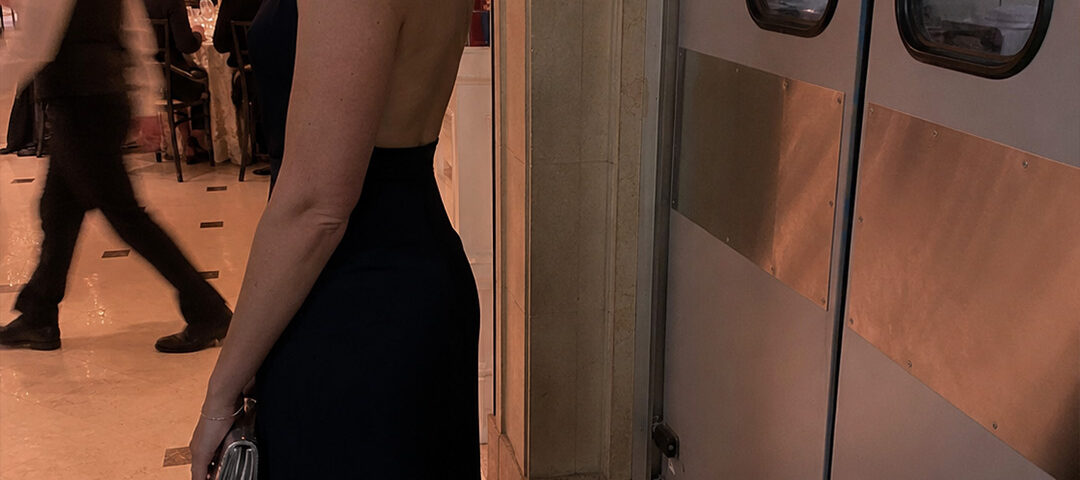
THE CHAIR BY THE KITCHEN DOOR
The seating chart said Table 42, but there was no Table 42.
Audrey Vale stood beneath the crystal chandeliers of the Newport mansion, one hand resting lightly on her silver clutch, and stared at the back corner of the ballroom where the polished hardwood met the service corridor. The entire room glowed with the soft gold of rented luxury. White roses rose from every proper table in tall glass vases. Champagne flutes caught the light. Satin napkins sat folded like swans beside imported china. Every cousin, family friend, former neighbor, business acquaintance, and out-of-town guest had been given a place in that glittering room.
Everyone except her.
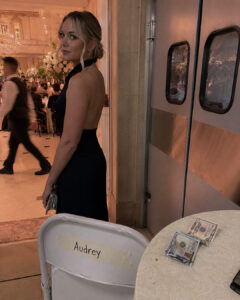
In the narrow shadow beside the swinging kitchen doors sat one cheap white plastic folding chair.
A strip of ripped masking tape had been slapped across the back.
Her name was written on it in thick black marker.
Audrey.
Not Audrey Vale.
Not Ms. Vale.
Not even the same flowing gold calligraphy used on the escort cards near the entrance.
Just Audrey, scribbled like a reminder for a storage bin.
For a long second, she did not move. Around her, the wedding reception continued to breathe and shimmer. A waiter passed carrying silver trays of crab cakes. A violinist tuned softly near the stage. Guests laughed with the easy warmth of people who believed they had been invited into an evening of love, old money, and elegant family celebration.
Audrey looked at the chair again.
Then she looked toward the head table.
Her younger sister, Britney, stood beneath the flowered arch near the sweetheart table, glowing under a cathedral veil that had cost more than some people’s first cars. She laughed with her bridesmaids while their mother, Cynthia, adjusted the lace along the train as if handling museum fabric. Their father, Richard, stood by the bar in a custom tuxedo, already deep in conversation with one of Isaiah Dubois’s uncles, gesturing with the false confidence of a man who wanted everyone to believe the evening had come from his own pocket.
Audrey almost admired the performance.
Almost.
She walked to the plastic chair.
The kitchen doors swung open before she could sit. A young waiter came through backward, balancing a tray of covered plates, and the edge of the door bumped the folding chair hard enough to scrape it several inches across the floor. Audrey’s clutch slipped from her hand. Her phone and keys scattered beneath the little cocktail table beside the chair.
The waiter went pale.
“I’m so sorry, ma’am.”
“It’s not your fault,” Audrey said.
Her voice was calm. That was one of the things people misunderstood about her. Calm was not surrender. Calm was calculation with good posture.
She gathered her things, set her clutch on her lap, and lowered herself onto the chair. It wobbled slightly beneath her. The smell of butter, dish soap, and hot pans drifted through the swinging doors, drowning out the expensive floral arrangements. From where she sat, she could see only half the dance floor. A column blocked the rest.
At Table 8, one of her mother’s tennis friends lifted a glass and looked away too quickly.
At Table 12, distant cousins leaned toward each other and whispered.
At Table 4, Mrs. Dubois, Isaiah’s mother, turned her head with a faint frown.
Audrey kept her spine straight.
She had spent years sitting across from executives who lied with more polish than her entire family combined. She had listened to partners explain missing money with serene smiles. She had reviewed offshore transfers, falsified ledgers, inflated invoices, and hidden liabilities for companies that thought prestige could soften numbers.
A plastic chair could not break her.
But it did clarify the room.
Her mother appeared five minutes later, the sharp click of her silver heels cutting through the music before Audrey saw her face.
Cynthia Vale wore a custom gown the color of moonlight and self-importance. Her makeup was flawless. Her hair did not move. She stopped in front of Audrey and looked not at her daughter’s scattered belongings, not at the red mark on her wrist from the chair jolt, not at the awkward placement beside the kitchen, but at the narrow space between the folding chair and the service doors.
“Audrey,” Cynthia hissed, keeping her smile fixed for anyone watching. “You are practically blocking the catering staff. Move closer to the wall.”
Audrey looked up slowly. “Nice to see you too, Mom.”
“Don’t start. Not today.”
“I’m sitting exactly where the chart sent me.”
Cynthia glanced behind her toward the Dubois tables, then lowered her voice even more. “We placed you somewhere discreet because we know how uncomfortable you get in social situations. Isaiah’s family is very accomplished. We do not need you sitting up front talking about forensic accounting like you’re at a deposition.”
Audrey looked past her mother to Table 4, where Mrs. Dubois continued watching with unnervingly calm attention.
“I present financial findings to boardrooms full of hostile attorneys twice a month,” Audrey said. “I think I can survive a wedding reception.”
Cynthia’s mouth tightened. “Your sister worked very hard to create a beautiful evening. Smile. Try to look grateful. The videographer will pan the room later, and we can’t have you looking bitter in the background.”
Grateful.
The word landed strangely.
Three months earlier, an envelope had arrived at her parents’ suburban home by mistake. Heavy matte black paper. A premium credit invitation meant for Audrey, forwarded to the wrong address because one old financial profile still listed her childhood home. Her mother usually tossed Audrey’s mail into a shoebox in the garage. This time, Britney found it.
A week later, Audrey’s fraud monitoring system sent the first alert.
A premium credit line had been opened in her name.
Two hundred and fifty thousand dollars.
The applicant used her Social Security number, her birth date, her income range, her credit score, and a digital signature meant to resemble hers. The verification number had been routed to a prepaid phone. The shipping address led not to Audrey’s Manhattan condo, but to Britney’s apartment.
Audrey could have frozen the account that day.
Any normal person would have.
But Audrey was not normal when it came to evidence. She did not build cases from suspicion. She built them from patterns, records, timestamps, merchant logs, delivery confirmations, and behavior under pressure.
So she watched.
And Britney spent.
Twenty-five thousand dollars on imported white roses. Fifteen thousand on the gown. Eight thousand for the open bar deposit. Twelve thousand for the quartet and jazz band. Venue retainers. Lighting packages. Custom invitations. Bridesmaid gifts. Her father’s tuxedo. Her mother’s gown. Even the late-night dessert cart had been charged to the unauthorized account under Audrey’s name.
The story Britney gave their parents was simpler.
The wedding cost fifty thousand. Richard and Cynthia handed over money from their retirement savings, beaming with pride that they were helping their golden daughter marry into a respected family. Britney quietly transferred that money into a private account for the honeymoon and shopping after the wedding.
The actual wedding?
Audrey paid for every flower in the room without consenting to one.
And now her mother was telling her to smile from a plastic chair by the kitchen door.
Cynthia leaned closer and adjusted Audrey’s collar with two fingers, as if correcting a prop.
Audrey caught her wrist gently and moved it away.
“Do not touch me.”
Cynthia froze.
The silence between them was small but sharp.
“You are unbelievably ungrateful,” her mother whispered. “Your sister didn’t even want you here. I insisted because it would look strange if her only sister missed the wedding. Do not make me regret that.”
Audrey’s expression did not change.
“I would hate to spoil the illusion.”
Cynthia’s eyes narrowed.
Then she turned and marched back toward Britney, who was tilting her head for the photographer while her bridesmaids arranged the veil.
Audrey stayed seated for another minute.
Then she opened her clutch, pulled out her phone, turned on the flash, and stood.
She photographed the chair.
One clean, high-resolution image.
The white plastic seat. The masking tape. Her name in marker. The kitchen doors behind it. A busboy pushing a cart of dirty dishes through the background.
Evidence did not need to be emotional.
It only needed to be clear.
A moment later, Mrs. Dubois appeared beside her.
Unlike Cynthia, Mrs. Dubois moved with the quiet assurance of a woman who had never needed to shout for attention. Her emerald gown was simple, expensive, and unbranded. Her silver hair was swept into an elegant twist, and her eyes held the sort of intelligence that made evasions dangerous.
“Audrey,” she said warmly. “I was hoping to see you closer to the family tables.”
Cynthia, caught mid-return, rushed back with a brittle laugh.
“Oh, don’t mind Audrey. We begged her to sit up front, but you know how she is. Crowds overwhelm her. She practically insisted on sitting somewhere discreet.”
Audrey looked at her mother.
Cynthia’s smile did not move.
Mrs. Dubois turned to Audrey, and the doubt in her eyes was subtle but unmistakable.
“If the noise back here becomes unpleasant,” Mrs. Dubois said, “there is an empty seat beside my sister at Table 4. You are welcome there.”
Audrey smiled.
For the first time that evening, it was genuine.
“Thank you, Mrs. Dubois. That is very kind. But I assure you, I am exactly where my family wants me to be.”
Mrs. Dubois held her gaze for a moment longer.
Then she touched Audrey’s shoulder gently and returned to the front of the room.
Audrey waited until both women were gone before picking up the folding chair.
Table 26 had three empty seats. It sat near the middle of the ballroom, far enough from the kitchen to avoid the swinging doors and close enough to the dance floor to breathe. Audrey carried the plastic chair by its metal frame, weaving through tables, ignoring the glances from relatives who had spent decades watching her be repositioned for Britney’s comfort.
Before she could place the chair down, a hand gripped her wrist.
Britney stood behind her in a cloud of lace, perfume, and panic.
“What do you think you’re doing?” the bride whispered.
“I’m moving to an empty space where I won’t be bumped by the catering staff.”
“You do not belong at this table.”
Audrey looked down at Britney’s fingers on her wrist.
“Let go.”
Britney released her, but only because a few guests were watching.
Up close, the sweet bridal mask had vanished. Britney’s eyes were bright with rage beneath the veil. The diamonds at her ears sparkled under the ballroom lights. Audrey knew the earrings were real. She also knew they had been purchased two weeks earlier with the unauthorized credit line.
“You are here for optics,” Britney said. “That’s it. Mom said it would look bad if my only sister wasn’t invited, so I let her add your name. You are not going to sit in the middle of my wedding looking like some judgmental office drone and ruin the mood.”
Audrey’s pulse remained steady.
“You mean your perfect mood?”
“Yes,” Britney snapped. “My perfect mood. My perfect night. My perfect life. You wouldn’t understand that because you’ve always made yourself small and then acted superior when nobody noticed you.”
Across the room, Isaiah looked toward them.
He was too far to hear, but close enough to see Britney’s body language.
Audrey met his eyes briefly.
Then she turned back to her sister.
“I’ll go back,” she said softly. “If that’s what you want.”
Britney’s smile returned, quick and triumphant.
“It is.”
Audrey carried the chair back to the kitchen doors and set it in place. She did not sit.
Her father appeared near the bar a few moments later.
Richard’s face was flushed from expensive scotch. He wore the tuxedo Britney had charged to Audrey’s name and the look of a man who believed volume could replace authority.
“Your mother told me you were trying to infiltrate the corporate tables,” he said.
“Infiltrate?”
“This is exactly what I mean. You always turn everything into a clever little remark.” He leaned in, the smell of alcohol and cologne mixing unpleasantly. “Do you have any idea what this wedding cost us?”
Audrey looked at him.
Richard reached into his wallet and pulled out one hundred-dollar bill and one fifty.
He slapped them onto the cocktail table beside the folding chair.
“There. Pay for your plate. That is about what the catering costs per person. Since you came empty-handed and spent the evening sulking, the least you can do is stop being a burden.”
Audrey stared at the bills.
One hundred and fifty dollars.
That was the final number her father had assigned to her worth in the room.
She had spent two months waiting for one sign of decency. A real seat. A warm greeting. A hand on her shoulder. A private thank-you. Even silence would have been better than this. But they had handed her a plastic chair, a lie, a public scolding, and now a bill for food charged to a card opened under her identity.
She smiled.
Richard took half a step back.
Something in her face unsettled him.
“You’re right,” she said quietly. “I should not be a burden.”
She picked up her clutch.
The bills remained on the table.
Then Audrey walked out of the ballroom.
The Rhode Island night was cool enough to feel clean after the heat of the reception. Music and laughter followed her through the heavy side doors, fading as she crossed the manicured gravel path toward the parking lot. Valets stood near the entrance beside rows of rented luxury cars. Audrey kept walking past them to the darker section near the hedges, where her charcoal Porsche waited under a soft pool of light.
Inside the car, silence settled around her like an agreement.
She placed her clutch on the passenger seat, opened her leather briefcase, and took out her encrypted laptop. The screen lit her face in cool blue. She entered two passwords, then opened a private folder.
BRITNEY WEDDING FINANCIAL FILE.
Subfolders appeared in clean order.
Credit application.
Digital authorization logs.
Merchant charges.
Delivery records.
Cardholder dispute evidence.
Private account transfer from parents.
Venue correspondence.
Photographs.
Everything was there.
Not speculation. Not family resentment. Not childhood memory dressed up as revenge.
Evidence.
Audrey opened the premium card portal and called the dedicated client line. The representative answered after two rings.
“Executive card services. This is David.”
“David, my name is Audrey Vale. I need to report unauthorized account activity and execute an immediate freeze on a premium credit line opened under my identity without consent.”
Her voice changed when she spoke professionally. It became flat, precise, and impossible to interrupt.
She provided the account number, secure PIN, and identification markers. David’s keyboard clicked rapidly.
“I see the account,” he said, tone sharpening. “Current balance is two hundred and fifty thousand dollars. There are active authorizations pending from a private event venue in Newport. Are you confirming those charges were not authorized by you?”
“Yes. The application was submitted using my personal information and a forged digital authorization. I have a complete evidence package ready for your compliance team. Freeze the account immediately. Reject pending authorizations. Flag the balance as disputed and under identity-misuse review.”
“One moment.”
Audrey watched the mansion lights through the windshield.
Inside, salads were probably being cleared.
The open bar was probably running at full speed.
Britney was probably laughing near the dance floor, believing her unwanted sister had finally gone back to whatever shadow suited her best.
David returned.
“The credit line is locked. Pending transactions will reject. You will not be held responsible for disputed charges while the investigation proceeds. Our compliance team will contact you for documentation Monday morning.”
“Thank you.”
She ended the call.
Then she called the venue.
“Newport Castle Events Management,” the receptionist answered over the faint rush of a working kitchen.
“I need the general manager on duty immediately. This concerns the payment method underwriting the Dubois wedding in the grand ballroom.”
A few seconds later, a deep voice came on.
“This is Gregory.”
“Gregory, my name is Audrey Vale. I am the legal identity attached to the premium card on file for tonight’s wedding. That card has just been frozen because it was opened without my authorization. If your staff attempts to run the remaining balance, it will decline. You need to request a valid payment method from the responsible party immediately.”
There was a silence so complete she could hear the distant clatter of plates through the line.
“Miss Vale,” Gregory said slowly, “are you telling me the event currently happening in my ballroom is unfunded?”
“I am telling you the payment method is under formal bank review and no further charges will be approved.”
Another silence.
Then his voice changed.
Not panic.
Operational urgency.
“Understood.”
Audrey looked at the glowing windows of the ballroom.
“Good luck, Gregory.”
She ended the call and leaned back in the leather seat.
She did not feel triumph yet.
Only relief.
The decision had been made. The card was frozen. The file was preserved. Whatever happened next belonged to the people who had built the lie.
Inside the ballroom, the illusion did not collapse all at once.
It thinned.
The first sign was the music. The quartet was halfway through a romantic melody when the lead violinist lowered his bow. A venue coordinator leaned onto the stage and whispered into his ear. One by one, the instruments fell silent.
Guests looked up from their plates.
Then the chandeliers dimmed.
The warm gold light faded to a cooler, flatter glow from the wall sconces. The ballroom suddenly looked less enchanted and more expensive in a nervous way. The shadows grew harder. The flowers looked excessive. The silk tablecloths showed small wrinkles no one had noticed before.
At the back of the room, the kitchen doors stopped swinging.
A waiter holding a tray paused, touched his earpiece, and turned around. Other servers followed. Within a minute, the flow of food stopped entirely.
Britney noticed last.
She had been near the sweetheart table, laughing with her bridesmaids, when the room shifted around her. Her smile remained for three seconds too long. Then she saw the empty-handed waiters leaving. Her eyes narrowed.
“What is happening?” she demanded.
No one answered quickly enough.
She lifted her dress and marched toward the stage.
Before she reached the sound technician, Gregory entered through the side door with two members of venue security. He looked pale but composed, and he carried a leather folio in one hand. He walked to the microphone. Feedback cracked once through the speakers.
Every head turned.
“Ladies and gentlemen,” he said, voice amplified across the room, “we apologize for the interruption. Due to an urgent payment verification issue, food and bar service must pause immediately. The credit line underwriting this event has been frozen by the account holder as unauthorized. We are requesting a valid payment method from the responsible parties before services can continue.”
The room went silent.
Not quiet.
Silent.
Three hundred guests sat beneath half-dimmed chandeliers and processed the phrase unauthorized.
Richard moved first.
He surged toward the stage, face dark with indignation. “There must be a mistake. I funded this wedding. Speak to me privately.”
Gregory opened the folio and glanced down.
“Sir, the card on file is not in your name. It is registered to Audrey Vale.”
The name moved through the room faster than sound should have been able to travel.
Audrey.
Guests turned toward the back corner by the kitchen doors.
They saw the plastic chair.
They saw the masking tape.
They saw the two bills sitting on the cocktail table beside it.
They did not see Audrey.
Mrs. Dubois rose slowly from Table 4.
She did not speak.
She did not need to.
Cynthia stumbled back into her chair, one hand gripping the tablecloth. The water glass near her plate tipped, spilling across the white silk like a spreading stain. Richard’s mouth opened, then closed. For once, volume failed him.
Britney grabbed the microphone from the stand.
“This is a misunderstanding,” she said, forcing a laugh so bright and thin it nearly broke. “A bank error. My sister has always been dramatic about money. She probably made some jealous phone call because she couldn’t stand seeing me happy.”
No one laughed.
That made her more desperate.
“Audrey!” she shouted, pointing toward the dark corner. “Stand up and fix this. Tell them you made a mistake.”
The guests followed her finger.
The plastic chair sat empty.
The two bills remained on the table, crisp and damning.
Isaiah Dubois stepped onto the stage.
He did not look angry. That made him more frightening. He was thirty-one, composed, raised in a family where manners and accountability had been taught as the same thing. Until that evening, he had believed Britney was sweet, ambitious, perhaps a little insecure around his family’s established world, but fundamentally honest.
Now he took the folio from Gregory and read.
The top page listed the cardholder.
Audrey Vale.
The line beneath it carried the compliance alert.
Unauthorized application under formal identity review.
Attached were itemized charges: roses, bar deposit, gown, music, lighting, venue fee, Richard’s tuxedo, Cynthia’s custom gown, luxury car rentals, bridal suite upgrade.
All under Audrey’s name.
Isaiah looked from the papers to Britney.
“Why is your sister’s name on the credit line paying for our wedding?”
Britney’s face crumpled, then hardened.
“She did this to embarrass me.”
Isaiah’s voice remained low. “That is not an answer.”
Mrs. Dubois joined him on the stage.
“Britney,” she said, and somehow the sound of her using the bride’s name was colder than any insult. “You told us Audrey was unstable, jealous, and dependent on your parents.”
Britney wiped at her eyes. “She is.”
“Then why is her financial identity funding your wedding?”
Cynthia rushed forward. “Please, Mrs. Dubois, this is a family matter. We can explain.”
Mrs. Dubois turned to her.
“No. A family matter is a seating disagreement. This is a financial deception involving my son, my guests, and a venue that has just stopped service in the middle of a reception. Do not reduce it to family tension.”
Cynthia went pale.
Isaiah stepped down from the stage and stood before Britney. He looked at her gown, at the veil, at the diamonds, at the trembling hands she clasped in front of her.
“Did you use Audrey’s information?”
Britney shook her head too quickly.
“No.”
“Did you apply for that card?”
“No.”
“Did you know the wedding was being charged to an account in Audrey’s name?”
She looked at Cynthia.
Then Richard.
Neither rescued her.
For the first time in her life, there was no parent stepping in to absorb the cost of her lie.
“I was going to pay it back,” Britney whispered.
The room heard enough.
A wave of murmurs rolled through the ballroom.
Isaiah stepped back.
The small movement was more devastating than shouting.
“You let me marry a story,” he said. “Not a person.”
“Isaiah, please.”
“No.” He looked at Gregory. “My family will settle any charges connected to our own travel and rooms separately. We will not participate in this event further.”
Britney reached for his hand.
He did not let her touch him.
Mrs. Dubois placed a hand lightly on his arm. “We are leaving.”
The Dubois family rose as one, not in chaos, but in discipline. Coats were gathered. Bags collected. Drivers called. Guests from Atlanta moved toward the exits with the quiet urgency of people trained to preserve dignity by not lingering near scandal.
Britney turned and fled through the side doors.
Richard and Cynthia followed.
In the parking lot, Audrey watched them from the quiet of her car.
Britney appeared first, dragging the hem of her gown over the gravel. The lace caught on stones. Her veil slipped loose and trailed behind her. Richard came after her, breathing hard, his tuxedo jacket open. Cynthia followed with both hands lifting her silver gown, makeup already streaked beneath one eye.
Britney found the Porsche and slammed both palms against the tinted driver’s window.
“Audrey! Open the door.”
Audrey waited.
Richard arrived beside her. “Open this car right now.”
Cynthia leaned close to the glass. “You need to call the bank. Tell them this is a misunderstanding.”
Audrey lowered the window four inches.
Cold night air rushed in, along with panic.
“There is no misunderstanding.”
Britney’s face twisted. “You ruined my wedding.”
“No,” Audrey said. “The payment method did.”
“You could fix it.”
“I could have stopped it two months ago.”
All three of them froze.
Cynthia stared at her. “What?”
“I knew,” Audrey said. “I knew when the application was approved. I knew when the card shipped to Britney’s apartment. I knew when the roses were charged, and the dress, and the open bar, and Dad’s tuxedo.”
Richard’s face emptied.
Britney stepped back as if the car had moved without warning.
“You watched?” she whispered.
“I documented.”
Cynthia’s voice sharpened. “You planned this.”
“I waited.”
“For what?”
Audrey looked at them through the narrow opening.
“For one decent reason not to do it tonight.”
No one spoke.
“You could have given me a real seat,” Audrey said. “You could have greeted me like family. You could have thanked me privately even if you were too embarrassed to tell the truth. You could have left me alone. But you put me next to the kitchen doors, lied about me to Mrs. Dubois, grabbed my wrist when I tried to move, and charged me one hundred and fifty dollars for a plate I never touched.”
She reached into her clutch and removed the two bills.
The same bills Richard had thrown onto the cocktail table.
She slid them through the window. They fluttered down and landed near his polished shoes.
“Here is my contribution, Richard.”
Her father stared at the money.
Family does not charge for dinner.
She did not say it loudly.
She did not need to.
The words reached him anyway.
Britney shook her head, tears mixing with rage. “You had everything. You always had everything. The grades, the job, the city, the money. I was just trying to have one perfect day.”
“You used my name to buy it.”
“You weren’t using that credit line.”
Audrey almost laughed, but the sound never came.
“Do you hear yourself?”
Britney’s voice rose. “I deserved this. I deserved to look like I belonged. Isaiah’s family has everything. You don’t understand what it feels like to be compared to people like that.”
“I understand being compared,” Audrey said. “I was compared to you my whole life and told to lose on purpose.”
Britney opened her mouth, but another voice spoke from the darkness behind her.
“You believe belonging can be purchased with someone else’s identity?”
Isaiah stood ten feet away with Mrs. Dubois beside him.
Britney turned slowly.
Her face collapsed.
“I was panicking,” she said. “I just wanted to make a good impression.”
Isaiah looked at her with exhausted clarity.
“You did.”
The sentence destroyed her more completely than anger could have.
Mrs. Dubois stepped closer to Audrey’s window and inclined her head.
“I am sorry,” she said.
Audrey nodded once.
“You offered me a seat.”
“I should have insisted.”
“You believed what you saw before most people did. That is enough.”
Isaiah looked at Audrey through the narrow gap.
“I’m sorry too.”
“For what?”
“For not asking questions sooner.”
Audrey’s gaze softened slightly. “You were the target too.”
He absorbed that.
Then he turned back to Britney.
“I will have counsel handle the marriage status. Do not contact me directly.”
Britney gasped. “We just took vows.”
“You took them under a false story.”
He removed his tuxedo jacket, the one charged to Audrey’s card, folded it once, and handed it to his mother.
Then he walked away.
The Dubois vehicles left the mansion grounds in a clean line of black SUVs. Their taillights disappeared through the gates, taking with them the status Britney had tried to borrow and the future Cynthia had already begun bragging about.
Audrey rolled the window back up.
The thick glass sealed out the crying, pleading, and accusations.
She started the engine.
In the mirror, she saw Gregory speaking with venue security near the entrance. He had the folio in his hand. Her parents were arguing now, not with her, but with each other. Britney stood in her ruined dress under the parking lot light, looking less like a bride than someone waking from an expensive dream into a bill she could not pay.
Audrey drove away.
Not fast.
Not dramatically.
She simply left.
Three months later, winter pressed cold against the glass walls of Audrey’s Manhattan office.
From the thirty-sixth floor, the city looked sharp and bright beneath the morning sun. Taxis moved like yellow sparks below. Steam rose from manholes. The Hudson caught strips of pale light between towers.
Audrey sat behind her mahogany desk with a cup of coffee, reading a compliance report on a merger involving a medical supply distributor. Her phone sat face down, blessedly silent.
The aftermath of the wedding had unfolded with the precision of a ledger correcting itself.
The bank completed its review and cleared Audrey of responsibility. The venue filed civil claims for unpaid balances. Britney entered a formal restitution agreement and accepted legal consequences that would follow her for years, though the harshest outcome was avoided through repayment and cooperation. Richard and Cynthia liquidated retirement funds, sold their suburban home under pressure, and moved into a smaller apartment far from the club circles they once worshiped.
The tennis club removed Cynthia from its membership roster for “conduct concerns.”
Richard’s golf friends stopped inviting him.
Britney’s social media career evaporated. No brand wanted association with a wedding that had become a whispered cautionary tale about image, debt, and borrowed status. She took a retail job and began repaying what she could under supervision. Whether she felt remorse or only resentment, Audrey did not know.
She did not ask.
Her parents tried calling for weeks.
Then came messages.
Then emails.
Then relatives “just checking in” with the heavy tone of people sent to negotiate.
Audrey’s attorney issued a formal no-contact notice.
The silence afterward was not lonely.
It was luxurious.
Without the constant drain of family emergencies, Audrey’s work sharpened further. She led a major acquisition review, found hidden vendor liabilities worth millions, and saved a client from overpaying for a company with beautiful margins and ugly books. Her firm promoted her to junior partner faster than expected.
Her assistant, Sarah, said people on the floor were starting to call her “the blue dress.”
Audrey pretended to hate it.
Secretly, she did not mind.
At 10:00, her office intercom chimed.
“Audrey,” Sarah said, “your appointment is here. Dubois Medical Holdings.”
Audrey looked up.
She had known the client name, of course. She had read the intake notes. But part of her had assumed someone from their acquisitions team would arrive. A gray-suited director. A general counsel. A pair of analysts.
“Send them in.”
The frosted glass door opened.
Mrs. Dubois entered first, wearing a navy blazer and pearls, carrying a leather briefcase. Isaiah followed in a charcoal suit. He looked composed, professional, and older than he had three months earlier.
Audrey stood.
“Mrs. Dubois. Isaiah.”
“Good morning, Audrey,” Mrs. Dubois said. “Thank you for seeing us.”
“Please sit.”
They took the chairs across from her desk.
Mrs. Dubois placed the briefcase on the edge of the desk and folded her hands on top of it.
“We are not here to discuss your family,” she said. “That chapter is closed. We are here because my company is evaluating a ninety-million-dollar acquisition, and I do not trust the seller’s numbers.”
Audrey leaned back slightly.
Now this was language she liked.
Isaiah opened the file and slid a preliminary ledger across the desk.
“Their margins are too clean,” he said. “Inventory adjustments are strange. Vendor credits appear right before reporting periods. Our internal people see red flags, but we need someone outside the family with no emotional investment and no tolerance for performance.”
Mrs. Dubois’s eyes sharpened.
“After Newport, I made several calls. Your professional reputation is extraordinary. Precise. Relentless. Difficult to impress. Exactly the kind of person we need.”
Audrey looked down at the ledger.
Numbers arranged themselves in front of her like a language she had never once doubted.
For so long, her family had insisted she was cold because she preferred evidence to emotional performance. They called her awkward because she did not flatter. Bitter because she remembered. Difficult because she asked where the money went.
Here, those same traits were qualifications.
“What level of access will I have?” Audrey asked.
“Full,” Mrs. Dubois said.
“Digital systems, vendor files, bank records, contracts, acquisition correspondence?”
Isaiah nodded. “Everything.”
“My hourly rate is high.”
“We assumed so.”
“If I find inflated valuation, hidden debt, or vendor-side misrepresentation, I will document it clearly. I do not soften findings to protect egos.”
Mrs. Dubois smiled.
It was not warm in the usual way.
It was better.
Respect.
“We would expect nothing less.”
Audrey extended her hand across the desk.
Mrs. Dubois shook it firmly.
Isaiah shook next.
No false sweetness.
No family obligations.
No plastic chair by a kitchen door.
Only competence meeting competence across a desk.
After they left, Audrey stood by the window and looked out over Manhattan. The city below was loud, ambitious, and indifferent, but from up there it looked almost orderly.
She thought of the ballroom in Newport.
The empty chair.
The two bills on the cocktail table.
The moment the music stopped.
For years, Audrey had believed that being excluded meant she had failed to earn a place.
Now she understood something else.
Some rooms place you in the shadows because they are afraid of what the light will reveal.
Her family had given her a plastic chair by the kitchen.
She had turned it into Exhibit A.
They had charged her for a plate.
She had paid exactly what they were worth to her and left the money behind.
They had built a wedding on her name without her consent.
She had taken her name back.
Audrey returned to her desk and opened the Dubois acquisition file. The first spreadsheet appeared on the screen, rows of numbers waiting patiently for someone skilled enough to hear what they were hiding.
She smiled.
Then she began.