THE ROOM THEY CALLED EMPTY
“Open the door, Caleb.”
My mother stood between me and the house I had owned for exactly eight weeks.
Two scuffed red suitcases waited beneath the porch lantern. Heather stood behind them in an ivory wool coat and burgundy leather boots that looked too expensive for a woman who supposedly had nowhere to sleep. Her mascara had been carefully smudged beneath her eyes, giving her the appearance of someone who had been crying longer than she actually had.
The late-November sky had already faded to a bruised purple. Bare oak branches moved above the quiet cul-de-sac, and cold air slipped beneath the collar of my overcoat.
I had just completed a twelve-hour shift reviewing the financial records of a commercial client whose executives believed confusion was the same thing as innocence. My shoulders ached. My eyes burned from staring at spreadsheets. All I wanted was a hot shower, takeout, and one silent evening in the four-bedroom colonial I had spent ten years preparing to buy.
Instead, my mother had brought my sister’s luggage.
“Move away from the door,” I said.
Patricia folded her arms over her camel-colored coat.
“You haven’t even heard what happened.”
“I can see what happened. Heather packed.”
“She was removed from her apartment this afternoon.”
Heather lowered her gaze toward the stone walkway.
My mother continued. “She cannot go back there. She is exhausted, humiliated, and barely holding herself together.”
“I’m sorry she’s struggling.”
“Then open the door.”
She said it as though sympathy and obedience were the same thing.
I looked at Heather.
She was thirty-six years old, four years older than me. Her long dark hair rested in polished waves over one shoulder. Even under the porch light, I recognized the coat from a department store advertisement. Her boots alone probably cost more than the monthly rent on my first studio apartment.
“How long were you planning to stay?” I asked.
Heather’s mouth trembled.
“I don’t know. Until I can breathe again.”
“That isn’t a length of time.”
“Why are you interrogating her?” Mom snapped. “She’s your sister.”
“And this is my home.”
My mother looked past me toward the tall front windows and warm light glowing through the entryway.
“This house has three empty bedrooms.”
“They’re not available.”
“You live here alone.”
“That was intentional.”
Patricia’s expression hardened. “You have always been the strong one. Heather has never had your stability. Why do you need every room?”
The sentence was almost gentle.
That made it worse.
For most of my life, Mom had used my strength as an excuse to give me less. I could handle disappointment. Heather could not. I could work for what I needed. Heather required help. I could absorb one more sacrifice because I had already survived all the others.
Now the pattern had reached my front door.
Heather moved one hand toward the nearest suitcase.
“I knew he would do this,” she whispered.
Mom glanced back at her. “Do what?”
“Make me beg.”
“I’m not asking you to beg,” I said. “I’m telling you that you cannot move into my house.”
Heather looked up.
Her hurt expression disappeared so quickly that I almost missed what replaced it.
Anger.
“You have four bedrooms.”
“I know how many bedrooms I bought.”
“You spent seven hundred and fifty thousand dollars on a house for one person.”
“I put twenty-five percent down and qualified for the mortgage without a co-signer. None of that created an obligation to house you.”
Mom stepped closer.
“Listen to yourself. You sound like one of those men you investigate at work, hiding behind technicalities while your own family suffers.”
“Ownership is not a technicality.”
“This house belongs to the family.”
“No. It belongs to me.”
The words settled between us.
The front door remained locked behind my mother. My key rested in my right hand, but she had placed herself directly in front of the deadbolt, certain I would not risk causing a scene in the neighborhood.
That certainty irritated me more than the suitcases.
They had not come to ask.
They had come believing the decision had already been made.
Heather tugged nervously at one of the suitcase handles. A folded paper slipped from beneath the leather grip and fluttered onto the stone step.
All three of us looked down.
I bent and picked it up.
It was a mail-forwarding form.
My address had been written across the center in Heather’s rounded handwriting. The start date was the following Monday.
I read it twice.
Then I looked at her.
“You already changed your mailing address?”
Heather’s face lost color.
“It’s just a form.”
“You filled it out before coming here.”
“I needed somewhere for my mail to go.”
“You planned to live here permanently.”
“No one said permanently.”
“People do not forward their mail for a weekend.”
Mom reached for the paper.
I moved it out of her reach.
“Caleb, stop treating your sister like a suspect.”
“You arrived with luggage and paperwork naming my property as her new residence.”
“Because we knew you would help once you understood.”
“You knew I might say no, so you tried to make the move a fact before I could answer.”
Heather’s eyes filled again.
“Why do you hate me?”
“I don’t hate you.”
“You have always thought you were better than me.”
“No. I learned that if I wanted anything, I had to earn it myself.”
“That’s the same thing.”
“It isn’t.”
Patricia placed one protective hand on Heather’s shoulder.
“Your sister has been through two painful divorces. Her business failed. Her landlord treated her terribly. She needs time to recover.”
“I can help you find a hotel tonight. Tomorrow, I can send you the number for the county housing office and a credit counselor.”
Heather gave a short, bitter laugh.
“A hotel. That’s what I’m worth to you.”
“It’s more than you arranged for yourself.”
Mom inhaled sharply.
“That was cruel.”
“It was accurate.”
“She needs family, not phone numbers.”
“What you mean is she needs my house.”
“She needs one room.”
“For how long?”
“Until she gets back on her feet.”
Heather had been getting back on her feet for nearly twenty years. The phrase had followed her from our mother’s apartment to two marriages, three attempted businesses, and every financial emergency that arrived after she ignored the previous one.
I looked at the red suitcases again.
One was old and scratched. The other still carried a department store tag looped beneath its handle.
My mother’s voice softened.
“Caleb, please. I worked two jobs to raise you. I did everything I could after your father left. I am asking you for one thing.”
The old guilt arrived exactly where she intended.
I saw her younger, carrying coffee pots through a diner at midnight, her ankles swollen inside white shoes. I remembered the smell of grease on her uniform and the quarters she counted at the kitchen table. She had been abandoned with two children and no savings. Nothing about those years had been easy.
But hardship did not make every later demand reasonable.
“You are asking me to surrender the only place I have ever owned.”
“No one is asking you to surrender anything.”
“You called the rooms family property.”
“You know what I meant.”
“I do.”
My mother had spent my childhood deciding Heather’s needs were communal and mine were private.
Heather needed a dress for a school dance, so Mom skipped groceries and borrowed from a coworker. When my sneakers split across the soles, I was told to line them with cardboard until payday.
Heather quit school three weeks before graduation because she wanted to move in with a man who promised her a better life. Mom called it courage. When Heather returned five years later with debt and a failed marriage, Mom gave her the larger bedroom and asked me to sleep on the couch during college breaks.
Whenever Heather fell, the family formed a cushion beneath her.
Whenever I climbed, Mom asked why I had not brought my sister with me.
“I’m not opening the door,” I said.
Patricia stared at me.
“Then where are we supposed to go?”
“You said Heather lost her apartment. You didn’t.”
“I’m not leaving her alone.”
“That is your choice.”
“You would separate your own mother and sister?”
“No. I am refusing to let you make your choice inside my house.”
A car moved slowly around the curve of the cul-de-sac, its headlights sliding across the front lawn. Mom lowered her voice, aware of the neighbors.
“You are embarrassing us.”
“You brought luggage to my porch without permission.”
Heather wiped beneath one eye.
“I can’t go back to that apartment.”
“You said you were removed from it.”
She looked away.
I took out my phone and called the security desk at the entrance to the neighborhood.
Mom’s eyes widened.
“Who are you calling?”
“The gatehouse.”
“Caleb.”
When the officer answered, I gave my name and address.
“I have two visitors who need assistance leaving the property,” I said. “They also brought luggage they may not be able to transport immediately. Can someone come by?”
My mother’s posture stiffened.
“You would call security on us?”
“I am asking for help keeping this calm.”
“We are your family.”
“You are also blocking my front door.”
The security officer said a patrol car would arrive within five minutes.
I ended the call.
Heather grabbed one suitcase.
Mom seized the other.
“You have become a cold man,” she said.
“No. I became a man who understands that saying no does not require hatred.”
“This is not over.”
“I know.”
They dragged the suitcases down the stone path. At the driveway, Heather stopped and looked back.
“You’ll regret having all this space when no one wants to visit you.”
I held up the mail-forwarding form.
“You weren’t planning to visit.”
She turned away.
A small sedan waited near the curb, so overloaded with clothes and shopping bags that the rear window was barely visible. Mom wrestled the suitcases toward it, but there was no room in the trunk.
The security vehicle arrived as they were arguing over where to put the bags.
I asked the officer to hold the luggage at the gatehouse until they could retrieve it. Mom looked at me as though I had publicly shamed her.
I watched them drive away.
Then I climbed the porch steps, unlocked my door, and stepped inside.
The silence of the house wrapped around me.
I had chosen the property because of that silence.
The colonial sat at the end of a private lane outside Columbus, far enough from the city to feel removed but close enough for my commute. The front hallway opened into a living room with built-in bookshelves and tall windows overlooking the backyard. The kitchen had pale oak cabinets and a wide island I had not yet learned how to use properly. Upstairs were four bedrooms: mine, a home office, a guest room, and one completely empty room at the end of the hall.
Mom had seen emptiness.
I had seen possibility.
I set my briefcase on the kitchen island and placed Heather’s forwarding form beside it.
My phone lit up.
Martha Ellison.
Martha had known my mother for fifteen years through New Covenant Community Church. She was kind, practical, and dangerously connected to every piece of information that traveled through the congregation.
I opened the message.
Caleb, I am sorry to interfere, but your mother and Heather are at my house. Patricia says you left them outside with nowhere to go. She also said Heather was removed from her apartment this afternoon. Pastor Miller wants to help. Please call me.
I placed the phone facedown.
The microwave clock showed 7:03.
Three hours earlier, I had been in a downtown conference room explaining to a vice president why a missing invoice did not become legitimate simply because he was offended by the question.
Now my mother was using a church congregation to turn my refusal into a moral failure.
I loosened my tie and walked upstairs.
The empty bedroom stood open.
Late-evening shadows filled the room. There was no furniture, only clean beige carpet and a single unopened box of books near the wall. I had planned to build shelves after the holidays. A reading chair would sit beside the window. Maybe a small record player in the corner.
I had not told anyone.
It was difficult to explain why a library mattered to a man whose job already required him to spend most of his life reading.
The truth was that books had raised me almost as much as my mother had.
When our apartment became too loud, I went to the public library. When money ran out, books gave me places where poverty did not decide the ending. When Heather’s emergencies swallowed every conversation, I sat beneath fluorescent lights and studied accounting manuals because numbers obeyed rules people often ignored.
The room was not empty.
It was waiting.
I returned downstairs and opened a cabinet above the refrigerator. Behind a stack of owner’s manuals was a small cardboard box lined with a dish towel.
Inside lay the broken base of a crystal award.
My name remained visible beneath a jagged edge.
CALEB TURNER
TEN YEARS OF EXCELLENCE
The award had arrived at my mother’s apartment by mistake two months earlier, while my mail was still being forwarded. My firm had presented it after promoting me to senior forensic auditor.
For one foolish evening, I believed the promotion and the house might finally make Mom proud.
I invited her and Heather to dinner at a restaurant overlooking the river. After dessert, I placed the real estate brochure on the table.
“My offer was accepted,” I said. “I’m buying the colonial.”
Heather examined the photograph of the brick exterior.
“You need four bedrooms?”
Mom did not congratulate me.
She looked at the listing price, then at Heather.
“Are you out of your mind?”
My smile faded.
“I’ve saved for ten years.”
“Your sister can barely afford her apartment, and you are buying a mansion.”
“It isn’t a mansion.”
“Families do not display their success while someone they love is struggling.”
“I invited you because I thought you would be happy.”
“Happy that you have enough money to buy a showpiece but not enough compassion to help Heather restart her business?”
Heather stared at the table, allowing tears to gather without falling.
I paid the bill.
A week later, I went to Mom’s apartment to collect forwarded mail and found the award shattered in the kitchen trash.
The engraved base had been separated from the crystal column. One corner was chipped. The upper portion had broken into pieces small enough to glitter beneath coffee grounds and paper towels.
Mom walked into the kitchen while I was holding it.
“Heather bumped it off the counter,” she said.
“Was she carrying it?”
“She was cleaning.”
“Heather doesn’t clean your kitchen.”
“She was trying to help.”
The lie was so smooth that I knew it had been prepared.
I looked toward the living room. Heather sat on the sofa watching television, a shopping bag beside her.
She never came into the kitchen.
She never apologized.
Mom never asked if the award mattered to me.
She only said, “Don’t make her feel worse. She’s been very fragile lately.”
I carried the broken base home.
That night, something inside me stopped waiting for my mother’s approval.
Now, standing in my new kitchen with the damaged award in my hand, I understood that the porch confrontation had not begun on the porch. It had begun years earlier, every time Mom taught Heather that my achievements existed to solve her problems.
My phone rang.
Pastor Miller.
I answered.
“Caleb, I hope I’m not calling too late.”
“It depends on why you’re calling.”
He sighed.
“Your mother and sister are with Martha. Patricia is deeply upset.”
“I imagine she is.”
“She says Heather lost her housing through circumstances beyond her control.”
“What circumstances?”
“A difficult divorce, a failed business, rising rent.”
“Heather’s second divorce was three years ago.”
“I am not taking sides.”
“You called me to ask for my house.”
“I called because your mother wants the family to sit down before this becomes more painful.”
“It is already painful.”
“Then let us speak openly.”
I looked at the forwarding form on the island.
“When?”
“Sunday after service.”
“Who will be there?”
“Your mother, Heather, Martha, and perhaps two elders who know your family.”
“That sounds less like a conversation and more like an intervention.”
“It is intended as mediation.”
“Then I have a condition.”
He paused.
“What condition?”
“Mom says their financial emergency left them no options. I am a financial auditor. If she wants me to evaluate that claim, she must provide complete records for every account carrying her name and sign a limited authorization allowing me to communicate with creditors about those accounts.”
“That seems formal.”
“They made my private home a topic for the church. Formal is appropriate.”
“I don’t think Patricia expects an audit.”
“She expects a bedroom. She can provide the reason.”
Pastor Miller was silent.
Finally, he said, “I will speak with her.”
The next morning, I woke to three messages.
The first came from Patricia.
If you need paperwork before you can show compassion, fine. I have nothing to hide.
The second came from Pastor Miller, confirming she had signed the authorization at the church office.
The third came from Martha.
I left the folder with the receptionist at your firm. Patricia insisted it proves they had no choice.
At nine-thirty, a legal-size envelope arrived at my office.
My mother had written my name across the front.
Inside were six months of bank statements, two credit-card statements, rent notices, medical bills, Heather’s divorce-support deposits, and a one-page authorization signed by Patricia Turner.
I read the authorization twice.
It allowed me to review accounts carrying Mom’s name and speak to creditors for the limited purpose of assessing housing and debt options.
Everything was proper.
Everything was voluntary.
My mother had given me the records because she was certain they proved her story.
By noon, they proved something else.
Patricia received a modest pension from twenty-two years working in the county school district after leaving the diner. She also earned part-time wages helping in the church daycare.
Heather received three thousand dollars a month in spousal support.
Their rent was sixteen hundred and fifty dollars.
The arithmetic should have worked.
It did not.
Four rent payments were missing.
During those same four months, the joint checking account showed repeated transfers to Heather’s personal debit card. Two of Mom’s credit cards carried balances totaling more than thirty-eight thousand dollars. Heather was listed as an authorized user on both.
One statement showed purchases at department stores, beauty retailers, restaurants, and a weekend resort.
The other showed cash advances.
Not one or two.
Twelve.
The statements had been switched to paperless delivery fourteen months earlier. The email address attached to the account belonged to Heather.
I leaned back in my office chair.
Mom had signed the applications, but Heather had controlled the statements.
That did not make Patricia innocent. She had agreed to give Heather access. She had probably ignored warning signs because seeing them would require her to stop being Heather’s rescuer.
Still, the scale of the debt was larger than she seemed to understand.
I opened the county court website.
The eviction case was public.
The landlord had not raised the rent. The complaint stated that no payment had been received for four months despite repeated notices. A separate small-claims filing included an itemized demand for carpet cleaning, a damaged bathroom fixture, and water repairs to the unit below.
Photographs were attached to the filing.
The apartment was not destroyed, but it had been treated carelessly. Stains covered part of the living-room carpet. A bathroom vanity had water damage. The management company sought nearly eight thousand dollars beyond the unpaid rent.
At the bottom of the complaint was a copy of the final written notice.
Patricia had signed for it six weeks earlier.
They had known.
They had time to plan.
They had not planned to pay the rent or find another apartment.
They had planned to move into my house.
I looked again at Heather’s forwarding form.
The date beside her signature was three days before the eviction.
The red suitcases had not represented sudden desperation.
They represented a strategy.
I printed only what I needed: the income summary, the unpaid rent record, the credit-card totals, the eviction filing, and the forwarding form. I blacked out account numbers, addresses, and personal identifiers.
I did not print Heather’s restaurant receipts or every purchase she had made. I was not preparing to humiliate her.
I was preparing to defend myself.
Before leaving work, I called the card companies under the authority Patricia had signed.
Both confirmed what the statements suggested. Heather was an authorized user. Patricia remained responsible for the balances. The accounts were current only because minimum payments had been automatically withdrawn from her pension deposit.
At the present rate, the balances would take years to repay.
I called Mom.
She answered on the second ring.
“Did you find what you needed?”
“Yes.”
“Then you understand why we had nowhere else to go.”
“I understand more than I did.”
“Good.”
“Did you know the two cards carry thirty-eight thousand dollars in balances?”
Silence.
“What?”
“Did you know?”
“That cannot be right.”
“Both statements were in the folder you sent.”
“I don’t receive paper statements.”
“They go to Heather’s email.”
“She handles the online accounts.”
“I know.”
Mom lowered her voice.
“Caleb, don’t start blaming your sister.”
“I asked whether you knew.”
“She used the cards for household expenses.”
“Some of the charges are household expenses.”
“And the rest?”
“We can discuss them Sunday.”
“Tell me now.”
“I’m not going to do this over the phone.”
“Caleb.”
“Sunday.”
I ended the call.
For the rest of the day, I tried to focus on work.
Numbers usually calmed me. That afternoon, they felt personal.
Every line on the statements was a decision my mother had refused to see. Every minimum payment represented another month in which she protected Heather from consequences while quietly spending the security she had earned.
Near five, I opened the cardboard box in my desk drawer and removed the broken crystal base.
I ran one thumb across my engraved name.
When I was a child, I believed success would eventually make Mom look at me the way she looked at Heather.
At sixteen, when I started bagging groceries after school, I imagined Mom telling neighbors she was proud.
At twenty-two, when I graduated from state college with an accounting degree, I waited for her to frame my photograph. She kept it in a drawer because Heather was in the middle of her first divorce and “didn’t need reminders that everyone else was moving forward.”
At thirty-two, I bought a house.
Mom called it cruel.
The painful truth was not that she had failed to see my success.
She had seen it clearly.
She simply interpreted it as excess Heather was entitled to use.
Sunday morning arrived gray and cold.
I dressed in a charcoal suit, white shirt, and dark blue tie. The manila folder went into my leather portfolio. The broken award base rested beside it, wrapped in a clean cloth.
New Covenant Community Church occupied a broad brick building near the center of town. A small American flag stood near the main entrance beside a sign advertising a holiday food drive. Families moved through the lobby in winter coats, carrying paper cups of coffee and folded programs.
Conversations changed when I entered.
Some people greeted me. Others watched silently.
The story had traveled.
My mother had worked quickly.
The conference room sat behind the administrative wing. A long table filled the center. Pastor Miller waited at one end with two elders. Martha sat beside her daughter Nicole, looking tired.
Patricia and Heather occupied the middle seats.
Mom wore a floral dress beneath a navy cardigan. Heather had tied her hair into a loose bun and removed most of her makeup. A tissue rested in one hand.
They had dressed for sympathy.
An empty chair waited for me at the opposite end.
I entered, closed the door, and placed my portfolio on the table.
The brass clasp clicked.
Heather looked at it.
Mom did not.
“Thank you for coming,” Pastor Miller said.
“I said I would.”
“Please sit.”
I remained standing long enough to look around the room.
“I want to understand the purpose of this meeting.”
Pastor Miller folded his hands.
“Your mother and sister are experiencing a serious housing crisis. They believe the conflict has grown because everyone is hurt and communication has broken down.”
“My communication was clear.”
“Caleb,” Mom said softly, “we came to your home because we trusted you.”
“You came with a forwarding form.”
Martha looked toward Patricia.
“A what?”
Mom’s face tightened.
Heather pressed the tissue beneath one eye.
“I only filled it out because I didn’t know where else my mail could go.”
“You filled it out three days before the eviction.”
Pastor Miller raised one hand.
“We will discuss each concern. Patricia, you asked to speak first.”
Mom inhaled.
“I worked two jobs when these children were young. Their father disappeared, and I did everything possible to give them a future. Caleb has been blessed with a career and a beautiful home. Heather has suffered through two marriages and financial hardship. I never expected my son to solve every problem. I expected him to open one of three unused bedrooms until his sister could recover.”
“Did you ask him before arriving?” one elder asked.
Patricia hesitated.
“We knew he would resist because he has become very private.”
“That was not the question,” I said.
“He would have said no.”
“I did say no.”
Heather began crying quietly.
“I knew he hated me.”
“No one said that,” Pastor Miller replied.
“He looks at me like I’m a failure.”
I watched her.
For once, I believed some of the pain was real.
Heather had spent her life moving from one rescue to another. She probably did feel judged by me. She probably also felt terrified of a life where no one absorbed the cost of her choices.
Those feelings did not create a right to my home.
“I don’t hate you,” I said. “I do not trust you.”
Her crying stopped for half a breath.
Mom turned toward me.
“You have no compassion.”
“I offered to pay for a hotel that night and help locate housing.”
“You offered phone numbers.”
“I offered options that did not require surrendering my house.”
Martha leaned forward.
“Patricia told me you left them in the cold.”
“They arrived in a car. I called neighborhood security because they blocked my front door. Their luggage stayed at the gatehouse for less than an hour.”
Nicole looked at her mother.
“That isn’t the story we heard.”
Patricia’s voice sharpened.
“We were humiliated.”
“You tried to move into someone else’s home without asking,” Nicole said. “What did you expect?”
Pastor Miller glanced toward me.
“Caleb, your mother provided the financial records you requested. Did you review them?”
“I did.”
“And?”
I opened the portfolio.
The room became still.
I removed the broken crystal base first and placed it on the table.
Mom stared at my name.
Heather looked away.
Pastor Miller adjusted his glasses.
“What is that?”
“My firm sent it to my mother’s address after I completed ten years with the company. When I went to collect it, I found it shattered in her trash.”
“It was an accident,” Patricia said immediately.
“You never asked if it mattered to me.”
“This meeting is about housing.”
“This is about the belief that anything I earn matters only when Heather can use it.”
Mom’s face flushed.
“That is not true.”
“When I bought my house, you called it selfish. When my firm honored my work, the award ended up broken. When Heather lost her apartment, you did not ask whether she could stay. You brought her luggage.”
“I did what mothers do.”
“You mothered one child by consuming the other.”
No one moved.
The sentence had lived inside me for years.
Once spoken, it changed the air.
Mom’s lips parted, but no answer came.
I unwrapped the forwarding form and placed it beside the award.
“This was attached to Heather’s suitcase. My address was filled in before they arrived.”
Martha looked at Heather.
“You told me the eviction happened unexpectedly.”
“It did.”
“The final notice was signed six weeks earlier,” I said.
I opened the manila folder.
“I am not going to display private account numbers or every purchase. Patricia signed a limited authorization allowing me to review the accounts she said proved they had no options. I used those records and publicly filed court documents.”
Pastor Miller nodded slowly.
“Proceed.”
I slid the first page toward the center of the table.
“Patricia receives a pension and part-time wages. Heather receives three thousand dollars each month in spousal support. Their rent was sixteen hundred and fifty.”
One elder studied the summary.
“That should have covered the apartment.”
“It could have.”
Heather shifted in her chair.
“Expenses add up.”
“They do. But rent was not paid for four months.”
Mom looked at her.
“What?”
“You knew we were behind,” Heather said.
“I knew one month was late.”
“The court record shows four.”
“That is impossible.”
I placed the eviction complaint beside the summary.
Mom reached for it.
Her eyes moved rapidly across the page.
“They never raised the rent,” I said. “The filing also includes a claim for unpaid rent and property damage.”
Heather’s voice rose.
“The apartment was old. They blamed everything on us.”
“I am not here to determine the damage claim. I am here to show that the eviction was not caused by a sudden rent increase.”
Patricia looked at her daughter.
“You told me the landlord raised it by five hundred dollars.”
“He did.”
“The lease and complaint show the same monthly amount for two years,” I said.
Heather pressed the tissue between both hands.
“You’re trying to make me look terrible.”
“I did not create the record.”
I removed the credit-card summary.
“This is the part Patricia did not know.”
Mom’s eyes lifted.
“The two accounts in your name carry thirty-eight thousand dollars in balances. Heather is an authorized user on both. Statements were sent to her email.”
Patricia stared at the page.
“No.”
“I confirmed it with both companies under the authorization you signed.”
“That money was for household expenses,” Heather said.
“Some was. Much was not.”
“What does that mean?” Mom asked.
I kept my voice steady.
“It means there were department-store purchases, beauty services, restaurant charges, a resort weekend, and twelve cash advances. Minimum payments have been coming from your pension account.”
Mom turned slowly toward Heather.
“You said the card was nearly paid off.”
“I was handling it.”
“You said the balance was six thousand.”
“I was going to fix it.”
“With what?”
Heather looked around the room.
Everyone who had been watching me now watched her.
“I was trying to start my business again.”
I slid one final summary onto the table.
“There are no wholesale invoices, shipping expenses, registration fees, or business deposits in the records you provided.”
“You don’t know everything.”
“I know enough to say the financial emergency did not come from bad luck alone.”
Mom’s hands trembled over the statements.
“How much did you take in cash?”
Heather did not answer.
“Heather.”
“I used what I needed.”
“For what?”
“I was under pressure.”
“So was I.”
“I thought the boutique would take off.”
“There was no boutique.”
“I was planning it.”
“With my retirement?”
“You told me I could use the card.”
“For groceries.”
“You said family money was family money.”
The phrase struck the table like a dropped plate.
Patricia froze.
It was her own belief reflected back at her.
The same belief she had carried to my porch.
The same belief she used to claim my bedrooms.
For the first time, she seemed to hear what it sounded like when someone else said it.
Martha looked at my mother.
“You knew Heather had access to the cards?”
“I added her for emergencies.”
“Did you know about the balances?”
“No.”
Heather pushed back from the table.
“This is humiliating. I came here because my brother refused to help, and now he’s turning everyone against me.”
I closed the folder.
“No.”
My voice was quiet, but the room listened.
“I am not asking anyone here to stop caring about you. I am asking you to stop treating my house as the price of that care.”
Heather stared at me.
“You have more than you need.”
“You do not get to calculate what I need.”
“Three bedrooms are sitting empty.”
“The rooms are mine even when no one is sleeping in them.”
Mom wiped one hand across her face.
“Caleb, I did not know about the cards.”
“I believe you did not know the full balance.”
“Then you understand that I’m a victim too.”
“I understand that Heather concealed information from you.”
“Then help me.”
“I will give you the number of a nonprofit debt counselor. I will help you make the appointment. I will not pay the balances, co-sign a lease, lend money, or offer a room.”
Her expression collapsed.
“I am your mother.”
“Yes.”
“I raised you.”
“Yes.”
“And you can sit there while I lose everything?”
“You are not losing everything today. You are learning what your choices cost.”
“I chose my daughter.”
“You chose to protect Heather from consequences until the consequences reached you.”
Pastor Miller removed his glasses.
“Patricia, Caleb is not responsible for these debts.”
Mom looked at him as though he had betrayed her.
“This is supposed to be a place of grace.”
“It is,” he said. “Grace does not require another person’s deed or house key.”
Martha exhaled.
“I let you stay with me because I believed you had been removed from your apartment without warning and your son refused even temporary shelter.”
“We had nowhere else,” Patricia said.
“You had six weeks’ notice.”
“Heather said—”
“I know what Heather said.”
Martha’s disappointment was quieter than anger.
That made it more powerful.
“You may remain at my house until six this evening. Nicole has already found the number for a short-term women’s residence and a church member who rents rooms. After that, I need you to leave.”
Heather stood.
“You’re throwing us out too?”
“I am setting a limit based on information you withheld.”
“Everyone is turning against me.”
“No,” Martha said. “People are stopping their lives from revolving around you.”
Heather looked toward Mom.
“Say something.”
Patricia continued staring at the card statements.
“Mom.”
“How much did you spend?”
“I told you, I was trying to rebuild.”
“How much?”
Heather’s face hardened.
“You gave me permission.”
“I gave you permission to buy groceries.”
“You always said you would take care of me.”
“I did.”
“Then why are you acting like this?”
Mom raised her eyes.
They were wet, but her voice was clear.
“Because taking care of you has left me with no place to live.”
Heather recoiled.
The golden child had finally heard a sentence Patricia had spent decades refusing to say.
For a moment, I saw both of them differently.
Heather was still responsible for her choices. But she had also been trained to mistake rescue for love.
Patricia had spent so long proving herself as a mother by saving Heather that she no longer knew who she was without a crisis to solve.
Understanding them did not require me to open my door.
Pastor Miller stood.
“I believe this meeting has reached its purpose.”
Mom looked at him.
“What purpose?”
“The truth is now in the room.”
I gathered the papers.
Heather pointed at me.
“You planned this.”
“I agreed to a meeting you requested.”
“You wanted to shame us.”
“I wanted the pressure on my home to stop.”
“Congratulations. You won.”
“This was never a competition.”
“It always was to you.”
“No. I stopped competing years ago.”
I placed the broken award base back inside the cloth.
“I am not the child standing between you and Mom’s love. I never was.”
Heather’s expression changed.
For one second, beneath the resentment and performance, I saw the six-year-old girl who remembered our father leaving. She had spent her life demanding proof that someone would always choose her.
Then the moment vanished.
She grabbed her purse and left the room.
Patricia did not follow immediately.
She looked down at her hands.
“I told myself you didn’t need me as much,” she said.
The others remained silent.
I did not rescue her from the confession.
“You were always capable,” she continued. “You handled everything. Heather fell apart over every little thing.”
“So you gave her everything.”
“I thought you understood.”
“I understood that being easy to love meant receiving less of it.”
Her face tightened.
“That isn’t fair.”
“It was my childhood.”
She looked toward the door Heather had used.
“If I stopped helping her, I was afraid she would disappear.”
“And while you kept her close, you pushed me away.”
Patricia began to cry.
Not the controlled tears she had used at the beginning of the meeting.
These were older and quieter.
I felt the familiar pull to comfort her.
I did not move.
Compassion did not have to become surrender.
“I will send you the counselor’s information,” I said. “That is what I can offer.”
She nodded once.
I left the conference room carrying my portfolio.
The hallway outside was almost empty. Sunday school volunteers stacked folding chairs near the wall. Somewhere in the sanctuary, a piano played softly while the custodian collected abandoned programs.
No one applauded when I passed.
No one needed to.
I had not gone there to win an audience.
I had gone to take my house out of the conversation.
The next several weeks were quieter than I expected.
Martha helped Patricia find a furnished studio near a bus line. Mom sold her newer car voluntarily because the payment was too high and used part of the money for the deposit. A nonprofit counselor negotiated lower interest rates on the credit cards and created a repayment plan that fit her pension and part-time income.
Heather refused to live in the studio because Patricia would not add her to the lease.
For the first time, my mother said no.
Heather stayed for a week with a friend in another county, then moved to Tennessee to live near our father, who had resurfaced through social media years earlier. The arrangement did not last long. After that, she rented a room and took a job at a furniture store.
I learned these things through Martha.
I did not call Heather.
She did not call me.
Patricia sent three messages during the first month.
The first asked whether I could lend her two thousand dollars to pay the security deposit before the car sold.
I replied with the emergency assistance number her counselor had provided.
The second asked whether I could co-sign the studio lease.
I said no.
The third contained only four words.
I understand your answer now.
I did not know which answer she meant.
Perhaps all of them.
Winter settled over the neighborhood.
The red suitcases disappeared from the gatehouse. Heather retrieved them the morning after the porch confrontation. The forwarding form remained in my desk drawer beside the mortgage documents.
I began working on the third bedroom.
I measured each wall twice and ordered unfinished oak shelving from a local carpenter. On weekends, I sanded the boards in the garage and stained them a warm brown. I installed a reading lamp beside the window and found a deep green chair at an estate sale.
The work took longer than expected.
I liked that.
Every shelf required patience. Every screw had to be set correctly. The room came together through small decisions no one else made for me.
Books filled the walls.
Accounting texts went on the lower shelves. History, biographies, and novels climbed toward the ceiling. I framed an old library card from my childhood and placed it above the desk.
The broken award base sat on the highest shelf.
I did not repair it.
I did not need to pretend it had never been broken.
One Saturday morning in early March, I was installing the final shelf when the doorbell rang.
The security camera showed Patricia standing alone on the porch.
No luggage.
No folders.
No one behind her.
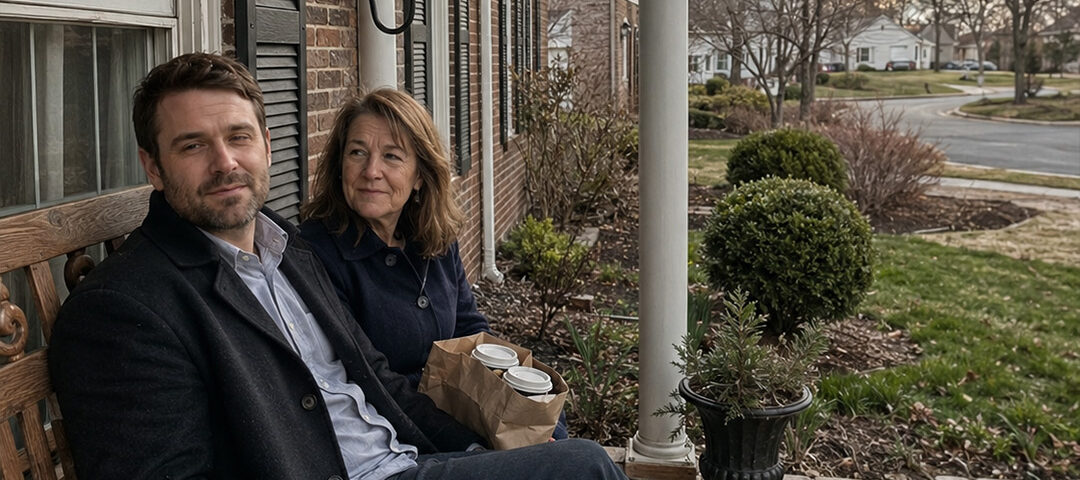
She wore a navy coat and held a small paper bag.
I left the drill on the floor and went downstairs.
When I opened the door, she did not step forward.
“Hello, Caleb.”
“Hello, Mom.”
“I called the gatehouse first.”
“I know.”
“They said I needed your approval.”
“You do.”
She nodded.
“I brought coffee.”
I looked at the paper bag.
Two cups. No envelopes. No bills.
“What do you need?”
The question hurt her.
I saw it.
Still, she answered.
“To apologize without asking for anything.”
Cold air moved between us.
I stepped onto the porch and closed the door behind me.
We sat on the wooden bench beneath the front window. She handed me one cup.
Black coffee.
She remembered.
For several minutes, we watched sunlight move across the quiet street.
Patricia spoke first.
“I knew Heather broke the award.”
My hand stopped around the cup.
“She knocked it from the counter after reading the card from your firm. It did not break completely the first time.”
I looked at her.
“What does that mean?”
“She picked it up and dropped it again.”
The truth was quieter than the version I had imagined.
That made it more painful.
“And you lied.”
“Yes.”
“Why?”
“Because she was crying.”
“So?”
“I thought if I made you confront her, she would spiral.”
“And if you lied to me?”
“You were the strong one.”
I looked toward the bare trees.
“There it is.”
“I know.”
“No, Mom. I don’t think you do.”
“I used your strength as permission to hurt you.”
The sentence sounded rehearsed, but not false.
“I told myself you would understand because you always understood. You handled work, school, money, everything. Heather needed protecting.”
“She needed limits.”
“I know that now.”
“You knew it then.”
Patricia lowered her gaze.
“I was afraid.”
“Of what?”
“That if I stopped saving her, she would leave me the way your father did.”
There it was.
Not an excuse.
A reason.
Our father had left Patricia when she was twenty-eight, taking his clothes and half the rent money. Heather was six and remembered waiting near the window for him. I was two and remembered almost nothing.
Mom had spent the next thirty years trying to prevent the first abandonment from happening again.
She gave Heather whatever kept her close.
Money.
Excuses.
Protection from consequences.
Eventually, my house.
“I’m sorry he left you,” I said.
“So am I.”
“But I was not him.”
“No.”
“You punished me for being the child who stayed.”
Her eyes closed.
“Yes.”
We sat with that answer.
A truck passed at the end of the lane. Somewhere behind the house, a bird called from the bare hedge.
“What happens now?” she asked.
“I don’t know.”
“Do you hate me?”
“No.”
“Do you forgive me?”
“Not yet.”
She nodded slowly.
“I understand.”
“Forgiveness will not give you a key.”
“I didn’t ask for one.”
“I need you to hear it anyway.”
“I hear you.”
She lifted her coffee but did not drink.
“I started counseling.”
“With the debt counselor?”
“A different kind.”
That surprised me.
“Pastor Miller gave me the name of a therapist who works with families and dependency.”
“How is it?”
“Uncomfortable.”
“That probably means you are discussing the right things.”
A small smile appeared.
“You sound like yourself.”
“I am myself.”
“I didn’t always let you be.”
“No.”
She looked toward the front door.
“Martha said you turned one of the bedrooms into a library.”
“I did.”
“The one we called empty?”
“Yes.”
“I would like to see it someday.”
I studied her face.
The old version of myself would have opened the door immediately, grateful for the smallest sign of interest.
The man I had become understood that a door could remain closed without becoming cruel.
“Not today,” I said.
Pain crossed her expression.
Then she nodded.
“All right.”
I stood.
She stood too.
“Thank you for the coffee.”
“Thank you for listening.”
“I listened. That is not the same as fixing this.”
“I know.”
She walked toward the steps.
“Mom.”
She turned.
“When you’re ready to visit without asking for money, a room, a signature, or a rescue, call me.”
Her eyes filled.
“I thought that’s what I did today.”
“It was.”
A faint hope entered her face.
I opened the door.
“Call again.”
She left without looking back.
I watched her drive away from the upstairs window of the library.
Three weeks later, she called.
Then again two weeks after that.
Our conversations were short. We discussed her work at the church daycare, the repayment plan, and the bus route she had learned after selling the car. She never asked me for money.
In May, I invited her for coffee.
She arrived five minutes early and rang the bell.
I opened the door.
She waited.
The pause mattered.
“Come in,” I said.
She stepped across the threshold only after I moved aside.
The house smelled of coffee and lemon polish. Sunlight filled the front hallway. We went upstairs.
When Patricia entered the library, she stopped.
Books covered three walls from floor to ceiling. The green chair sat beside the window. My desk faced the backyard, where spring leaves moved above the fence. The engraved crystal base rested on the highest shelf, its broken edge catching the light.
Mom looked around slowly.
“You filled it.”
“It was never empty.”
Her eyes settled on the award.
“I wish I could replace that.”
“It came from my company. The company knows what I accomplished.”
“That isn’t what I meant.”
“I know.”
She moved closer to the shelf but did not touch it.
“I was proud of you.”
“You did not act like it.”
“No.”
“Pride that stays hidden does not help the person who earned it.”
“I know that now.”
She looked at me.
“I am proud of you, Caleb.”
The words reached the younger part of me that had waited decades to hear them.
They did not heal everything.
They did not erase the cardboard inside my childhood shoes, the restaurant dinner, the red suitcases, or the forwarding form.
But they were true.
For that moment, true was enough.
“Thank you,” I said.
We drank coffee in the library.
Mom sat in the green chair. I took the desk chair. We spoke carefully, like people crossing a bridge neither fully trusted.
Heather’s name came up only once.
“She has a job,” Mom said.
“I heard.”
“She is angry with both of us.”
“That is hers to work through.”
“I worry about her.”
“You probably always will.”
“I’m learning that worry is not an instruction.”
“That sounds useful.”
She smiled.
When she left, she hugged me at the front door.
I returned the hug, but I did not offer a key.
After her car disappeared, I went upstairs and stood in the center of the library.
The room was quiet.
For most of my life, silence had meant someone was disappointed in me. It meant Mom was protecting Heather, or Heather was preparing her next accusation, or I was alone with a problem no one intended to help solve.
In my house, silence meant something else.
It meant no one was making decisions in the next room.
No luggage waited outside my door.
No one had written my address on a form without permission.
No one was counting the bedrooms and deciding what portion of my life they deserved.
I reached for the broken award base and turned it toward the light.
The engraving remained clear.
The crystal above it was gone, but the name survived.
So had I.
I placed it back on the shelf beside my house key.
Then I sat in the green chair, opened a book, and listened to the home I had earned remain entirely, peacefully mine.
The room had never been empty.
It had been waiting for me.
Disclaimer: This story is a work of fiction created for entertainment purposes. Any resemblance to real persons, events, or places is coincidental.