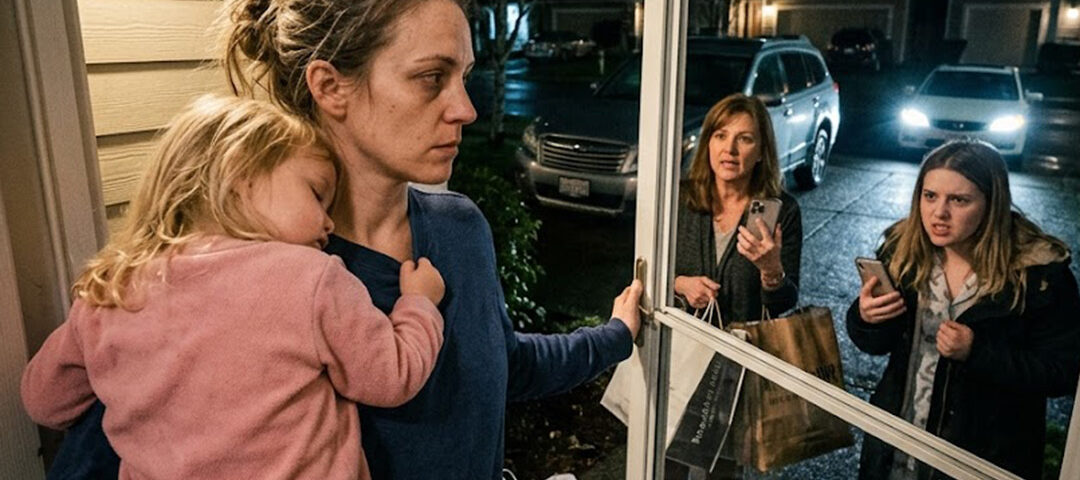
“She was fine. Stop making this bigger than it was.”
My mother said those words without looking at the three-year-old trembling in my arms.
Lily’s small fingers were twisted into the collar of my blouse. Her cheeks were damp, her breathing uneven from crying, and every few seconds she lifted her head to make sure I was still there.
We were standing inside the security office of Brookfield Mall beneath fluorescent lights that made everyone look pale. A row of monitors covered one wall. On the largest screen, shoppers moved through the food court in silent black-and-white squares.
My mother, Brenda, stood near the door holding six glossy shopping bags.
The bags contained matching winter coats, shoes, and toys for my sister Kendra’s twin boys.
Nothing in her hands belonged to Lily.
A security supervisor named Mr. Ellis stood beside the desk with a printed incident report. His expression was professional, but the controlled tension around his mouth told me he had already heard enough.
“Mrs. Walsh,” he said to my mother, “your granddaughter was alone for a significant period. Staff announcements were made repeatedly.”
Brenda adjusted one of the bags on her arm.
“She wandered away while I was paying. Children do that.”
“She was located near the exterior doors.”
“I heard you the first time.”
Mr. Ellis looked at me.
“We have documented the timeline and preserved the relevant camera logs. We also tried every contact number your daughter could give us.”
Lily had been sitting inside that office for almost two hours.
Two hours while my mother continued shopping.
Two hours while strangers tried to calm my child with apple juice and a paper cup of crackers.
Two hours during which Brenda did not notice—or did not care enough to stop what she was doing and look properly.
I tightened my arms around Lily.
“Mom, where were you?”
Brenda finally met my eyes.
“I told you. I was buying the boys’ coats.”
“For two hours?”
“The store was crowded.”
“You didn’t hear the announcements?”
“I was in fitting rooms and checking out.”
“You didn’t notice Lily was gone?”
Her face hardened.
“Amelia, she was with us one moment and missing the next. I can’t glue children to my side.”
“You were responsible for her.”
“I was responsible for three children.”
“No. Kendra’s boys are nine. Lily is three.”
Her eyes narrowed.
There it was—the expression I had known since childhood. The look that said I was forcing her into an unreasonable conversation by noticing something she preferred to dismiss.
Before I could answer, her phone rang.
Kendra’s name filled the screen.
Brenda answered on speaker because both hands were occupied by shopping bags.
“Mom, did you find the matching boots?” my sister asked before saying hello.
“Yes, but we’ve had a little situation.”
“What happened?”
“Lily wandered away.”
Kendra sighed.
“Is she okay?”
“She’s fine. Amelia is here making it sound like a major disaster.”
My daughter flinched when she heard her name.
I looked down and kissed the top of her head.
Kendra continued, “Did you get the navy boots or the black ones?”
“The black ones.”
“Good. The navy would clash with their coats.”
Mr. Ellis turned his face slightly, as if giving himself a second to maintain his composure.
I waited for Kendra to ask how long Lily had been missing.
She did not.
I waited for my mother to correct the impression that this was a minor inconvenience.
She did not.
Instead, Brenda nodded toward me and said, “Your sister is upset because I spent more on the boys.”
That was the moment everything inside me went cold.
Not angry.
Cold.
Anger would have made me shout. It would have allowed them to tell each other that Amelia was emotional again, jealous again, overreacting again.
Cold gave me clarity.
“This has nothing to do with shopping,” I said.
Kendra’s voice sharpened through the phone.
“Then why are you creating a scene?”
I looked at my mother’s bags.
One store receipt protruded from the top. I could see the total printed in bold near the bottom.
More than six hundred dollars.
My mother had spent six hundred dollars on Kendra’s children while my daughter sat crying in a security office.
I did not answer my sister.
I turned toward Mr. Ellis.
“I need a copy of everything.”
“Of course.”
“The incident report, announcement log, and camera timeline.”
Brenda gave an impatient laugh.
“For heaven’s sake.”
I ignored her.
Mr. Ellis printed two additional pages and clipped them to the report.
“The video itself must remain in our system, but this reference number will allow an authorized reviewer to request preservation.”
“Thank you.”
He lowered his voice.
“Your daughter was very frightened, but she responded well once we gave her your photograph from the emergency contact record.”
My chest tightened.
“You had my photograph?”
“She remembered your name. We located a previous lost-property report connected to your phone number.”
Lily pulled away just enough to whisper, “I told them Mommy comes.”
I pressed my cheek against her hair.
“Yes, sweetheart. Mommy came.”
My mother shifted the shopping bags again.
“Can we leave now?”
I looked at her.
She did not appear ashamed.
She appeared inconvenienced.
I signed the security form, carried Lily to the parking garage, and secured her inside her car seat. Her hands wrapped around my thumb while I tightened the straps.
“Don’t go,” she whispered.
“I’m right here.”
“Grandma went away.”
The sentence entered me slowly.
Not Grandma lost me.
Grandma went away.
In Lily’s mind, she had not wandered from someone watching her. The person responsible for her had disappeared.
I sat beside the open car door until her breathing calmed.
My mother approached carrying the bags.
“You need to stop reinforcing this,” she said.
I stood.
“Reinforcing what?”
“Her fear. Children take their cues from adults.”
“She was alone for two hours.”
“She needs to learn not to wander.”
“She is three.”
“You always make excuses for her.”
I stared at my mother.
“For Lily?”
“You act as if she’s fragile.”
“She is a toddler.”
“Kendra’s boys never behaved this way at her age.”
Of course they had not.
In my mother’s memory, Kendra’s children had never cried, made messes, interrupted conversations, or required more care than was convenient.
They were not grandchildren to Brenda.
They were extensions of the daughter she had spent a lifetime celebrating.
I opened the driver’s door.
“Do not contact me tonight.”
She blinked.
“Excuse me?”
“Do not call. Do not come to my house.”
“You’re being dramatic.”
“No. I’m being clear.”
“You cannot keep my granddaughter from me because of one mistake.”
“I can decide who supervises my child.”
Her mouth tightened.
“Kendra was right. This is about the shopping.”
I got into the car and closed the door.
On the drive home, Lily remained quiet.
Usually, she narrated everything she saw: red truck, big dog, yellow sign, cloud shaped like a bunny. That afternoon, she held her stuffed ladybug and watched the window.
At a stoplight, I glanced into the rearview mirror.
Her eyes met mine immediately.
“Mommy?”
“Yes?”
“You’re still here?”
“I’m still here.”
She asked me that question four more times before we reached our street.
My name is Amelia Hart.
I was thirty-three years old when the mall incident happened, but in my family I had been old enough to handle things since I was seven.
Kendra was two years younger and somehow remained the child in every room.
She was the one whose report cards went on the refrigerator, even when mine were better.
The one who received birthday parties at skating rinks while I was told dinner at home was more meaningful.
The one whose sadness required the entire household to change plans.
If I was upset, my mother called me mature enough to understand.
I learned early that maturity was not praise.
It was the word adults used when they wanted the reliable child to accept less.
My father noticed the imbalance, though he rarely confronted it directly. He worked long hours managing a group of commercial properties with his older brother, Richard. He was loving but tired, and my mother was skilled at making every disagreement sound like a misunderstanding.
When I was fourteen, Kendra wanted a new bedroom set.
My parents told me we could not afford summer art camp because family money was tight.
Two weeks later, a white furniture truck arrived.
I stood in the driveway watching men carry a canopy bed into Kendra’s room.
My father found me there.
“I’m sorry, honey.”
“It’s okay.”
“No, it isn’t.”
But nothing changed.
That became the pattern.
My father recognized the unfairness.
My mother explained it.
I absorbed it.
After he died unexpectedly when I was twenty-six, Uncle Richard became trustee of the family’s shared business interests. My father’s portion of the commercial properties supported several beneficiaries, including my mother and both daughters.
Richard offered me a monthly distribution.
I declined.
“I have a job,” I told him. “Keep my share invested.”
“You are entitled to it.”
“I know.”
“Your mother accepts hers.”
“I know.”
“Kendra uses the business education fund for her consulting company.”
“I know that too.”
He studied me across his office desk.
“You spend a great deal of energy making sure no one can accuse you of needing anything.”
The observation embarrassed me because it was true.
“I just want my own life.”
“Then build it. But do not confuse independence with refusing what your father intended for you.”
I still declined the monthly money.
I worked in project administration for an architectural firm, purchased a modest townhouse, and created a quiet life for myself.
When Lily was born, I opened an education account in her name using my own income.
My mother called it unnecessary.
“Richard will provide for all the grandchildren.”
“I want Lily to know her mother planned for her.”
Brenda’s mouth tightened.
“You always have to prove something.”
Perhaps I did.
I wanted to prove that my daughter would never need to perform usefulness in exchange for security.
Yet even after becoming a mother, I continued tolerating the old family pattern.
Brenda attended every one of the twins’ school events and remembered their clothing sizes.
She forgot Lily’s preschool recital after promising to come.
When she visited my house, she brought the boys’ old toys in grocery bags and called them gifts.
At Christmas, the twins opened tablets from her. Lily received a coloring book.
I told myself a three-year-old did not understand price.
But children understand attention long before they understand money.
Lily would watch Grandma kneel to greet the twins while receiving a distracted pat on the head herself.
I saw it.
I hated it.
I still hoped it would improve.
That hope was why I agreed to the mall trip.
Brenda called on Thursday.
“I’m taking the boys shopping Saturday. Let me bring Lily.”
I hesitated.
My mother heard it.
“You act like I’m a stranger.”
“You usually find the twins easier.”
“They’re older.”
“Exactly.”
She softened her voice.
“I want time with my granddaughter.”
A small part of me—the oldest, most foolish part—believed her.
I packed snacks, wipes, an extra shirt, and Lily’s emergency card. I explained that Grandma was taking her on a special trip.
Lily was excited.
She chose her yellow shoes.
When Brenda arrived, she barely looked at the backpack.
“We won’t need all that.”
“Please keep it with her.”
“I raised two children, Amelia.”
I almost changed my mind.
Then Lily hugged my legs and said, “I go with Grandma.”
I let her.
That decision sat heavily inside me as I carried her from the car into our house after the mall.
I wrapped her in a blanket and turned on her favorite cartoon. She would not let me leave the couch, so I sat beside her until she fell asleep against my shoulder.
Only then did I look at my phone.
Messages had begun arriving.
Mom: You embarrassed me in front of mall staff.
Kendra: You need to stop treating Mom like she did something intentional.
Mom: Call me when you calm down.
Kendra: The boys are upset because you ruined their day.
There was nothing about Lily.
No apology.
No question asking whether she had eaten, slept, or stopped crying.
I carried her upstairs and placed her in bed. When I tried to move away, her hand tightened around my sleeve.
I stayed until she released it in sleep.
Then I went downstairs.
The kitchen was quiet except for the refrigerator motor. Evening light had faded from the windows, leaving my reflection suspended in the dark glass above the sink.
I placed the mall report on the table.
The pages included the time Lily was found, the location, the announcements, and the time my mother finally entered the security office.
I read the timeline twice.
The facts were worse on paper because paper did not allow anyone to interrupt them with excuses.
Lily had been found at 1:18 p.m.
The first announcement was made at 1:23.
My mother completed a purchase at 1:47.
Another purchase at 2:16.
A third at 2:41.
She entered the security office after 3:00.
The receipts she carried matched the time stamps.
She had heard or ignored repeated announcements and continued shopping.
That was not one moment of distraction.
It was a series of decisions.
I photographed the report and sent it to Uncle Richard.
Then I called him.
He answered after one ring.
“Amelia?”
“Do you have a minute?”
“For you, yes.”
I told him what happened.
I did not cry.
I did not insult my mother or Kendra.
I read the timeline exactly as it appeared.
When I finished, Richard was silent.
“Are you still there?”
“Yes.”
His voice sounded different.
“Is Lily safe?”
“She’s asleep.”
“Has she been checked by her pediatrician?”
“I called the after-hours line. They said to monitor her and bring her in Monday unless something changes.”
“Good.”
Another pause.
“Your mother continued making purchases after announcements began?”
“The receipts appear to show that.”
“Send me the full report.”
“I did.”
“I’m opening it now.”
I heard computer keys.
Then nothing.
Richard breathed out slowly.
“Amelia, I am sorry.”
The apology almost broke me because it was the first one anyone had offered.
“Thank you.”
“Did Brenda use the family supplementary card today?”
“I don’t know.”
“I do.”
His voice hardened.
“The charges are already appearing.”
I looked toward the stairs.
“What are you going to do?”
“My responsibility as trustee.”
“I’m not asking you to punish anyone.”
“I understand.”
“I only called because Mom and Kendra use the trust as proof that nothing they do has consequences.”
Richard remained quiet.
Then he said, “The trust is not a reward system. It has rules regarding appropriate use and fiduciary conduct. Your mother’s allowance is discretionary. Kendra’s business credit line requires legitimate business expenses.”
“What does that have to do with the mall?”
“The purchases may have been made with funds intended for household support, and Kendra’s line has shown irregular activity for months. I delayed a review because your mother insisted it would create unnecessary conflict.”
I closed my eyes.
“So this was already happening.”
“Yes.”
“What will you do?”
“Place a temporary administrative hold while the accounts are reviewed.”
“How long?”
“As long as necessary.”
“Richard—”
“Amelia, sixty-eight thousand dollars has moved through Kendra’s business line this quarter. I have invoices that do not match the stated work. Your mother has charged personal luxury purchases to a card meant for medical, household, and transportation expenses.”
I stared at the report.
“And today?”
“Today confirms that the card is being used without basic judgment.”
“I don’t want them saying I destroyed their lives.”
“They will say that because it is easier than examining their records.”
He softened slightly.
“You are not ordering me to do anything. You reported a serious family incident supported by documentation. I am independently carrying out my duty.”
“What about the twins?”
“Their education accounts are protected. Their basic needs do not depend on Kendra’s business line.”
“And my mother?”
“She has her own pension and savings.”
I thought about the six shopping bags.
“All right.”
“Do not engage with them tonight.”
“I already told Mom not to come.”
“Lock your door.”
The instruction sounded dramatic, but Richard knew our family.
Brenda did not respect boundaries when her comfort was threatened.
“I will.”
“Call me if anyone appears.”
We ended the conversation.
Ten minutes later, my phone began vibrating.
At first, the calls came from my mother.
Then Kendra.
Then alternating numbers from both of them.
A message appeared.
What did you tell Richard?
Another.
My card was declined in front of everyone.
Another.
Kendra’s operating account is frozen. Fix this.
Then:
You are using Lily to manipulate the family.
I turned the phone facedown.
It continued vibrating against the kitchen table.
The sound traveled through the wood in short, angry bursts.
I made tea.
I checked on Lily.
I locked the front and back doors.
When I returned to the kitchen, there were twenty-three missed calls.
By ten, there were forty-one.
By eleven, fifty-seven.
Just before midnight, the count reached sixty-eight.
Not one voicemail asked how Lily was doing.
The messages focused on money.
A boutique had refused my mother’s card.
Kendra’s software subscription had failed.
A car payment scheduled through the business line had been rejected.
A hotel deposit for a family trip had been canceled.
Their panic revealed the architecture of their lives.
Everything looked independent from the outside.
Underneath, Uncle Richard’s signature supported it all.
Headlights swept across my living-room wall.
A car entered the driveway too quickly.
Then another.
Doors closed.
Footsteps crossed the walkway.
The pounding began.
“Amelia!”
My mother’s voice carried through the door.
“Open this right now.”
I checked Lily’s monitor. She stirred but did not wake.
I walked to the entryway and turned on the porch light.
The pounding continued.
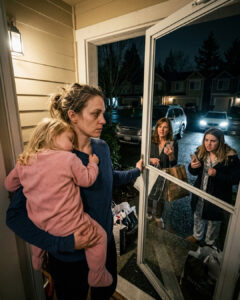
I opened the door but kept the storm door locked between us.
Brenda and Kendra stood on the porch.
My mother still wore the blouse she had worn to the mall. Kendra had pulled a coat over her pajamas. Both held their phones like evidence.
“What did you say to Richard?” Brenda demanded.
“The truth.”
“You made him cancel my cards.”
“I did not control his decision.”
Kendra stepped closer.
“My business account is frozen.”
“He said the account is under review.”
“You called him because Mom lost sight of Lily.”
“Lily was alone for almost two hours.”
“She wandered.”
“She is three.”
My mother lifted her phone toward the glass.
“You call Richard and tell him you exaggerated.”
“I did not.”
“Tell him it was a misunderstanding.”
“The incident report is not a misunderstanding.”
Kendra crossed her arms.
“You have always resented the help we receive.”
I almost laughed.
Instead, I remained quiet.
She continued.
“You refused your distributions, and now you want everyone else punished for accepting theirs.”
“This is not about accepting support.”
“Then what is it about?”
I lifted the printed report.
“This.”
My mother glanced at it.
“You’re waving paperwork around as if I committed some unforgivable act.”
“You did not notice my daughter was missing.”
“I noticed eventually.”
The sentence stunned even Kendra.
She turned toward our mother.
“Mom.”
Brenda looked defensive.
“You know what I mean.”
“No,” I said. “I think you finally said exactly what you mean.”
Her face changed.
“Do not twist my words.”
“I spent my entire life being told I was mature enough to accept less. I will not teach Lily that same lesson.”
“No one treated you badly.”
“Kendra’s needs always came first.”
“This again.”
“Yes. This again. Except now the pattern reached my daughter.”
Kendra leaned toward the door.
“You’re jealous of my boys.”
“I am protecting my child.”
“By freezing money that supports mine?”
“Their education accounts are untouched.”
Her eyes widened.
“How do you know?”
“Richard told me.”
“So you discussed our private finances.”
“You came to my house at midnight to discuss them.”
My mother lowered her voice.
“Amelia, open the door.”
“No.”
“I am your mother.”
“And I told you not to come.”
“We need to speak like a family.”
“We are speaking.”
“Not through glass.”
“The glass is the boundary you ignored when you drove here.”
Her face flushed.
“Do you enjoy this?”
“No.”
“You always wanted Richard to think you were better than us.”
“I wanted someone to believe me.”
The sentence came out more quietly than I intended.
For a moment, no one spoke.
Kendra looked away first.
My mother recovered quickly.
“You have made your point. Now fix the accounts.”
“No.”
“What do you mean, no?”
“I will not call Richard.”
“Then I will.”
“He is not answering you.”
Her expression confirmed it.
Kendra held up her phone.
“He said all communication must be in writing.”
“That sounds appropriate.”
“Appropriate?” she repeated. “My company cannot operate.”
“If it is a legitimate company, the review will establish that.”
Her mouth tightened.
“You don’t know anything about my business.”
“No. Richard does.”
My mother’s voice sharpened.
“You are destroying this family over one afternoon.”
“No. I am refusing to keep the family comfortable by pretending the afternoon did not matter.”
“What do you want?” Kendra asked.
It was the first useful question either had asked.
“I want no contact with Lily until I decide otherwise.”
My mother stared at me.
“You cannot do that.”
“I can.”
“I’m her grandmother.”
“You were responsible for her, and she spent two hours believing she had been abandoned.”
“That is your interpretation.”
“That is what she told me.”
Brenda’s certainty faltered.
Only slightly.
“She said that?”
“Yes.”
“What exactly did she say?”
“Grandma went away.”
The porch became quiet.
My mother looked toward the dark driveway.
For one second, I saw something resembling shame.
Then Kendra spoke.
“Mom didn’t mean to.”
Intent appeared whenever my family wanted the person who was hurt to carry the responsibility for healing.
“I know,” I said.
Brenda looked back at me.
“Then why are you doing this?”
“Because not meaning to harm someone does not erase the harm. It tells you what you need to repair.”
“What does repair look like?”
“Accountability.”
“That is a vague word.”
“No. It means you stop calling it a misunderstanding. You stop blaming Lily. You stop claiming I am jealous. You acknowledge the timeline, follow the trust review, and stay away from my daughter until she feels safe.”
Kendra gave an incredulous laugh.
“And if we don’t?”
I held the report against the glass.
“Then all future communication goes through counsel and the trustee. The mall has preserved the camera record. I will make every decision based on Lily’s welfare, not on keeping you comfortable.”
The confidence left Kendra’s face.
My mother stared at the pages.
“You would involve lawyers against your own mother?”
“You brought financial demands to my doorstep at midnight.”
She opened her mouth.
Nothing came out.
I unlocked the main door only long enough to step back inside.
“You need to leave.”
“Amelia,” Brenda said.
“Good night.”
I closed the door.
The pounding did not resume.
Through the side window, I watched them stand beneath the porch light for another minute. Kendra spoke rapidly. My mother remained still.
Then they returned to their cars.
The driveway emptied.
I leaned against the door and allowed my knees to weaken.
Strength often looks calm from the outside.
Inside, it can feel like holding an entire structure upright with both hands.
I went upstairs.
Lily was awake.
“People loud,” she whispered.
“I know.”
“Grandma?”
“Yes.”
She pulled the blanket beneath her chin.
“Is she taking me?”
“No.”
“You promise?”
“I promise.”
I lay beside her until morning.
The administrative review lasted six weeks.
Richard hired an independent accounting firm to examine the family business distributions. The findings were not dramatic in a criminal sense. They were ordinary enough to be more revealing.
My mother had used a household-support card for designer clothing, resort deposits, gifts, and personal subscriptions.
Kendra’s consulting business had charged family travel, vehicle expenses, private-school donations, and home renovations as business development.
Invoices had been created after purchases rather than before them.
Several payments labeled client entertainment corresponded with family dinners.
The trust had not caused their dependence.
It had concealed it.
Richard scheduled a formal family meeting at his office.
I did not want to attend.
He asked me to come only because decisions involving all grandchildren would be made.
The conference room overlooked a row of renovated warehouses our family had owned since my father’s time. A long walnut table occupied the center.
Brenda sat at one end.
Kendra and her husband, Sean, sat beside her.
I chose the chair across from Richard.
My mother did not look at me.
Kendra did.
Her expression carried anger, exhaustion, and the first signs of a life no longer buffered from consequences.
Richard opened a folder.
“The temporary hold is now permanent under revised terms.”
Brenda sat straighter.
“You cannot remove my allowance.”
“I can convert it.”
“Into what?”
“Direct payment of approved housing, medical, and insurance expenses. No unrestricted supplementary card.”
Her face flushed.
“I am not a child.”
“Then managing your personal spending should not be a problem.”
Kendra leaned forward.
“What about my company?”
“The business credit line is closed.”
“You will destroy it.”
“The trust was never intended to operate your company indefinitely.”
“My father wanted me supported.”
“Your father wanted both daughters supported.”
Kendra glanced at me.
“She refused the money.”
“That did not transfer her rights to you.”
Richard turned another page.
“The consulting firm must provide standard financial statements if it seeks future investment. Personal expenses will not be reimbursed.”
Sean rubbed one hand across his face.
“We cannot repay everything at once.”
“A repayment schedule has been prepared.”
Kendra stared at him.
“You knew?”
“I received the documents yesterday.”
“You didn’t tell me?”
“I wanted to understand them first.”
The look between them told me their marriage had its own hidden accounts.
Richard continued.
“The grandchildren’s education funds will be restructured equally.”
My mother finally looked at me.
“Lily already has her own account.”
“One Amelia created herself,” Richard said. “That does not justify excluding her from what her grandfather intended.”
He placed three blue folders on the table.
“One account for Lily. One for each twin. Equal starting balances and equal annual contributions.”
Kendra’s mouth tightened.
“You are taking money from my children.”
“No,” Richard said. “I am stopping the practice of treating one branch of this family as the only branch that matters.”
The room became completely still.
My mother looked toward the window.
The sentence had come thirty years late.
It still mattered.
Richard closed the main folder.
“The mall expenses will be treated as personal charges, not trust-supported household expenses.”
Brenda looked at him.
“You think I deserve all this because I lost sight of a child?”
“No,” he said. “I think the incident forced me to examine an arrangement I should have reviewed years ago.”
She turned toward me.
“You caused this.”
I met her eyes.
“No. I documented what happened.”
“You knew Richard would react.”
“I hoped someone would.”
Her face tightened.
“Your father would hate seeing the family divided.”
“My father saw the division.”
That stopped her.
“He apologized to me for it more than once.”
Brenda looked genuinely surprised.
“What did he say?”
“That he was sorry he let my being quiet become an excuse to give me less.”
Her eyes filled.
“He never told me that.”
“He tried. You called it another misunderstanding.”
No one spoke for several seconds.
Then my mother stood.
“I cannot sit here and be judged by everyone.”
Richard remained calm.
“This is not a judgment. These are terms.”
She collected her handbag.
“To you, maybe.”
She walked out.
Kendra remained in her chair.
When the door closed, she looked at me.
“Are you happy?”
“No.”
“You finally got what you wanted.”
“What do you think I wanted?”
“To be the good daughter.”
I shook my head.
“I wanted Lily to come home safely.”
Her expression changed.
For the first time since the mall, she looked uncertain rather than angry.
“The boys said Mom was looking at coats when Lily disappeared.”
I waited.
“They said Lily kept asking for a snack. Mom told her to stay near the bench.”
“She is three.”
“I know.”
“Do you?”
Kendra lowered her eyes.
“I spoke to them separately. They both said Mom noticed Lily was gone before she finished shopping.”
My hands became cold.
“How long before?”
“They don’t know exactly.”
“Did you tell Richard?”
“Yes.”
That explained the finality of the trust decision.
“Why didn’t you tell me?”
“I thought you would use it against her.”
I stared at my sister.
“Kendra, she already used it against Lily.”
Her eyes filled.
“I know.”
It was the first time she had said those words without adding an excuse.
I stood.
“I need to go.”
“Amelia.”
I stopped.
“I’m sorry.”
The apology was quiet.
I looked at her.
“For what?”
“For calling you jealous. For not asking if Lily was okay. For knowing Mom favored my children and pretending it was harmless.”
The conference room seemed to shrink around us.
“Why now?”
“Because the money stopped, and I saw how much of my life depended on never questioning her.”
That was honest.
Painfully honest.
“I don’t know what to do with that,” I said.
“You don’t have to do anything.”
I left before she could ask for forgiveness.
Lily’s response to the mall lasted longer than anyone except me understood.
For weeks, she panicked when I stepped out of sight.
At preschool drop-off, she clung to my coat.
In the grocery store, she refused to sit in the cart unless one hand held my sleeve.
At night, she asked whether I would still be home when she woke.
Her pediatrician recommended a child therapist who used play rather than direct questions.
During the first appointment, Lily placed a small doll inside a toy house and put the grandmother doll outside a plastic shopping store.
“Who is this?” the therapist asked gently.
“Grandma.”
“What is Grandma doing?”
“Buying.”
“And where is the little girl?”
“Waiting.”
The therapist looked at me.
My throat tightened.
Over time, Lily’s play changed.
The little girl found a helper.
Then a mother arrived.
Then the grandmother doll disappeared from the story.
I did not push her to put it back.
My mother sent gifts.
I returned them unopened.
She mailed letters explaining that she had made a mistake but also reminding me that children were difficult to supervise.
I kept the letters but did not respond.
An apology that includes a defense is often a request to resume the relationship without repairing it.
Kendra called occasionally.
At first, our conversations remained practical. She asked about Lily. I answered briefly.
Then one afternoon, she arrived alone carrying a small box.
I met her on the porch.
“I won’t stay,” she said.
“What is it?”
“The twins chose it.”
Inside was a stuffed owl wearing a yellow scarf.
“They said Lily liked it at the store but Mom told her it was too expensive.”
I looked at my sister.
“When was that?”
“The mall.”
My chest tightened.
“They remembered?”
“They remember more than I wanted them to.”
She placed the box on the porch table.
“They asked why Grandma kept buying things after Lily was gone.”
“What did you say?”
“The truth.”
“Which truth?”
“That Grandma made a serious mistake and that adults are responsible for protecting children.”
I studied her face.
“That must have been difficult.”
“It was.”
“Why tell them?”
“Because I spent years letting Mom turn favoritism into love. I don’t want them learning that being favored makes unfairness acceptable.”
I looked at the owl.
“Thank them.”
“I will.”
Kendra stepped toward the walkway, then stopped.
“Sean and I sold the SUV.”
I said nothing.
“We’re paying the trust back.”
“That is between you and Richard.”
“I know. I just wanted you to know I’m not asking him to reverse anything.”
“All right.”
She left.
I gave the owl to Lily after explaining it came from her cousins.
She hugged it immediately.
“Grandma?”
“No. The boys.”
She smiled.
“My boys.”
I did not correct her.
They were her cousins, but in her three-year-old language, people she loved belonged to her.
My mother’s first real apology came eight months after the mall.
She did not call.
She wrote one page by hand.
Amelia,
I have spent months trying to explain the afternoon in a way that would make me feel less ashamed. Every explanation placed the responsibility somewhere else—on the crowd, on Lily being active, on the announcements being difficult to hear, on you being angry.
The truth is simpler.
I knew she was missing before I finished shopping.
I told myself she could not have gone far. I was embarrassed to ask for help because I did not want anyone to think I had been careless. I continued with the purchase because I believed I could find her afterward without anyone knowing.
I chose my pride over her fear.
Then, when you arrived, I chose my pride again.
I am sorry.
I do not expect access to Lily. I only want you to know I finally understand why you closed the door.
Mom
I read the letter three times.
Then I placed it in the kitchen drawer beside the mall report.
Understanding did not immediately create trust.
But for the first time, it created the possibility of something other than permanent silence.
I showed the letter to Lily’s therapist.
“What do you want?” she asked.
“I don’t know.”
“That is allowed.”
“I’m afraid that forgiving my mother means giving her another chance to hurt Lily.”
“Forgiveness does not assign childcare duties.”
I smiled faintly.
“No.”
“You can accept responsibility from someone without restoring the old role.”
That idea took time to settle.
A year after the incident, I agreed to meet my mother at a public park.
Lily remained with my friend Hannah.
I arrived early and chose a bench near the playground.
Brenda walked slowly from the parking lot. She wore simple clothes and carried no gifts.
That mattered.
She sat beside me but left space between us.
“Thank you for coming.”
“I read your letter.”
“I meant every word.”
“Why did it take eight months?”
“Because I kept believing that if I found the right explanation, I would not have to see myself clearly.”
I looked toward the swings.
“Did losing the allowance change that?”
“Yes.”
The answer surprised me.
“At first, I was furious about the money. Then Richard made me review three years of statements. I saw how often I spent on Kendra’s family and how rarely I even remembered Lily’s needs.”
“You should not need a ledger to see a child.”
“No.”
She folded her hands.
“I began attending counseling.”
I looked at her.
“Why?”
“Because Richard said the trust could pay my bills but could not make people want to sit with me.”
The sentence held no self-pity.
Only recognition.
“I do not expect you to trust me,” she continued. “I would like to earn the right to know how Lily is doing.”
“She still asks whether I will disappear.”
My mother closed her eyes.
“I am sorry.”
“She remembers the security office.”
“I know.”
“No, Mom. You know the fact. I live with the memory.”
Tears moved down her face.
She did not wipe them away immediately.
“What would earning trust look like?” she asked.
“I don’t know yet.”
“All right.”
“No unsupervised time.”
“I understand.”
“No gifts used to bypass conversation.”
“Yes.”
“No comparing her to the twins.”
“I won’t.”
“And if she doesn’t want to see you, you accept that.”
Her voice trembled.
“I will.”
We met three more times without Lily.
My mother did not ask when the punishment would end.
She did not mention the trust.
She listened.
Months later, Lily agreed to see her at the same park.
I explained everything in simple language.
“Grandma made a big mistake. She is sorry. Mommy will stay the whole time.”
“Are you still here?”
“I will be right beside you.”
Brenda waited near the bench.
When Lily approached, my mother crouched but did not reach for her.
“Hi, Lily.”
My daughter stood behind my leg.
“Hi.”
“I’m glad to see you.”
Lily looked at me.
I nodded.
Grandma took a small breath.
“I’m sorry I did not keep you safe at the mall.”
Lily stared at her.
“You went away.”
“Yes.”
“You buyed coats.”
My mother’s face broke.
“Yes.”
“I cried.”
“I know. I am very sorry.”
Lily remained silent.
Then she asked, “You do it again?”
“No.”
The answer came without explanation.
“No, I will not.”
Lily did not hug her.
She went to the sandbox.
My mother sat on the bench and watched from a respectful distance.
That was where rebuilding began.
Not with a dramatic family reunion.
With ten quiet minutes in a park.
Kendra’s relationship with me changed too.
Without easy access to trust money, her consulting firm became smaller but real. She kept two legitimate clients, closed the expensive office, and worked from a converted room in her house.
The twins began spending more time with Lily.
They never mentioned the financial freeze.
Children cared more about building blanket forts than maintaining family status.
Uncle Richard remained trustee.
He never restored unrestricted allowances.
He created direct accounts for medical needs, housing support, and education. Every beneficiary received equal review.
At first, my mother called the structure humiliating.
Later, she admitted it made her feel secure without allowing impulsive spending to control her.
I finally accepted a portion of my father’s intended distribution—not for myself, but to fund a nonprofit childcare program connected to local shopping centers and public venues.
The program trained staff to respond when young children became separated from caregivers. It also provided identification cards and family-contact kits at no cost.
Richard approved the grant immediately.
“You are finally allowing your father’s money to support something you care about,” he said.
“I suppose I am.”
“He would be proud.”
For years, I had resisted family resources because I associated them with favoritism.
I learned money itself was not the problem.
Silence was.
Unaccountable access was.
The belief that support belonged more naturally to one daughter than another was.
Used carefully, the same trust that concealed unhealthy patterns could help protect other families.
Two years after the mall incident, I took Lily back to Brookfield.
Not because she asked.
Because avoiding the building had given it too much power.
She was five by then, taller and talkative again.
We entered through a different door and stopped beside the large directory map.
“Mommy stays with me,” she said.
“Yes.”
She held my hand.
We visited the bookstore, ate lunch in the food court, and chose a birthday gift for one of her cousins.
Near the end of the afternoon, we passed the security office.
Mr. Ellis still worked there.
He recognized my name after I introduced myself.
“This is Lily?” he asked.
She nodded seriously.
“I remember your ladybug,” he said.
Lily looked surprised.
“I still have her.”
“I’m glad.”
He showed her the sticker cabinet and let her choose a silver star.
Before we left, Lily walked several steps ahead of me toward a display.
Then she turned.
I was still there.
Her shoulders relaxed.
She walked back, placed her hand in mine, and smiled.
That small movement felt larger than every confrontation that came before it.
My family did not change because I made one phone call.
The call only stopped the money long enough for everyone to hear what had been hidden beneath it.
My mother heard the cost of her favoritism.
Kendra saw how dependence had shaped her loyalty.
Uncle Richard recognized that generosity without oversight could become permission.
And I finally understood that being the reliable daughter did not require remaining invisible.
The sixty-eight missed calls did not represent sixty-eight attempts to repair the harm.
They represented panic over access.
That distinction gave me the courage to let the phone ring.
I did not dismantle my family that night.
I dismantled the arrangement that required my daughter and me to remain small so everyone else could stay comfortable.
What survived afterward was less polished.
Less convenient.
More honest.
That was enough.
One Sunday evening, years later, Lily sat at my kitchen table doing homework while the stuffed owl from her cousins rested against her backpack.
My mother was in the living room reading quietly. She no longer entered our house without asking. Kendra was bringing the boys for dinner, and Uncle Richard had promised to stop by with pie.
The family was still complicated.
Some wounds remained tender.
But no child in that house had to disappear for another child to feel important.
The doorbell rang.
Lily looked up.
“Mommy?”
“I’m right here.”
She smiled and returned to her homework.
I walked to the door and opened it.
This time, everyone who entered knew exactly whose safety came first.
If you came here from Facebook because of this story, return to the Facebook post, tap Like, and comment exactly “Amazing” to support the storyteller. That small action means more than it seems and gives the writer genuine encouragement to keep sharing more stories about family pressure, firm boundaries, and finally protecting what you worked so hard to build.
Disclaimer: This story is a work of fiction created for entertainment purposes. Any resemblance to real persons, events, or places is coincidental.