The phone call that blew my world to pieces arrived on a bleak, rain-slicked Tuesday.
I was at the dining table, helping my ten-year-old son, Marcus, trace the coordinates on a geography map. It was barely a month before his milestone double-digit birthday. When the screen lit up with the word Mother, I swallowed the tightness in my throat and swiped answer, forcing a casual tone.
“Maya,” she said. Her voice was chillingly level—the exact, detached cadence she weaponized whenever she was issuing an executive order rather than asking an opinion. “You need to cancel Marcus’s birthday plans.”
The words hit like a physical strike to the chest.
“What? Mom, he’s turning ten. It’s a huge deal.”
“The decision has been finalized,” she replied, as if dictating a corporate restructuring. “Your brother’s kids are going through a sensitive time. Julian and Clara had to pull the plug on their elite summer camp enrollment. Throwing a celebratory event right now is incredibly tone-deaf.”
I stared blankly ahead, completely paralyzed.
My brother’s children—pampered by private tutors, country club memberships, and an absolute monopoly on the family’s attention—were somehow the victims because my son wanted a basic afternoon with his friends.
Marcus didn’t want luxury. He wanted a box-mix vanilla cake, a cheap football, and three classmates running around our overgrown, rented lawn. He just wanted to matter for twenty-four hours.
“You are being incredibly self-absorbed,” she pressed on, her tone sharpening into razor-edged condemnation. “You never look at the bigger picture. Family demands sacrifice, Maya.”
I cut my eyes toward Marcus. He was staring hard at his map, desperately pretending he couldn’t hear a thing, but his shoulders were rigid, and his lower lip was trembling violently.
He understood perfectly.
Even at nine years old, he knew exactly where he ranked on the family totem pole.
In that exact second, every ounce of fight evaporated from my veins.
“Fine, Mom,” I whispered.
The moment the call cut out, he looked up, a heavy tear spilling over his lashes.
“She really hates having me around, doesn’t she?”
As I wrapped my arms around him, a brutal reality I had spent a decade dodging finally locked into place.
In this family, my boy’s joy wasn’t a milestone to love. It was a liability to be suppressed.
The Cold Accounting of Love
In my mother’s mind, affection was a strictly audited financial ledger. It was a dynamic I couldn’t comprehend as a little girl, but as an adult, the ruthless mathematics of it became blindingly clear.
Every single milestone, triumph, or misstep was logged into a silent, unforgiving balance sheet. My older brother, Julian, was permanently anchored to the asset column.
I was, and always had been, the bad debt.
Julian was the golden standard. Being two years older, he was anointed as the family prodigy the moment he drew breath. He was the effortless straight-A student, the varsity quarterback, the Ivy League graduate who coasted on legacy and praise.
He married Vanessa right after college. She was equally flawless—spotless, highly connected, and perfectly curated.
Our parents financed a massive, high-society wedding for them. They instantly moved into a pristine mansion within a guarded enclave, produced two children right on schedule, and broadcasted a flawless, heavily filtered life on social media. Julian went into high-stakes corporate law, effortlessly charming clients into multi-million dollar retainers. He was the living, breathing manifestation of our mother’s wildest social ambitions.
He was her trophy.
I, on the other hand, was the cautionary tale.
I was the introverted, artistic kid who lived in the library. My grades were excellent, but they required grueling, late-night labor. I had to go to a local community college because our parents claimed the family funds were entirely drained by Julian’s elite university bills.
That community campus was where I met Marcus’s father. He was magnetic, spontaneous, and for a fleeting second, I genuinely believed I was writing my own happy ending.
But the fantasy shattered at hypersonic speed.
He wasn’t built for responsibility. Or more accurately, he wasn’t built for responsibility with me.
He vanished when my pregnancy ultrasound hit the six-month mark, leaving no forwarding address. I dropped out of my classes, signed a lease on a cramped, dingy apartment, and took a grueling job answering phones at a logistics firm.
I clawed my way up an inch at a time, grinding through night-school accounting certifications while Marcus slept in a crib next to my desk. Now, I worked remotely, balancing the books for a few local independent shops.
I lived in a dated, shared duplex. I drove a battered sedan with dented doors. I was a single mother with “unrealized potential”—a phrase my mother weaponized with a heavy, performative sigh, as if my very existence were an exhausting chore.
“Julian gives me social capital,” she informed me once during a flash of unfiltered malice.
We were standing in her designer kitchen while she vented about a minor disagreement with Vanessa.
“I can walk into my country club dinners and brag about his latest partnership track, or the kids’ private academy rankings. It validates me.”
Then she turned her gaze onto me, her eyes completely vacant of warmth, filled only with a deep, exhausting resentment.
“You just give me anxiety.”
That was the absolute truth of it. Her capacity to care was directly tethered to her public image. Julian’s triumphs elevated her status. My survival was nothing but a blemish on her narrative of a perfect matriarch running a flawless dynasty.
The ledger governed every single holiday dinner.
When Julian announced a luxury safari trip to Africa, my mother practically wept with delight, spending the next six weeks broadcasting it to her entire social circle.
When I proudly announced I had finally erased the last dollar of my community college debt, she offered a curt nod and said, “Well, about time. One less mess to clean up.”
His victory demanded an ovation.
My victory was merely the grudging reduction of a deficit.
Inheriting the Deficit
When Marcus was born, I watched that brutal accounting system ruthlessly expand to the next generation.
Chloe and Leo, Julian’s kids, were immediate assets. They were visually flawless, meticulously dressed, and enrolled in elite youth leagues.
Marcus was logged as a liability from day one. He was the walking proof of my failed relationship, a living disruption to the spotless pedigree my mother demanded.
She tried to play the part, in her own sterile way. She bought him cold, hyper-practical gifts—government bonds, sturdy orthotic sneakers, educational workbooks he dreaded opening. But she never once looked at him with the fierce, protective pride she showered on Chloe and Leo.
When Chloe sang completely out of tune at the dinner table, my mother beamed and called her a prodigy.
When Marcus proudly handed her a detailed canvas he had spent days painting, she gave a tight, manufactured smile and said, “Very nice, Marcus. Just make sure the paint doesn’t ruin my hardwood floors.”
So when she declared that Marcus’s birthday party would hurt the family’s feelings, the translation was simple: our joy was socially inconvenient.
Our small, unpretentious milestone brought zero value to the family asset column. It wasn’t a story she could boast about over cocktails. In fact, it did the exact opposite—it forced her to look at the glaring disparity between her two children, a reality she went to extreme lengths to conceal.
Our happiness was a messy, unauthorized variable that ruined her perfectly balanced books.
I remember one specific Christmas Eve with terrifying clarity. Marcus was five. I had skipped meals and pulled double shifts for four months to buy him the one thing he wanted more than life itself: a massive, motorized train set.
It took up the entire living room floor when we clicked the tracks together. His eyes looked like supernova stars when the little engine roared to life. He spent the whole morning transfixed, his small hands carefully aligning the tiny cars.
Later that afternoon, we drove over to my mother’s estate for the formal family gathering. Julian and his wife were already positioned in the grand room, surrounded by a towering mountain of designer wrapping paper.
Chloe and Leo were aggressively playing with brand-new, top-tier virtual reality headsets.
My mother met us at the grand entrance.
“What did Santa leave under your tree, Marcus?” she inquired.
Marcus’s entire face lit up with pure joy.
“A train! A giant electric train with real steam and a remote control!”
My mother’s face instantly froze. She shot a sharp, panicked look toward Julian and Vanessa, who were tracking the exchange with cold indifference.
“A train? That sounds incredibly disruptive,” she muttered.
She immediately grabbed my bicep, dragging me forcefully into the empty butler’s pantry, her fingers digging into my skin.
“Maya, we had an explicit agreement,” she hissed, her voice a low, lethal whisper. “We said we would keep gifts understated this year. Julian’s firm had an incredibly volatile quarter.”
“It was one single toy, Mom,” I whispered back, my voice shaking as I checked to make sure Marcus was out of earshot. “It’s the only major thing he received.”
“A virtual reality headset is an educational investment for their future,” she snapped, using completely warped logic. “A massive, noisy train set is just ostentatious. It looks like you are actively trying to outdo your brother.”
Outdo him.
The sheer delusion of it.
I wasn’t trying to compete with anyone. I was just a mother desperately trying to inject a piece of magic into her child’s life with the meager resources she had earned. But through her lens, my attempt to make my son feel special was a direct declaration of war against her golden boy. It was a hostile disruption of the hierarchy.
I was told to return to the grand room and order Marcus to put away his excitement, forcing him to play with the communal gift my mother had provided: a basic set of plastic blocks meant to be shared equally among the three cousins.
My son’s magnificent train set was never allowed to be mentioned again.
That was the regime. Julian’s family set the benchmark, and we were the systemic error that required constant correction. Our lives were aggressively edited, cropped, and suppressed to fit into her grand narrative of success—even if it meant our spirits were discarded on the cutting room floor.
The ban on his tenth birthday wasn’t some sudden, isolated betrayal. It was simply the heaviest, most transparent entry in a ledger that had been tracking our emotional bankruptcy for a lifetime.
The Boiling Point
The phone call regarding Marcus’s party was a sudden flash of lightning, illuminating a toxic wasteland I had normalized for decades. But the storm clouds had been building since the day I was born.
The humiliation was rarely loud. It was a stealth campaign. It was an accumulation of microscopic slights that, over a lifetime, coalesced into a suffocating, soul-crushing weight. It was a perpetual, low-frequency hum of rejection—a gentle but unyielding pressure to shrink ourselves, to take up less oxygen, to expect nothing.
The holidays were an annual masterclass in emotional suppression. Everyone’s comfort was fiercely protected, except mine and Marcus’s.
After the train set debacle, I surrendered to the rules. I would buy Marcus his real gifts to open in the privacy of our duplex at dawn. Then, I would pack a hollow, cheap, unexciting item for him to unwrap at my mother’s estate. It felt dirty and deceptive, like I was actively hiding my love for my own child to keep the peace.
One year, I saved up to buy him a beautiful, leather-bound adventure anthology he had been begging for. At home, his face exploded with joy, and he instantly curled into a ball on our worn armchair, lost in the pages.
The decoy gift I brought to my mother’s house was a basic set of winter thermals.
When gift-opening commenced, my nephew Leo tore open a massive box containing a commercial-grade racing drone. It was an incredibly expensive, high-spec piece of tech. He immediately fired it up inside the house, the rotors screaming, and Julian just poured more scotch and laughed. “Let it rip, buddy!”
My mother beamed like a proud queen.
Marcus opened his modest box and pulled out the gray thermal underwear. He stared at them, then slowly turned his eyes to me, his expression completely unreadable.
“Oh, how wonderfully practical,” my mother chimed in with a high-pitched, performative cheer. “That is so sensible of you, Maya.”
I caught the glance Vanessa shot across the room. It was a lethal cocktail of pity and absolute triumph.
She knew the rules of the game. We all did.
“Thank you,” Marcus murmured, his voice sounding like it was underwater. He neatly placed the clothing back into the cardboard box.
He didn’t throw a tantrum. He didn’t complain. But his quiet heartbreak was so heavy I could feel it like a physical pressure against my lungs. He spent the next three hours sitting silently on a footstool, watching Leo smash a thousand-dollar drone into the custom crown molding, while I sat there feeling like the most pathetic failure of a mother on earth.
Easter Sunday was the exact same script.
My mother staged a massive, heavily funded egg hunt across her manicured lawns. She spent days packing hundreds of plastic eggs with cash and high-end candy, but the event carried a strict, unwritten mandate: the afternoon existed entirely to make Julian’s children feel like absolute champions.
When Marcus was seven, his coordination hit a growth spurt. He was lightning fast. He tore across the grass, his cheap plastic basket rapidly filling to the brim with bright shells. He even managed to track down the legendary “platinum egg,” which contained a crisp fifty-dollar bill.
He was bursting with pride. He sprinted toward my lawn chair, his small face glowing, holding the shimmering egg high in the air.
My niece Chloe spotted it and instantly erupted into hysterical, theatrical tears. She hadn’t filled her basket yet.
My mother moved with terrifying speed, sweeping past Marcus as if he were invisible to console Chloe.
“Oh, my beautiful angel, don’t cry,” she crooned, rocking her.
Then she snapped her head up, locking her eyes onto Marcus.
“Marcus, look at how many eggs you’ve taken. True family values are about sharing. Hand Chloe half of your candy right now. And give her the platinum egg. You’re the older boy here. You need to do the right thing.”
I wanted to burn the house down.
I wanted to scream until my throat bled that this wasn’t sharing—it was theft. I wanted to scream that the entire purpose of a game is learning how to win with grace and lose with dignity.
But the entire family unit was locked on us. Julian was already stalking across the grass, a dark, threatening scowl pulling at his features.
So, I did what I always did. I backed down.
“Just do it, Marcus,” I said quietly, my voice cracking. “Hand the egg to Chloe.”
He looked at me, his eyes wide with a devastating mix of confusion and ultimate betrayal. His jaw trembled. But he was a profoundly good kid. He obeyed. He walked over to his smirking cousin and dropped the platinum prize into her basket. My mother immediately lauded him for being a “good, compliant little boy,” but the light in his eyes vanished on the spot.
He didn’t hunt for another egg. He just sat on the concrete porch steps, staring at his sneakers until the sun went down.
His cousins were never, ever forced to surrender a single piece of their lives to him.
The systemic erosion wasn’t just targeted at Marcus; it was designed to keep me under heel, too.
The previous autumn, I secured a major promotion at my accounting firm. It wasn’t a corporate vice-presidency, but for a single mom working from a kitchen table, it was monumental. I was elevated to Senior Portfolio Lead. It brought a solid salary bump and, more importantly, a desperate shred of professional validation. I had broken my back for it—pulling all-nighters, taking on messy forensic audits, and constantly proving my worth.
I called my mother, my heart pounding with pure excitement.
“Mom, you won’t believe it. I got the promotion. I’m the Lead.”
A heavy, dead silence stretched across the line. I was waiting for a scream of joy. A simple, “I’m proud of you, Maya.”
Instead, she let out a long, exhausted, theatrical sigh.
“Oh,” she murmured. “Well… I suppose that’s fine.”
“Fine?” I echoed, the adrenaline instantly turning to ice in my veins. “Mom, it’s huge. It gives us a real safety net. I can finally take Marcus on a real trip next summer.”
“Maya, I am going to ask you to be incredibly discreet about this around your brother,” she whispered conspiratorially. “He has been under immense pressure. A massive real estate development deal just collapsed, and his quarterly metrics are disastrous. Just show some basic sensitivity.”
I stood frozen in my small kitchen, the phone pressed against my ear, feeling like I had taken a baseball bat to the stomach.
I hadn’t even given my brother a single thought. My professional milestone had absolutely nothing to do with him.
But in her reality, the universe revolved around his ego. My hard-earned success was a direct threat to his mood, and it was my designated job to bury it, downplay it, and ensure my life never disrupted the delicate ecosystem of the golden child.
So when she called to outlaw Marcus’s tenth birthday party, it wasn’t an accidental slight. It wasn’t a thoughtless comment. It was the definitive crystallization of our entire family doctrine:
Your child is barred from experiencing joy unless it serves someone else’s status.
Your entire life must be lived in complete darkness so they can monopolize the sun.
It was the final, irrefutable proof that to our own blood, we weren’t human beings to be cherished. We were logistical problems to be managed.
The Line in the Sand
I severed the call, and the ensuing quiet in the duplex felt heavy enough to suffocate me. The steady sound of Marcus’s pencil tracing coordinates had ceased. The building was dead silent.
The only sound left was the low rattle of the old refrigerator and the terrifying, frantic thudding of my own pulse.
I couldn’t move. I just stood pinned to the floor, the phone gripped so hard in my palm my knuckles turned stark white.
My eyes drifted slowly toward the fridge door, landing on a crumpled piece of loose-leaf paper secured by a cheap sunflower magnet. It was Marcus’s birthday wishlist. He had drafted it the previous week, taking an entire hour to meticulously organize his thoughts.
His handwriting was still slightly unformed—big, looping, hopeful letters. At the very top, he had sketched a lopsided cake with ten messy candles.
Next to it, he had written out his grand demands: Pepperoni pizza, a real leather football, blue balloons, friends.
That was the entire list.
He hadn’t demanded an expensive console, designer streetwear, or an international vacation. He just wanted to eat greasy pizza and throw a football around a patchy patch of grass with a handful of kids his own age.
He had circled the word friends twice.
He was a naturally reserved, observant kid, and integrating into a new school hadn’t been seamless. The mere fact that he felt secure enough to want an actual party, to invite people into his personal domain, was a massive emotional milestone. It was a monumental victory for his self-esteem.
And my mother had just obliterated it with three level sentences.
He didn’t want luxury. He wanted laughter. He wanted one single calendar day where he was the center of gravity—not because he was being disciplined or forced to compromise, but because he was loved.
When my mother had handed down the order, my mouth had automatically formed the word, “Fine.”
It was a total reflex—a survival mechanism engineered over thirty-four years of desperate compliance. It was the white flag I always waved.
Fine, I’ll hide my promotion.
Fine, I’ll force Marcus to surrender his prize.
Fine, I’ll buy the garbage decoy gifts.
Fine, I’ll disappear.
I had spent my entire life trying to earn a single entry on the asset side of her ledger. I genuinely believed that if I made myself quiet enough, undemanding enough, and invisible enough, she would eventually look at me and love me unconditionally.
But that night, staring at my boy’s tiny, hopeful handwritten list, something deep within my foundations fractured. It wasn’t a violent explosion; it was a silent, cataclysmic tectonic shift.
I finally saw the truth: I was sprinting after a mirage. Her approval wasn’t a prize I could ever win; it was the leash she used to keep me compliant. And in my desperate, pathetic attempt to keep her happy, I was programming my own son with the most toxic lesson a child could learn:
That love means begging for permission to exist.
That his feelings were subordinate to the egos of his wealthy relatives.
That his worth was up for negotiation.
The profound isolation that crashed over me in that moment was terrifying. It wasn’t just that my mother and brother were aligned against me—it felt like I was completely detached from the entire world. These were the people who were supposed to be my anchor in a storm.
Instead, they were the hurricane.
I forced myself through the motions of the evening. I checked his geography map. I boiled a pot of pasta. We sat on the couch watching a nature documentary about the Arctic. But my spirit was a million miles away, systematically dismantling thirty-four years of memories. I saw the prison grid with absolute clarity now. It was a cage I had spent my life reinforcing, mistaking the bars for a home.
Later, I tucked Marcus under his blankets. He was completely silent, his earlier tears replaced by a hollow, defeated resignation that tore my soul apart.
“Mom?” he whispered into the dark room.
“Yeah, baby?”
“Can we still have a cake? Just the two of us?”
I reached out, gently smoothing his hair away from his forehead.
“We are going to have the most spectacular cake this city has ever seen,” I promised, my throat tight with suppressed emotion.
He offered a small nod, satisfied, and closed his eyes. I stood frozen in his bedroom doorway for a long time, tracking the rhythmic rise and fall of his chest. He was so incredibly pure, so decent. He deserved a mother who would wage war for his happiness, not someone who traded it away for a scrap of family validation.
His joy required a protector, not a negotiator.
I walked back to the dark living room and dropped onto the couch. The panic was gone. The anger had burned itself out, leaving behind a cold, indestructible clarity.
My mother was never going to experience an epiphany. Julian was never going to develop empathy. They were perfectly content in the toxic hierarchy they had constructed.
I was the one who had to change the rules.
The breaking point wasn’t the phone call itself. It was the reflection of my own cowardice staring back at me from my son’s eyes. I was passing my own chains down to him, teaching him to accept systemic disrespect as a valid form of love.
Sitting there in the silent dark of that rented duplex, I chose to exit the game.
I was completely done balancing a rigged ledger. I was done shrinking. I was done saying, “Fine.”
I had no idea what the fallout would look like, but I knew my first step. I was not going to look my ten-year-old son in the face and tell him his existence didn’t matter. I was not going to let a single soul dictate the boundaries of his happiness ever again.
That night, I stopped being a daughter. I became a mother.
The Defiant Celebration
The execution wasn’t born out of a loud, manic breakdown. There was no screaming match, no cinematic confrontation. It arrived with the calm, absolute certainty of dawn.
When my alarm blared at six a.m., I threw off the covers instantly, a steady surge of adrenaline pumping through my veins for the first time in years. I walked into the kitchen, the cold linoleum biting at my bare feet, and flipped on the overhead light.
The apartment was silent. I just stood there, absorbing the quiet.
It didn’t feel lonely anymore. It felt like a clean slate.
I marched to the pantry, pulling down the flour, sugar, cocoa powder, and eggs. I dragged out my heaviest mixing bowl and a metal whisk.
I started building his cake from scratch.
The heavy, physical rhythm of measuring ingredients and beating the batter felt intensely grounding. It was a silent, unyielding act of war, expressed through flour and sugar.
Every revolution of the whisk was an explicit declaration:
I am choosing my child.
I am choosing his dignity.
I am choosing freedom.
Twenty minutes later, I heard the soft padding of small feet. Marcus appeared in the archway, squinting against the bright light, rubbing his eyes. He locked onto the flour dust on the counter, the mixing bowl, and the rich chocolate batter. His face twisted into a volatile mix of confusion and terrifying hope.
“What are you doing, Mom?” he whispered.
“I’m baking your birthday cake,” I said, never breaking my pace.
He took two tentative steps forward, his eyes turning huge.
“But… I thought Grandma said it was illegal this year,” he murmured, keeping his voice incredibly low, as if a loud noise would shatter the illusion.
I dropped the whisk, turned around, and dropped to my knees so we were entirely eye-to-eye. I needed him to read every line on my face. I needed him to know this wasn’t a cruel joke. I gave him a massive, unfiltered smile.
“We are doing it anyway,” I said, my voice vibrating with absolute certainty. “You only turn ten once, Marcus. We are throwing a massive party.”
That was it. No grand, theatrical speech about standing up to oppression—just a simple statement of absolute fact.
His face fractured into a smile so blindingly bright it felt like the sun had detonated inside our cramped kitchen. He lunged forward, locking his arms around my neck, burying his face in my shoulder.
“Can I mix the frosting?” he choked out.
“You’re the executive director of frosting,” I laughed.
The next few hours were a beautiful, chaotic blur. We baked, getting chocolate splatters all over our clothes. While the layers baked, we launched the counter-offensive.
I fired off a direct group text to the parents of his eight closest school friends, extending an open invitation for a backyard hangout that Saturday. Pizza, cake, football. Zero gifts allowed. Just come help Marcus celebrate hitting double digits.
Within sixty minutes, every single parent responded with an enthusiastic confirmation.
We spent the week organizing. My financial reserves were tight, but my resolve was infinite. I tracked down a solid, pre-owned quarterback target net on a local digital marketplace for fifteen bucks. We hit the discount store, loading up on bright blue streamers and a cheap plastic tablecloth patterned with yard lines. Marcus hand-selected his own candles—a giant, glittering “1” and “0.”
It was the exact antithesis of everything my mother and brother worshipped. There was zero luxury, zero status, and zero elegance. The decorations cost less than a lunch, the food was delivery pizza, and the itinerary was just kids destroying their clothes in the mud.
But it was entirely ours. It was engineered out of pure, unadulterated devotion.
I didn’t notify my mother. I didn’t message Julian. I felt absolutely zero obligation to explain or defend my life to them. For the first time in thirty-four years, their existence carried exactly zero weight. The chronic anxiety that usually paralyzed my chest had evaporated, replaced by a cold, immovable resolve.
My universe narrowed down entirely to the little boy currently running around the living room, blowing up balloons until his cheeks looked like they were going to pop. His booming laughter echoed off the walls, and it was the most magnificent symphony I had ever heard.
That was the real victory. It wasn’t about the logistics of a party; it was the conscious choice to stop living my life as a defensive reaction to my family’s cruelty. I was constructing my own kingdom with its own laws.
And the foundational law of this new world was simple: My son’s happiness is non-negotiable.
The Infiltration
The afternoon of the party arrived with cloudless, brilliant skies. Marcus woke up by literally launching himself onto my mattress, his face alive with an electric energy I hadn’t seen in him for years.
“It’s game day!” he roared.
We finalized the backyard, lashing the blue balloons to the rusty chain-link fence and dragging the football net into position. The sun was scorching. The entire setup felt flawless. It was humble, it was rowdy, and it was completely unsanctioned. We weren’t apologizing for our light anymore; we were basking in it.
The party itself was a masterpiece of pure, beautiful chaos. Eight ten-year-old boys tore across the lawn, their voices a continuous, roaring chorus of trash-talk and pure adrenaline. They threw themselves into the football drills with a wild, sweaty abandon that filled my throat with tears.
The pre-owned target net snapped a cord on the very first throw, but nobody cared. The cheap plastic tablecloth was immediately coated in grease and spilled punch. The balloons danced violently in the wind.
It was everything I had envisioned for him. It was raw. It was real. It was his domain.
He was a completely transformed human being in the center of that beautiful madness. The hyper-vigilant, hesitant little boy who constantly tried to minimize his presence had vanished. He was boisterous. He was dominant. He caught a deep pass in the corner of the yard, and the entire group of boys swarmed him, hoisting him onto their shoulders while screaming his name.
I watched from the safety of the back porch, a paper plate balanced in my hand, feeling an internal stillness so deep it felt holy.
This was the exact soundtrack a childhood was supposed to have.
I turned around to head inside to prep the cake when a sudden, distinct metallic sound shattered the magic.
It was the sharp click of our side gate latch.
My entire body locked up. None of the parents were scheduled to return for another hour.
A familiar, ancestral dread—a sensation coded directly into my DNA—surged through my veins. I turned around slowly, the breath instantly dying in my throat.
My mother was marching across the grass. Julian was flanking her right shoulder, with Vanessa trailing behind them like a ghost.
None of them were smiling.
My mother’s jaw was locked in a rigid, hostile line. Julian’s arms were crossed tightly over his chest, his face dark with corporate authority. Vanessa was eyeing our cheap dollar-store streamers with a look of profound disgust, as if the plastic were a personal insult to her pedigree.
They cut through the middle of the children’s party like a toxic oil spill, the boys’ laughter visibly dying down as the three adults marched past. They looked absurd—dressed in pristine designer linen and expensive loafers, hostile invaders in our small sanctuary of joy.
For one terrifying millisecond, the old Maya clawed her way to the surface. The compliant girl who would have sprinted forward, stammering apologies, frantically trying to defuse their rage and manage their comfort. The urge to beg for peace was a massive, lifelong reflex.
But then my eyes hit Marcus.
He had dropped the football. He was standing dead center in the yard, staring at them, the brilliant light in his eyes instantly draining away. The confident, booming kid was gone, replaced in a split second by the broken child who believed he was about to be punished simply for experiencing happiness.
That was all the fuel I needed. The old Maya died on the spot. The protector took the line.
My mother didn’t slow down until she was standing on the bottom step of the porch, looking up at me. She didn’t offer a greeting. Her voice was a razor-sharp, low hiss—calculated to stay below the kids’ radar but vibrating with absolute fury.
“We handed down a family directive, Maya,” she spat. “You deliberately defied me. You are being completely toxic.”
“I am celebrating my son’s birth,” I said. My voice was shockingly level. I didn’t elevate the volume. I didn’t allow a single tremor. I just stated the reality.
Julian lunged forward, stepping onto the porch step, his face crimson with self-righteous indignation. He pointed a violent finger toward the silent kids on the lawn.
“You are actively undermining my children’s emotional stability,” he whined, his voice dripping with privilege. “Vanessa had to spend the entire morning dealing with Chloe’s tears because she couldn’t comprehend why Marcus gets a celebration while she has to make sacrifices. Do you have any concept of the stress you’ve caused?”
The sheer, unadulterated delusion of his words was breathtaking. Chloe had an annual birthday extravaganza that cost more than my car. She had live performers, professional catering, and rented venues. The concept that my son’s fifteen-dollar backyard football game could somehow threaten her empire was clinical insanity.
This had absolutely nothing to do with Chloe’s stability. This was about his control.
He couldn’t tolerate me experiencing a single sliver of life that hadn’t been approved, vetted, and authorized by the family board of directors. He couldn’t stomach the sight of me being happy on my own terms.
I looked right past their furious, twisted features. I looked back at the lawn. One of the boys had just cracked a joke, and the entire group collapsed back into a pile of giggles, the temporary tension evaporating. Marcus was dead center in the dogpile, laughing so hard he was gasping for oxygen.
They were dirty. They were loud. They were beautifully, uncomplicatedly alive. They were everything my family could never be.
My focus snapped back to my brother. I locked my eyes directly into his. The chaotic pounding in my chest had ceased entirely. I was completely, beautifully numb. The truth was so glaringly obvious it was comical.
I wasn’t the deficit in this equation. They were.
“If your children require my son to suppress his birthday just to feel secure,” I said, my voice deadpan, quiet, and completely devoid of anger, “then you are failing as a parent, Julian. And it is not my job to fix your mistakes.”
The Great Escape
The ensuing silence was absolute. The only remaining audio was the distant sound of a lawnmower three blocks away.
My mother’s mouth opened slightly, her jaw going slack. She looked exactly like I had physically struck her across the face. Julian just stared, his eyes bugging out in total disbelief.
He was so deeply conditioned to me folding, so accustomed to me apologizing for the very space I occupied, that his brain couldn’t process this version of me. He had zero legal precedents for a sister who refused to bow.
I hadn’t screamed. I hadn’t shed a tear. I hadn’t given them the dramatic scene they wanted. I had simply laid down a boundary of solid granite.
On their side lay a lifetime of emotional terrorism, weaponized guilt, and psychological control. On my side lay my son, my life, and our absolute right to exist in peace. And for the first time in thirty-four years, I hadn’t just chosen a side. I was holding the line.
The paralyzed silence felt like it lasted a century. My words remained hanging in the air, a total rejection of their reality—the reality where the entire universe was expected to orbit around Julian’s ego and my mother’s vanity.
My mother recovered first. Her shock instantly twisted into a dark, trembling venom. The mask of elegant disappointment shattered completely, exposing the raw, ugly desperation for dominance that fueled her soul. Her eyes filled with tears of pure, unadulterated rage.
“How dare you?” she whispered, her voice violently shaking. “After the decades of charity we have handed you? We carried your failures. We managed your crises. And this is the betrayal we get? You spit on our love and choose a group of strangers over your own blood?”
The ancient guilt hook flew straight at my throat. It dug in deep—that primal, visceral instinct to retreat, to take the words back, to beg for their love at any cost. I could feel the old programming attempting to override my brain. A lifetime of conditioning screaming at me to be the broken, quiet daughter who absorbs the poison to keep the family happy.
Just apologize, the voice in my skull panicked. Just make the screaming stop.
Then my focus shifted to Marcus. He was tracking us from the center of the lawn, his friends forgotten. His small face was frozen in a look of terrifying suspense. He was waiting to see what his mother would do. He was watching to see if I would fight for his honor, or if I would surrender him to the wolves like every single time before.
He was my shield. He locked me in place.
Julian, taking cues from my mother’s escalation, took a heavy step up the porch stairs. His face was purple, his jaw tight. He was a man accustomed to winning every argument, a man who demanded absolute compliance. My calm defiance was an existential threat he could not permit.
“You are going to pay for this, Maya,” he growled, dropping his pitch to a lethal, quiet threat. “You think you’re being clever, playing the big hero in front of these neighborhood kids? You are humiliating this family name, and I will personally ensure you regret this afternoon.”
The threat was vague, but the translation was clear as glass. It meant total social execution. It meant turning every extended relative against me. It meant using every dollar of leverage he possessed to squeeze my life until I broke. It was the ultimate, desperate play of a tyrant who realized the prison doors had been kicked off the hinges.
But the terror they expected simply failed to launch. All I felt looking at them was an intense, crushing wave of pity.
They were trapped inside a game I had already quit. Their threats, their blackmail, their venom—it was nothing but background noise from an empty room. It lacked the power to touch me.
I didn’t yell. I didn’t draft a defense. I didn’t list the decades of emotional abuse that had led to this porch. There was no point. The war was already over. I had secured the victory the second I chose to walk off their battlefield.
A small, authentic smile split my lips. I looked from my mother’s wet, furious face to my brother’s shaking frame.
“I am not abandoning my family,” I said, my voice quiet, serene, and steady. “I am walking toward sanity.”
And then, I executed the most revolutionary move of my entire existence.
I turned my back on them.
I walked down the wood steps, turned away from their rage, and stepped directly onto the grass into the center of the party. The physical movement was so simple, so total. It was the materialization of the boundary I had just drawn.
I left them standing there, completely speechless and discarded, in the middle of my yard.
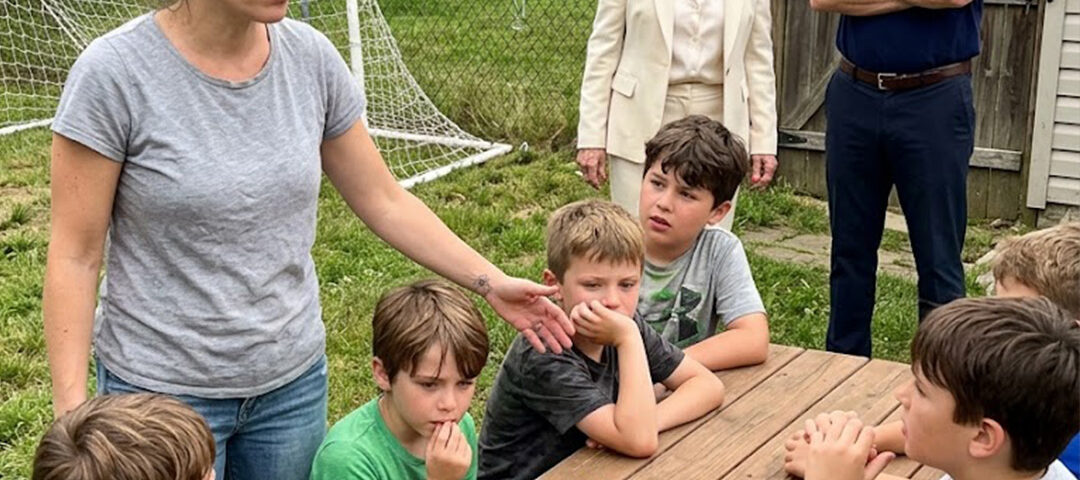
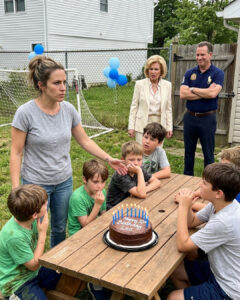
I marched over to the wooden picnic table where the homemade chocolate cake was waiting.
“Alright, team!” I shouted to the lawn, my voice echoing clear and bright. “Bring it in for cake!”
A massive grin broke across Marcus’s face. He and his friends instantly abandoned the football and swarmed the table, their fear totally forgotten. I pulled out a box of matches and began striking them, lighting the ten blue candles one by one. The tiny fires danced to life in the wind.
I could feel my mother’s glare boring into the back of my neck. I could feel the sheer pressure of her hatred. I knew she was still positioned on that porch, waiting for me to falter, to look back, to dissolve into tears.
I ignored her existence.
I locked my focus onto the candles. I locked my focus onto the circle of filthy, ecstatic faces surrounding the table. I locked my focus onto my son, his eyes reflecting the flickering yellow light.
His friends launched into the birthday anthem. Their voices were deafening, completely out of tune, and absolutely beautiful. I joined them, my voice blending into the messy, glorious noise. For those thirty seconds, the rest of the planet ceased to exist. There was only my boy, his cake, and his song.
“Make a wish, Marcus,” I murmured when the final note cleared.
He closed his eyes tight, drew in a massive breath, and let it rip. Every single candle died in one shot.
The boys erupted into cheers. Marcus beamed, a look of pure, unadulterated triumph radiating from his face.
And in that exact moment, watching him smile, I felt it—a sudden weightlessness inside my ribs. A sensation of heavy iron chains, links I had carried so long I thought they were part of my skeleton, simply shattering and falling away.
I was entirely clean.
I had prioritized my child’s joy over their theater. I had chosen mental clarity over their validation. I had allowed my mother to burn with rage on my porch, and I had lit the candles anyway.
The ultimate revenge wasn’t wrapped in a clever insult. It was wrapped in the simple, defiant act of being happy.
The Truth on the Screen
They vanished before the first slice of cake even hit a plate. I didn’t even turn around to watch the retreat. I just heard the heavy metallic slam of the side gate, a final, hollow punctuation mark that was instantly drowned out by eight boys screaming for the biggest corner piece.
I handed Marcus the plastic knife, and he drove it deep into the chocolate frosting. It felt like a sacred ritual—our official declaration of independence.
The rest of the afternoon dissolved into a beautiful, sugar-fueled blur. The parents eventually materialized to collect their sons, each offering a sincere thank-you as they departed.
“Marcus is an incredible kid, Maya,” one of the mothers told me as she loaded her car. “I’ve never seen him look this alive.”
The words felt like medicine on an open wound. She saw him. She recognized his light. It was a concept so baseline, yet it was the exact acknowledgment my own flesh and blood had spent a decade denying him.
Once the final kid had gone, Marcus and I tackled the aftermath together. We gathered the greasy pizza boxes, popped the remaining balloons, and folded the stained tablecloth. We moved in a deep, comfortable harmony—the rhythm of two people who were entirely locked into the same frequency. He was physically exhausted, but vibrating with a deep satisfaction.
“That was the absolute greatest day of my entire life,” he said as he handed me cups for the dishwasher. “Ever.”
“You earned every second of it, kiddo,” I said, messing up his hair. “You deserve the world.”
We crashed onto the sofa to flip on a movie, and for a few fleeting hours, our tiny universe was flawless. But I knew the real world was hovering outside the glass.
Around nine o’clock, after Marcus had drifted off to sleep on my shoulder, I finally walked over to the kitchen counter to face my phone. Three unread text messages were waiting on the black screen.
The first was from my mother:
Mom: I have never experienced such a disgusting display of public humiliation in my entire life. You have shattered this family unit with your pathologically selfish behavior. Your father is physically ill from the stress. I am completely done with you.
The second was from Julian:
Julian: Your conduct today was narcissistic and pathetic. You owe Vanessa and me a formal apology, but that is nothing compared to what you did to Mom. You staged a toxic scene and broke her spirit. I hope you’re incredibly proud of your little stunt.
The third text—the one engineered to be the lethal blow—was from Vanessa:
Vanessa: Julian mentioned you were short on your duplex lease payment for next month. After the hostility you displayed today, we are officially withdrawing our financial assistance. Actions carry weight, Maya. Good luck.
A year ago—even a week ago—those blocks of text would have completely vaporized my sanity. I would have been consumed by a wave of hyperventilation, paralyzing guilt, and absolute terror. The financial threat regarding the rent was their nuclear option, their ultimate tool of psychological leverage. They had thrown me a life raft a few times over the years when the accounting metrics got tight, and they never let me forget it. It was another permanent entry in the family ledger that I was forbidden from ever paying off.
It was their leash, and they had just yanked it with maximum force.
The screen lit up again, buzzing with incoming notifications from extended relatives. The digital execution had commenced.
But as I stood there reading the venom on the display, something miraculous and strange occurred inside my chest.
I didn’t flinch.
I felt a microscopic ghost of the old panic, a faint echo of the ancient terror, but it was hollow and powerless. It possessed exactly zero leverage over my soul. I saw the words for what they truly were—not an evaluation of my character, but a definitive diagnosis of theirs.
They were nothing but desperate, clumsy prison guards screaming at an inmate who had already cleared the wall.
Guilt. Rage. Financial execution. It was the only ammunition left in their arsenal.
Right then, a low, rhythmic knock sounded at my front door. I pulled it open to find Elena, my closest coworker and fellow single mother, holding a chilled bottle of white wine. We had an ironclad pact to serve as each other’s emergency contacts whenever life went sideways.
“I tracked your party updates on social media,” she said, stepping over the threshold. “The boys looked like a feral pack of wolves. I figured your nervous system would be completely fried.”
“You have no earthly idea,” I gasped, letting out a laugh that felt like oxygen returning to my lungs as I took the bottle.
We huddled around my small linoleum table, and I laid out the entire war. I told her about the ultimatum, the choice to throw the party anyway, and the uninvited infiltration of the dynasty. I detailed the porch showdown, the insults, and the words I had used to cut them down.
As the narrative spilled out, I didn’t experience a single shred of embarrassment or regret. I felt entirely clean.
When I finished, Elena sat silently for a moment, tracing the rim of her glass. She locked her eyes onto mine, a deep, analytical expression taking over her face.
“You know,” she murmured slowly, “I’ve worked alongside you for three years, and I have never seen you look like this.”
“Like what? A complete disaster?” I joked, trying to lighten the gravity.
“No,” she said, her head shaking firmly. “Not even close. You look weightless.”
The word hit me with the velocity of a religious awakening.
Weightless.
That was the exact diagnosis. A crushing, invisible armor I had worn since my first memory had simply disintegrated. The pressure of their toxic standards, their constant surveillance, and their silent, suffocating hatred had vanished into thin air. I was light because I was finally, truly alive.
I flipped my screen around, showing her Vanessa’s message regarding the lease money. Elena scanned the text, her pupils narrowing into slits.
“Wow,” she breathed, her voice dripping with disgust. “That isn’t family love, Maya. That’s a hostage situation.”
“I know,” I said. And for the first time in thirty-four years, I meant it down to my bones.
We didn’t spend the next hour drinking wine. We spent it on my laptop, scouring real estate listings. The concept of absolute independence, which had always felt like a distant, impossible fantasy, suddenly crystallized into a concrete strategic plan.
The threat of losing their rent money wasn’t a chain pinning me to their floor anymore.
It was the key that unlocked the exit.
They believed they were dropping a nuclear bomb on my life. In reality, they had just handed me the ultimate liberation—an ironclad reason to disappear forever.
The Sound of Freedom
By the time Monday night arrived, the deal was sealed.
I located a microscopic, immaculate one-bedroom flat two towns over, well outside their social perimeter. The square footage was significantly smaller than our current duplex, and the neighborhood lacked any luxury pedigree, but the monthly cost was completely sustainable on my single income alone. It would require ruthless budgeting, but we would survive.
We didn’t require their charity. We didn’t require a single scrap of their existence.
That identical evening, Marcus and I began packing our lives into cardboard boxes. We lined up our novels, packed our plates into old newspapers, and cleared the art from the drywall. Every strip of packaging tape I sliced felt like sealing a coffin on the past.
I wasn’t just organizing our physical belongings; I was boxing up their rules, their manufactured shame, and the legacy of a life where I was a background extra in my own story. I was walking toward sanity, and the path was paved with moving boxes and packing tape.
That relocation saved our lives. It sounds theatrical, but it is the literal truth.
The tiny flat, complete with its warped hardwood floors and a kitchen that could barely tolerate two people standing side-by-side, became our fortress. It was the very first perimeter that felt entirely untainted—a domain where the air wasn’t thick with the smoke of someone else’s judgment.
The transformation in Marcus was instantaneous. The deep, defensive crease that had been permanently carved between his young eyebrows completely smoothed out. He started sleeping heavily through the night, cured of the occasional night terrors where he would wake up sobbing, terrified that he was in trouble simply for being too loud or playing too hard.
In our new sanctuary, there was no authority to offend. He could scream at the television during games. His booming laughter bounced off the small walls, filling the rooms. It was a frequency I realized I hadn’t permitted him to hit nearly enough.
He integrated into his new school effortlessly. The kids there didn’t view him as the secondary, poor cousin of the glorious golden children. They just saw Marcus—the kid with a lethal left foot on the soccer field who told brilliant jokes.
He exploded into life. He was morphing into the exact human being he was always engineered to be, completely removed from the poisoned soil of my mother’s empire.
I went through a parallel evolution. Without the chronic, low-grade adrenaline spike of waiting for my mother’s next critique or my brother’s next entitlement, my own skeletal structure relaxed. I locked into my accounts, pulled in three independent local clients, and realized that my solo revenue was more than enough to anchor our modest lifestyle.
We weren’t elite, but we were sovereign. That intoxicating hit of self-determination carried a value no check from my brother could ever match.
I went completely dark on my family for months. After an initial, hysterical wave of abusive messages, their phones went silent. I knew their strategy: they were waiting for the money to run out, waiting for me to crawl back on my knees, begging for the financial life support they had cut.
When the surrender never materialized, their system broke down. My self-sufficiency had completely stripped them of their currency.
A full year passed in that beautiful, uninterrupted cadence. Before I could even process the time, Marcus’s eleventh birthday was on the horizon. This time around, there was zero strategy, zero negotiation, and zero anxiety. We engineered his celebration out in the open air, completely unshaded.
We invited his entire fifth-grade class to a public park. We ordered stackable pizzas, a massive store-bought cake he picked out himself, and fifty bright balloons. It was a loud, rowdy, intensely public festival of joy. I took dozens of photos, streaming them to my social channels without a single second thought.
There was Marcus, surrounded by a roaring circle of smiling kids, his face completely painted in blue icing. He looked radioactive with joy.
A few afternoons later, I was standing over my small counter frosting cupcakes for his school’s spring bazaar when a heavy, aggressive knock rattled my front door.
My heart didn’t even twitch with panic. All I felt was a tired, heavy sense of reality.
I pulled the door open, and there stood Julian.
He looked absolutely decimated. He had deep, dark bruises under his eyes, and his designer shirt was wrinkled and stained. He looked vibrating with anxiety and rage—a total contradiction to the immaculate patriarch he simulated in his digital feeds.
He didn’t wait for permission. He shoved his way past my shoulder, stepping into my tiny living room and scanning the parameters with a venomous sneer.
“This is your grand victory?” he mocked. “This is the empire you abandoned your blood for? A shoe box?”
“It’s a home, Julian,” I said, my voice dead level as I clicked the lock behind him. “State your business.”
“My business?” He whipped around, his pitch spiking. “I want you to look at the wreckage you’ve caused. Mom saw the public photos from his park party. She has been hysterical for days. Days, Maya. You have completely dismantled her reputation in the community. Her friends are asking why her grandson is throwing public park parties, and she is forced to construct lies because the reality of your behavior is too humiliating to admit.”
I just stood there, observing him.
After twelve months of total silence, that was his emergency. Not a single inquiry into my well-being. Not a single question about how his nephew was growing. His entire universe was pinned to his mother’s vanity. The narrative she fed her friends. The pristine facade of their dynasty that had suffered a catastrophic fracture.
He hadn’t traveled to my home because he missed his sister. He was standing in my living room because my independent happiness was a PR crisis for their empire.
The old Maya would have engaged. I would have constructed a passionate defense, fought his logic, or collapsed into tears. But the woman standing on that cheap hardwood floor was a stranger to him. I felt nothing but a profound wave of pity for how suffocatingly small his reality was. He was still grinding away inside a game, completely blind to the fact that I had flipped the board over a year ago.
I let him ride out his tantrum. I let him bleed out all his displaced stress and corporate fury. When he finally hit a wall, his chest heaving for oxygen, I fixed him with a calm gaze.
“Her reputation?” I asked, my voice barely a whisper. “This entire visit is about her reputation?”
“Of course it is!” he yelled. “Family demands absolute loyalty! We protect the image!”
I shook my head slowly, a faint, melancholic smile hitting my lips.
“No, Julian. You’ve got it completely wrong.”
I took a deep breath, the rich scent of vanilla and sugar from the kitchen filling my lungs. And then I delivered the final, crushing truth that had taken a year to ferment in my soul.
“Maybe she should stop optimizing her image,” I said, “and start repenting for her reflection.”
He stared at me, his jaw dropping open. He had absolutely zero counter-argument.
The words slammed into him, and for a fraction of a second, I tracked a sudden panic cross his eyes. It wasn’t realization; it was total disorientation, as if I had suddenly spoken to him in a language from another planet. He possessed zero tactical defenses against a human being who operated in absolute truth. His weapons—guilt, corporate intimidation, financial dominance—were completely useless in this room.
He exited without uttering another syllable, his neck crimson with a volatile mix of frustration and unwashed shame. I tracked his retreat through the window, then neatly clicked the deadbolt into place. I walked back into the kitchen, picked up my frosting bag, and returned to finalizing the cupcakes for my son’s school.
The war was long over, and I hadn’t even realized I had won it until that exact second.
The peace inside my tiny flat was total.
I used to believe that forgiveness meant crawling back into the cage, pretending the poison didn’t exist, and allowing the people who mangled your spirit to do it again. Now, I understand that real forgiveness is a solitary act of self-preservation. It means exiting the theater without an ounce of malice. It means accepting that you possess zero power to transform human beings, but you hold absolute power over whether they are permitted to cut you again. It means locating your own peace, even if you have to build it entirely outside the grid.
My mother has never issued an apology. She likely never will. She fires off sporadic, vague text messages filled with prose about “family solidarity” and how much she longs for the “old days.”
What she actually longs for is the version of me she could control.
I respond whenever I feel like it, utilizing polite, sterile, distant sentences. The sovereignty is mine now. The communication happens entirely on my terms.
Marcus is twelve now. He’s turning tall and angular, hovering right on the precipice of young adulthood. He is profoundly decent, sharp-witted, and absolute in his confidence. When he laughs, it’s a massive, unfiltered, chest-deep noise that fills the room.
It sounds exactly like liberation. It is the definitive soundtrack that reminds me I made the right call.
So if you have ever been instructed to extinguish your own light simply because your joy makes someone else feel insignificant—don’t you dare. You are not toxic for protecting your sanity. You are not malicious for prioritizing your child’s right to breathe.
And if you have ever been forced to abandon the people who built you just to give your own heart a fighting chance at survival, remember this:
Real peace isn’t defined by the presence of a traditional family.
It is defined by the presence of a love that never demands a license to exist.