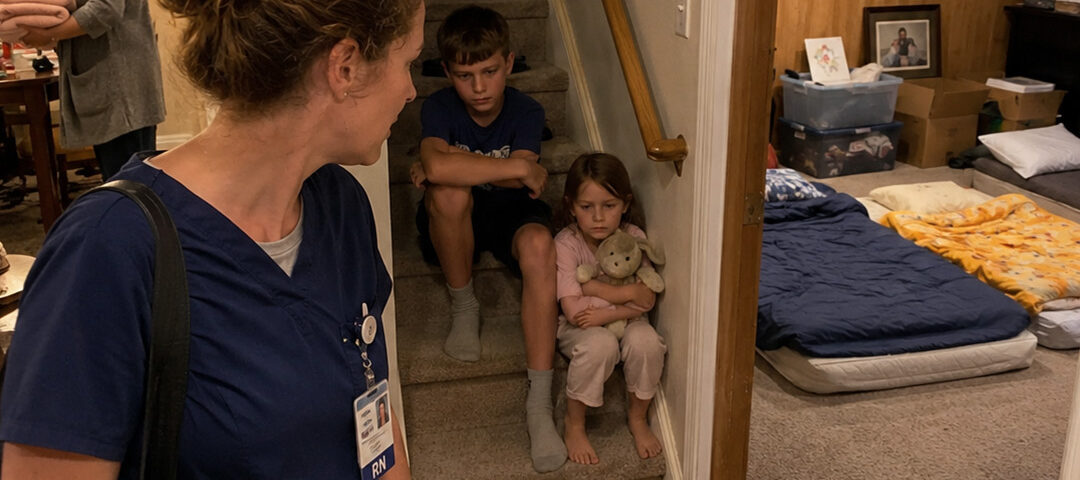
“The basement is where they’ll sleep now.”
My mother said it from the hallway as though she were explaining where she had stored the extra towels.
I had just worked a twelve-hour nursing shift, the kind that leaves your feet aching before lunch and your thoughts reduced to simple things by the drive home. I had pictured a hot shower, leftover pasta, and my children arguing over whose turn it was to choose the movie.
Instead, I walked into silence.
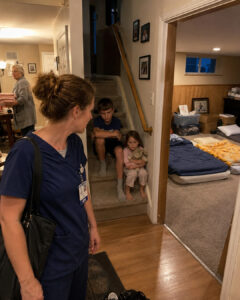
Mason sat halfway down the basement stairs with his arms wrapped around his knees. He was nine years old, long-legged and serious, with the same habit I had of becoming very quiet whenever he was hurt. Ivy sat beside him holding her stuffed rabbit so tightly that one of its ears had folded beneath her fingers.
Both of them had been crying.
Not loudly.
They had cried the careful way children cry after learning that too much emotion makes adults tell them to calm down.
I dropped my work bag beside the front door.
“What happened?”
Mason looked toward the living room before answering, as though he needed to know who might hear him.
Ivy did not wait.
“Grandma said we have to sleep downstairs now because Tyler needs our room.”
Her voice broke on the last word.
I crouched in front of them, still wearing navy scrubs and the hospital badge clipped to my pocket.
“What do you mean, downstairs?”
Mason pointed behind him.
I followed the narrow staircase into the finished basement.
My parents had always described the space as comfortable. It had paneled walls, an old sectional sofa, a television, and a square window near the ceiling that showed the lower half of the backyard fence. The furnace occupied a utility room behind a thin door and began humming every twenty minutes.
It was not a terrible basement.
That was never the point.
Two twin mattresses had been placed on the carpet beside a stack of moving boxes. Mason’s blue comforter was folded on one mattress. Ivy’s yellow blanket lay on the other. Their clothes had been packed into plastic bins and lined against the wall.
Someone had already removed their drawings, books, and night-light from the bedroom upstairs.
Their lives had been relocated before anyone told them a decision had been made.
On top of one box sat Mason’s framed class photograph. The glass had a fingerprint in the corner.
Beside it was a drawing Ivy had made of our family three weeks earlier. She had drawn herself, Mason, and me in front of my parents’ house, all of us holding hands beneath a bright orange sun.
The page had been folded down the middle.
“Did Grandma ask you before she moved your things?”
Mason shook his head.
“She said we should be grateful because some kids share one bed.”
I closed my eyes for a second.
When I opened them, Mason was watching me with an expression no child should have to practice.
“Are we in trouble?” he asked.
“No.”
“Did we do something?”
“No, honey.”
“Then why does Tyler get our room?”
I looked at the mattresses, the boxes, and the small basement window.
I could not give him the answer my mother expected me to give.
Tyler is younger.
Your uncle is having a hard time.
It is only temporary.
Family makes sacrifices.
All of those statements might have been true.
None answered his question.
“Go put your shoes on,” I said. “Both of you.”
Ivy’s grip loosened slightly around the rabbit.
“Where are we going?”
“Upstairs first.”
My mother was in the hallway linen closet, refolding towels with the careful concentration of someone who wanted to appear busy. My father sat in his recliner with the television on. A basketball game played across the screen, though his eyes remained fixed on the same spot long after we entered.
“You moved my children to the basement,” I said.
It was not a question.
My mother placed a folded towel on the shelf.
“Temporarily.”
“For how long?”
“Tyler is coming to stay for a few weeks while Daniel gets settled.”
Daniel was my younger brother. He and his wife, Leah, had separated recently, and he was leaving their townhouse until they decided what came next. Tyler, their four-year-old son, would spend several nights each week with him.
I knew they were struggling.
I knew Tyler needed stability.
I also knew my children had already spent eight months trying to find stability after my own marriage ended.
“He needs a proper room,” my mother continued.
“Mason and Ivy needed a proper room too.”
“The basement is finished.”
“That isn’t what I said.”
My father picked up the remote and muted the television.
“We put the good mattresses down there,” he said. “It’s warm.”
Mason moved closer to my side.
I felt his shoulder against my hip.
My mother looked at the children and softened her tone.
“You can make it fun. It can be like camping.”
Ivy looked toward the basement door.
“Camping has tents.”
My father almost smiled, but my mother did not.
“Renee, we’re trying to solve a family problem.”
“So am I.”
She folded another towel.
“Tyler is little. He wakes during the night. Daniel needs to be close to him, and your old bedroom is too small for both of them.”
“Then where is Daniel sleeping?”
“The den.”
“The den has a pullout couch.”
“It is not appropriate for a four-year-old.”
“But the basement is appropriate for a seven-year-old and a nine-year-old.”
Her mouth tightened.
“You are twisting this.”
“I’m repeating it.”
The room became quiet.
My father shifted in his chair. Mason stared at the floor. Ivy rested her head against my arm.
I had imagined this kind of confrontation many times over the previous eight months. In those imaginary arguments, I raised my voice. My mother raised hers. My father accused me of ingratitude. Someone walked out.
What I actually felt was not explosive.
It was clarity.
Sharp, quiet clarity.
The kind that arrives when dozens of small compromises finally add up to something you can no longer explain away.
“Pack what you need for tonight,” I told the children.
My mother turned from the closet.
“Where are you going?”
“Not far.”
“You just finished a shift.”
“I know.”
“Renee, don’t be dramatic. It’s one room.”
“It has never been one room.”
She blinked.
I took off my hospital badge and set it on the entry table.
“It has been eight months of one thing after another. I let it go because I was tired, grateful, and trying to rebuild. I told myself the small things did not matter.”
“What small things?”
“Tyler’s photographs went on the mantel the first week after they were taken. Mason’s and Ivy’s school pictures are still in the drawer beneath the phone.”
My mother glanced toward the living room.
“That is not intentional.”
“The Easter baskets had their names written on paper tags because you forgot to order them. Tyler’s had his name stitched into the fabric.”
“He is younger.”
“When you take them to lunch, you call it helping me. When Tyler visits, you call it making memories.”
“That is unfair.”
“When Mason had his school concert, you left before his song because Daniel called and said Tyler wanted ice cream.”
“Tyler was upset.”
“Mason noticed.”
My mother’s eyes moved toward him.
Mason looked away.
I continued because if I stopped, I knew I would return to silence.
“You gave Tyler the first piece of birthday cake at Ivy’s party because he was the youngest. You let him open one of her gifts because he felt left out. You told her she was old enough to understand.”
Ivy pressed the rabbit against her chest.
My mother looked genuinely surprised.
“Ivy, you never told me that upset you.”
Ivy whispered, “You said I was being selfish.”
My father lowered the remote into his lap.
My mother sat down slowly on the arm of the couch.
“I don’t remember saying that.”
“She does,” I said.
Her face changed, but only briefly.
Then the defense returned.
“We have done everything for you since the divorce.”
“I know.”
“You needed a place to live. We opened our home.”
“I know.”
“We never asked for rent.”
“I offered.”
“We refused because you are our daughter.”
“And I have thanked you every day. I buy groceries. I cook. I clean. I take Dad to his appointments. I have never pretended you did not help us.”
“Then why are you speaking as though we have treated you terribly?”
“Because gratitude does not require me to pretend my children are not being taught that they matter less.”
My father stood.
“That is not what anyone is teaching them.”
I looked at the basement door.
“They came home from school and found their belongings packed into bins because someone more important needed their room.”
“No one said more important,” he replied.
“You did not have to.”
Mason’s face tightened.
That expression made the decision for me.
I had spent years learning how quickly children absorbed the rules adults never said aloud.
At the hospital, I worked in a pediatric unit. I had cared for children who apologized when they needed pain medication and children who believed being quiet made them easier to love. I had sat beside parents and explained that a child’s fear did not disappear simply because an adult had practical reasons for causing it.
Yet in my parents’ house, I had begun doing exactly what I warned others against.
I had asked Mason and Ivy to keep understanding.
Understand why Grandma forgot.
Understand why Grandpa was tired.
Understand why Tyler needed more attention.
Understand why Daniel’s problems filled every room.
Understand why we had to be grateful.
Children can understand many things.
That does not mean adults should repeatedly ask them to absorb the cost.
“We’re leaving,” I said.
My mother stared at me.
“Where would you even go?”
I reached into my work bag and removed a manila envelope.
I had carried it for eleven days.
Inside was a copy of a lease application, a savings statement, and a handwritten note from a property manager named Monica Greene. The apartment was in a low brick building near the elementary school. It had two bedrooms, thin walls, older appliances, and a narrow balcony overlooking a parking lot.
It was not available for another month.
I had planned to tell my parents after the final approval.
“I have an apartment lined up.”
My father looked at the envelope.
“You signed a lease?”
“Not yet. The unit becomes available next month.”
“You cannot move tonight, then.”
“No. But we are not sleeping here tonight.”
My mother stood again.
“Renee, this is ridiculous.”
“I called my friend Tasha from the driveway. She said we can stay with her for a few nights.”
“You called someone before speaking to us?”
“I made sure my children had somewhere to go.”
Her expression sharpened as though my preparation were a personal betrayal.
“How long have you been planning to leave?”
“Since the second month.”
“And you said nothing.”
“I was waiting until I could afford it without risking the kids’ stability.”
“We thought you were rebuilding here.”
“I was.”
“Then why save secretly?”
“Because I needed to know I could leave before anyone could make me feel as though I had no choice.”
My father looked wounded.
“We would never hold this house over you.”
I thought of the number of times my mother had said under our roof when I disagreed with her. I thought of the way my father became silent whenever she reminded me how much rent cost in the area.
“You may not have meant to,” I said. “But I felt it.”
My mother crossed her arms.
“So this has all been an act.”
“No. The dinners, the help, the gratitude—none of that was an act. I love you. The children love you. But love does not make every arrangement healthy forever.”
She looked toward Mason and Ivy.
“Are you telling your mother you want to leave?”
The question landed in the room exactly as she intended.
Mason’s face went pale.
I stepped between them.
“Do not make them answer that.”
“I am only asking.”
“You are asking children to choose between their mother and their grandparents while they are already upset.”
“I want to know what they think.”
“They thought they had a bedroom this morning.”
My father inhaled slowly.
“Everyone needs to calm down.”
“I am calm.”
“You’re taking them away over a sleeping arrangement.”
“I am taking them somewhere they do not have to wonder whose needs will move them next.”
My mother looked toward the basement.
“We can put their things back.”
The offer came too quickly.
Not because she understood.
Because she wanted the immediate consequence to stop.
“This is not about winning the room back,” I said.
“What else do you want?”
“I want you to understand why you moved them without asking.”
“We did it for Tyler.”
“That is who benefited. It is not why you believed it was acceptable.”
She stared at me.
I could see the answer forming before she spoke.
“You are easier.”
There it was.
The truth was so quiet that my father looked toward her in surprise.
My mother pressed her lips together.
“I did not mean—”
“You knew I would manage it,” she continued. “You always manage things. Daniel is overwhelmed. Tyler is sensitive. We thought you would understand.”
“I did understand.”
My voice shook for the first time.
“I understood so many times that you stopped asking what understanding cost me.”
She sat down again.
My father rubbed one hand over his face.
For several seconds, the only sound came from the muted basketball game and the furnace turning on beneath us.
I looked at my mother.
“I am not angry that you love Tyler. I love him too. I am not blaming a four-year-old for needing a room or my brother for going through a separation.”
“Then why are you doing this?”
“Because my children just learned that they are the ones who get moved when someone more difficult arrives. I am not letting that lesson settle.”
My mother’s eyes filled.
“We never wanted them to feel unwanted.”
“I know.”
The answer surprised her.
“That is the part that frightens me. You did not do this to hurt them. You did it without thinking about them at all.”
The children packed small overnight bags.
Mason chose three books, his headphones, and the old baseball cap his father had given him. Ivy packed pajamas, a toothbrush, six crayons, and three stuffed animals before I convinced her to leave two behind.
While they gathered their things, my father followed me into the kitchen.
“You really have enough saved for an apartment?”
“Yes.”
“How?”
“I have been picking up weekend shifts.”
“You already work full-time.”
“I know.”
“Does your mother know?”
“No.”
He leaned against the counter.
“You should have told us.”
“Would it have changed anything?”
“We might have helped.”
“You were helping. I did not need more help. I needed an exit that belonged to me.”
He looked toward the hallway.
“Your mother is not good with surprises.”
“Neither were my children.”
He closed his eyes.
That was the first moment I believed he understood even a small part of what had happened.
Tasha lived fifteen minutes away in a townhome with her teenage daughter. She opened the door wearing sweatpants and a shirt from the hospital’s annual charity race.
Mason and Ivy stood close beside me.
Tasha looked at their overnight bags, then at my face.
“Guest room is ready,” she said.
No questions.
No commentary.
She led the children upstairs, showed them the bathroom, and brought out extra blankets. Her daughter ordered pizza and invited Mason to choose a movie. Ivy sat cross-legged on the rug, still holding the rabbit.
Later, after the children fell asleep, Tasha and I sat at the kitchen island with mugs of tea.
“You did the right thing,” she said.
“I do not know yet.”
“You knew enough.”
“I might have waited another month.”
“Maybe.”
“I have no furniture.”
“You have beds.”
“Those belong to my parents.”
“You can buy beds.”
“I have to pay the deposit.”
“You saved for the deposit.”
“I did not save for moving early.”
She reached across the island and took my phone.
“What are you doing?”
“Calling Monica.”
“At eleven at night?”
“Leaving a message.”
She opened the contact information from the apartment application and dialed.
Monica returned the call the next morning.
The current tenant had already moved out, but maintenance was not scheduled to finish painting for two more weeks. If I accepted the unit as it was and signed the lease immediately, she could give me access in three days.
“There are nail holes in the walls,” she warned.
“I own a hammer.”
“The bedroom carpet is clean but old.”
“My children have lived with a furnace humming beside their beds.”
She became quiet.
“I’ll prepare the papers.”
I signed the lease at a small desk inside the apartment office.
Monica slid a folder toward me. The lease, building rules, emergency contact form, and receipt for the deposit were clipped together.
Then she placed two brass keys on top.
I stared at them longer than necessary.
For eight months, every key I carried belonged to someone else’s space. The key to my parents’ front door had come with an unspoken reminder that we were guests. The key to my old marital home no longer opened anything.
These keys were ordinary.
One had a blue plastic cover. The other had a small scratch across the head.
They felt heavier than they looked.
“Everything okay?” Monica asked.
“Yes.”
I closed my fingers around them.
“Everything is finally clear.”
Daniel called that evening.
I was sitting in Tasha’s dining room comparing prices for mattresses when his name appeared on my screen.
I considered ignoring it.
Then I answered.
“Mom says you are moving out because of Tyler.”
“I am moving because of a decision Mom and Dad made.”
“He is four, Renee.”
“I know how old he is.”
“He is confused. Leah and I are separating. He needs consistency.”
“So do Mason and Ivy.”
“They are older. They understand more.”
“That is exactly what everyone keeps saying when they want them to accept less.”
Daniel sighed.
“Why are you turning this into competition?”
“I am not competing with your son.”
“It sounds like you resent him.”
“I resent that the adults around him treat his comfort as automatically more important.”
“That is not fair.”
“You did not ask where my kids would sleep.”
Silence.
“I assumed the basement.”
“Yes.”
“It’s a nice basement.”
“That is not the point.”
“What is the point, Renee?”
“The point is that our parents packed up my children’s room without asking because they believed I would accommodate everyone. Then you called to defend Tyler without asking how Mason and Ivy felt.”
He exhaled.
“I am dealing with a separation.”
“So am I.”
“Your divorce is final.”
“The paperwork is final. The children do not wake up magically healed because a judge signed something.”
He did not respond.
I looked at the apartment listing on my laptop. The living room appeared larger in the photograph because of the wide-angle lens. The kitchen had brown cabinets and a refrigerator with one mismatched handle.
“I am sorry you are struggling,” I said. “I mean that. But my children are not the extra space everyone gets to use when your life becomes difficult.”
Daniel’s voice softened.
“I did not ask them to move.”
“You accepted it without asking who had to.”
After the call, I sat in Tasha’s quiet dining room with the new keys beside my laptop.
I did not feel victorious.
I felt tired.
Boundaries are often described as bold lines drawn in a single brave moment. Mine looked like spreadsheet columns, discounted mattresses, a utility deposit, and a calculation of how many extra shifts I could safely work without becoming absent from the children I was trying to protect.
The next three weeks passed in cardboard boxes.
My parents allowed us to return for our belongings, but every visit carried a different kind of pressure.
The first time, my mother followed me from room to room.
“You do not need to take the dressers.”
“The apartment has none.”
“We bought them.”
“You bought them for the children.”
“They can use them when they visit.”
“They need them where they live.”
Her face tightened.
“So they are never staying here again?”
“I did not say that.”
“You are making it sound permanent.”
“The apartment lease is for a year.”
“What happens after that?”
“I do not know.”
She stood in the doorway of the children’s old bedroom.
The room already looked different. My parents had purchased dinosaur bedding for Tyler. A night-light shaped like a moon glowed beside the bed. New toy bins sat against the wall.
Mason saw them from the hallway.
He did not say anything.
He walked downstairs and carried out a box of books without being asked.
That night, in Tasha’s guest room, he lay awake while Ivy slept on the other mattress.
I sat beside him.
“You okay?”
“Did Grandma buy all that stuff for Tyler?”
“Yes.”
“She packed our things in boxes.”
“Yes.”
“She could have bought us new stuff.”
I swallowed.
“She could have.”
He stared at the ceiling.
“Does she like him more?”
The question hurt because it was simple.
Children do not ask whether adults have unconscious patterns, conflicting loyalties, or different expressions of affection. They ask what behavior means.
“I think Grandma loves all of you,” I said carefully. “But sometimes adults show love in ways that are not fair.”
“Why?”
“Because they get used to expecting certain people to adjust.”
“Like us?”
“Like me. And then you, because you are mine.”
He turned toward me.
“Are you mad at Grandma?”
“Yes.”
His eyes widened slightly.
“I am also sad. And I still love her. All three things can be true.”
“Are you going to forgive her?”
“I do not know what forgiveness will look like yet.”
He considered that.
“Can I be mad too?”
“Yes.”
“Even if she says sorry?”
“Yes.”
He closed his eyes.
“Okay.”
I stayed beside him until he fell asleep.
Moving day came on a gray Saturday morning.
Beatrix, one of my coworkers, arrived with her husband and a borrowed pickup truck. Tasha brought breakfast sandwiches. Monica unlocked the service entrance and showed us how to reserve the elevator with a brass key.
My father arrived alone.
He carried a toolbox and did not mention my mother’s absence.
“I thought you might need shelves installed,” he said.
The apartment smelled like fresh paint and old carpet. Sunlight came through the sliding glass door and fell across the empty living room.
Mason walked from room to room, counting outlets.
Ivy opened every cabinet in the kitchen.
“There’s no dishwasher,” she announced.
“We have three dishwashers,” I said.
“Who?”
“You, Mason, and me.”
Mason groaned.
For the first time in weeks, Ivy laughed.
The apartment had two bedrooms. I had assumed the children would share one while I used the smaller room.
Mason stood in the doorway.
“Which side is mine?”
I looked at the two rooms.
“You each get one.”
“Where will you sleep?”
“The living room for now.”
He frowned.
“You need a room.”
“So do you.”
“We can share.”
Ivy appeared beside him.
“I don’t want him touching my stuff.”
“I do not touch your stuff.”
“You touched Mr. Rabbit.”
“I moved him off my pillow.”
I raised both hands.
“You will each have a room. I bought a sleeper sofa.”
The sofa would not arrive for another week, but I had found one on clearance and paid in installments.
Mason looked uncertain.
“Can I really choose?”
“Yes.”
He selected the room facing the parking lot because he could see the school bus stop from the window.
Ivy chose the smaller room because it had a wall wide enough for her drawings.
She taped the first picture up before the moving boxes had been opened.
It was another drawing of our family.
This time, the house behind us was a tall rectangle with three windows. A row of cars filled the bottom of the page.
Above the building, she drew the same bright orange sun.
My father installed shelves in both rooms. He worked quietly, measuring twice before drilling.
Near lunchtime, he found me unpacking dishes in the kitchen.
“Your mother wanted to come.”
“She could have.”
“She was afraid you would ask her to leave.”
“I would not have.”
“She does not know what to say.”
“She could start with Mason and Ivy.”
He looked toward the bedrooms.
“She is embarrassed.”
“That is not the same as sorry.”
“No.”
He placed a level on the counter.
“I am sorry.”
I looked at him.
He kept his eyes on the tool.
“I should have stopped it before you came home,” he said. “Your mother told me her plan that afternoon. I thought it was easier to let her handle the rooms.”
“Easier for whom?”
He nodded.
“That is what I keep asking myself.”
I did not rush to comfort him.
He had apologized. That mattered.
It did not require me to erase the consequence.
“Thank you for saying it.”
He looked up.
“I miss the kids.”
“They miss you too.”
“Can I take them for lunch next weekend?”
“Ask them.”
His expression shifted.
“You want me to ask the children?”
“Yes. They should have some control over when they are ready.”
He nodded slowly.
“I can do that.”
Our first night in the apartment, we ate pizza on paper plates because the table had not arrived.
The walls were thin enough that we could hear a baby crying next door and someone upstairs dropping what sounded like a shoe every ten minutes. The refrigerator rattled whenever the motor started. The parking lot lights shone through the blinds.
It was one of the most peaceful nights of my life.
No one reminded us that the space belonged to someone else.
No one changed the rules after we went to school.
No one asked the children to understand why they had been moved.
After dinner, Mason arranged his books on the shelves Grandpa had installed. Ivy fell asleep beneath three drawings and a paper chain she had made from construction paper.
I lay on an air mattress in the living room and listened to the apartment settle.
My body ached from lifting boxes.
My checking account balance frightened me.
The future was not secure in the way I wanted it to be.
Yet when I closed my eyes, I could breathe.
My mother came to the apartment two weeks later.
She brought a covered casserole, a bag of groceries, and two framed photographs.
Mason’s school portrait.
Ivy’s school portrait.
She stood in the hallway until I invited her inside.
The children were in their rooms. They had heard her knock but had not come out.
My mother placed the casserole on the kitchen counter.
“This place is nice.”
“It is small.”
“Small can be nice.”
I waited.
She touched the edge of one frame.
“I found these in the drawer.”
“I know.”
“I should have put them up.”
“Yes.”
Her mouth trembled.
“I did not understand what I was doing.”
“You understood that Tyler needed to feel welcome.”
“Yes.”
“You did not ask what Mason and Ivy needed.”
“No.”
The answer was barely audible.
She looked toward their rooms.
“I kept thinking you were strong.”
“I am.”
“I treated that as though it meant you did not need care.”
I leaned against the counter.
“That has happened my whole life.”
She closed her eyes.
“When Daniel struggled in school, we hired tutors. You came home with good grades, so we assumed you were fine.”
“I studied at the library because it was quiet.”
“When he lost jobs, we helped him make plans. You worked two jobs and never asked for anything.”
“I stopped asking because the answer was usually that Daniel needed more.”
She opened her eyes.
“I do not know how I failed to see it.”
“You benefited from not seeing it.”
The sentence was difficult to say.
It was also true.
She nodded.
“I did.”
We stood in the small kitchen while the refrigerator rattled between us.
“I want to apologize to the children,” she said.
“Do not ask them to make you feel better.”
Her eyes filled.
“I won’t.”
“Do not explain that Tyler is younger.”
“I won’t.”
“Do not say you are sorry they were hurt. Say what you did.”
She looked toward the hallway.
“All right.”
Mason came out first.
He stood near his bedroom door with his hands in his pockets. Ivy followed, holding Mr. Rabbit.
My mother crouched so she was closer to their height.
“I moved your things without asking,” she said. “I gave your room to Tyler because I assumed you would adjust. That was unfair. You were not being selfish, and you did nothing wrong.”
Ivy looked at me.
I stayed silent.
My mother continued.
“I am sorry I made you feel as though your place in the house could disappear.”
Mason’s jaw tightened.
“Do we have a room there now?”
My mother took a breath.
“Your old room is being used by Tyler when he visits.”
Mason looked down.
“But Grandpa and I are turning the den into a room that belongs to you and Ivy when you choose to stay. We will not move your things without asking.”
“Is it smaller?” Ivy asked.
“Yes.”
She frowned.
My mother nodded.
“It is smaller, and I understand why that may still feel unfair.”
The honesty changed something.
Not everything.
Something.
Ivy looked at the framed photographs on the counter.
“Where are those going?”
“Wherever you want,” my mother said.
Mason carried his frame into his bedroom.
Ivy took hers and placed it on the dresser beside Mr. Rabbit.
Neither child hugged my mother that day.
She did not ask them to.
She stayed for dinner and listened while Mason explained the view from his window. She asked Ivy about every drawing on the wall, even the one that was only purple circles.
When she left, she paused beside me in the hallway.
“Thank you for letting me come.”
“This does not mean everything is fixed.”
“I know.”
“Good.”
Three months passed.
The apartment filled slowly.
A used dining table came from a nurse in my unit who was moving out of state. Tasha found lamps at a yard sale. My father built a narrow bookshelf for the living room and asked before attaching it to the wall.
I learned how far my paycheck could stretch when every expense had a name.
I also learned that peace creates energy.
At my parents’ house, I had been constantly adjusting—managing moods, anticipating criticism, explaining the children, defending my schedule. In the apartment, my responsibilities were heavier, but they were clear.
I worked fewer extra shifts after the move.
I attended Mason’s science fair.
I helped Ivy paint a cardboard castle for school.
On Friday nights, we ate popcorn on the sleeper sofa and watched movies beneath blankets.
The children still visited my parents, but the visits became shorter and more intentional. My father picked them up only after asking. My mother stopped changing plans without discussing them with me.
The den became their room.
My father painted it pale blue. My mother placed both school portraits on the mantel beside Tyler’s.
Not above.
Not below.
Beside.
Daniel avoided me for nearly four months.
Then he appeared at the hospital cafeteria during one of my breaks.
He looked tired. The separation had become permanent, and he was sharing custody of Tyler. He carried a paper coffee cup and sat across from me without asking.
“I owe you an apology.”
I unwrapped my sandwich.
“For which part?”
He accepted the question.
“For assuming your kids should make room for mine because my situation felt more urgent.”
I waited.
“I kept thinking Tyler was the youngest, so everyone should adjust around him. Leah told me I do it too.”
“What happened?”
“He had a birthday party at her apartment. Another child wanted the blue cup. Tyler started crying, and I told the other kid to give it to him.”
“That sounds familiar.”
“Leah asked why Tyler’s disappointment always became someone else’s responsibility.”
I looked at him.
He rubbed both hands around the coffee cup.
“I heard your voice.”
“I am sorry.”
He almost smiled.
“No, you’re not.”
“No.”
He looked through the cafeteria window toward the hospital parking garage.
“I didn’t think about Mason and Ivy.”
“I know.”
“That sounds worse when I say it out loud.”
“It should.”
He nodded.
“Can Tyler visit your apartment sometime?”
“Yes.”
“Really?”
“He is my nephew. He did not create the problem.”
“I was afraid you blamed him.”
“I blamed the adults.”
Daniel looked down.
“That includes me.”
“Yes.”
He accepted that too.
The following month, Tyler spent a Saturday afternoon with us.
He and Ivy built a blanket fort in the living room. Mason showed him how to play a racing game. At dinner, Tyler asked whether he could sleep in Ivy’s room.
Ivy looked at me.
“It is your room,” I said. “You decide.”
She considered the request.
“Only if he sleeps on the floor.”
Tyler grinned.
Daniel looked toward me.
Neither of us said anything.
The difference between generosity and surrender is choice.
That night, Ivy chose.
Nearly a year after I found my children on the basement stairs, my mother invited us to Sunday dinner.
I asked the children whether they wanted to go.
Mason shrugged.
Ivy asked what dessert Grandma was making.
“Apple pie.”
“Then yes.”
When we arrived, all three grandchildren’s photographs stood on the mantel.
Dinner was quieter than the family meals I remembered. Daniel helped clear plates. My father asked Mason about baseball without checking the television. My mother listened while Ivy described a class project and did not interrupt to tell a story about Tyler.
After dessert, the children ran upstairs.
A few minutes later, we heard laughter from the den.
My mother folded her napkin.
“I still think about that night.”
“So do I.”
“I wish you had told me sooner.”
The old version of me would have apologized.
Instead, I said, “I wish you had noticed sooner.”
She nodded.
“That too.”
My father looked between us.
“Would you ever consider moving back if you needed to?”
“No.”
The answer came gently.
My mother’s face tightened for half a second, then relaxed.
“Because of us?”
“Because the apartment is our home.”
She looked toward the ceiling, where the children were moving around upstairs.
“I understand.”
And for once, I believed she did.
The apartment still had thin walls and a view of the parking lot. The refrigerator continued to rattle. My sleeper sofa had a metal bar that found the center of my back no matter how I arranged the cushions.
It was not the home I had imagined before my divorce.
Before everything changed, I had pictured raising Mason and Ivy in a house with a fenced yard, a large kitchen, and enough storage that winter coats did not crowd the entryway.
Life had given us less space than I planned.
It also gave us something I had not known we were missing.
Certainty.
Mason knew his books would remain where he left them.
Ivy knew no one would remove her drawings while she was at school.
Both children knew that if an adult wanted them to make a sacrifice, they were allowed to ask why.
Sometimes the answer might still be yes.
Families share. Children adjust. Difficult seasons require flexibility.
But adjustment would no longer be treated as proof of love.
One evening, while I folded laundry on the sleeper sofa, Mason came out of his room carrying the framed photograph that had once rested on a basement box.
“Can I get a new frame?”
“What is wrong with that one?”
“The corner is cracked.”
I took it from him.
The damage was small, a thin line along the wooden edge.
“We can replace it.”
He sat beside me.
“Do you still have the drawing from the basement?”
I knew which one he meant.
I had flattened Ivy’s folded family drawing beneath several heavy books and kept it inside the manila envelope with the old apartment application.
“Yes.”
“Why?”
“I didn’t want to lose it.”
“Even though it got folded?”
“Especially because it got folded.”
He considered that answer.
“Are you still mad?”
“At Grandma?”
He nodded.
“Sometimes.”
“Me too.”
“That is okay.”
“She is better now.”
“She is trying.”
“Does trying count?”
“Yes. It just does not erase what happened.”
He leaned back against the sofa.
“Do you think we would still live here if she had never moved us downstairs?”
I looked around the apartment.
At the dining table covered with Ivy’s colored pencils.
At Mason’s backpack beside the door.
At the key bowl on the counter, holding the two brass keys Monica had given me.
“Probably not yet,” I said.
“Then maybe something good came from it.”
“Something good came from what we chose afterward.”
He smiled slightly.
“That sounds like a nurse answer.”
“It is a mother answer.”
He took the photograph back to his room.
Later, I opened the kitchen drawer where I kept important papers.
The manila envelope lay beneath the lease and utility receipts. Inside were the original savings statement, Monica’s handwritten note, and Ivy’s drawing.
I unfolded it carefully.
The crease remained visible through the orange sun.
For a long time, I had thought protecting my children meant keeping their lives smooth. I worked long shifts, paid bills on time, remembered school forms, and tried to prevent every disappointment I could.
The night on the basement stairs taught me something different.
Protection does not always mean preventing hurt.
Sometimes it means noticing the lesson hidden inside that hurt before it becomes part of a child’s identity.
Mason and Ivy had almost learned that love belonged most securely to the person with the greatest need, the loudest feelings, or the youngest age.
They had almost learned that being capable made them easier to displace.
I could not control every message the world would send them.
I could control whether our home repeated it.
I folded the drawing along its original crease and placed it back inside the envelope.
Then I turned off the kitchen light.
The parking lot outside was quiet. A neighbor’s porch light cast a pale square across the pavement. From Mason’s room came the soft sound of pages turning. Ivy was singing to herself behind her closed door.
I stood in the hallway between their rooms and listened.
No one was crying quietly on a staircase.
No one’s belongings waited in boxes because another child had arrived.
They were not guests.
They were not temporary.
They were home.
I had not moved out to punish my parents.
I had moved because somewhere during those eight months, I had allowed other people to decide what my children were expected to believe about their own worth.
It took two mattresses beside a furnace, a folded drawing, and a question from my son to remind me that the responsibility had always belonged to me.
My parents loved my children.
That had never been the whole question.
The real question was whether their love could learn to become fair, thoughtful, and accountable.
Over time, it did.
Not perfectly.
Not all at once.
But enough that my children could know their grandparents without surrendering their sense of place.
Enough that my mother learned to ask before rearranging a room.
Enough that my father stopped confusing silence with agreement.
Enough that Daniel began teaching Tyler that disappointment did not make him less loved.
And enough that I finally stopped believing gratitude required me to stay wherever my children felt small.
The next morning, I woke before my alarm.
Sunlight had begun to enter through the living-room blinds. The sofa creaked as I sat up, and the refrigerator started its familiar rattle.
I made coffee and stood beside the sliding glass door.
Below me, cars filled the parking lot. A school bus turned into the complex and stopped beneath the bare maple trees.
Behind me, Mason’s door opened.
He walked into the living room wearing mismatched socks and carrying a book.
“Morning,” he said.
“Morning.”
Ivy followed several minutes later, her hair tangled and Mr. Rabbit tucked beneath one arm.
She climbed onto the sofa beside me.
“Can Tyler sleep over Friday?”
“Ask your brother.”
“It’s not his room.”
“It is his home too.”
She looked toward Mason.
He pretended to think deeply.
“Only if he doesn’t touch my controller.”
Ivy grinned.
I wrapped one arm around each of them.
The apartment was cramped. The rent was high. There were weeks when I checked my bank balance twice before buying groceries and nights when my back reminded me that sleeper sofas were not designed for permanent use.
But no one in that room was waiting to be chosen.
No one was measuring how much space they were allowed to occupy.
My children knew that kindness did not require disappearance.
They knew that being strong did not mean they had to accept every burden quietly.
And they knew that when someone more important seemed to arrive, their mother would not pack them into boxes and ask them to understand.
I held them close while the morning light moved across the floor.
For the first time since my divorce, I did not feel as though I was rebuilding a smaller version of the life we had lost.
We were building something entirely our own.
If you came here from Facebook because of this story, return to the Facebook post, tap Like, and comment exactly “Amazing” to support the storyteller. That small action means more than it seems and gives the writer genuine encouragement to keep sharing more stories about family pressure, firm boundaries, and finally protecting what you worked so hard to build.
Disclaimer: This story is a work of fiction created for entertainment purposes. Any resemblance to real persons, events, or places is coincidental.