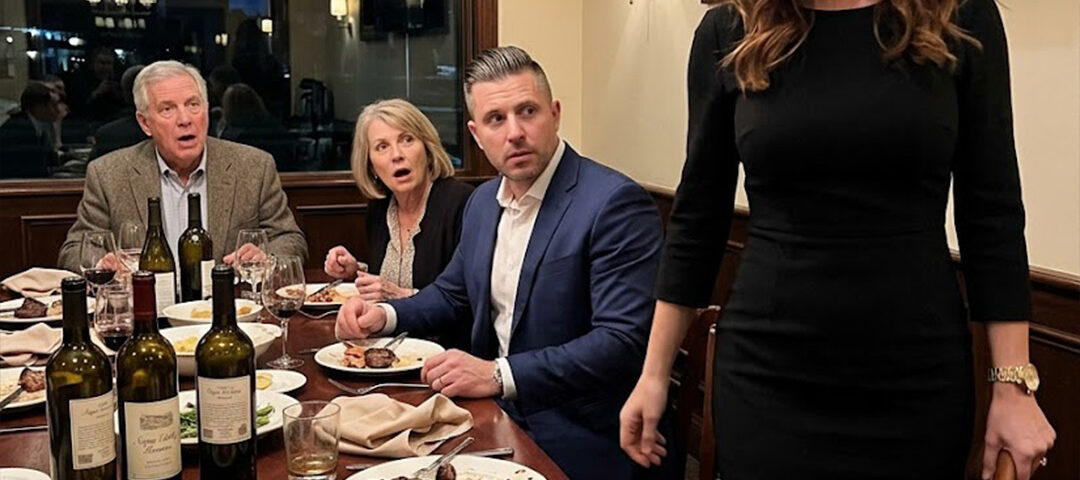
My parents invited me to dinner to “make things right” after five years apart. When I arrived, my entire family was already there — 13 people, lobster, wagyu, and a $1,600 reserve bottle on the table. Dad smiled and said, “You’re paying, right?” I called the waiter over and whispered two sentences. He nodded. Fifteen minutes later…
The first thing I noticed was the wine.
Not my mother’s face. Not my father’s smile. Not the way my older brother Cameron looked me up and down as if five years of silence had reduced me to an outfit he could judge. It was the three empty bottles sitting in the middle of the long private dining table, labels turned outward with the lazy confidence of people who had ordered them for display, not taste.
I knew that label.
My company stocked it for certain private clients, the ones who liked to say they did not care about price but always waited to see who noticed the price. A rare Bordeaux, deep vintage, kept in the kind of cellar where temperature and humidity were monitored more carefully than most people monitored their marriages. At the Monarch, one bottle cost sixteen hundred dollars before tax, tip, and the quiet little service fees guests never saw until the leather check presenter landed in front of them.
There were three bottles.
All empty.
I stood in the doorway of the private room with my hand still on my clutch and felt the old version of myself rise in me for one weak, foolish second. That girl would have apologized for being late even though she had arrived exactly on time. She would have smiled too brightly, shrunk her shoulders, and accepted the chair at the far end of the table like a sentence. She would have been grateful for being invited at all.
But I was not that girl anymore.
“Vanessa,” my mother sang from the head of the table.
Patricia Allen had a voice she used in public and a voice she used at home. The public one was honey over ice, sweet enough to disguise the chill. She wore a pearl necklace and a cream silk blouse, her hair blown into the same elegant shape I remembered from childhood photographs, and she lifted one hand toward me as though welcoming a guest she had missed terribly.
There was no warmth in her eyes.
Only calculation.
My father, Richard, sat beside her with a napkin tucked neatly over one knee and a half-eaten steak in front of him. He gave me a small nod, the kind he used to give servers and parking attendants. Cameron lounged near the center of the table in a navy suit that looked expensive from across the room but tight in the shoulders when he moved. His wife sat beside him, not smiling, just watching.
Around them were aunts, uncles, cousins, two spouses I had only met once, and one teenage nephew who probably did not know why the room felt so charged but knew enough to keep his eyes on his phone.
Thirteen people.
Not three.
Not my parents and me, as promised.
A trap has a certain smell when you have spent enough of your life inside one. It smells like buttered lobster shells, expensive wine, and a silence that arrives half a second too late.
“Mom,” I said, stepping inside.
My voice sounded calm, even to me.
The hostess quietly closed the heavy oak doors behind me. The latch clicked softly, cutting off the warm murmur of the main dining room and leaving me sealed inside with the family I had spent five years unlearning.
My mother rose just enough to kiss the air near my cheek. “You look well.”
That meant she had expected me not to.
“Thank you.”
Cameron leaned back, letting his gaze drift from my black dress to my shoes. “Still doing the catering thing?”
A few cousins looked down at their plates to hide smiles.
I sat in the only empty chair, placed deliberately at the end of the table, nearly an arm’s length from the nearest setting. Not a seat in the family circle. An observation post. A little island where they could see me but not include me.
“I’m still in hospitality,” I said.
Cameron lifted his wineglass. “That’s a generous way to put it.”
Five years earlier, that sentence would have bruised. Five years earlier, I was twenty-eight, broke, exhausted, and renting a room above a laundromat after walking away from the family home with two suitcases and no financial safety net. My parents had cut off help the moment I refused to follow the business school path they had designed for me. Cameron had called my first catering job “food errands.” My mother had told relatives I was going through a rebellious phase. My father said I would come crawling back when the rent was due.
I never crawled.
I worked.
I took early morning kitchen shifts and late-night event jobs. I learned wine lists, vendor contracts, staffing rotations, menu margins, fire codes, guest psychology, kitchen politics, and the way wealthy people liked to be seen without seeming like they wanted to be seen. I saved every dollar. I opened a tiny private dining concept with four tables and a borrowed espresso machine. Then a second. Then a catering arm. Then a restaurant partnership. Then an acquisition. Then a group.
By the time my mother’s letter found my old address and was forwarded through three layers of assistants to my actual office, I owned more dining rooms than my family had ever sat in.
They did not know that.
I had kept it that way on purpose.
The letter had been written by hand, which was how Patricia made manipulation look sincere. She said she missed me. She said Dad was getting older. She said life was too short for silence. She said they wanted “one quiet dinner, just the three of us, to make things right.” She suggested the Monarch because, as she wrote, it had always been one of her dreams to dine there as a family.
The Monarch had become part of my portfolio six months earlier through a discreet acquisition. My name had not yet been attached publicly. The dining public still believed the old ownership group was behind it. My staff, of course, knew the truth, but they had been trained in discretion.
That was why David, the general manager, stiffened slightly when he saw me enter the private room. Only slightly. A professional at his level did not stare. But I saw his eyes register the table, the empty bottles, the untouched chair, my family, and then me.
He knew.
He knew before I did.
My mother started talking across me before I had taken a sip of water.
“It’s such a relief to finally have everyone together,” she said, loud enough for the whole room. “We were just telling Aunt Linda how hard it has been not knowing if Vanessa was okay. She always had so much potential.”
Had.
Cameron’s wife studied the bread plate.
Aunt Linda put on a sympathetic expression. “Your mother worried constantly.”
That was untrue. My mother enjoyed worrying in public because it gave her an audience and a saint’s posture. In private, she could go months without wondering if I had eaten, as long as she had a version of me to use at brunch.
“I’m fine,” I said.
Cameron laughed. “Well, sure. Fine is one of those flexible words.”
My father finally looked at me directly. “Your mother tells me you’re still single.”
There it was. The old inventory.
Career. Money. Marriage. Weight. Hair. Usefulness.
“Dad,” I said gently, “I thought we were here to talk about making things right.”
He took another sip of wine. “That depends on what you think needs making right.”
The room hummed with the quiet pleasure of people watching a familiar game restart. I could almost see the old seating chart of my childhood: Cameron in the center, me at the edge, my parents holding the rules, everyone else collecting proof that I deserved what happened next.
I looked down the table and began counting quietly.
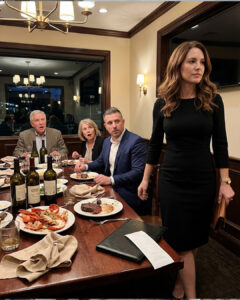
Lobster shells cracked and abandoned on white porcelain. Two seafood towers reduced to melting ice and lemon rinds. Wagyu steaks, half-eaten and cooling. Truffle mashed potatoes. Butter-poached asparagus. Caviar service. Three reserve bottles. A fourth bottle, unopened, sitting in a silver cradle near my father’s elbow as if waiting for someone to approve the next round.
No one had offered me a menu.
No one had asked whether I was hungry.
That was when the picture sharpened.
They had not invited me to share a meal.
They had invited me to arrive after one had already been consumed.
The waiter entered ten minutes later, moving softly over the carpet with a black leather check presenter in his hand. His name was Daniel. I remembered hiring him personally during the acquisition transition because he had corrected a wine pairing in my first interview without looking terrified afterward.
Daniel placed the check near my father.
My father did not open it.
He placed his palm on top of the leather folder and slid it down the long table. It scraped over the mahogany with a low, smooth sound and stopped neatly in front of me.
A white slip peeked from the edge.
$3,699.42.
My mother adjusted her pearls.
Cameron smiled.
I let my eyes rest on the number. Not because it frightened me. Because I wanted to remember the exact amount they thought would break me.
“Why are you giving this to me?” I asked.
My father’s mouth curved.
“You owe us,” he said.
He did not shout. He did not need to. Richard Allen had spent his life delivering cruelty in the calm voice of a man reading terms and conditions.
“For what?” I asked.
“For being raised,” he said. “For the years your mother and I wasted trying to turn you into someone respectable. For the embarrassment you caused this family. Consider this a small repayment.”
A silence settled over the room, thick and expectant.
There it was. The purpose of the evening, spoken plainly at last.
Cameron leaned forward. “Don’t make it awkward, Vanessa. Just put your card down. Unless things are tighter than you’ve been pretending.”
A cousin snickered.
My aunt lowered her voice, though not enough. “Poor Patricia. Imagine your daughter disappearing for five years and then acting offended when asked to contribute.”
I looked at my mother.
She did not seem embarrassed. If anything, she looked relieved. Her letter had been bait, and now the hook was in front of me. They believed I would either pay or fall apart. Either outcome would satisfy them. Payment would prove they still owned me. Tears would prove I still belonged beneath them.
I remembered the woman I had been when I left. Counting quarters for laundry. Buying rice in bulk. Wearing the same black flats until the soles split. Wondering if maybe my family had been right and I really had ruined my future over pride.
Then I thought of the woman sitting at that table now.
The woman whose company owned the table.
I smiled.
Not broadly. Not cruelly. Just enough for my father’s smirk to falter.
I lifted one hand.
Daniel saw me and came immediately.
“Yes, ma’am?”
My father looked satisfied, assuming I was about to ask for a payment plan or a private corner to beg.
I leaned slightly toward Daniel and whispered two sentences.
“Close my sparkling water to the owner account. If the party at this table can’t settle their own check, follow the standard refusal-of-payment protocol.”
Daniel’s eyes widened for half a second.
Then he nodded.
“Of course, Ms. Vale.”
My mother heard the name. Vale. My professional name. The one I had used after leaving home because I no longer wanted every introduction to carry the weight of Richard Allen’s approval. She looked confused, but not yet afraid.
I placed my napkin beside my untouched plate and stood.
My father blinked. “Where do you think you’re going?”
“Home.”
“You’re not leaving us with this bill.”
“I didn’t order this bill.”
Cameron laughed sharply. “You’re unbelievable.”
“No,” I said, looking at every face around the table. “I’m finally accurate.”
I turned toward the door.
My mother’s voice cracked behind me, losing its public sweetness. “Vanessa.”
That single word held all the old commands. Stop. Come back. Don’t embarrass us. Don’t make us responsible for what we did.
I kept walking.
The heavy doors opened before I reached them. David stood outside, perfectly composed, hands clasped in front of him. His face gave away nothing, but his eyes held a private question. I answered with the smallest nod.
Then I stepped into the main dining room, where warm lights glowed over white tablecloths and guests spoke in low, expensive tones. The Monarch at dinner service was a machine of elegance: glasses refilled before they emptied, chairs pulled out before a guest reached for them, crumbs swept silently between courses, birthdays remembered without being announced too loudly.
My father’s table would be handled exactly according to policy.
The valet brought my car around within three minutes. Through the front window, I could see Daniel return the check presenter to my father. Richard opened it now. His brows drew together. He reached into his jacket and produced a silver card with the dramatic confidence of a man who believed metal color was a personality.
Daniel stepped away to process it.
I stood beneath the awning and watched.
When Daniel returned, my father’s expression changed.
It was small at first. A tightening near the eyes. A quick glance at the card, then at Daniel, as if the card had misbehaved in public. He pulled another from his wallet. Blue this time. Then a black one. Cameron stood, irritation flashing across his face, and handed over his own card with a dismissive flick.
Daniel remained polite.
One by one, the cards returned.
Declined.
The table began to shift. Not dramatically. People like my family always tried to keep panic well-dressed. My aunt opened her purse. An uncle looked toward the door. Cameron pulled out his phone and stabbed at the screen. My mother pressed her hand to her throat as if the pearls might help her breathe.
I got into my car.
As my driver pulled away from the curb, my phone began vibrating on the leather seat beside me.
Mom.
Dad.
Cameron.
Mom again.
I did not answer.
At the first red light, a message came through from my mother.
Come back right now. This restaurant is being unreasonable.
Then one from Cameron.
You think this is funny? You just made a huge mistake.
Then my father.
You will pay for this.
I looked out at the city lights sliding across the windshield and felt something I had not felt after interacting with my family in my entire adult life.
Peace.
The next morning, my penthouse kitchen smelled like dark roast coffee and rain against glass. I stood barefoot at the counter while my phone loaded the consequences of the night before.
There were missed calls. Dozens of them. Voicemails. Texts. A video link from a local community Facebook group where my mother had already begun performing.
I tapped it.
There was Patricia, seated in what appeared to be a rideshare, hair slightly messy in a way I knew had taken effort, mascara smudged just enough to suggest suffering without sacrificing symmetry.
“My family experienced something heartbreaking last night,” she said to the camera. “Our estranged daughter invited us to dinner, then abandoned us with a bill she created.”
I paused the video.
Then I laughed into my coffee.
She had always been good. I had to give her that. Within twelve hours, she had transformed a failed dinner ambush into a public tragedy starring herself. She claimed she and my father had gone with open hearts. She claimed I had ordered expensive items to celebrate a promotion at my “little job.” She claimed I had slipped away and left them helpless.
The comments were exactly what she wanted.
How could a daughter do that?
Poor Patricia.
Some people forget where they came from.
My phone buzzed again. A voicemail from Aunt Linda. I deleted it without listening. Another from a cousin threatening to “testify.” Deleted. Cameron sent a voice note. I let the transcript load instead of playing it. The first line was enough: You owe us fifty grand for what you did.
Fifty thousand dollars.
Not for dinner. Not really.
That number bothered me.
By nine, I was in my office.
Monarch Hospitality Group occupied the top floors of a glass tower in the financial district. The lobby had stone floors, live orchids, quiet security, and a coffee bar that served espresso better than most restaurants. I walked through the executive entrance in a charcoal suit and white silk blouse, nodding to the security team as they greeted me.
Upstairs, my assistant Megan stood from her desk with a tablet in hand.
“We have a situation downstairs.”
I took off my gloves. “How bad?”
“Loud, but contained.”
She turned the tablet toward me. The lobby security feed showed two men near the visitor desk. My father and Cameron. Still wearing the suits from last night, though wrinkled now, their faces tight with anger and lack of sleep. Cameron leaned over the counter, pointing at the guard. My father paced behind him, red-faced and furious.
Megan said, “They’re demanding to see your supervisor.”
I almost smiled. “My supervisor.”
“They said they’re your family and that you stole from them. Security wants permission to remove them.”
“Not yet.”
Megan looked up.
“Put them in the secondary administrative conference room,” I said. “No windows. No executive view. Let them think they found my little office.”
Megan’s face remained professional, but one eyebrow moved slightly. “Understood.”
Twenty minutes later, I sat at the end of the most ordinary room in my headquarters. Beige walls. Laminate table. Six chairs. No art. No skyline. It was used for vendor disputes and internal policy interviews, a room deliberately stripped of ego.
The door opened hard enough to hit the wall.
Cameron entered first.
“You are going to write us a check today,” he said, planting both hands on the table. “Fifty thousand dollars. Minimum.”
My father followed, pointing a shaking finger at me. “You humiliated this family.”
“No,” I said. “You ordered food and wine you couldn’t pay for.”
Cameron’s eyes narrowed. “Don’t act superior in this sad little room. You’re a mid-level employee playing dress-up. I will walk upstairs and tell whoever runs this place exactly who you are.”
“You’re welcome to try.”
His mouth curled. “You really think I won’t?”
My father stepped closer. “Your brother is the only one keeping this family afloat right now. We needed that dinner to impress investors, and you ruined it.”
The room went silent.
Cameron turned toward him.
“Dad,” he said sharply.
But it was too late.
The missing piece clicked into place.
The dinner had not only been designed to make me pay. It had been staged. Cameron needed someone nearby to believe his family had money. Needed the expensive wine, the lobster, the private room. Needed me as the backup payment method and the scapegoat if it failed.
“You needed that dinner to impress investors,” I repeated.
My father realized what he had said. His face tightened.
Cameron forced a laugh. “He misspoke.”
“No,” I said. “He finally didn’t.”
Cameron leaned over the table. “Listen to me. You’re going to fix this, or I will destroy whatever little career you have.”
I reached beneath the table and pressed the security button.
Not because I was afraid.
Because I was done.
The door opened within seconds. Four security officers stepped in, calm and enormous in dark suits.
My father looked at them, then at me. “What is this?”
“These men are trespassing and attempting to pressure me for money,” I said. “Escort them out. They are not permitted back in any property owned or managed by Monarch Hospitality Group.”
Cameron froze.
“Monarch?” he said.
My father’s mouth opened. “Owned?”
I stood, buttoning my jacket.
“Yes,” I said. “That would be the company where I push papers.”
They did not understand yet. Not fully. But I saw the first fracture in their certainty as security walked them out.
That afternoon, I called Marcus Bennett, my lead attorney.
“I need a full review of Cameron’s firm,” I said. “Business filings. Loans. Personal guarantees. Anything connected to my name.”
“Is this urgent?”
“They demanded fifty thousand dollars in person after failing to pay a restaurant bill.”
“Very urgent, then.”
By the next morning, Marcus sat across from me with a folder so thick it looked like a closing binder.
“Vanessa,” he said, and when attorneys say your first name before explaining, you know the paper is bad. “There’s a commercial loan.”
“How much?”
“Five hundred thousand.”
I stared at him.
“The primary borrower is Cameron’s venture firm,” Marcus continued. “The secondary guarantor is you.”
“That’s impossible.”
“Yes,” he said. “It should be.”
He slid the signature page across my desk.
My name sat at the bottom in ink I had never touched.
It was good. Whoever forged it had studied the loops, the angle of the V, the way I crossed the second line in my last name. But it was wrong in the tiny ways only I would know. Too careful. Too young. A copy of a woman from five years ago.
Marcus explained how they had used an old childhood bank account my parents had opened when I was a teenager. Dormant, forgotten, still technically tied to early identity records. They had linked it to the application, used family-held personal details, and slipped through the first layer of verification.
The loan was ninety days overdue.
The fifty thousand was not random.
It was the amount needed to stop the bank from escalating.
I looked at the forged signature until the letters blurred.
My parents had not simply tried to make me pay for dinner.
They had already tried to make me pay for everything.
For three days, my legal team worked without sleep. Marcus brought in a forensic accountant named Elise and a private investigator named Cole, a quiet former compliance specialist who looked like he had not smiled since 2008. We converted the smaller boardroom into a war room. Screens. Timelines. Bank records. Old account files. Transaction paths.
The evidence formed itself with the neat brutality of numbers.
The loan application had been submitted from my parents’ home network. The forged signature file had been uploaded from Cameron’s laptop. The money had landed in Cameron’s business account, then disappeared into a maze of small shell companies, luxury leases, club dues, legal retainers, and offshore transfers sloppy enough to insult the word sophisticated.
And then came the final opportunity.
Cole discovered that Cameron and my father had bribed their way onto the guest list for Aura’s grand opening.
Aura was my newest resort and restaurant, a glass-and-stone property built into the waterfront cliffs, designed to attract the kind of investors Cameron liked pretending he belonged among. My name had been kept out of pre-opening publicity. The press called me the mysterious founder. Invitations were nearly impossible to get.
Cameron had spent the last of his cash buying access to my room.
When Cole told me, I laughed for the first time in days.
“Let them in,” I said.
Marcus looked at me. “You’re sure?”
“I want them comfortable.”
Saturday night, I watched them arrive on the security feed.
My father in a rented tuxedo, chin high, scanning the entrance for people to impress. Cameron beside him, face tight beneath the smile, handing business cards to anyone wearing a watch that looked expensive enough. My mother arrived later in a silver dress, clearly deciding that if there was a room full of status, she deserved to be seen in it.
From the private command suite above the ballroom, I watched them move through the crowd like men running out of air.
Cameron pitched his firm to a real estate developer near the ice sculpture. The developer politely escaped. My father introduced him to a retired hedge fund manager, exaggerating his assets with the ease of a man who had lied at dinner tables for decades. My mother laughed too loudly at jokes she had not heard.
They were desperate.
Desperation has a rhythm.
Fast eyes. Damp temples. Too much smiling. Too many handshakes. A refusal to notice doors closing.
At nine o’clock, the lights dimmed.
The music lowered.
The emcee stepped onto the stage and announced that the founder of Monarch Hospitality Group would formally welcome the guests to Aura.
I stood at the top of the grand staircase in a midnight-blue gown, not because I needed drama, but because some rooms only understand power when it is lit correctly.
The spotlight found me.
Below, hundreds of faces lifted.
I saw the exact moment my family recognized me.
Cameron’s champagne glass tilted in his hand. My mother’s mouth opened. My father went pale so quickly the tuxedo made him look even older.
I descended slowly, every step a quiet answer to every insult they had ever wrapped in concern. The crowd parted at the bottom. I walked to the acrylic podium and looked out over the ballroom.
“Good evening,” I said. “My name is Vanessa Vale, founder and CEO of Monarch Hospitality Group.”
Applause filled the room.
I let it last.
Not for ego.
For timing.
When it faded, I spoke about Aura, about three years of development, about the Monarch acquisition, about integrity in hospitality and the responsibility of building places where people trusted us with their most important evenings.
Then my father made his last mistake.
He stepped forward with a bright, desperate smile and raised his glass toward the investors around him.
“That’s my daughter,” he announced loudly. “We taught her everything she knows. This empire is a family success.”
The ballroom did not stop.
But the air around him did.
People looked from him to me.
He expected me to play along. He expected public pressure to make me polite. He had used that trick my entire life: create an audience, force the role, make me choose between dignity and a scene.
So I returned to the podium.
I tapped the microphone twice.
The room quieted.
My father’s smile began to fail.
“There seems to be a misunderstanding,” I said, my voice carrying clearly beneath the chandeliers. “The gentleman who just spoke does not represent Monarch Hospitality Group. He had no role in its founding, funding, operations, or vision.”
My mother grabbed his arm.
Cameron stopped breathing.
“In fact,” I continued, “I have not had a personal relationship with him in five years.”
A murmur moved through the ballroom like wind through glass.
Then two members of my security team entered from the side doors, each carrying a silver tray. On each tray sat a thick manila envelope.
They stopped in front of my father and Cameron.
“Please accept the envelopes,” I said.
Cameron stared at his as if it might burn his hand.
“Open them.”
He tore his open first.
The first page was a formal banking compliance notice. Behind it were copies of the forged loan document, the IP log, the transfer record, and the financial trail from the stolen loan proceeds.
My father opened his envelope more slowly.
His hands shook.
“These documents,” I said into the microphone, “are formal notices relating to unauthorized use of my personal identity in a commercial loan application, the movement of those funds through undisclosed accounts, and an ongoing legal action now being handled through proper channels.”
I did not need to say more.
People in rooms like that knew how to read between polished lines.
The investors who had spoken to Cameron minutes earlier stepped away from him as if distance were disinfectant. My mother covered her mouth. Cameron looked down at the papers, then up at me, and I saw in his face the end of a lifelong illusion.
The golden child had run out of gold.
I asked security to escort them out.
No one clapped. That would have been vulgar.
They simply watched.
That was worse.
The rest of the night continued with astonishing ease. Music resumed. Champagne circulated. Guests congratulated me in quieter tones, more respectful now, as if the display had proven something beyond wealth. It had proven governance. Control. The ability to protect a room from rot.
I thought it was over.
It was not.
Three days later, my mother went on local morning television wearing a beige cardigan and the practiced face of heartbreak. She accused me of turning against my family for money. She claimed Cameron had made a clerical mistake. She claimed I built my company by taking advantage of my late grandfather’s estate.
It was false.
All of it.
But lies do not need truth to move quickly. By noon, the clip had spread. By dinner, protesters stood outside the Monarch holding signs written by people who had never met me. By the next morning, several investors wanted me to settle quietly.
“Pay them,” one board member said in an emergency meeting. “Make this disappear.”
I stood at the head of the table and looked at the people who had invested in my clarity, now asking me to purchase silence from the very people trying to destroy me.
“No,” I said.
“Vanessa, this could hurt the London and Tokyo acquisitions.”
“Then let them wait.”
“This is family.”
“No,” I said. “This is extortion wearing family clothes.”
I asked for twenty-four hours.
I got them.
That night, close to midnight, the private elevator to my office chimed.
Only three people had access.
I reached beneath my desk and rested my fingers near the security button as the doors opened.
Courtney stepped out.
Cameron’s wife looked nothing like the woman who had once laughed softly while my brother mocked me at holiday dinners. Her blonde hair was undone, her makeup smudged, her trench coat pulled tightly around her. In one shaking hand, she held a silver flash drive.
“How did you get up here?” I asked.
“I took Cameron’s access card,” she said. “The one he wasn’t supposed to have.”
She walked to my desk and placed the drive on the glass between us. The tiny metallic click sounded louder than the elevator.
“What is this?”
“His backups,” she said. “Everything. The forged loan files. The fake documents about your grandfather. Offshore account numbers. Emails. Password lists. His flight itinerary.”
I looked at her.
“He’s leaving tomorrow night,” she said. “He plans to take what cash he can and leave me with the debt.”
There it was again.
The pattern repeating.
Use people.
Drain them.
Leave them with the bill.
Courtney’s eyes filled, but she did not ask for forgiveness. That, at least, was wise.
“I know I helped them,” she said. “I know I laughed when I should have walked away. I’m not innocent. But I am not going down for him.”
I picked up the flash drive.
“What do you want?”
“Protection,” she said. “A lawyer. A clean exit. I’ll tell your team everything.”
I stared at her until she looked away.
“You will give a sworn statement tonight,” I said. “Every password. Every account. Every message. If you hold back one detail, I will make sure your cooperation is worth nothing.”
She nodded so hard it looked painful. “Okay.”
By sunrise, Marcus had a complete deposition. By noon, Cameron’s flight was flagged and canceled. By Friday morning, my family sat across from me in a law office conference room, believing they had forced me to negotiate.
My mother entered first, chin high.
My father sat without being invited.
Cameron looked exhausted, but he still smiled. “Let’s get to business.”
They demanded the charges be withdrawn. They demanded I pay the fraudulent loan. They demanded one million dollars for emotional damage. Cameron, with breathtaking confidence, demanded twenty percent of Monarch Hospitality Group and an executive title.
I let them finish.
Then I pressed a button.
The blinds lowered.
The projector came on.
Cameron’s own laptop screen appeared on the wall.
The recording showed everything. The fake documents being created. The offshore transfers. The forged signature file. The folder labeled Grandfather Estate Narrative. The private flight booking.
Cameron stopped moving.
“Courtney sends her regards,” I said.
My mother made a sound like air leaving a punctured balloon.
My father whispered, “This can be fixed.”
“No,” I said. “It can be documented.”
Marcus placed three papers in front of them: public retraction, bank confession, no-contact agreement. Beside them, he placed a pen.
“You have one minute,” I said. “Sign, or the full file goes where it needs to go.”
Cameron signed first.
His hand shook so badly his name barely looked like a name.
My father signed next.
My mother signed last, crying real tears this time, the kind with no camera to reward them.
I walked out before they finished gathering themselves.
Six months later, Cameron’s company was dissolved, his remaining assets went to the bank, and his name became a cautionary whisper in every room where he had once tried to sound important. My parents sold their house and moved somewhere smaller, quieter, and far less interested in their stories. Courtney divorced him and disappeared from my life with the good sense not to return.
And me?
I kept building.
One clear evening, I stood on the rooftop terrace of the Monarch with the people who had become my real family: Megan, Marcus, Cole, David, and the team who had watched me refuse to shrink. Below us, the restaurant hummed at full capacity. The city glittered beyond the glass rail.
David poured a glass of the same rare Bordeaux my family once tried to make me pay for.
I lifted it, not to prove anything to them.
Only to remind myself that I was allowed to enjoy what I had earned.
The truth is, the best revenge was never making them pay a bill.
It was becoming the woman they could no longer afford to underestimate.