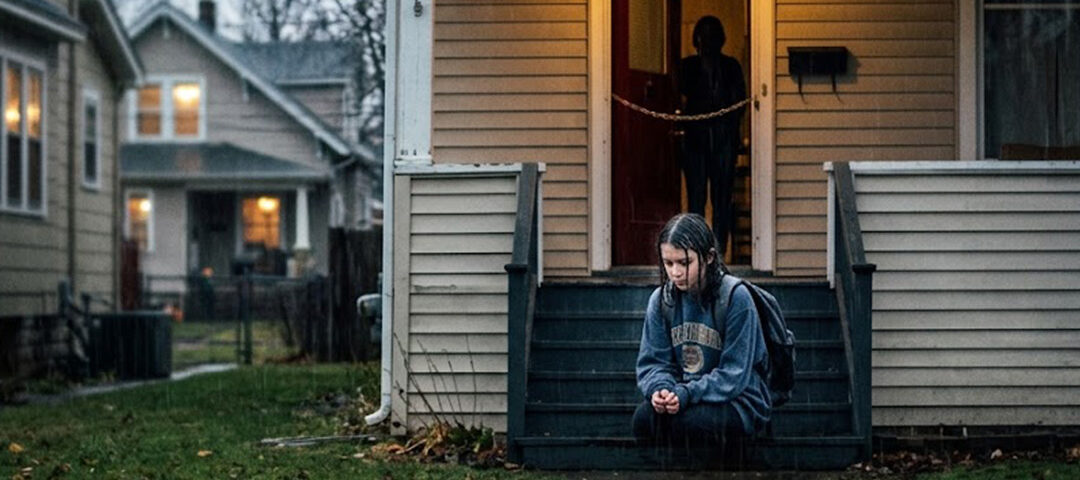
The key turned twice in Ivy’s frozen hand and opened nothing.
Rain ran from the ends of her hair onto the front of her school sweatshirt. Her backpack was pressed against her chest beneath the bare maple tree beside my mother’s porch, and water filled her sneakers each time she shifted her feet.
I nearly drove past her.
The storm had blurred the neighborhood into gray shapes, and I did not expect to find my twelve-year-old daughter sitting outside the house where we had lived for sixteen months.
I stopped hard at the curb and ran toward her without closing the car door.
“Ivy.”
She looked up. Her face was pale from the cold.
“My key won’t work.”
She held it out with both hands as though it had personally betrayed her.
The blue plastic cap was scratched from years of use. That key had opened the same door when she left for school that morning. It had opened it the night before when I carried groceries inside. It had hung from the same yellow lanyard since we moved into my mother’s house after her rehabilitation stay.
I wrapped one arm around Ivy and tried the lock myself.
The key entered but would not turn.
A new silver dead bolt gleamed where the old brass lock had been.
I tried the side entrance.
Another new lock.
Fresh curls of pale wood clung to the doorframe. Someone had not merely decided we should leave. Someone had hired a locksmith and made certain we could not enter.
Through the narrow window beside the front door, I saw my sister Brooke standing in the hallway.
My mother was behind her, one hand resting on the walker I had adjusted two weeks earlier.
Neither woman looked surprised to see Ivy drenched beneath the porch light.
I knocked once.
Then again.
The door opened three inches and stopped against the security chain.
Brooke’s face appeared in the gap.
“What are you doing here?”
“What am I doing here?”
My voice sounded calmer than I felt.
“Ivy got off the school bus forty minutes ago. She’s been standing outside in this weather.”
“She should have waited somewhere covered.”
Ivy flinched beside me.
I looked past Brooke toward my mother.
Elaine Mercer stood close enough that I could see the gray cardigan I had buttoned for her before leaving for work that morning. Her white hair was slightly flattened on one side from the afternoon nap she always denied taking.
“Mom, did you know she was outside?”
Her eyes shifted toward the glowing doorbell camera above us.
“This didn’t have to become a scene.”
That was her answer.
I tightened my coat around Ivy’s shoulders.
“Please give me her dry clothes. Her allergy medicine is in the upstairs bathroom, and her school computer is on her desk.”
“You can come back when everyone is calm,” Brooke said.
“She is twelve years old.”
“And you’re making this worse.”
Behind her, the living room looked subtly wrong.
Brooke’s framed portrait sat on the side table where Ivy’s school photograph had been that morning. Her handbag hung from the hook I used for my work coat. A folded blanket covered the recliner where I prepared Mom’s weekly medication packs and sometimes slept when she was having a difficult night.
The room had not been cleaned.
It had been staged.
A message from the previous week rose in my memory.
Karen Whitmore, the registered nurse who managed my mother’s home-care plan, had scheduled a reassessment for nine the next morning. She wanted to review medications, safety needs, recent dizziness, and the responsibilities of whoever provided most of Mom’s daily care.
Before I could reply in the family group chat, Brooke had written:
I’ll be there. I’m her primary caregiver.
At the time, I assumed she meant primary contact.
Brooke handled paperwork. She attended planning calls when her salon schedule permitted. She sometimes collected prescriptions, took Mom to lunch, or stayed with her if I worked late.
I handled the hours when forms became useless.
The call at two in the morning.
The sudden dizziness in the bathroom.
The shower Mom was too frightened to take alone.
The blood-pressure reading that refused to settle.
The appointment when a doctor changed one small instruction and everyone needed to understand exactly what it meant.
Now Brooke needed me gone before Karen arrived and began asking ordinary questions.
I still did not know what my sister had reported.
I only knew the timing of the new locks was not an accident.
I removed my phone and photographed the silver dead bolt, the fresh wood around it, Ivy’s wet clothes, and the security chain holding the door nearly closed.
Brooke laughed softly.
“Documenting your victimhood?”
“No. Documenting where my daughter was left.”
I did not threaten her.
I did not push against the door.
I did not remind Mom that my driver’s license, tax forms, hospital records, and every piece of mail carried that address.
Those arguments could wait.
Ivy could not.
I guided her back to the car and turned the heat as high as it would go. Her lips had lost their color. She held both hands over the vents, watching droplets gather on her sleeves.
“Did Grandma see me?” she asked.
“We’ll talk when you’re warm.”
I sent Karen a brief email before leaving the curb.
I wrote that Ivy and I had been locked out of our residence without warning. I said I could no longer confirm or carry out the current care arrangement. I did not accuse Brooke of anything I could not prove.
Then I drove to a discount store.
We bought sweatpants, socks, underwear, a sweatshirt, toiletries, and a cheap phone charger. In the fitting room, Ivy peeled off her wet socks and tried to turn away so I would not see how badly her feet were trembling.
I knelt and rubbed them through a dry towel.
“You didn’t do anything wrong.”
“I know.”
She said it too quickly.
Once she was warm, I called the local nonemergency number and explained that Ivy and I lived at the address but had been denied entry after the locks were changed. I requested an incident number and asked how to retrieve essential belongings without escalating the situation.
The dispatcher told me not to force entry. An officer could be present later while we collected medicine, school property, identification, and necessary clothing.
That was enough for the moment.
I needed a record, not a spectacle.
I booked a room at a modest motel near Ivy’s school and the hospital where I worked as a pharmacy technician. Her father lived in Arizona and had not participated in our daily life for three years. The only local family we could have called was standing behind the chained door.
A coworker would have offered her couch.
But I could not make Ivy arrive soaked at someone else’s house and listen while I explained why her grandmother had watched through a camera instead of letting her inside.
The motel smelled faintly of bleach and old carpet. The floral bedspread belonged to another decade, but the shower was hot.
Ivy stayed beneath the water until steam covered the mirror.
When she emerged wearing the oversized sweatshirt, she looked younger than twelve.
She sat on one bed while I plugged in her damaged phone.
“Did Grandma know I was there?” she asked again.
Lying would have been easier.
It would also have taught her to doubt what she had seen.
“The camera was on,” I said. “So yes, I believe they knew.”
Her eyes filled.
“Did I do something?”
I took her hands.
“This was a choice made by adults. You did nothing to cause it, and you do not have to earn your way back through that door.”
She leaned against me.
Neither of us cried. We were too tired.
My phone showed four missed calls from Mom.
Her voicemail sounded irritated, not sorry.
“Rachel, don’t make this bigger than it needs to be. Call me when you’ve calmed down.”
A text from Brooke arrived a minute later.
Come at 8:45 for Ivy’s school things. Be gone before 9.
I read it twice.
She was not offering us a chance to collect our belongings. She was creating a fifteen-minute window before Karen arrived.
I placed the useless blue-capped key on the motel table and set my alarm.
Until that night, I believed Brooke and Mom wanted us out.
Looking at the message, I understood that was only part of it.
They wanted Karen to believe we had never lived there at all.
The following morning, I dropped Ivy at school with a borrowed backpack and no computer. Her sneakers were still damp from being washed in the motel sink.
She stood beside the car longer than usual, both hands around the straps.
“Are you going back there?”
“Only to get what you need.”
“What if they don’t give it to you?”
I wanted to promise that adults could not simply keep a child’s belongings because they were angry with her mother.
After the previous night, promises like that sounded careless.
“Then I’ll make a list,” I said. “And I’ll keep asking in the right way.”
She studied my face, deciding whether I believed myself.
Then she walked toward the school without looking back.
I reached Mom’s house at exactly 8:45.
For sixteen months, I had known that building by sound. The loose gutter tapped the brick when wind came from the west. The furnace groaned before heat reached the upstairs vents. The third stair complained beneath anyone heavier than Ivy.
From behind the windshield, it looked like a place I had once visited rather than the home where my daughter’s height was marked in pencil on a bedroom doorframe.
A black trash bag sat on the porch.
Brooke opened the door before I reached the steps. She left the chain in place.
“That’s Ivy’s.”
I loosened the knot.
Inside were two pairs of jeans, three shirts, socks, and a sweatshirt she had outgrown the previous winter. Several pieces had been crushed into the plastic while still on their hangers.
“Where’s her school computer?”
“You can discuss the rest with Mom.”
“Her allergy medicine is upstairs. My work documents are in the desk. I also need the gray medication notebook from the kitchen.”
Brooke’s expression sharpened at the final item.
“That belongs to the house.”
“I bought it.”
“You used it for Mom.”
“So it contains my records of the care I provided.”
She folded her arms.
“You don’t get to empty the place because you’re angry.”
“I’m asking for a child’s school property, her medication, and the records I need for work.”
“You can come inside after you talk to Mom and agree to stop sending dramatic emails.”
I checked my phone.
8:55.
Brooke followed my glance.
“You have four minutes. Take the bag and go.”
A dark blue sedan pulled up behind mine.
Karen Whitmore stepped out carrying a leather portfolio and a small medical bag.
She had been assigned when Mom returned home from rehabilitation after a minor stroke. She was practical, soft-spoken, and almost impossible to rush.
Karen looked from me to the trash bag, then to the chained door.
“Rachel?”
Brooke opened the door wider but did not remove the chain.
“She’s leaving.”
Karen’s eyes rested briefly on my motel clothes.
“I thought Rachel lived here.”
“She moved out six weeks ago,” Brooke said. “She came back this morning to cause trouble.”
I could have interrupted.
I could have listed the mail in my name, the groceries inside the refrigerator, the six hundred fifty dollars I transferred toward household expenses every month, and Ivy’s school records bearing that address.
Instead, I waited.
Karen turned toward me.
“Your email said you and Ivy were locked out last night.”
“Yes.”
“You have an incident number?”
I gave it to her.
Brooke laughed.
“She exaggerates everything. She sleeps here sometimes because she likes making Mom dependent on her.”
“Sixteen months is a long sleepover,” I said.
Brooke looked at Karen.
“See? This is what she does.”
Mom appeared behind her, gripping the walker.
“Karen, this is family business. There’s no reason to cancel the assessment.”
Karen did not ask who legally lived there. She looked at Mom’s posture, the angle of the walker, and the color in her face.
“All right,” she said. “We’ll begin with safety.”
Brooke removed the chain and let her inside.
I remained on the porch beside the trash bag.
Karen paused in the entryway.
“Rachel, your authorization remains active. I may need to ask you questions about care you personally provided.”
Brooke looked at Mom.
“I thought we removed her.”
“You reported that she no longer resided here,” Karen replied. “That is not the same as revoking an authorization.”
Mom’s hand tightened around the walker.
Karen placed her portfolio on the dining table.
From the porch, I could see the kitchen beyond her. My blue ceramic mug was gone from the counter. Brooke’s keys rested beside the fruit bowl.
“Please bring me the current medication list,” Karen said.
Brooke opened one drawer, then another.
“It should be here.”
“The printed schedule or the handwritten record?”
Brooke looked toward Mom.
Karen continued.
“What time does Elaine take her anticoagulant?”
“Morning.”
“Which one?”
“The blood thinner.”
“What is its name?”
Brooke hesitated.
“Eliquis.”
Mom was not taking Eliquis.
Karen glanced toward me, but I kept my hands around the trash-bag handles.
“When was the dose last adjusted?” she asked.
“Her doctor handles that.”
“Of course. Who received the instructions after the cardiology appointment?”
“I did.”
“What changed?”
Brooke’s voice became defensive.
“It was a small adjustment.”
The instinct to answer rose so quickly that I stepped forward before catching myself.
Mom’s warfarin schedule had changed ten days earlier after a blood test showed the dose was too high. I had written the new pattern in the gray notebook and taped a printed copy inside the cabinet above the microwave.
Karen saw my movement.
“Rachel?”
“The schedule changed after the blood test,” I said carefully. “I can’t confirm what happened after I was locked out. I don’t know who prepared last night’s dose.”
Brooke turned toward me.
“You see what she’s doing? She wants Mom removed from her home.”
“I said I do not know who prepared the medication.”
“She’s jealous because Mom chose me to handle things officially.”
Karen raised one hand.
“This is not about jealousy. I need to identify who is carrying out the approved plan.”
Brooke walked to the cabinet and removed the taped schedule. She held it up as though proving she had known where it was all along.
Karen read it.
“Who wrote this?”
Nobody answered.
My handwriting slanted across the page.
Karen asked Brooke what she did when Mom became dizzy while standing. She asked when to check her blood pressure, which symptoms required an urgent call, and where emergency instructions were kept.
Brooke answered in generalities.
“I watch her.”
“I know when something is wrong.”
“I make sure she drinks water.”
Each statement sounded caring until Karen asked what it meant in practice.
Mom finally interrupted.
“Brooke knows me better than any nurse.”
Karen closed the cabinet.
“Then answering specifically should not be a problem.”
Brooke’s shoulders lifted.
“Rachel filled your head with this before you arrived.”
“I sent one email,” I said. “It stated that the locks had been changed, Ivy had been left outside in the rain, and I could no longer confirm the care arrangement.”
“You were making a scene.”
“You gave me a fifteen-minute window.”
Karen looked toward the trash bag and then at the clock above the stove.
“I cannot complete this assessment while there is a dispute about who actually provides care.”
Mom’s face lost color.
“You said this was routine.”
“It was routine until the information stopped matching.”
Karen asked me to prepare a written account of the care I had personally provided. She did not ask me to interpret Brooke’s behavior or accuse anyone of deception.
“Use dates,” she said. “Appointment calendars, messages, work schedules, receipts, and tasks you remember performing yourself. If you are uncertain, say so.”
Brooke stepped between us.
“You’re rewarding her for sabotaging this family.”
“I am verifying who performed the work.”
I lifted the trash bag.
“Can Ivy have her computer now?”
Brooke stared at me, then disappeared into the hallway. She returned with the computer and allergy medicine.
She did not bring my work documents or the gray notebook.
As I turned toward the driveway, Karen followed me to the edge of the porch.
“Rachel, do you understand how Brooke is listed in the current plan?”
“I thought she received a few paid respite hours when I worked late.”
Karen watched my face before answering.
“According to the plan, Brooke is the paid direct-care worker assigned most of the approved hours. You are listed as unpaid natural support.”
The words felt too formal to belong to my life.
I looked through the glass toward the kitchen where I had prepared pills every Sunday, tracked Mom’s blood pressure, slept in the recliner after bad nights, and left notes before rushing to work.
“How many hours?”
“Approximately thirty-nine each week.”
I looked at the trash bag in my hand.
Thirty-nine hours was not occasional help.
It was nearly a full-time job.
“According to the file,” Karen continued, “Brooke has been the person caring for Elaine almost every day for fourteen months.”
The house had not merely changed the name of the person allowed through its door.
It had changed the name of the woman who had lived the life inside it.
Back at the motel, I opened my calendar and stared at a blank document on my laptop.
Karen wanted a written account of what I had done.
The previous eighteen months felt impossible to measure.
No appointment was labeled the night Mom called because she was afraid to sleep alone. No receipt showed how long I sat beside her bed listening to the uneven rhythm of her breathing. No photograph captured the times I steadied her beside the bathtub while she insisted she could manage alone.
I began with dates I could prove.
Mom’s discharge appointment.
Cardiology visits.
Blood tests.
Physical therapy sessions.
Pharmacy pickups.
Beside each date, I wrote what I remembered doing.
During the first month after her stroke, I drove across town before work to prepare breakfast and confirm that she had taken her medication. I returned at night to help her shower because she feared falling when no one was nearby.
“I raised two daughters,” she said one evening while I steadied her beside the tub. “I can wash my own hair.”
Then her knee buckled, and she caught my wrist hard enough to leave marks.
Two months later, Ivy and I moved into the house.
I told myself it was temporary. Mom needed someone nearby until her balance improved, and my lease was almost finished.
On our first night, Mom let Ivy draw a pencil line on the bedroom frame and write her age beside it.
That house had not always been a trap.
When Ivy was a baby, Mom slept on my couch for two weeks after a difficult delivery. She rocked my daughter while quizzing me from flash cards for my pharmacy-technician certification.
After my father died, she kept his blue ceramic mug for me. Whenever I visited, it waited on the second shelf with the handle turned outward.
Those memories were real.
That was why I stayed long after temporary care became permanent expectation.
I added medication preparation to my list.
Blood-pressure checks.
Low-sodium meals.
Bathing assistance.
Transportation.
Calls to doctors.
Nights spent listening for the walker in the hallway.
The work grew slowly enough to appear normal.
Brooke handled forms. She told me Mom qualified for a program that could reimburse a relative for occasional coverage, mileage, and supplies.
I knew she received some money.
I never objected because she did take Mom to lunch, collect prescriptions, and stay when I worked late.
Looking through old messages, I found one from the previous March.
Thanks for covering last night. How’s Mom this morning?
At the time, I read it as gratitude.
Now the word covering sounded different.
It suggested the night belonged to Brooke and I had stepped in as a substitute.
There were more.
How’s she doing tonight?
Thanks for handling the appointment.
Let me know if Mom gives you trouble with the shower.
Brooke often knew what happened without being present. I assumed Mom told her because sisters shared information.
I had never wondered whether those conversations served another purpose.
Brooke was good at appearing involved.
She posted photographs taking Mom to lunch beneath captions about family responsibility. On appointment days, she sometimes arrived for the final ten minutes, took a picture beside Mom, and left before the pharmacy opened.
I performed the parts nobody photographed.
Four months earlier, my supervisor offered me a team-lead position. It came with better pay but required two evening shifts each week.
Mom said she could manage.
The next morning, she became dizzy and called me from the bathroom floor.
I declined the position.
That same month, Ivy left drama club because rehearsals ended after six and I could not guarantee transportation.
She said she did not mind.
I wanted to believe her.
As I entered dates into the document, Ivy sat cross-legged on the other motel bed completing an assignment on the recovered computer.
“Was that Grandma’s doctor?” she asked when I added another appointment.
“Yes.”
“You missed my rehearsal that day.”
I checked the date.
She was right.
“I’m sorry.”
“I know.”
She closed the computer halfway.
“Did Grandma ever thank you for all of this?”
The question made me defensive before it made me sad.
“She didn’t need to thank me every time. She’s my mother.”
Ivy watched me.
“That isn’t what I asked.”
My phone rang before I had to answer.
Karen explained that Mom’s authorization allowed her to discuss the care tasks I participated in. It did not make me Mom’s medical decision-maker or grant access to Brooke’s complete payment records.
“I can ask what you did and verify your role,” she said. “I cannot send you another person’s service notes.”
“I understand.”
“Did you know Brooke was assigned approximately thirty-nine paid hours each week?”
“No.”
“And you understood your role to be what?”
“Her daughter.”
Karen waited.
“Unpaid support, I suppose.”
The phrase hurt even though it was technically correct.
Mom had never paid me for missed work, groceries, gasoline, or the monthly transfer toward the house.
I had never asked.
“Was Brooke present for the hours she reported?” Karen asked.
“I can only tell you when I know she was not.”
“That distinction matters.”
I opened Brooke’s social-media page.
A bridal shower in Baltimore.
A wedding in Ohio.
A lake weekend with friends.
I recognized several dates because I had remained home with Mom while Brooke posted photographs from another state.
“I’ll send my schedule and the dates I can verify,” I said.
Nothing more.
After the call, the family group chat filled with messages.
Brooke wrote that I was using my pharmacy training to confuse an elderly woman and interfere with her medical decisions.
An aunt replied that family problems belonged inside the family.
Another relative said Mom needed peace, not an investigation.
I typed three responses and deleted them.
Explaining myself had always been my first instinct. If I could find the perfect words, I believed everyone would finally understand.
Instead, I saved screenshots, muted the group, and returned to my calendar.
Karen called near sunset.
“I need to verify a date without telling you what another person reported. March seventeenth, around 2:15 in the morning. Where were you?”
The motel room seemed smaller.
“At Mom’s house.”
“Who else was present?”
“Ivy was asleep upstairs. Brooke was attending a wedding in Ohio.”
“What happened with Elaine?”
I closed my eyes.
“I heard something fall in the bathroom. Mom was on the floor beside the vanity. Her blood pressure was high, and she was frightened. I called the nurse line and stayed with her until the reading came down.”
Karen asked me to describe only what I remembered.
I told her about the cold tile beneath my knees, Mom’s hand locked around mine, and the numbers glowing on the monitor.
When I finished, Karen remained silent.
“Why are you asking about that night?”
“I’m verifying who performed the care.”
“Brooke wasn’t there.”
“I understand.”
My hand tightened around the phone.
“Why is that night in Brooke’s file?”
Karen did not offer a conclusion she had not earned.
“That is what I’m trying to determine.”
After the call, I stared at the calendar.
Until then, I had been proving how much work I performed.
Now I understood I also needed to prove where Brooke had not been.
Anger wanted me to write everything at once.
Anger could make clean truth resemble revenge.
I forced myself to use only records that belonged to me.
My hospital schedule showed each shift and every day I left early.
Pharmacy receipts documented medication pickups.
Ivy’s school calendar reminded me of performances, parent meetings, and dinners I missed.
Photographs on my phone were harder to view.
Weekly medication packs spread across the kitchen table.
Mom’s blood-pressure monitor beside my cold coffee at three in the morning.
A swollen ankle resting on a kitchen chair.
Each date opened into a memory.
One Tuesday in February, I fell asleep upright in the recliner because Mom was afraid another dizzy spell would come if I went upstairs.
One Friday in April, Ivy ate reheated pasta alone while I sat on the bathroom floor holding Mom’s hand.
In June, I promised Ivy we would watch a movie, then spent the evening speaking with a nurse after Mom’s ankles began swelling.
Those moments had felt private when they occurred.
Now I was turning them into a timeline because someone else placed her name over them.
Brooke’s messages formed a pattern.
After nearly every difficult night, she contacted me the following morning.
How’s Mom?
Thanks for handling it.
Let me know if she gives you trouble.
Several messages aligned with photographs showing Brooke at restaurants, weddings, or weekends away.
She had not been in the house.
Yet she knew enough to speak as though I had merely completed part of her shift.
An email from Brooke arrived the next day, copied to Karen.
She claimed I kept the medication notebook hidden in my bedroom, preventing her from learning the routine. She said my refusal to share information caused her difficulty during the assessment.
There was enough truth in the accusation to sting.
I maintained the notebook and sometimes kept it beside my bed on nights when Mom was unstable because I wanted it within reach if I called the nurse line.
Brooke had never asked me to teach her the system.
I had also never insisted she learn.
I replied only to Karen.
I maintained the notebook because I handled most medication questions. Brooke had access to the house, pharmacy packs, and printed instructions. I should have created a clearer handoff, but I did not prevent her from learning.
Admitting my imperfect choice made me feel exposed.
It also prevented Brooke from using one truth to hide everything else.
A private message from her arrived minutes later.
Keep pushing this and I’ll tell your hospital you tampered with Mom’s medication. Let’s see how long a pharmacy tech keeps her job after that.
My stomach tightened.
I pictured my supervisor reading the accusation without context.
I did not answer.
I opened the authorized pharmacy portal and downloaded the dispensing history. Mom’s medication had been issued in sealed dose packs. I had never altered a prescription, changed a dose independently, or transferred medication into unmarked containers.
When her doctor adjusted the warfarin schedule, I copied the instructions exactly and taped the printed version inside the cabinet.
I saved Brooke’s message and forwarded it to Karen as evidence of pressure.
Mom called that afternoon.
Her voice carried the familiar tiredness that had made me forgive her before she apologized.
“You embarrassed your sister.”
“I described the care I performed.”
“She was trying to help me, and now Karen is treating her like a dishonest person.”
I asked why she told Karen I moved out six weeks earlier.
A pause lasted long enough for me to hear the television in the background.
“Brooke only wanted Karen to understand that you were not the sole person helping.”
“That is not what moving out means.”
“You always make words harsher than necessary.”
I looked across the motel room at Ivy, reading with headphones on.
“Did you know Brooke was listed as your primary paid caregiver?”
“Your sister handled the forms. I signed what she put in front of me.”
I wanted to believe that answer.
Mom hated paperwork. Since the stroke, long forms made her impatient and anxious.
One confused signature could be explained.
Fourteen months of records would be harder.
“Did you read them?”
“I trusted my daughter.”
She meant Brooke.
The words landed before she realized what they implied.
Mom quickly invited us home.
“You and Ivy can come back. We’ll talk like adults and put this misunderstanding behind us.”
“Will the old lock be restored?”
“We can discuss the key when you get here.”
Her offer was not an apology.
It was another door I could enter only after agreeing that what happened outside it did not matter.
“I’m not coming tonight.”
“Rachel—”
I ended the call.
Karen phoned again near evening and asked me to repeat the March bathroom incident from the beginning.
I described the sound of the fall, Mom beside the vanity, the blood-pressure monitor, and my call to the nurse line.
“Did you ever tell Brooke that Elaine’s left slipper was caught beneath the vanity?” Karen asked.
The question stopped me.
The slipper had been wedged so far under the cabinet that I lay on the tile and reached for it after Mom was safely in bed. I remembered dust on my sleeve and Mom whispering that she felt foolish.
It was not medically important.
I did not write it in the gray notebook.
“No. Only Mom and I knew.”
Karen did not tell me where she had seen the detail.
She did not need to.
I had spent days wondering how Brooke took credit for my work.
Now I understood she could not have built the story alone.
Someone inside that bathroom had carried a private detail from the floor where I knelt into a record bearing my sister’s name.
The question was no longer what Brooke had taken from me.
It was what my mother had chosen to give her.
I did not sleep.
Every time I closed my eyes, I heard the dull sound that pulled me from bed that night.
Mom had been on the bathroom floor, one leg folded beneath her. For one terrible second, I thought she was having another stroke.
I asked her to smile, lift both arms, and repeat a simple sentence while watching her face for weakness.
Her speech was clear, but her blood pressure was high and her hands would not stop shaking.
She refused emergency transport.
“Please don’t leave me here alone,” she whispered.
There had been nothing calculated in her voice.
She was frightened, and I was her daughter.
I stayed until dawn with my back against the bathtub and her head on my shoulder.
The next morning, Brooke sent one message.
Thanks for covering.
I had been too tired to understand what the word meant.
Karen arranged a meeting at the managed-care office.
The building sat behind a medical plaza, all beige walls and fluorescent lights. The small conference room felt less intimidating than Mom’s kitchen.
Karen brought only a blank notepad.
She asked what I understood about the home-care arrangement.
I told her Brooke said the program reimbursed her for occasional help, mileage, and several shifts when I worked late.
Karen listened without correcting me.
Then she explained that under Mom’s participant-directed plan, Mom was considered the employer responsible for approving Brooke’s visits. Caregivers recorded when they started and ended. Corrections followed a formal process and required approval through Mom’s account.
The old explanation began slipping away.
I wanted to believe Brooke filled out forms and Mom signed without understanding.
One signature could be confusion.
Repeated approvals over fourteen months were more difficult to dismiss.
“Could Brooke have changed hours after Mom approved them?”
“Compliance will review when entries were made, when corrections were requested, and which account approved them,” Karen said. “I won’t guess before they do.”
“What about the notes?”
“I cannot show you Brooke’s records. I can ask whether you performed a particular task and compare your answer with what was reported.”
“The slipper appeared somewhere.”
“Yes. The question is how that information entered the record.”
Karen warned me not to turn every strange memory into proof. If I was uncertain of a date, I needed to say so. If I did not know Brooke’s location, I could not assume she was absent.
“The review becomes weaker, not stronger, if anger fills the gaps,” she said.
I promised to provide only what I could support.
It was no longer the promise of a daughter protecting family secrets.
It was the promise of a woman preserving the difference between what she feared and what she knew.
When I left the office, I sat in my car before starting the engine.
Across the street, a red sign stood in front of a narrow brick building.
TWO-BEDROOM APARTMENT AVAILABLE.
It was close enough for Ivy to walk to school in good weather. The hospital was less than fifteen minutes away.
I copied the phone number but did not call.
Part of me believed Karen would discover one mistake, Mom would apologize, Brooke would return the old key, and we would be back at the same kitchen table by the end of the week.
I was collecting evidence against a story I still hoped was untrue.
I found Ivy at the public library after school. The recovered computer had died because its charger remained locked inside Mom’s house.
She sat at a public terminal beneath a sign limiting sessions to one hour.
When she saw me, she minimized a motel website.
“I was checking whether the rates go up on weekends.”
“You don’t need to worry about that.”
“I know.”
Which meant she already was.
She packed her books into a plastic shopping bag and asked to leave through the side entrance. Two girls from her class stood near the front desk, and Ivy did not want them to see the bag.
“They think we’re remodeling,” she said once we reached the parking lot.
The lockout began as a fight between adults.
It was already changing how my daughter moved through school, which stories she told her friends, and how much space she believed she could occupy.
Mom called while we drove toward the motel.
I pulled into an empty section of a grocery-store parking lot.
“What exactly did you tell Karen?” she asked.
No greeting.
No question about Ivy’s cold, wet clothes or where we had slept.
Her first concern was the file.
“I told her what care I performed.”
“You made it sound as if Brooke did nothing.”
“I described what I did. Karen can determine the rest.”
Mom complained the review had frozen payments and disrupted everything.
I listened until she paused.
“Did you tell Brooke about the night you fell in the bathroom?”
Silence.
“Did you tell her about the slipper beneath the vanity?”
“I tell your sister things. She worries.”
“Why would she need to know which slipper was under the cabinet?”
“You’re turning a family conversation into evidence.”
“Why did she need the exact time and blood-pressure reading?”
Mom changed the subject.
“The property taxes are behind. Insurance increased again. Brooke found a way to bring money into the house, and suddenly you want to tear everything apart.”
“Was the caregiver money used for the house?”
“Some of it.”
“How much?”
“That isn’t the point. If it keeps a roof over all of us, who is being hurt?”
I looked at Ivy in the passenger seat. She had turned toward the window, but I knew she heard every word.
“She was left outside that roof in the rain.”
Mom did not answer.
I spent two days protecting the possibility that Brooke acted alone.
Mom’s words destroyed the idea that she knew nothing.
She understood money was attached to the care. She understood the house benefited. She understood Brooke needed details.
What remained uncertain was how deliberately she helped construct the false story.
That evening, the useless blue-capped key lay beside my phone on the motel table.
Ivy picked it up.
“If we don’t live there anymore, does that mean you don’t have to go back when Grandma calls?”
I stared at her.
My family removed my clothes, changed the locks, and denied my place in the house.
Yet Mom and Brooke still assumed I would remain available whenever the house needed me.
My phone began vibrating.
Brooke’s name filled the screen.
Then a message appeared.
Mom is dizzy. I don’t know which dose she takes tonight. Get back here now.
My body reacted before my mind.
I stood, grabbed my purse, and closed my hand around the car keys.
For eighteen months, that movement had been automatic.
Then I saw Ivy watching from the bed.
I slowly put the keys down.
I called Karen and reached for the nurse-line number.
Brooke answered on the fourth ring, already speaking too loudly.
“Mom can barely stand. You need to get here.”
I asked whether Mom’s face looked uneven, whether she could raise both arms, whether her speech sounded different, and whether she had severe chest pain or difficulty breathing.
Brooke accused me of wasting time.
I made her answer each question.
When she said Mom’s speech was clear and both arms remained level, I told her to call the nurse line immediately and emergency services if any warning sign appeared or Mom became less responsive.
I contacted Karen and sent the current medication list to her secure address, along with the cardiologist’s number, the date of the last blood test, and the written dose change.
I did not send private instructions directly to Brooke after she threatened to accuse me of tampering.
Every safety instruction needed to pass through someone who could verify what had been sent and when.
Karen remained on the phone while the on-call nurse evaluated Mom.
I stayed in the motel with Ivy, answering only questions about what I knew before the lockout.
For nearly an hour, every part of me expected news that something terrible had happened because I had not driven back.
Ivy sat beside me, her shoulder against mine.
She was waiting to see whether one frightened call could still pull us through the door that had been locked against her.
Karen called later.
Mom had been assessed, and there was no sign of another stroke.
Brooke confused the old medication schedule with the new one and omitted an evening dose because she thought it had been discontinued.
The mistake had not caused a major medical emergency, but it left Mom anxious, dizzy, and without anyone in the house who reliably understood the current plan.
Relief came first.
Then guilt, so familiar it nearly felt like duty.
I pictured Mom beneath the kitchen light with both hands around a glass of water, frightened and angry that I had not appeared.
Then I looked at Ivy, still wearing discount-store clothing because her own closet remained behind a lock.
Mom had not been abandoned.
A nurse evaluated her.
Karen had the correct information.
Emergency care remained available if needed.
Brooke told the family a different story.
In the group chat, she wrote that Mom experienced a serious episode while I sat in a motel refusing to help. Relatives responded before I finished reading.
How could you do this?
She is still your mother.
What if something had happened?
I answered once.
I contacted Karen, provided the current medication information, helped connect Brooke with the nurse line, and remained available for safety questions. The medical professional involved confirmed I did not need to drive to the house.
Then I muted the group.
I would not argue with a version of events designed to make my physical presence the only acceptable proof that I cared.
Karen documented that Brooke could not follow the medication plan independently.
A temporary professional caregiver was assigned while the review continued.
The solution was ordinary and practical, which made Brooke angrier.
A trained person entering the house would see what I had done without needing the family’s permission to name it.
Mom called after she settled.
“I knew you’d never let anything happen to me.”
Her tone held quiet satisfaction, as though the evening proved the lock, the rain, and the lie about where I lived had changed nothing important.
“You knew I would keep you medically safe.”
“Of course. You’re my daughter.”
The sentence should have sounded loving.
Instead, it revealed the bargain she believed we had made.
She could remove my child from the house, erase my role, and still count on my labor the moment consequences became uncomfortable.
“I will give Karen any information necessary for your safety,” I said. “That does not mean I am returning to the same arrangement.”
Her voice hardened.
“Brooke wants to meet. Please stop punishing everyone long enough to listen.”
Brooke chose a diner beside the highway.
She sat in a back booth with a folder beside her coffee and a new brass key arranged carefully on the table.
She pushed the key toward me before I removed my coat.
“Mom wants you and Ivy home.”
I did not touch it.
“Did Mom ask you to change the locks?”
“We both agreed the situation had become unhealthy.”
“You left Ivy outside.”
“You keep saying that as though we knew the rain would get worse.”
“She rang the bell. She called both of you.”
Brooke pushed the folder across the table.
“This is how we move forward.”
The first page described me as a family member providing occasional unpaid assistance. Another paragraph said Brooke remained the primary caregiver and that confusion about our residence resulted from a private family disagreement unrelated to the care plan.
I was expected to acknowledge that I contacted Karen while upset and agree not to raise future concerns without first discussing them with Brooke.
In exchange, Ivy and I could return to our rooms.
Brooke would give me the new key and share part of the monthly payment as recognition for the help I sometimes provided.
She spoke as though I had negotiated a promotion in a job I never applied for.
“Where did the money go?”
“The property taxes were behind. Insurance increased. Utilities cost more.”
“And the rest?”
Her fingers tightened around the coffee cup.
“Some paid salon debts and credit cards. The salon is how I support myself and stay available to Mom.”
“If the program stops, Mom loses the house,” Brooke added. “Do you want her placed somewhere unfamiliar because you needed credit?”
The house had real financial problems.
Mom delayed tax payments and worried constantly about insurance.
But no agency was arriving the next morning to seize the property.
Brooke blended genuine strain with the most frightening possible outcome and placed responsibility for preventing it in my hands.
Near the end of the document, one paragraph required me to remain available whenever the primary caregiver could not cover a shift. Those hours would not be entered under my name, and payment would occur only if Brooke approved it separately.
“You want me to keep doing the work.”
“You understand Mom better than anyone. That’s why it makes sense.”
Her answer was so calm that the structure became visible.
My competence was not a reason to recognize me.
It was the reason they believed I should continue without recognition.
I slid the key back.
Brooke stared at it as though I rejected the house itself.
“I’m keeping this draft. Karen needs to see what you’re asking me to sign.”
She leaned forward and lowered her voice.
“When Mom ends up in assisted living, everyone will know it happened because you walked away. You’ll be the daughter who chose paperwork over her own mother.”
The words found the fear she intended them to find.
I imagined Mom packing the rooms where she had lived with Dad.
For several seconds, the key between us looked like the final chance to prevent everything from changing.
I left without taking it.
When I returned to the motel, Ivy sat at the small desk with colored pencils spread around her.
She had drawn a two-bedroom apartment with uneven windows, a narrow kitchen, and a bright yellow lock on the front door. Two figures stood inside, one tall and one small, each holding a key.
I placed Brooke’s draft beside the picture.
Unpaid backup caregiver available as needed.
They were offering me a key only if I returned as the person whose labor could be used, whose name could be erased, and whose daughter could be excluded whenever the arrangement became inconvenient.
The apartment was smaller than Ivy’s drawing.
It had two bedrooms, a narrow kitchen, and a view of the back of a grocery store. The carpet was worn near the windows, and the cabinets had been painted too many times.
Still, when the property manager handed me the lease, my name appeared beside the word tenant.
No family vote could erase it.
I used most of my savings for the deposit and first month’s rent.
Signing did not feel like winning.
It felt like admitting the motel was not temporary and Mom’s house might never become ours again.
My hand trembled when I wrote the date.
I signed anyway.
The property manager gave me two sets of keys.
I placed one in my purse and kept the other in its paper envelope. I told myself I would wait until we had beds and curtains before giving it to Ivy.
Furniture was not the real reason.
Placing a new key in her hand felt like closing the old door forever.
We spent our first afternoon sitting on the bare living-room floor.
Karen requested a structured care handoff, so I created one another person could actually use.
I listed Mom’s medications, allergies, doctors, pharmacy, appointments, dietary restrictions, fall risks, and symptoms requiring an urgent call.
I added details no medical chart captured.
Mom often claimed she felt fine when dizzy because she feared being sent to the hospital. She hid ankle swelling beneath loose socks. If she became unusually quiet after standing, someone needed to check her blood pressure rather than accept her first answer.
She drank more water from the blue ceramic mug.
She refused oatmeal if it was too thick and later complained of weakness because she skipped breakfast.
She minimized how often she touched walls for balance.
Writing those things felt like dismantling a life built one habit at a time.
None required me to return.
All mattered to the person replacing me.
At the end, I added a boundary.
I could answer reasonable questions about Mom’s history when Karen or a medical professional contacted me. I was no longer available for scheduled shifts, overnight supervision, emergency coverage, or backup caregiving.
I read the sentence several times before sending it.
Karen called after reviewing the handoff.
“The information is clear. The temporary caregiver has accepted responsibility for the plan, and your boundary is valid.”
The words did not remove my guilt.
They gave it a shape separate from responsibility.
“You transferred what is necessary for Elaine’s safety,” she said. “You are not required to remain an unpaid substitute for the assigned worker.”
Brooke answered by calling relatives.
By evening, I received messages from people who had not asked how Ivy was doing but somehow knew I was jealous, vindictive, and trying to force Mom from her home because I did not receive caregiver payments.
Aunt Denise called while Ivy and I measured the bedrooms for secondhand furniture.
“Your mother stayed with you after your divorce,” she reminded me. “She helped when Ivy was a baby. She loaned you money when your car broke down.”
Every memory was true.
That made her argument more painful than Brooke’s lies.
“It matters,” I said. “That’s why this hurts.”
“Then go home and fix it before strangers take over.”
I looked through the doorway at Ivy kneeling on the floor with a tape measure.
“Strangers are not taking over. A trained caregiver is doing work that was already supposed to be organized.”
“You know your mother doesn’t trust outsiders.”
“I also know she left my daughter in the rain.”
“That was wrong, but families survive by forgiving.”
Forgiveness was being offered as another word for returning to the same arrangement.
I almost agreed to visit Mom and settle privately because I remembered her warming bottles before I asked.
Those memories were not false.
They simply did not erase what came later.
After the call, Ivy stood in the doorway holding the tape.
“I still miss Grandma.”
“I know.”
“But I don’t want to sleep somewhere they can change the lock while I’m at school.”
Her voice was steady.
That made it harder to hear.
She was not asking me to hate Mom.
She was asking me to understand that love did not make a locked door safe.
The following morning, my supervisor forwarded a notice that the team-lead position had reopened.
My first instinct was to calculate who would prepare dinner for Mom, check her blood pressure, and remain through late evenings.
Then I remembered those hours no longer belonged to the house.
I submitted my application before I could talk myself out of it.
I did not imagine a promotion would solve our problems.
I only allowed myself to want work I had earned without first asking whether my family could spare me.
Karen’s meeting notice arrived that afternoon.
The managed-care organization required Mom, Brooke, and me to attend a planning conference because the reported roles no longer matched the information being verified.
The purpose was to identify who performed disputed care, establish a safe plan, and correct inaccurate hours.
Attached was a preparation sheet listing dates requiring clarification. It did not reveal Brooke’s complete notes, but it showed service confirmations approved through Mom’s employer account across many months.
Authorization marks repeated week after week.
This was not one rushed signature.
Someone approved changes again and again, including weeks when Brooke traveled and I was the only person sleeping in the house.
Brooke sent a photograph of the agreement from the diner.
The brass key rested on top.
Sign it and Mom can stay home.
The message reduced every fear I carried to one choice.
If I signed, Brooke’s version of the past could remain intact. Mom might keep the arrangement she wanted, and the family could say I had finally calmed down.
If I refused, payments could stop. Brooke might lose her position. Mom would have to accept care from someone outside the family.
That evening, I stood alone in the empty apartment while light rain touched the windows.
I imagined a professional caregiver opening Mom’s cabinets, asking permission before helping her shower, and learning routines I once believed only I could manage.
I also imagined Mom sitting in the house she feared losing, convinced her daughter chose paperwork over her.
I called Karen.
“What happens if I tell the truth at the meeting?”
“Payments may remain suspended while compliance reviews them. Brooke may lose eligibility as a paid caregiver. Elaine will need another plan, and I cannot promise the financial outcome.”
“Will Mom be safe?”
“Yes. The temporary worker is scheduled, the medication plan has been transferred, and each approved shift now has an assigned person.”
After the call, I printed Brooke’s statement and placed it beside the care handoff.
One page kept the lie alive by placing my name beneath it.
The other kept Mom safe without requiring me to disappear inside her life.
The meeting took place in a small conference room at a community health center.
Karen sat at one end with a laptop. A compliance specialist named Mr. Hale appeared on a wall screen.
Mom sat beside Brooke holding her purse tightly.
I chose the chair across from them and placed my folder, the gray medication notebook, and the completed handoff on the table.
Karen began before Brooke could speak.
“We are here to determine who performed the disputed care, ensure Elaine’s safety, and create an accurate plan. We are not deciding which daughter loves her mother more.”
Brooke’s mouth tightened.
She spoke first anyway.
She described herself as Mom’s primary caregiver and claimed I helped whenever I wanted to take control. She admitted I prepared medication and attended appointments but said I inserted myself into tasks she already managed.
She listed days when she drove Mom to lunch, collected prescriptions, and stayed at the house.
Those days were real.
That made her story sound convincing.
I did not challenge every statement.
When Karen named a date, I opened my calendar and answered only that question.
The first disputed shift was a Saturday in February.
Brooke said she spent most of the day with Mom.
I confirmed she took Mom to lunch.
Then I showed a message sent less than two hours later asking whether Mom had eaten dinner and whether her ankles remained swollen.
My phone location and grocery receipt showed I returned before four and stayed through the night.
“Rachel chose to take over,” Brooke said. “That doesn’t mean I wasn’t responsible.”
Karen moved to another date.
Brooke was assigned an evening shift but photographs placed her at a bridal shower in Baltimore.
“I clocked in before leaving and remained available by phone.”
“You cannot provide in-person assistance from another state,” Karen said.
“I had coverage.”
“Who provided it?”
Brooke looked at me.
“Rachel.”
Mr. Hale asked whether the change was recorded under my name.
“No. Mom still received the service.”
Another shift placed Brooke at the salon.
Another showed her at a wedding in Ohio.
Each time she repeated the same explanation.
I had been present.
Mom had been safe.
The work was completed.
Finally, Brooke placed both hands on the table.
“She volunteered. Nobody forced her. The family received the care. Who was harmed?”
Mom kept her eyes on her purse clasp.
Karen opened the final disputed date.
“March seventeenth.”
Brooke’s face changed.
She said she remembered because Mom had fallen in the bathroom. According to Brooke, she helped her from the floor, checked her blood pressure, and stayed until the reading improved.
I placed my hospital schedule on the table.
“I was not working. I was home.”
“You may have come in later,” Brooke said.
“I lived there.”
Karen asked what time the incident occurred.
“Around 2:15.”
Brooke described Mom beside the vanity, frightened but conscious. She said the blood-pressure monitor came from the bedroom.
Then she added that Mom’s left slipper had become caught beneath the cabinet.
The room became completely still.
I turned toward her.
“How did you know about the slipper?”
She blinked.
“You wrote it in the notebook.”
“I didn’t.”
“You write down everything.”
“Not that. It had nothing to do with treatment.”
“Then you mentioned it.”
“I never told you.”
Karen remained silent.
Mr. Hale did not move on the screen.
I turned toward Mom.
“Did you tell Brooke what happened that night?”
Mom pressed her lips together.
“Mom, did you tell her about the slipper beneath the vanity?”
She looked toward Karen, as though hoping the question could be ruled inappropriate.
Then she looked at Brooke, whose confidence had begun to crack.
“It was only a detail,” Mom said.
My hands went cold.
“Why did she need it?”
Mom lowered her eyes.
“Brooke needed the hours to match.”
For a moment, I thought I misunderstood.
“What does that mean?”
“She needed to describe what happened during the time she was assigned to be there. Real details made the report consistent.”
The bathroom returned with painful clarity.
My knees on the cold tile.
Mom gripping my wrist.
Her whisper asking me not to leave.
I had believed the moment belonged to us.
“How many times did you do that?”
“Rachel, this is becoming cruel.”
“How many times did you tell Brooke what I did so she could report it as her work?”
Mom could not say it happened once.
Instead, she admitted that when I handled an appointment, stayed through the night, or responded to a problem, she often told Brooke what happened, when it began, and how long it lasted.
Brooke tried to soften it.
“The program required detailed documentation. Mom helped make the records accurate.”
“The records were not accurate. They carried your name.”
Mom’s voice rose.
“The money paid property taxes. It kept the insurance active. It bought supplies. It helped Brooke while the salon struggled.”
“You locked my daughter outside so Karen would not see who was doing the work.”
“We needed the house to match the plan,” Brooke said. “You were supposed to collect your things before the assessment. You made it bigger.”
Karen asked whether Brooke understood that reporting work performed by another person created a false payment record.
Brooke’s restraint finally broke.
“She was doing the work anyway. Why shouldn’t someone in this family get paid for it?”
The sentence revealed more than every document.
They did not merely believe I would continue caring for Mom.
They believed my work belonged to the family before it belonged to me.
They believed they could attach Brooke’s name to it and call me selfish when I objected.
Brooke opened her folder and placed the brass key beside the statement.
Mom pushed it toward me.
“If you sign, we can put this behind us. You and Ivy can come home. Brooke can continue the program, and I won’t have strangers walking through my house.”
I looked at the key.
A week earlier, I would have seen access, forgiveness, and the possibility of restoring what we lost.
Now I saw the price attached.
Mom softened her voice.
“If you walk out, I may lose this house.”
The old guilt rose exactly as she expected.
I imagined overdue taxes and insurance notices. I imagined Mom packing rooms where she had lived with my father.
Then I remembered Ivy beneath the maple tree, holding a useless key while two women watched through a camera.
I opened the gray notebook and slid it toward Karen with the completed handoff.
“This contains everything required to keep Mom safe.”
I took the statement from Brooke’s folder and drew a line through my name beside Backup Caregiver. I initialed the change.
I signed the page confirming that my handoff information was accurate.
I left the statement crediting Brooke for my work untouched.
“I will not let Mom be medically unsafe,” I said. “But I will not keep your lie safe.”
Karen confirmed that the temporary professional caregiver would remain while records were reviewed. Brooke’s payments stayed suspended.
No one was led away.
No one announced a dramatic punishment.
The room simply lost the version of reality that allowed everything to continue.
I gathered my folder.
Mom called my name as I reached the door.
Every instinct told me to turn around, comfort her, and explain how we could repair the damage.
I did not return to the table.
In the hallway, I removed the blue-capped key from my ring and closed my fist around it until the teeth pressed marks into my palm.
Then I called Ivy.
“We’re going home.”
For the first time, I did not mean my mother’s house.
In the weeks after the meeting, nothing collapsed as Brooke predicted.
Mom remained in her home.
A professional caregiver visited four afternoons each week and kept the medication plan current. Mom received a fall-alert device and joined an adult day program twice a week.
She complained about rearranged kitchen towels and apples cut too thin.
She also stopped calling me each time she felt slightly unsteady.
The caregiver encouraged her to prepare simple breakfasts and complete small tasks independently.
Outside help did not destroy her independence.
In some ways, it required her to rebuild it.
Brooke’s paid status remained suspended during the review. Records showed enough disputed entries that she entered a repayment arrangement and lost eligibility to continue as Mom’s paid direct-care worker.
She still told relatives the system overreacted.
I stopped waiting for consequences to transform someone who did not want to learn.
I left the family group chat after sending one message.
Mom has a safe professional care plan. Her medical information is private. I will not debate an official review with people who never asked who performed the work.
At the hospital, my supervisor invited me to interview for the team-lead position.
My first thought was still the evening schedule.
Who would make Mom’s dinner?
Who would monitor her blood pressure?
Then I remembered the care handoff and the professional whose job was to be present.
“I want the interview,” I said.
I did not feel fearless.
I stopped treating fear as proof I was doing something wrong.
Six weeks after the lockout, Karen arranged a two-hour window for Ivy and me to collect our remaining belongings.
Mom agreed Brooke would not be there.
The maple tree had lost nearly all its leaves when we returned. The porch looked unchanged except for the new silver lock.
Mom opened the door before I knocked.
For a moment, the three of us stood on opposite sides of a threshold that once required no thought.
The house smelled of cinnamon tea, furniture polish, and lavender detergent.
My father’s blue mug had returned to the second shelf, its handle turned outward.
Seeing it hurt more than the changed lock.
The house had held real love before love became leverage.
Ivy went upstairs to pack books and clothes.
The pencil marks remained on her doorframe. She touched the highest line.
“Do we have to paint these over?”
“No. They belong to the house now.”
Her face fell.
I photographed every mark, including the crooked letters she wrote at ten.
“The memory doesn’t disappear because we don’t own the wall.”
Mom stood in the doorway.
She looked smaller than I remembered, perhaps because I was no longer rushing to fill every empty space around her.
“I never thought you would really leave.”
“That was the problem. You believed I would stay regardless of what you did.”
She looked toward Ivy, but my daughter continued packing.
“I was afraid,” Mom said. “The taxes were behind. Brooke was struggling. I didn’t want strangers deciding whether I could remain in my house.”
“I believe you were afraid. That does not explain leaving Ivy outside.”
Mom lowered her eyes.
“I know.”
She reached into her cardigan pocket and offered a new brass key.
“Keep it for emergencies.”
I did not take it.
“Karen and the caregiver have access. If there is a medical emergency, call them or emergency services.”
“A key cannot be how you make me responsible again.”
Her fingers closed around it.
The rejection hurt her.
This time, I did not rush to repair the feeling.
Brooke returned before our two hours ended, carrying grocery bags.
“You said they were taking essentials.”
She turned toward me.
“You’re stripping the house because you couldn’t stand being told no.”
I lifted the gray notebook from the kitchen shelf. Karen already possessed the complete handoff, but the notebook contained my handwriting, appointment reminders, and personal notes.
It belonged with me.
“I’m taking our clothes, documents, school items, and personal property.”
“You destroyed this family to prove a point.”
I met her eyes.
“This family broke when you left a child in the rain to protect a timesheet.”
There was nothing left to argue.
Before leaving, I removed the blue-capped key from my purse.
I had carried it for six weeks although it opened nothing.
I placed it beside the fruit bowl.
Not as a weapon.
Not as a trophy.
It was simply a key to a door I no longer intended to ask permission to enter.
Mom watched me.
“Will I still be allowed to see Ivy?”
“That depends on whether you can take responsibility without asking her to comfort you. She will not tell you what happened was acceptable so you can feel better.”
Mom nodded slowly.
For once, she did not ask me to make the answer easier.
Ivy came downstairs carrying one box and the half-finished crossword book she and Mom used to complete at the kitchen table.
She could have left it behind out of anger.
Instead, she placed it carefully on top of her clothes.
Loving her grandmother and refusing to live in that house were not opposites.
I was relieved she did not believe they had to be.
We carried the final boxes to the car.
When I closed the trunk, I heard the front door shut behind us.
I did not turn to see whether Mom stood at the window or Brooke watched through the camera.
For the first time, I was the one who chose to walk away from that door.
As we left the driveway, Ivy reached across the console and took my hand.
“Are you sad you gave the key back?”
“Yes.”
She squeezed my fingers and looked once toward the house.
“Good.”
“Good?”
“That means it was a home once. It just isn’t ours now.”
Six months later, I found Ivy waiting outside our apartment in the rain.
For one sharp second, my body remembered everything before my mind understood.
Wet hair.
A backpack against her chest.
A child standing on the wrong side of a locked door.
Then Ivy grinned and lifted a yellow keychain shaped like a sun.
“I wasn’t locked out. I wanted you to see this before I used it.”
She inserted the key and turned it easily on the first try.
Rain dotted her jacket, but she was not shivering. No one watched through a camera while deciding whether she belonged inside.
Our apartment was smaller than Mom’s house.
We had no wide living room, porch, or backyard maple tree. The kitchen table barely fit between the refrigerator and wall.
But every mug, photograph, and book stood where we chose to place it.
Nothing depended on someone else allowing us to remain.
I received the team-lead position two months earlier. The raise did not make us wealthy, and I still compared grocery prices.
My schedule became clearer.
My work was finally recognized.
For years, I treated my time as something everyone else could claim first.
I learned that being dependable did not require remaining endlessly available.
Ivy returned to drama club. On the night of her first performance, I sat in the third row while she played a hotel manager in a school comedy and delivered three lines with enough seriousness to make the audience laugh.
My phone stayed silent inside my purse.
Mom was not abandoned.
The caregiver had become part of her routine. Karen helped enroll her in a balance class, and she ate lunch with the same group of women every Tuesday.
Brooke visited less often once no payment or public praise was attached.
The work she described confidently on forms became less appealing when she had to perform it in real time.
Mom asked to meet us at a diner halfway between her house and our apartment.
She did not ask me to come home. She did not call Ivy first to pressure me.
I asked my daughter whether she wanted to go.
She thought for an entire day before agreeing to one lunch. She did not want to visit the old house or stay overnight.
Mom was already seated when we arrived. She looked healthier than she had at the care meeting, though nervousness made her smooth the paper napkin repeatedly.
She brought the crossword book and placed it between them without assuming Ivy would take it.
We spoke about school, my new job, and Mom’s balance class.
Then she put both hands on the table and looked directly at Ivy.
“I knew you were outside.”
Ivy lowered her eyes to the crossword book.
“You rang the bell, and I saw you on the camera. I agreed to change the locks. I allowed you to remain in the rain because Brooke and I wanted the house to look a certain way for Karen.”
Ivy did not rescue her from the silence.
Mom turned toward me.
“I told Brooke what you did for me. I gave her times, details, and things that happened when she was not there so she could report them as her work.”
Her voice shook.
“I knew you were the one caring for me. I believed you would continue no matter how I treated you.”
There was no excuse about paperwork or confusion.
She said fear explained her choices but did not make them right.
“I used your love as if it were something I owned,” she said. “And I used Ivy’s place in the house to control you. I’m sorry.”
Part of me waited months to hear those words.
Another part remained guarded because an apology could not remove the sound of the chain holding the door nearly closed.
“I’m not ready to say everything is forgiven because you finally named it.”
Mom nodded.
“Trust has to be rebuilt. You cannot call Ivy to make her feel guilty. You cannot use your health to make me come running. If you need assistance, follow the care plan. If you want a relationship with us, respect our boundaries even when you dislike them.”
Mom cried quietly.
She did not ask us to comfort her.
Ivy opened the crossword book and flipped through several pages.
“I can meet you here again next Saturday,” she said. “For one hour.”
Mom accepted without bargaining for more.
That mattered more than tears or promises.
Before we left, she pushed the crossword book toward Ivy.
She did not offer another key to the old house.
Their relationship would not be rebuilt through unrestricted access to the place where it had been broken.
It would begin with one hour in a public diner, a half-finished puzzle, and Ivy’s freedom to decide whether she wanted another meeting.
That evening, I gave Ivy the second apartment key with the yellow cover she had chosen.
“This is not a prize,” I told her. “It is a responsibility and a promise.”
“What promise?”
“If you’re angry with me someday, you still get to come home. If I’m disappointed in you, this door still opens. We can have rules, consequences, and difficult conversations, but neither of us gets to turn home into a weapon.”
Rain ran down the hallway window in narrow silver lines.
Ivy placed the key into the lock.
It turned immediately.
She stepped inside, then looked back and held the door open for me.
Karen had not arrived at my mother’s house with a miracle.
She asked one ordinary question.
Who was actually doing the work?
What changed our lives was that, for the first time, I answered without making myself smaller to protect the people who had erased me.
The yellow key did not open the largest house I had ever lived in.
It opened the first home where my daughter would never have to wonder whether love could change the locks.
If you came here from Facebook because of this story, return to the Facebook post, tap Like, and comment exactly “Amazing” to support the storyteller. That small action means more than it seems and gives the writer genuine encouragement to keep sharing more stories about family pressure, firm boundaries, and finally protecting what you worked so hard to build.
Disclaimer: This story is a work of fiction created for entertainment purposes. Any resemblance to real persons, events, or places is coincidental.