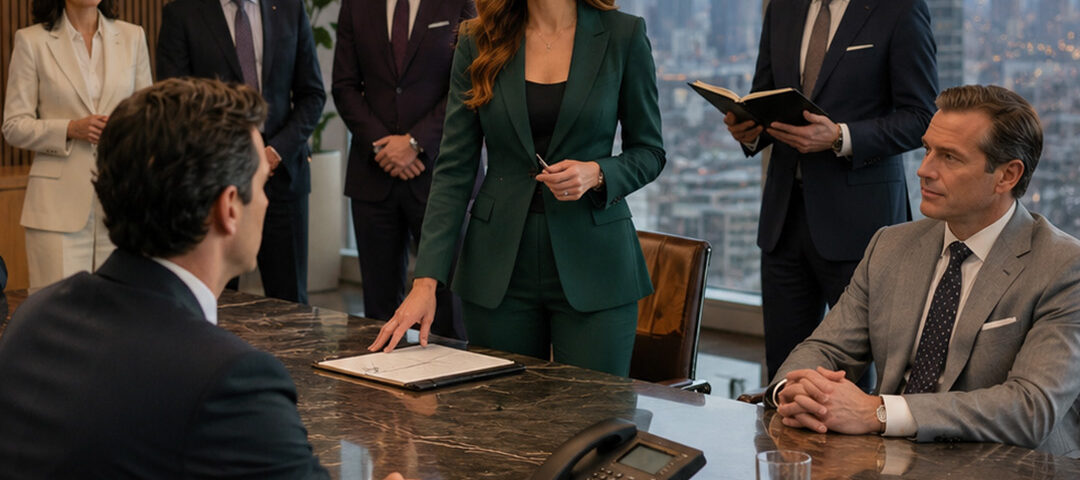
The conference room on the 42nd floor of Morrison Industries had floor-to-ceiling windows that overlooked downtown Seattle.
On a clear day, you could see Mount Rainier from there, pale and enormous beyond the skyline, like something permanent watching over everything temporary people tried to build beneath it.
That morning, there was no mountain.
Storm clouds gathered over Puget Sound, turning the water slate gray and pressing the city into a dim, metallic light. Rain crawled down the glass in thin silver lines. The ferries below looked like white scraps moving through shadow.
It felt appropriate, given what was about to unfold.
I sat in the back corner of the conference room, my chair slightly removed from the long mahogany table where the board members had gathered. Nobody questioned why I was there. Nobody questioned much about me anymore, because nobody in my family had ever considered me worth questioning.
I was Daniel Morrison.
The quiet son.
The one who had spent the last fifteen years working in the background, never making waves, never demanding attention, never stepping into the spotlight long enough to make anyone nervous.
The one nobody saw coming.
My sister Vanessa stood at the head of the table, exactly where our father used to stand before his health changed six months earlier.
She wore a red power suit that probably cost more than some of our junior engineers made in a month. Her hair fell in polished waves over her shoulders. Her expression held the absolute certainty of someone who had rehearsed victory so many times that she no longer believed reality could interrupt it.
Behind her, our mother dabbed at her eyes with a folded handkerchief.
Uncle Thomas, Dad’s younger brother and the company’s vice president of operations, nodded along with solemn approval.
My older brother Marcus leaned back in his chair with a satisfied smirk, one ankle crossed over his knee, already enjoying a moment that had not technically happened yet.
The entire family had gathered for this.
Vanessa’s moment.
“As you all know,” Vanessa began, her voice carrying the crisp, controlled tone she had perfected at Harvard Business School, “our father’s health situation has created a leadership vacuum.”
Nobody moved.
The independent board members watched from their seats with the careful faces of people trained not to react too early.
“Morrison Industries needs strong, decisive leadership to navigate the challenges ahead,” Vanessa continued. “The markets are volatile. Our competitors are circling. We cannot afford to drift.”
She clicked a small remote.
A presentation appeared on the screen behind her.
The title slide was tasteful, expensive-looking, and cold.
Strategic Restructuring and Leadership Transition.
“I’ve spent the last six months developing a comprehensive restructuring plan,” she said. “We are going to streamline operations, divest underperforming divisions, and refocus on our core competencies. Under my leadership, Morrison Industries will emerge leaner, stronger, and more profitable than ever.”
The family members around the table nodded.
Marcus actually started a slow clap that died quickly when nobody joined him. He dropped his hands into his lap and pretended it had been a thoughtful gesture instead of an embarrassing one.
Vanessa did not look at him.
She was too focused on the board.
“I am proposing that the board vote today to install me as CEO, effective immediately,” she said. “I have already secured proxy votes from Mother, Marcus, Uncle Thomas, and Aunt Caroline. That represents forty-two percent of the family shares. Combined with the institutional investors who have committed to supporting new leadership, we have more than enough to approve this transition.”
Robert Chin, our CFO for the past twenty years, cleared his throat softly.
Vanessa ignored him.
That was her first mistake.
“Additionally,” she continued, “I am recommending that we implement my restructuring plan within the next ninety days. This will involve selling off the manufacturing division in Ohio—”
“The one Dad built from the ground up,” I said quietly.
Everyone turned to look at me.
I rarely spoke in meetings. Not like that. Not from the back of the room. Not in the middle of a presentation Vanessa had clearly staged as a coronation.
I was the overlooked son, the one who had chosen to work in product development instead of pursuing the executive track. The one content to tinker with designs while my siblings fought for position.
At least, that was the version of me they had always preferred.
Vanessa’s gaze landed on me with a thin layer of irritation beneath her professional calm.
“The Ohio plant is underperforming,” she said. “Sentiment does not pay dividends, Daniel.”
“Dad would understand that,” she added.
I studied her for a moment.
“Would he?”
“Yes,” Vanessa said. “He was a businessman first. He would want us to make smart decisions, not emotional ones.”
“Smart decisions,” I repeated.
“Is that what you’re calling this?”
Marcus leaned forward in his chair.
“What’s your problem, Danny?”
There it was.
Danny.
The name he used whenever he wanted to shrink me back into the boy who followed him around the driveway asking to be included.
“You’ve never cared about the business side of things,” Marcus said. “You’re happy in your lab playing with prototypes. Let the adults handle strategy.”
I smiled slightly.
“I’m thirty-eight, Marcus. I stopped being Danny about twenty years ago.”
His smirk faltered.
Vanessa stepped in before Marcus could recover.
“You know what he means,” she said. “You’ve never shown interest in running the company. You’ve never positioned yourself for leadership. So why start now?”
“I’m not starting now,” I said.
I looked from Vanessa to Marcus, then to the board members watching with growing interest.
“I’m finishing what I started fifteen months ago.”
Silence fell over the room.
Robert Chin’s expression did not change, but I caught the slightest twitch at the corner of his mouth.
He knew what was coming.
He had been preparing for this moment since the previous year.
“What are you talking about?” my mother asked.
For the first time that morning, confusion crossed her face in a way that looked honest.
“Daniel,” Robert said carefully, “perhaps now would be an appropriate time to share the documentation we discussed.”
I nodded.
Then I pulled out my phone.
A moment later, the screen behind Vanessa changed.
Her restructuring plan disappeared.
In its place was a different document entirely.
The room leaned toward it, almost as one body.
“This is a stock transfer agreement,” I said calmly. “Dated March 15 of last year. Fifteen months ago.”
Vanessa turned toward the screen.
Her shoulders stiffened.
“It transfers ninety percent of Morrison Industries shares from our father to me,” I continued. “The transfer was completed, filed, and recorded six weeks before Dad’s health changed.”
The room erupted.
Not loudly at first. Not all at once. It began as a rush of small sounds: chairs shifting, papers rustling, someone inhaling too sharply, Marcus muttering something under his breath.
Then Vanessa spoke.
“That’s impossible.”
Her voice was still controlled, but the certainty had cracked.
“It’s public record,” Robert confirmed.
He stood fully now, his hands resting lightly on the back of his chair.
“Filed with the SEC. Registered with the state. Properly executed, reviewed, and binding.”
He looked at the board.
“Daniel Morrison currently owns ninety percent of Morrison Industries. He has been the majority shareholder for fifteen months.”
Marcus pushed back from the table.
“Dad would never—”
“Dad did,” I interrupted.
The words were not loud, but they stopped him.
“We spent eighteen months discussing it,” I said. “Working through the details. Planning the transition. He wanted to make sure the company stayed in the family, stayed true to its mission, and stayed under leadership that understood what he had built.”
My mother stared at me like I had become a stranger in front of her.
“Why didn’t you tell us?”
“Because Dad asked me not to.”
Her handkerchief lowered to the table.
“He wanted to see how things would play out naturally,” I said. “He wanted to see who would step up for the right reasons and who would scramble for power.”
Vanessa gripped the back of the chair in front of her.
“This is insane,” she said. “You can’t just drop this on us. You can’t.”
“I didn’t drop anything, Vanessa. The information has been publicly available for more than a year.”
I looked around the table.
“You never bothered to check. None of you did.”
Marcus’s face flushed.
“You all assumed that because I worked in product development, because I didn’t fight for the spotlight, I wasn’t involved in the business side.”
Uncle Thomas finally found his voice.
“Even if this is true, you can’t run this company alone. You don’t have the experience. The education.”
“The MBA from Wharton?” I asked.
His mouth closed.
“I do,” I said. “I completed it online over the past three years. Graduated with highest honors. Dad helped me navigate the program while I maintained my role in product development.”
Marcus stared at me.
“You’ve been working on an MBA in secret?”
“Not in secret,” I said. “I just didn’t announce it. There’s a difference.”
Vanessa’s hands were shaking slightly now.
She pressed her fingers against the chair, trying to steady herself.
“This doesn’t change the fact that the company needs restructuring,” she said. “The Ohio plant is still losing money. Market conditions are still challenging. Your ownership does not magically fix those problems.”
“You’re right,” I said.
Her eyes narrowed, as if she had expected resistance and did not know what to do with agreement.
“Which is why I’ve been fixing them for the past fifteen months.”
I clicked my phone again.
New data appeared on the screen.
A different chart.
A different story.
“The Ohio plant stopped losing money seven months ago,” I said. “It became profitable again last quarter. I implemented new automation systems, renegotiated supplier contracts, and brought in a plant manager who understands manufacturing instead of just cost cutting.”
The numbers were there.
Clean.
Verified.
Undeniable.
Vanessa stared at them while her restructuring plan began to crumble in front of everyone.
“The divisions you wanted to divest?” I continued. “I have already restructured three of them. The other two are scheduled for operational improvements that will make them profitable within the next fiscal year.”
I let the silence settle before I finished.
“I didn’t sell them off for a quick gain. I fixed them because that is what Dad would have wanted.”
Aunt Caroline, who had been quiet until then, folded her hands on the table.
“If you’ve been running things for fifteen months,” she said slowly, “why are we only hearing about this now?”
“Because until today, nobody challenged my ownership,” I said. “I was content to work quietly, implement changes gradually, and let the improvements speak for themselves.”
I looked at Vanessa.
“But Vanessa forced this meeting. She decided to make a public play for control. So now we are having a public conversation about who actually owns this company.”
Robert Chin stepped forward, his presence commanding attention without effort.
“For the record,” he said, “I have been working with Daniel since the stock transfer. Everything he has implemented has been done with proper authorization and board oversight. The board members who actually read the quarterly reports have been aware of his initiatives. They have been voting on his proposals for more than a year.”
Three board members, the ones who were not family, nodded.
Confirmation.
Vanessa turned to them.
“You knew?”
There was hurt in her voice now.
Not only anger.
One of the independent directors adjusted his glasses.
“We knew there was a new leadership direction,” he said carefully. “We were told the family was aware of the ownership structure. We had no reason to question it.”
“Because you assumed,” I said quietly.
Vanessa turned back to me.
“Just like Vanessa assumed,” I continued. “Just like Marcus assumed. You all assumed that because I didn’t broadcast my role, I didn’t have one.”
My mother was crying now.
These tears looked different from the soft, ceremonial ones she had dabbed away during Vanessa’s speech.
These were real.
“Why did your father do this?” she asked. “Why didn’t he give the company to all of you equally?”
“He tried that,” I said.
The memory came back with uncomfortable clarity.
My father sitting across from me in his home office, the rain tapping the windows, his hands folded over a legal pad filled with notes.
“He proposed an equal split when I was twenty-eight,” I said. “Vanessa was furious that she would have to share control with Marcus and me. Marcus was already planning how to sell part of his shares to fund his lifestyle. Dad realized that splitting it equally would create chaos.”
Marcus’s jaw tightened.
“So he made a different choice,” I said.
“He chose you,” Marcus said bitterly.
“No,” I replied. “He chose someone who cared about the company more than personal ambition. Someone who understood what he had built. Someone willing to work for fifteen years without demanding recognition because the work itself mattered.”
Vanessa shook her head.
“This is unbelievable.”
But her voice had lost its fight.
“You let me stand up here and make a fool of myself,” she said. “You sat in the corner and watched me lay out my entire plan, knowing you could shut it down with one sentence.”
“I wanted to hear it,” I said honestly. “I wanted to know what you would do if you had control.”
Her eyes sharpened.
“And now you know?”
“Yes.”
“Which is what?”
“That you would dismantle everything Dad built in the name of quarterly performance.”
“That is not fair.”
“Isn’t it?”
I clicked back to one of her slides.
“The Ohio plant where he started this company. The smaller divisions that serve regional markets. The employee development programs you labeled nonessential. The long-term research projects you cut from the budget.”
Vanessa’s mouth tightened.
“You would turn Morrison Industries into just another corporation optimizing for short-term value,” I said.
“That is not what this is,” she said.
“Your entire restructuring plan is about cutting costs and raising stock prices. There is not a single meaningful initiative in here about innovation, employee development, or long-term growth.”
I looked at her carefully.
“You’re thinking like a consultant, not an owner.”
“And you’re thinking like a sentimentalist,” she shot back. “Business is not about preserving the past. It is about adapting to the future.”

“I agree completely,” I said. “Which is why I have invested forty million dollars in research and development over the past year. Why I have expanded our patent portfolio by thirty percent. Why I have acquired two smaller companies that complement our technology base.”
I stepped closer to the table.
“I’m not preserving the past, Vanessa. I’m building the future. I’m just not doing it by destroying what Dad created.”
Robert pulled up another presentation.
This one showed the company’s actual performance over the past fifteen months.
Revenue was up.
Margins were improving.
Employee retention had increased.
Customer satisfaction scores were the highest they had ever been.
Marcus stared at the screen.
“This is impossible,” he muttered. “You couldn’t have done all this without us knowing.”
“I did it while you were all busy not paying attention,” I said.
Nobody liked that.
I said it anyway.
“You were focused on your own careers, your own ambitions, your own assumptions. Vanessa was climbing the corporate ladder at her consulting firm. Marcus was managing his investment portfolio. Uncle Thomas was preparing for retirement. Nobody was actually looking at what was happening inside Morrison Industries.”
One of the independent directors spoke then.
“Except the board members who were not family.”
Every family member turned toward him.
“Daniel has been presenting detailed quarterly updates,” he said. “His strategic vision has been reviewed and approved by this board multiple times.”
Another director added, “The only people who were not aware were those who did not bother to read the materials.”
Vanessa sank into the chair at the head of the table.
Her moment of triumph had collapsed into something colder than embarrassment.
It was not just that she had lost.
It was that she had lost in front of everyone she expected to applaud her.
“I don’t understand,” she said. “Why did Dad keep this from us? Why let us think we still had a say?”
“You did have a say,” I corrected. “You still had ownership. You had access. You could have attended board meetings, read reports, participated in strategic discussions. But you didn’t.”
I looked around the table.
“You assumed the company would be handed to whoever made the most noise when Dad could no longer stand in this room.”
My mother pressed a hand over her mouth.
“So this was a test,” she said softly. “He was testing us.”
“He was giving you a chance to show what you valued,” I said.
The words were difficult, but they were true.
“Vanessa valued control. Marcus valued money. Uncle Thomas valued comfort.”
I looked toward the windows, where the rain had softened the city into a blur.
“And I valued the company itself.”
Aunt Caroline broke the silence.
“What happens now?” she asked. “Are you going to remove us all?”
“From what positions?” I asked. “None of you actually work here except Uncle Thomas, and he has been planning to retire anyway.”
Uncle Thomas lowered his eyes.
“I’m not removing anyone out of spite,” I said. “I’m making clear that I own this company, I run this company, and I make the decisions about its future.”
Marcus leaned forward as if he had suddenly found one last foothold.
“But you’ll need our votes for major decisions. Minority holders can still block certain actions.”
“True,” I said.
He looked almost relieved.
“Which is why I have been building consensus with the board all along,” I continued. “Every major decision I’ve made has been structured carefully and properly. If you want to fight every initiative out of resentment, I can restructure future decisions in ways that minimize your influence even further.”
His relief disappeared.
“It’s your choice,” I said.
The threat hung in the air, unspoken but clear enough.
Vanessa looked down at the folders in front of her.
“What about the board position you promised me?” she asked quietly. “The CEO role?”
“I never promised you anything.”
Her head lifted.
“You promised yourself that role based on assumptions about the future.”
Her expression hardened, but I could see the hurt underneath it.
“Dad said I had executive potential,” she said.
“You do,” I replied. “Just not here. Not in a company you wanted to gut for short-term gains.”
She stood abruptly, gathering her materials.
“I can’t believe this,” she said. “I spent six months preparing for this moment. Six months developing strategy, building coalitions, planning the future, and you’re just dismissing it all.”
“I’m not dismissing your abilities,” I said. “You’re brilliant. You’re driven. You’re exactly the kind of leader some companies need.”
I paused.
“Just not this one.”
Her eyes flashed.
“This company needs someone who understands that we are not just manufacturing products,” I said. “We employ three thousand people across four states. We support communities. We build things that matter.”
“And I don’t understand that?”
“Your restructuring plan would have eliminated eight hundred jobs,” I said. “You called it operational efficiency. I call it hurting families to improve margins by two percent.”
“Sometimes hard decisions are necessary.”
“Yes,” I said. “And sometimes they are just cold decisions dressed up as business strategy. Dad knew the difference.”
I let her hear the rest before I said it.
“That is why he chose me.”
Marcus stood as well.
“This is unbelievable,” he said. “You influenced Dad when he was vulnerable. You convinced him to cut us out.”
“Dad was fully sharp when he made this decision,” I said. “It was more than a year before his health changed. He had his lawyers review everything multiple times. He consulted with estate planners, tax advisers, and business strategists. This was not a whim. It was a carefully considered choice.”
“A choice to turn his back on his family,” Marcus said.
“A choice to protect his company,” I replied. “And if you can’t see the difference, that is exactly why you weren’t chosen.”
My brother’s face went red.
“You’re not better than us. You’re just sneakier.”
“I’m more patient,” I corrected. “There’s a difference.”
He stared at me.
“I spent fifteen years learning every aspect of this business,” I said. “Not just product development, but operations, finance, strategy, human resources. I worked long weeks while you were treating the company like a future payout. I earned this, Marcus. Dad didn’t simply hand it to me.”
“You hid what you were doing.”
“I did the work without needing applause,” I said. “I cared about results more than recognition. I became exactly what Dad needed when he needed it.”
Uncle Thomas stood slowly then.
His face looked older than it had when he walked in.
“Your father talked to me about this,” he said.
Everyone turned toward him.
“Not the final transfer,” he added quickly. “But the succession problem. About a year before it happened, he asked me what I thought about splitting the company equally.”
My mother looked up.
“I told him he should do it,” Uncle Thomas said. “I told him it would keep the peace and avoid conflict.”
His voice dropped.
“You know what he said to me?”
Nobody answered.
“He said, ‘Thomas, I didn’t build this company to keep the peace. I built it to last. And only one of my children understands what that means.’”
My mother whispered, “He meant Daniel.”
Uncle Thomas nodded.
“He meant the one willing to sacrifice personal glory for the company’s future. The one who would work in obscurity if it meant the business thrived.”
Vanessa stood very still.
“He knew Vanessa would want to reshape the company in her image,” Uncle Thomas said. “He knew Marcus would look for the fastest financial exit when things became difficult. And he knew Daniel would protect what he had built, even if nobody appreciated it.”
Vanessa’s voice was quiet when she asked, “Did you know about the transfer?”
“Not officially,” Uncle Thomas said. “But I suspected. The way your father talked about Daniel. The questions he asked. The operational details he expected Daniel to know. I suspected, and I did not say anything because I trusted your father’s judgment.”
“Everyone trusted his judgment,” I said quietly, “except when it came to choosing me.”
The room fell silent again.
Robert Chin checked his watch.
“We still have a board meeting to conduct,” he said. “The agenda included voting on Vanessa’s proposal for CEO appointment and restructuring authorization.”
He looked at me.
“I assume we are tabling those items permanently.”
“Yes,” I said. “But I do have several proposals to present. Proposals I have been developing for the past six months.”
I stood and walked toward the head of the table where Vanessa still lingered.
She looked at me, and for a moment I saw past the ambition and anger to the sister I had grown up with.
The one who taught me chess when I was seven.
The one who defended me in middle school when older boys thought quiet meant weak.
The one who once believed protecting me was natural.
Then ambition found her.
And silence found me.
“You could have told me,” she said softly. “Before today. You could have warned me.”
“Would you have listened?” I asked.
She did not answer.
We both knew the truth.
“There is a place for you here, Vanessa,” I said. “Not as CEO. Not running restructuring initiatives that dismantle Dad’s legacy. But as a strategic adviser. As someone who challenges my thinking and pushes for efficiency.”
She laughed once, without humor.
“As long as I don’t have actual power.”
“As long as you understand that I’m protecting something bigger than quarterly earnings.”
She gathered her materials.
“I need time to think about all this,” she said. “About whether I can work for my younger brother. About whether I can accept that Dad chose you over me.”
“Take the time you need,” I said.
She turned toward the door.
“But Vanessa,” I added.
She stopped.
“Dad didn’t choose me over you. He chose the company over everyone, including me. I just happened to be the one willing to put the company first.”
She left without responding.
Marcus followed her, throwing me a look filled with resentment.
My mother remained.
She hesitated, then approached me carefully, as if I were someone she loved but no longer fully understood.
“I should be angry with you,” she said.
“I know.”
“For keeping this secret,” she said. “For letting us look foolish.”
“I know.”
She looked toward the door Vanessa had used.
“But I’m not angry,” she said. “I’m sad.”
That hurt more.
“Sad that your father felt he couldn’t trust us all equally,” she said. “Sad that we pushed him toward this choice.”
“He trusted you, Mom,” I said. “He just believed the company needed focused leadership.”
“And he was right,” she whispered.
She looked at the presentation still glowing on the screen.
“Look at what happened today. Vanessa would have torn it apart. Marcus would have sold what he could. The company would have been fractured.”
“And now it’s intact,” I said.
“But our family isn’t.”
“The family was fractured long before today,” I replied. “We just pretended otherwise.”
She stepped closer and kissed my forehead the way she had when I was a child.
“Your father would be proud of you,” she said. “Not just for owning the company. For how you protected it. He always said you were the quiet one who understood things the rest of us missed.”
“I learned from watching him,” I said. “From watching how he built something lasting instead of something flashy.”
She nodded, then left with Aunt Caroline.
That left me in the conference room with Robert Chin and the three independent board members.
The storm outside had thickened.
The city looked smaller through the glass.
“That was intense,” one of the board members said.
“Necessary,” I corrected.
Vanessa had forced the confrontation. Better to have it now than let her continue building toward a future that was never going to happen.
Robert looked at me.
“What’s next?”
“Next,” I said, “we get back to work.”
I placed my phone on the conference table.
“I have three proposals to present. First, I’m creating a profit-sharing program for all employees. Second, I’m investing twenty million dollars in expanding the Ohio plant. Third, I’m establishing a foundation in Dad’s name to support manufacturing education and apprenticeships.”
One of the board members leaned back.
“Your sister would say those are sentimental moves that don’t maximize shareholder value.”
“My sister isn’t the controlling shareholder,” I said calmly.
Robert’s eyes narrowed with interest.
There was one more thing the family did not know.
“I made Vanessa and Marcus an offer last month through intermediaries,” I said. “I bought out most of their remaining shares at a thirty percent premium. They each retained a small minority stake for family reasons, but they no longer hold enough to interfere with core initiatives.”
Robert Chin actually laughed.
“You bought them out before this meeting.”
“I wanted them to have an exit if they wanted one,” I said. “And I wanted to ensure they could not block initiatives that matter to the company.”
The room absorbed that.
“Everyone got what they asked for,” I said. “They got liquidity at a premium price. The company got stability.”
Robert smiled faintly.
“Your father taught you well.”
“He taught me that family businesses fail when family interests override business interests,” I said. “So I protected the business by reducing the influence of the family members who cared more about money than mission.”
“What about the ones who didn’t sell?” a director asked.
“Uncle Thomas kept his shares because he believes in what we’re building. Mom kept hers because she loves Dad’s legacy. Aunt Caroline sold half and kept half because she’s practical.”
I looked down at the table where Vanessa’s folders had been removed.
“Everyone made their choice freely.”
For a moment, I turned back toward the windows.
Somewhere in this city, my father was in a rehabilitation facility, working through the long, slow process of recovery.
He could not speak much yet.
He could not walk.
Most days, his communication came through small gestures, eye movement, and the pressure of his hand in mine.
But the day before the meeting, when I visited him and told him Vanessa was making her move, that the moment we had planned for was coming, he squeezed my hand three times.
Our signal.
I trust you.
It had taken everything in me not to cry in that room.
Now, standing where he used to stand, I understood the weight he had carried for decades.
Leadership was not the same as attention.
Power was not the same as noise.
And family loyalty, when handled carelessly, could become the very thing that destroyed what a family had built.
I turned back to the board.
“Let’s continue the meeting,” I said. “We have a company to run.”
Six months after that board meeting, Morrison Industries announced the most profitable quarter in company history.
The Ohio plant was running above full planned capacity. The divisions Vanessa wanted to sell had all become profitable. Employee satisfaction scores were the strongest they had ever been.
The profit-sharing program changed the mood inside the company almost immediately.
People who had spent years feeling like cost centers began acting like owners.
Plant managers started submitting operational ideas without waiting to be asked. Engineers stayed late because they wanted to solve problems, not because anyone demanded it. Workers in Ohio sent me a framed photograph of the expanded production line with signatures around the matting.
I hung it in my office.
Not because it was polished.
Because it was real.
Vanessa accepted a CEO position at a consulting firm in New York.
When our quarterly numbers were released, she sent me a brief email.
Congratulations. The results speak for themselves.
It was not warm.
It was not an apology.
But it was more than I expected.
We still do not talk much. The anger between us has softened into something like respectful distance, which may be the best our relationship can manage for now.
Marcus invested a large portion of his buyout money in a speculative venture and lost a painful amount of it during a market downturn.
He calls occasionally, usually with a casual tone that becomes less casual as the conversation goes on.
Sometimes he asks about board positions.
Sometimes consulting opportunities.
Sometimes he says we should “keep things in the family.”
I keep telling him no.
Some people need to learn the hard way that quick money is not the same as built wealth.
My mother visits Dad at the rehabilitation facility every day.
I join her three times a week.
Some visits are quiet. Some are frustrating. Some feel like progress measured in inches after a lifetime of miles.
Last month, Dad spoke his first clear word since his health changed.
“Company.”
His second word was, “Good.”
His third was, “Daniel.”
The therapist said it was remarkable progress.
I said it was Dad being Dad.
Even when he could barely speak, he was checking on the business and letting me know I had done right.
The advisory seat I offered Vanessa remains open.
I am not holding my breath for her to take it, but the offer stands because despite everything, she is my sister.
And despite everything, she is brilliant at what she does.
She just had to learn what I learned fifteen years ago.
The best kind of power is not the kind you seize in a room full of applause.
It is the kind you earn so thoroughly, so quietly, and so consistently that when the moment finally comes, nobody can take it away.
Morrison Industries is mine now.
Not because I schemed for it.
Not because I manipulated anyone.
Not because I was louder, sharper, or more polished than the people who thought they deserved it.
It is mine because I spent fifteen years becoming the person my father needed me to be.
The person the company needed me to be.
The quiet one.
The patient one.
The one who understood.
And in the end, that understanding turned out to be worth ninety percent of everything.