My name is Homer Coleman. I am sixty-seven years old, and for thirty-five of those years I built my life in Austin, Texas, one signature, one closing, one handshake at a time.
I was a notary before I was anything else people respected. Before the real estate office, before the listings with lake views and iron gates, before Coleman Realty Group had its name on billboards along Bee Cave Road and South Lamar, I was a man sitting behind a folding table in a rented office, making sure people understood what they were signing. I learned early that ink could do what words could not. Ink could protect. Ink could transfer. Ink could preserve a promise long after the people who made it forgot what they owed each other.
That was why the silence in the funeral chapel felt so strange.
There were eight empty chairs in the front row behind me. Reserved. That was what the small white cards said. Reserved for family.
My son Jason’s card sat on the aisle chair.
His wife’s card sat beside it, though technically she was not his wife yet when the service began. Their wedding would start that afternoon at Lakeway Resort, where there would be champagne towers, a string quartet, and two hundred guests who had decided a celebration mattered more than a goodbye.
My wife, Elaine Coleman, lay beneath white roses at the front of the chapel.
She had chosen white roses years earlier. Not for herself, she’d said, but because they made even sad rooms look gentle. Elaine believed in making hard things softer whenever she could. She put throws over old chairs, baked peach cobbler when neighbors were grieving, and remembered the names of bank tellers, dental assistants, grocery cashiers, and anyone else most people treated as temporary scenery.
She had known how to make a house feel held.
Without her, every room had edges.
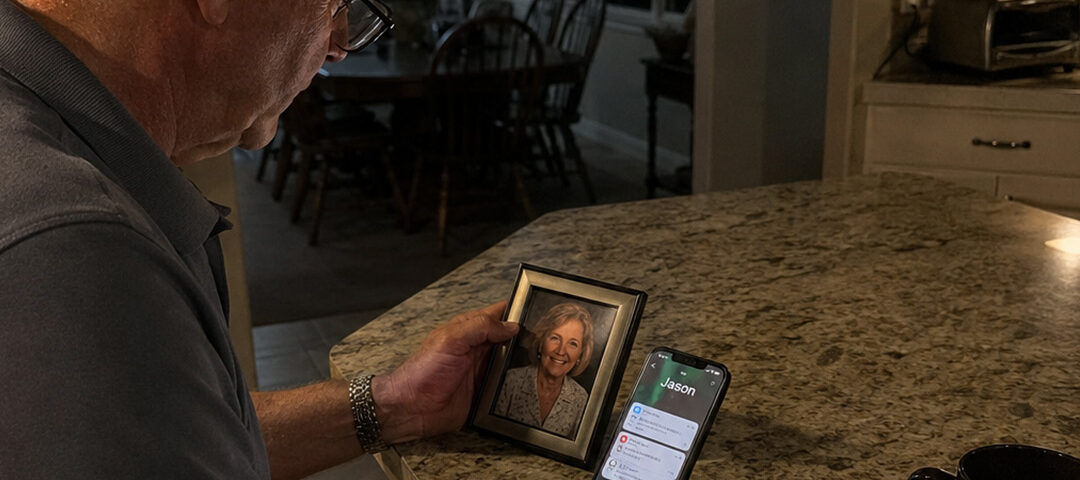
The chapel at Harris Memorial Services smelled faintly of lilies, polished wood, and rain left behind on overcoats. Carol Harris, the funeral director, had placed a framed photograph of Elaine near the casket. It was the one from our twenty-fifth anniversary in Galveston, Elaine laughing into the wind, her hair coming loose around her face, her hand tucked through my arm as if I were still the safest place in the world.
Behind me, people shifted in the pews. Friends from her cancer support group. Two couples from our old church. Margaret Feldman from her art charity board. Virginia Porter, my banker, sitting near the back with her hands folded. Robert Mitchell, my estate attorney, quiet and grave in a charcoal suit.
But not Jason.
Not his bride.
Not Ashley’s parents, who had lived off the kind of social polish that made absence look intentional.
No one from my blood family came.
My phone vibrated once during the opening prayer. I did not look at it at first. Then it vibrated again, a second pulse against my thigh, and some instinct told me to check.
Jason.
Dad, wedding starts in four hours. Can’t believe today is finally here.
I stared at the words until they blurred.
Can’t believe today is finally here.
His mother’s casket was ten feet from me.
I turned the phone off.
The service was brief because Elaine had always hated fuss. Carol read the poem Elaine had once clipped from a magazine and tucked into the drawer of her nightstand. Margaret spoke about Elaine bringing watercolor sets to children at the community arts program. Dr. Patricia Wong, who had treated Elaine during her last two years, spoke about courage without making it sound like a performance.
When it was my turn, I stood at the lectern and looked at those eight empty chairs.
I had written notes the night before. Three pages, folded carefully inside my suit pocket. A lifetime deserved better than improvisation. But when I unfolded them, the words looked too small.
So I looked at Elaine’s photograph instead.
“My wife loved people better than they deserved,” I said.
My voice sounded older than I remembered.
A few heads bowed.
“She kept chairs open. She kept food warm. She kept forgiving people long after they stopped earning it. I used to think that made her gentle.” I paused, swallowing against the tightness in my throat. “Now I think it made her strong.”
I did not look back at Jason’s empty chair again.
If I had, I might not have finished.
The morning Elaine died had been gray and still. I was in the kitchen making coffee when the nurse from hospice called. Her voice had that practiced softness people use when they carry news no one wants to receive.
“Mr. Coleman,” she said, “Elaine passed peacefully in her sleep.”
Peacefully.
People like that word because it gives grief something polite to stand behind.
The truth was that forty-two years of marriage vanished from my daily life between one breath and the next. The woman who knew how I took coffee, where I hid receipts, which knee hurt during rain, and why I still kept my father’s fountain pen even though it leaked—she was gone before the sun came up.
I sat at the kitchen island for almost an hour with the phone in my hand.
The house was quiet except for the hum of the refrigerator and the soft creak of pipes in the walls. Upstairs, Jason and Ashley were still asleep in the master bedroom, the one Elaine and I had moved out of six months earlier because Ashley said the upstairs light was better for her wedding videos and Jason said Mom’s knees made the stairs “impractical anyway.”
Elaine had squeezed my hand and whispered, “Let them have it, Homer. It’s only a room.”
But it had not been only a room.
Nothing they took had ever been only what they said it was.
First, it had been Sunday dinners.
“We’re just busy this week, Dad.”
Then holidays.
“Ashley’s family already booked the lake house.”
Then the guest room.
“We only need to stay here until after the wedding.”
Then our master bedroom.
“Mom will be more comfortable downstairs.”
Then my kitchen, my driveway, my office schedule, my money.
They never took anything all at once. That would have been too obvious. They took things the way rising water takes a room, inch by inch, until you look down and realize your ankles are gone.
Jason had not always been that kind of man.
I still remembered him at seven, running down the driveway after my truck, waving a baseball glove too big for his hand. I remembered him at twelve, crying in the garage because he thought he had disappointed Elaine by getting a C in math. I remembered him at seventeen, standing in his graduation gown with one arm around his mother, telling her, “I’m going to make you proud. I promise.”
Promises are easier when life has not yet asked you to choose.
Ashley Stewart entered his life four years before Elaine died. She was beautiful in a precise, expensive way. Perfect hair. Perfect posture. Perfect smile that never reached any room she did not control. Her father, Richard Stewart, owned luxury car dealerships across Texas. Her mother, Patricia, had the kind of voice that could make a compliment feel like a correction.
At first, Elaine told me to be kind.
“She’s young,” my wife said one evening after Ashley had complained that our living room felt “dated.” “Maybe she’s insecure.”
“Insecure people don’t usually insult your curtains while drinking your coffee,” I said.
Elaine had smiled, tired but amused. “You’re impossible.”
“No,” I said. “I’m accurate.”
She laughed then, the sound I would later miss more than my own breathing.
After Elaine got sick, the house changed. Not because illness changed it, though that would have been understandable. It changed because Jason and Ashley began planning their future inside it while Elaine was still fighting for her present.
Six months before the funeral, I came home early from the office to get a folder I had forgotten. Jason and Ashley were in the living room, their voices low but not low enough.
“The first thing we do is open up this kitchen,” Ashley said. “The whole place feels trapped in 1985.”
Jason laughed. “We can turn Dad’s office into a wine room.”
“What about Coleman Realty?”
“We sell it. The name has value. Between the business and the house, we’re looking at real money.”
Ashley’s voice warmed. “Your mom better not leave us some complicated trust.”
I stood in the foyer with one hand on the wall, listening to my son discuss my life’s work like furniture from an estate sale.
I should have confronted him then.
I should have called Robert that day.
But Elaine was alive, and as long as she was alive, some foolish part of me believed the family could still be repaired. I told myself Jason was under pressure. Wedding pressure. Career pressure. Ashley pressure. I told myself men say careless things when they are trying to impress the wrong woman.
Elaine knew better.
Two years earlier, before the cancer became the center of every calendar, she sat with me in my office while I reviewed our will.
“Homer,” she said, touching my hand, “maybe we should update this.”
“We have updated it.”
“I mean protections. A trust. Something that keeps Jason from being pushed.”
“He’s our son.”
“I trust the boy he was,” she said quietly. “I am not sure about the man he is becoming.”
I dismissed it.
Not sharply. Worse, gently.
I patted her hand and told her she was tired.
That was one of the last times I was wrong and she was alive to forgive me.
The day after Elaine died, I called Jason.
He answered on the fourth ring.
“Dad,” he said, his voice distant. “I heard.”
He heard.
As if someone had mentioned weather.
“Your mother died, Jason.”
“I know. I know. It’s terrible. Ashley and I are just in the middle of a lot right now.”
“A lot?”
“The wedding. The vendors. People flying in. You know how this week is.”
I closed my eyes.
“She loved you more than anyone on earth.”
There was a small silence on the line. Not grief. Discomfort.
“We’ll talk later, okay?”
Then he hung up.
Ashley never called.
Three days later, they came downstairs while I sat at the kitchen island surrounded by funeral papers. Florist options. Cemetery forms. Music selections. A printed order of service. Elaine’s reading glasses sat beside my coffee because I had found them on her nightstand and could not bear to move them farther away.
Ashley walked in wearing white linen and gold bracelets.
“Morning, Homer,” she said. “Is there coffee?”
Jason followed, scrolling on his phone.
“Hey, Dad. You look tired.”
I stared at him.
I had seen strangers at closings show more respect for people they had known five minutes.
“I am arranging your mother’s funeral,” I said.
“Right,” he replied. “Yeah. About that.”
Something in his tone made my stomach drop.
Ashley poured coffee into Elaine’s favorite mug without asking.
“Our wedding is March 29th,” she said, as if explaining a scheduling conflict to a receptionist. “We’ve had the venue booked eight months. Lakeway Resort, the caterer, the photographer, the florist. Two hundred guests. Everyone has plans.”
“March 29th is when I’m planning the service.”
Jason finally looked up.
“Can’t you move it?”
The kitchen went still.
The refrigerator hummed.
A truck passed outside on the street, bass faintly thumping through closed windows.
“Move your mother’s funeral?” I asked.
Ashley set the mug down with a delicate click.
“Homer, she’s gone,” she said gently, which made the sentence crueler, not kinder. “What difference does a few days make to her now?”
I looked at Jason.
This was the moment.
Every parent has them. Moments when your child stands at the edge of becoming someone, and you pray they step in the right direction. I waited for him to tell Ashley to stop. To say they would postpone. To say his mother mattered.
He looked at the floor.
“The timing is really bad, Dad,” he said.
It was not anger that came first.
It was clarity.
A cold, clean line drawn through every excuse I had ever made for him.
“You’re not coming,” I said.
“It’s not that simple.”
“It is exactly that simple.”
Ashley sighed. “You’re a businessman. You understand sunk costs.”
I heard Elaine’s voice in my memory.
I trust the boy he was. I am not sure about the man he is becoming.
“Get out of my kitchen,” I said.
Jason blinked. “What?”
“Both of you. Get out.”
Ashley’s mask slipped. “This is our home too, Homer.”
No.
It was not.
Not yet.
And if there was a merciful God, not ever.
I stood, gathered the funeral papers, and looked at my son.
“You are right about one thing, Jason. Your mother is gone.” My voice was calm enough to frighten even me. “But she was the only thing keeping this family together.”
He swallowed.
“Now there is nothing left to protect.”
I walked out before either of them could answer.
That night, I did not sleep. At three in the morning, I went into my office, turned on the desk lamp, and opened the filing cabinet that held the cleanest history of my life. Deeds. Incorporation papers. Account statements. Wills. Insurance records. Stock certificates. Partnership agreements. Thirty-five years of careful building.
The house at 2,847 Westlake Drive.
Coleman Realty Group.
Savings.
Investments.
A will naming Jason as sole beneficiary.
I laid the documents on the desk one by one.
Under the lamp, paper had a kind of honesty people often lacked.
My hands did not shake.
As a notary, I had spent my life watching people treat signatures like formalities until those signatures decided their futures. I knew Texas property law well enough to understand the difference between a will and a lifetime transfer. Most people thought inheritance was decided after death. It was not. A living person had the right to restructure ownership, create a foundation, transfer property, and decide what legacy meant before anyone else could get their hands on it.
The word that mattered was irrevocable.
Once done properly, it did not ask for permission from the disappointed.
By dawn, I had filled a legal pad with notes.
At six, I called Robert Mitchell.
He answered groggy but alert. “Homer? It’s early. Are you all right?”
“No.”
A pause.
“What do you need?”
“I need to create a charitable foundation. I need to transfer my house, business, and accounts into it. I need a new will. I need witness statements. I need everything filed before March 29th.”
Silence.
“That’s three weeks away.”
“I know.”
“This is about Elaine’s funeral.”
“And Jason’s wedding.”
Another silence. Longer this time.
“I’ll clear my morning,” Robert said. “Bring every document you have.”
At nine, I walked into Robert’s office on the sixth floor of Frost Bank Tower carrying a banker’s box and the kind of purpose grief sometimes gives a person when it stops being a wound and becomes a blade.
Robert listened as I told him everything. Not dramatically. I gave facts. The kitchen conversation. The overheard plan. The bedroom they had taken. The wedding on the funeral date. Jason’s silence.
When I finished, Robert leaned back and said the question he had to ask.
“Homer, he is your only son.”
“I had a son,” I said. “Now I have an heir waiting for me to become paperwork.”
Robert’s eyes sharpened.
“All right,” he said. “Then we do it properly.”
That morning, the Coleman Family Charitable Foundation was born in outline. Its mission would honor Elaine by helping families facing cancer with treatment costs, caregiving support, housing emergencies, and practical needs that insurance forms never seemed to understand.
Robert typed the mission statement, then turned the screen toward me.
The Coleman Family Charitable Foundation is dedicated to providing financial and emotional support to families affected by cancer, honoring those who faced illness with courage, dignity, and love.
I read it twice.
Elaine would have approved.
Jason would not.
“Yes,” I said. “That.”
For three weeks, I lived two lives.
In one, I was the grieving widower moving through funeral arrangements, choosing flowers, approving music, and listening to Ashley complain about makeup trials being crowded by “house energy.” Jason avoided my eyes and kept calling the wedding “the big day,” as if another day in that same week had not shattered my life.
In the other, I sat with Robert and Virginia Porter, my banker, building a legal structure so tight even grief could not shake it loose.
Articles of incorporation.
Foundation bylaws.
A new will.
A quitclaim deed transferring the house to the foundation.
Business ownership restructuring.
Bank account transfers.
Witness declarations.
Trustee provisions.
A board of directors that would take over after my death: Robert, Carol Harris, Virginia Porter, Dr. Patricia Wong from Austin Cancer Support Services, and Michael Rivera, a survivor Elaine had mentored during treatment.
Jason would receive fifty thousand dollars.
Nothing more.
Not because I wanted him destitute. Because I wanted him alive to understand limits.
Every document was drafted, reviewed, notarized, witnessed, and scheduled with the precision of a closing on a multimillion-dollar property.
Every evening, I came home to wedding chaos.
Ashley had turned the dining room into a command center. Seating charts covered the table. Fabric swatches lay across Elaine’s sideboard. Champagne invoices were stacked on the counter next to condolence cards she had not opened because they were addressed to me.
“Homer,” she called one night as I tried to pass quietly to my office, “could you spend Saturday at your office? We’re having the wedding party here before the rehearsal dinner, and the house feels crowded with everyone’s nerves.”
Everyone’s nerves.
My wife’s sweater still hung over the chair in the downstairs bedroom.
“My office is in this house,” I said.
Ashley gave a bright little laugh. “You know what I mean.”
I knew exactly what she meant.
A week before the funeral, Jason found me in the garage workshop. I was sanding a cherrywood memory box for Elaine. She had loved cherrywood because it reminded her of her grandmother’s dining table in San Antonio. The box had dovetailed corners, a fitted lid, and a felt-lined interior where I planned to place her favorite photograph and the letter I had not yet found the courage to write.
“Dad,” Jason said from the doorway. “You got a minute?”
I did not stop sanding. “What do you need?”
He stepped inside, looking uncomfortable among clamps, wood shavings, and old tools.
“You’ve been quiet lately.”
“My wife died.”
His face tightened. “I know.”
“Do you?”
He looked down. “After the wedding, maybe we can talk about the future.”
The future.
He meant my house, my business, my money, my disappearance into a more convenient shape.
I set the sandpaper down and looked at him.
“Yes, Jason. After the wedding, we will definitely talk about the future.”
Relief crossed his face. He thought he had repaired something.
“What are you making?”
“A memory box for your mother’s grave.”
His smile faltered. “That’s nice.”
Nice.
He left after that.
I picked up the engraving tool and carved the words into the lid.
Family is not blood. Family is choice.
Two days before the funeral, Ashley texted me from upstairs.
Homer, we’re moving to the hotel tonight for wedding prep. Rehearsal dinner tomorrow. You’re not invited, just wedding party and immediate family. See you after the honeymoon.
Immediate family.
I read the message twice.
Then I typed back, Have a wonderful evening.
When they came downstairs with matching designer luggage, Jason avoided looking at the framed photograph of his mother on the hallway table.
“The funeral is tomorrow at ten,” I said.
Ashley’s smile did not waver. “We know, but photos start at noon. There’s no way to make both work.”
“I understand,” I said. “Your priorities are clear.”
Jason paused with one hand on his suitcase.
“You’re okay, right?”
It was the closest he had come to concern.
“I’m tired,” I said. “Grieving. You understand.”
He nodded too quickly.
Ashley tugged at his sleeve. “Come on. The coordinator is waiting.”
At the door, Jason turned back. “We’ll see you after the honeymoon.”
“Actually,” I said, “I think we’ll see each other sooner than that.”
He frowned. “What does that mean?”
I smiled for the first time in weeks.
“You’ll understand soon enough.”
The morning of the funeral was beautiful.
That almost bothered me.
The sky was clear, pale blue over Austin, the kind of spring morning Elaine would have wanted to spend on the porch with tea. I dressed in my dark suit, the navy tie she had given me for our fortieth anniversary, and my father’s cufflinks. Then I placed the cherrywood memory box on the passenger seat and drove to Harris Memorial Services.
At nine-thirty, Robert arrived with his briefcase.
Virginia arrived ten minutes later.
Carol met me near the chapel doors.
“Everything is ready,” she said softly.
“So am I.”
She understood what I meant.
At ten, we held the service.
At eleven-fifteen, we gathered in the small conference room behind the chapel. The room had a round table, a box of tissues, a coffee urn nobody touched, and a window looking out toward the parking lot where only seven cars sat.
Robert laid out the final documents.
“This is the last set,” he said. “The revised will. Final transfer confirmations. Trustee declaration. Foundation asset schedule. Once these are signed, notarized, witnessed, and filed, Jason will have no claim beyond what you have designated.”
“How much time?”
“If we sign now, I file electronically within the hour. County deed recording should process by one. Bank transfers by two. Notifications are scheduled for nine tonight.”
Virginia’s expression remained professional, but her eyes softened.
“That should be during the reception,” she said.
“Yes,” Robert replied.
Carol touched my shoulder. “Homer, are you sure?”
I looked through the glass wall toward the chapel where Elaine’s flowers still stood.
“I buried my wife today with eight empty family chairs behind me,” I said. “I have never been more certain.”
I signed.
Robert notarized.
Carol and Virginia witnessed.
Signature.
Seal.
Witness.
Done.
Each page turned like a door closing.
At one o’clock, we buried Elaine beneath a soft breeze. I placed the cherrywood memory box at the base of her headstone. Family is not blood. Family is choice. The words caught the light.
By two, I was home.
The house was enormous and silent. I made coffee, sat in my office, and watched the hours move.
Photos arrived from people at the wedding who had no idea what I had just done. Jason beneath a flower arch. Ashley smiling in a dress worth more than Elaine’s first car. Five-tier cake. Champagne. A reception hall glowing gold.
At 8:30, Robert called.
“Everything is filed. Notifications queued.”
“One last chance to stop them?”
“Yes.”
“No.”
“Then justice arrives at nine.”
I hung up and placed Elaine’s photograph beside my phone.
At exactly 9:00 p.m., I unmuted it.
For three minutes, nothing happened.
Then the screen lit up.
Jason.
Then again.
And again.
Messages followed.
Dad, what have you done?
Call me now.
This isn’t real.
Dad please.
At 9:17, the missed calls reached twenty-three.
At 9:35, they reached forty-seven.
I answered on the forty-eighth.
Jason’s voice was barely recognizable.
“Dad, what did you do?”
I leaned back in my chair and looked at Elaine’s photograph.
“Hello, Jason,” I said calmly. “How was the wedding?”