The Peace They Thought My Money Would Pay For
At 7:15 the next morning, my son stood in my kitchen holding a $2,400 repair invoice, eight hours after telling me never to visit his house again.
“Just write the check, Dad,” Brandon said, glancing at his watch. “I have a client meeting at nine.”
The paper lay between us beside the coffee mug he had taken from my cabinet without asking. His navy suit was the one I had purchased for his promotion interview the previous year. His watch had been my retirement gift to him. Even the address printed beneath his name belonged to a house held by my family trust.
He did not apologize.
He did not ask whether I had slept.
He behaved as though the message he sent at 11:42 the night before had merely adjusted our schedule.
Dad, Brittany and I have talked. You come over too often. It’s overwhelming. We need space to be a family without you hovering. Don’t come to the house unless we specifically invite you. We want peace.
My name is Douglas Carter. I was sixty-eight years old that morning, though until then I had spent much of my retirement behaving like the exhausted parent of a teenager who could not safely cross a street alone.
For forty years, I worked as a structural engineer in Seattle. I calculated loads, stress points, wind resistance, and the hidden weaknesses that caused apparently solid structures to fail. I designed office towers, schools, parking garages, and two bridges that still carried thousands of people each day.
I knew that cracks rarely appeared without warning.
I simply failed to apply that knowledge to my own family.
Brandon was my only child. His mother, Elaine, died when he was twelve after a fast-moving illness that transformed our home from noisy and ordinary into quiet before either of us understood what was happening.
After the funeral, I built my life around keeping him safe.
I packed lunches badly. I learned which laundry settings ruined soccer uniforms. I attended parent conferences in work boots and sat in school auditoriums while still carrying rolled plans beneath one arm.
Every mistake I made as a grieving father became a promise to do more.
When Brandon struggled in college, I paid for an extra semester.
When his first apartment required a deposit, I wrote the check.
When he wanted a reliable car for a new sales position, I cosigned the loan and quietly covered the insurance.
I told myself I was giving him the stability Elaine would have wanted.
Years later, when he married Brittany and their son Leo was born, I purchased a large craftsman house on Oak Creek Drive through the Carter Family Trust. I allowed Brandon and Brittany to live there under a written occupancy agreement that required no rent as long as they maintained the property and respected the trust’s rules.
They called it their house.
I never corrected them in public.
That was my first mistake.
The house had four bedrooms, a cedar porch, a deep backyard, and an oak tree Elaine and I planted decades earlier when the land belonged to a smaller property. I selected it because Leo would have room to play and because Brandon said he wanted his son to grow up near good schools.
I paid the property taxes, insurance, major repairs, and homeowners association fees.
When Brittany wanted the kitchen remodeled, I lent them forty thousand dollars through a signed promissory note. They installed marble counters, changed the cabinets, and used the remaining money for furniture, travel, and expenses they never fully explained.
No repayment arrived.
I continued paying because I believed discomfort would distract Brandon from becoming the husband and father he could be.
In truth, comfort was preventing him from becoming either.
The message arrived while I was in my garage building a bookshelf for Leo’s eighth birthday.
He loved dinosaurs, so I had carved small silhouettes along the sides and planned to paint the bottom shelf forest green. Sawdust covered the workbench. A half-used sheet of sandpaper rested beneath my hand when the phone vibrated against the wood.
I read Brandon’s message three times.
My last visit had been two days earlier. I brought apples because Brittany used them in her morning juice. I repaired a leaking faucet after Brandon said the plumber wanted too much. I played dinosaurs with Leo for twenty minutes while his parents sat at the kitchen island scrolling through their phones.
I had not believed I was hovering.
I believed I was helping.
The difference, I realized in that garage, depended on whether the help came with respect.
I carried the phone into my kitchen and looked at the calendar on the refrigerator.
The next day was the fifteenth.
On the fifteenth, an automatic transfer covered Leo’s private school tuition. Another transfer moved money into the trust account used for Oak Creek Drive’s insurance and monthly expenses. The consulting stipend I paid Brandon through my family holding company also arrived near the middle of each month.
They wanted the peace of my absence.
They did not want the peace of my financial withdrawal.
I sat at the kitchen table and typed two words.
Understood. Done.
Then I turned off the lights and went upstairs.
I did not sleep. I lay beneath the ceiling fan reviewing the load-bearing points of my relationship with my son.
The mortgage-free occupancy.
The consulting payment.
The school tuition.
The emergency transfers.
The vacation money.
The credit-card rescues.
The house repairs.
The help had become so constant that Brandon no longer saw it as help. It had become the floor beneath his life, invisible because he had never been required to build it.
At 7:15, he knocked on my front door.
The knock was quick and impatient.
He stepped inside before I moved aside fully, walked into my kitchen, and poured coffee into the blue ceramic mug he had used since college.
“You need better beans,” he said after tasting it. “This is rough.”
I closed the front door slowly.
He pulled the invoice from his jacket.
“About the text,” he said, waving one hand as though brushing away smoke. “Don’t make it into something bigger. Brittany feels like she can’t relax when people drop by. We need boundaries.”
“People?”
“Guests.”
I studied him.
He had just called me a guest in a house purchased with my money, maintained through my trust, and occupied without rent because I wanted his family to feel secure.
“I understand boundaries,” I said.
“Good.”
He flattened the invoice on the table.
“The SUV’s transmission control system failed. The dealership wants twenty-four hundred before releasing it. My credit card is maxed because we put the vacation deposit on it.”
“What vacation?”
“Scottsdale next month.”
“I thought you were concerned about expenses.”
“We need the break.”
He checked his phone.
“Just write the check. I’ll pick up the SUV on the way to the office.”
He did not say please.
For thirty-two years, I had removed every obstacle before he could measure it. I told myself I was smoothing the road.
Instead, I had taught him that roads repaired themselves when he became impatient enough.
I opened the drawer containing my checkbook.
Brandon exhaled.
“Thanks, Dad. Seriously. Brittany was panicking.”
I took out my fountain pen, wrote the date, the dealership’s name, and the amount. Brandon watched my hand with visible relief.
“We’ll bring Leo by in a couple of weeks,” he said. “Once everything calms down.”
A couple of weeks.
Maybe.
I signed my name, tore the check from the book, and held it between two fingers.
Brandon reached out.
“You said you wanted peace,” I told him.
“Dad, I know. Let’s not rehash it.”
“Peace requires clear boundaries.”
“Exactly.”
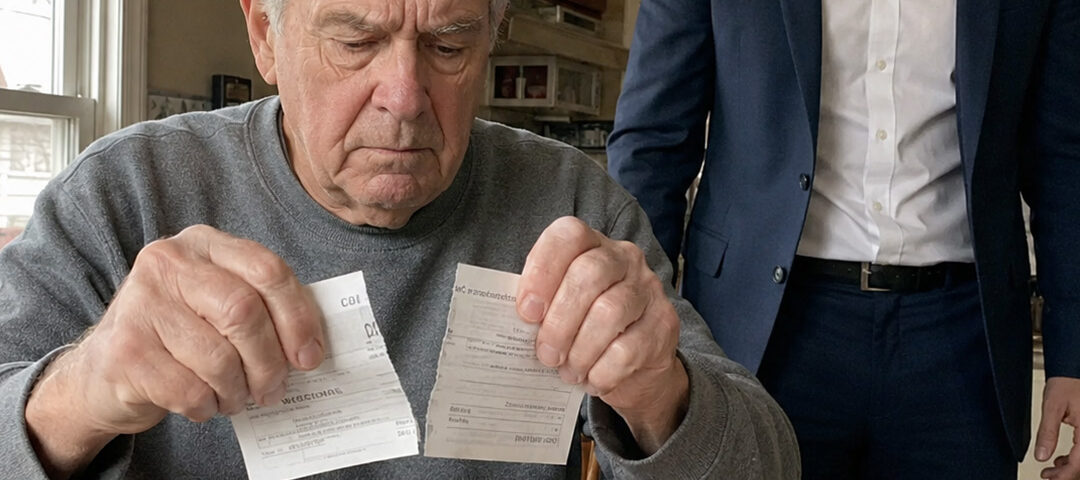
I tore the check in half.
The sound seemed louder than it should have been.
Brandon’s hand remained extended.
I placed the halves together and tore them again. Four pieces drifted onto the table.
His face changed slowly.
“What are you doing?”
“Respecting your request.”
“This has nothing to do with my car.”
“It has everything to do with your expectations.”
“I need that vehicle.”
“Then you need to pay the invoice.”
His voice rose.
“I cannot show up at a client site in the rental they gave me.”
“Why not?”
“It looks cheap.”
“Then arrive early and do excellent work.”
He stared at me.
“You’re punishing me because we asked for privacy.”
“No. I’m retiring.”
“From what?”
“The position of family bank.”
He gave a disbelieving laugh.
“You’re acting like a child.”
“I’m acting like a man who finally understands the arrangement.”
“What arrangement?”
“You keep the money close and the person providing it far away.”
“That is not fair.”
“Neither was your message.”
He looked at the pieces of the check.
Then his expression hardened.
“Fine. Keep your money. But don’t expect to see Leo until you apologize.”
The words hurt more than the text.
I had anticipated anger about the invoice. I had not expected him to use his son as leverage before breakfast.
“You will not use Leo to collect a check.”
“You don’t get to decide that.”
“I’m not asking you to leave angry,” I said. “I’m asking you to leave my house.”
He stared at me as if he had never heard the sentence directed toward him.
Then he walked out and closed the door hard enough to shake the framed photographs in the hallway.
The silence that followed felt different from the silence of the previous night.
It felt clean.
I gathered the torn paper and placed it inside an envelope rather than throwing it away. I wanted a physical record of the moment the arrangement changed.
Then I called Sylvia Ross.
Sylvia had been my estate attorney for nearly thirty years. She handled Elaine’s probate, created the Carter Family Trust, and warned me repeatedly that generosity without limits eventually became dependency.
She answered on the second ring.
“Douglas, it’s not even eight.”
“I need to see you today.”
“What happened?”
“My son asked me to stay away from the house while continuing to pay for it.”
There was a pause.
“I’ll clear ten o’clock.”
Sylvia’s office occupied the thirty-eighth floor of a glass tower downtown. Rain pressed against the windows, turning Seattle into gray shapes below us.
She did not hug me or offer false comfort.
She pointed toward the leather chair opposite her desk.
I placed Brandon’s message, the repair invoice, and the envelope containing the torn check in front of her.
She read everything.
“Tell me what you want,” she said.
“I want to stop confusing love with financing.”
“That is a goal, not an instruction.”
“I want to understand every active benefit Brandon and Brittany receive through me or the trust.”
Sylvia turned toward her computer.
“I’ve tried to show you the total before.”
“I wasn’t ready.”
“And now?”
“Now he has explained the relationship clearly.”
The printer began producing pages.
Sylvia placed the first ledger in front of me.
The numbers were not surprising individually.
Together, they were difficult to accept.
Property taxes.
Insurance.
Landscaping.
Security monitoring.
Roof repairs.
Heating-system replacement.
Kitchen loan.
School tuition.
Car assistance.
Vacation transfers.
Credit-card payments.
Consulting fees.
In the previous twelve months alone, I had paid more than one hundred thousand dollars toward Brandon’s household and personal lifestyle.
That did not include the value of living in the Oak Creek property without rent.
I ran one finger down the ledger.
“What work has he completed for the holding company?”
Sylvia opened another file.
“His agreement lists business development, vendor relations, and project introductions.”
“How many contracts did he generate?”
“None recorded.”
“Reports?”
“Three short memos in five years.”
I leaned back.
The six-thousand-dollar monthly payment was not compensation.
It was allowance dressed in professional language so Brandon could tell people he worked with family investments rather than admitted that his father supported him.
“Who owns Oak Creek Drive?” I asked.
“The Carter Family Trust.”
“And their legal status?”
“Permitted occupants under a revocable family-use agreement. They hold no ownership interest.”
“How much notice is required if the trustee terminates occupancy?”
“Sixty days under the agreement, though we could negotiate a shorter voluntary departure if both sides consent.”
“I want the agreement terminated.”
Sylvia removed her glasses.
“Douglas, removing the car repair is one thing. Ending their housing is another.”
“I know.”
“Do you want them immediately displaced?”
“No. I want the legal process followed precisely. Sixty days. Written notice. No public spectacle.”
“And the renovation loan?”
“Prepare a formal accounting and repayment request. Offer a reasonable plan.”
“You could demand the balance under the note.”
“I am not trying to financially destroy them.”
She studied me.
“What are you trying to do?”
“Stop protecting them from the cost of their own choices.”
Sylvia nodded slowly.
“And Leo?”
I looked toward the rain-streaked window.
He was innocent.
I would not allow my conflict with his parents to consume the education I had promised him.
“Cancel the automatic tuition transfer after the current term,” I said. “Create an education account under my control. Deposit the same annual amount there. Funds can go directly to accredited schools or future training. Brandon and Brittany cannot withdraw cash.”
“That may require them to move him if they cannot pay next term.”
“That decision belongs to his parents.”
“It will be emotionally difficult.”
“Yes.”
“The consulting agreement?”
“Terminate it according to the thirty-day clause. Pay everything properly owed. No manufactured cause and no humiliation.”
Sylvia wrote notes on a yellow pad.
“The household operating transfers?”
“Stop all discretionary payments. Continue only property expenses the trust is legally required to cover until they leave.”
She looked at the message again.
“Do you plan to sell the house?”
“I don’t know.”
“Then don’t decide today.”
That was why I trusted her.
She was not there to feed my anger. She was there to keep anger from becoming policy.
We prepared the notices.
I read every page.
The occupancy termination gave Brandon and Brittany sixty days to vacate Oak Creek Drive. It included access rules for inspections and repairs, a list of trust-owned furnishings, and an option to request a reasonable extension if they produced a documented relocation plan.
The consulting termination paid the final month under the agreement.
The loan accounting offered a five-year repayment schedule at the original low interest rate.
Nothing was cruel.
Nothing was vague.
Everything was different from the endless, informal support Brandon expected.
I signed as trustee.
Then as lender.
The signature as father existed nowhere on the documents, but I felt it in every movement of the pen.
When I returned home, the unfinished bookshelf waited in the garage.
I ran my hand over the carved dinosaurs and wondered whether Leo would ever receive it.
For the next three days, my phone remained quiet.
No broken-appliance messages.
No request for an emergency transfer.
No photograph of an expensive dinner described as a “much-needed family evening.”
I woke early, walked to the pier, purchased salmon from a vendor, and cooked dinner for myself at the dining table instead of eating over the sink.
The quiet showed me how much low-level anxiety I had mistaken for purpose.
On Friday afternoon, Brittany called.
Her photograph appeared on the screen because she was using Brandon’s phone contact card.
I answered after three rings.
“Hi, Dad,” she said brightly. “We haven’t heard from you. We were worried.”
“I’m fine.”
“That’s good. Your blood pressure and everything?”
“Excellent this week.”
She laughed too quickly.
“So, Leo’s birthday is next Saturday.”
“I know.”
“We’re doing a space theme at Galaxy Zone. Laser games, arcade credits, catered food. All his classmates are coming.”
“That sounds elaborate.”
“He deserves something special.”
“I agree.”
“The deposit is due today. You usually cover his party as your gift.”
I remained silent.
“We need five thousand,” she continued. “That includes the new gaming console.”
“I’ve already arranged Leo’s gift.”
“Oh.”
I heard typing.
“I don’t see a transfer.”
“There isn’t one.”
“Did you mail a check?”
“No.”
Her cheerful tone thinned.
“Then what did you arrange?”
“I placed ten thousand dollars into his education account.”
The typing stopped.
“What education account?”
“A protected account for tuition and future training. Payments can go directly to approved institutions.”
“That doesn’t help with the party.”
“It is not meant to.”
“We already invited people.”
“Then you need to plan a party you can afford.”
Her voice rose.
“Are you seriously punishing an eight-year-old over a disagreement with Brandon?”
“No. I’m separating support for Leo from cash available to his parents.”
“You promised him a birthday.”
“I promised to care about his future.”
“That’s not the same thing.”
“No. It lasts longer.”
She exhaled sharply.
“We don’t have five thousand available.”
“Then spend less.”
“You know how this will look.”
“Children rarely measure love by catering invoices.”
“You are ruining his birthday.”
“I am not discussing this further.”
“I’m putting Brandon on.”
“He can call after he reads the documents being delivered Monday.”
She went silent.
“What documents?”
“You’ll know when they arrive.”
I ended the call.
On Monday morning, a courier delivered the legal package to Oak Creek Drive.
I had instructed Sylvia’s office to avoid weekends, parties, and public settings. Signature was required only so the notice could not later be described as lost.
Brandon signed at 9:12.
He called at 9:18.
I did not answer immediately.
At 9:26, he called again.
At 9:31, Brittany called.
At 9:40, a message appeared.
You cannot remove us from our own home.
I replied once.
The property belongs to the trust. Please read the complete agreement and contact Sylvia with procedural questions.
At ten, my doorbell rang.
Brandon stood on the porch holding the thick cream envelope. Brittany waited behind him with her arms folded.
I opened the door but did not invite them inside.
“This is a mistake,” he said.
“It is not.”
“You gave us that house.”
“I allowed you to live there.”
“For five years.”
“Yes.”
“We built a life there.”
“I wanted you to.”
“Then why take it away over one text?”
“The text clarified a pattern. It did not create it.”
Brittany stepped closer.
“You’re angry because we asked for boundaries.”
“I respect the boundary. I will not visit without invitation.”
“Then cancel this.”
“No.”
Brandon shook the papers.
“You terminated my consulting agreement too.”
“Yes.”
“I depend on that income.”
“You were paid to perform work.”
“I did work.”
“Then bring Sylvia the reports, contracts, introductions, and documented results. The agreement still ends under its notice clause.”
His eyes narrowed.
“This is about control.”
“No. It is the end of control disguised as support.”
“You are trying to make us beg.”
“I have not asked you to beg.”
“What do you want?”
“I want you to manage your life with the income you earn.”
Brittany gave a bitter laugh.
“You know Brandon’s regular salary does not cover that house, school, cars, and everything else.”
“That is the information your budget should have reflected before you booked vacations.”
“You encouraged us to live there.”
“I encouraged you to build stability. You built expenses.”
Brandon looked past me into the hallway.
“Can we come in?”
“No.”
The answer surprised them.
For years, my house had been their emergency office. They arrived without notice, opened my refrigerator, and described my boundaries as moodiness.
“This is family business,” Brandon said.
“We can discuss it here or in Sylvia’s office.”
Brittany looked toward the neighbors’ houses.
“You want people to see us standing outside?”
“I did not bring you here.”
Brandon lowered his voice.
“What about Leo?”
“What about him?”
“You are forcing him out of the only home he knows.”
“I am giving his parents sixty days to secure appropriate housing.”
“He’ll have to change schools.”
“Possibly.”
“You said you cared about his education.”
“I do. The education account remains available.”
“That account is useless if we need money now.”
“The money belongs to his future, not your current lifestyle.”
Brittany’s expression hardened.
“You always thought you were better than us.”
“No. I thought I could solve every problem for you. That belief harmed all of us.”
Brandon stared at me.
“Are you saying this is your fault?”
“Partly.”
That answer stopped him.
“I taught you that frustration would eventually produce a check,” I continued. “I corrected every consequence before you felt it. I called that love because I was afraid losing your approval would feel like losing your mother again.”
His face changed at the mention of Elaine.
“You don’t get to use Mom.”
“I’m explaining my failure, not excusing yours.”
For a moment, none of us spoke.
Then Brittany turned toward the driveway.
“We should go. His lawyer can handle this.”
“You are welcome to obtain independent counsel,” I said.
Brandon folded the papers.
“We are not leaving the house.”
“The agreement describes the process if you refuse.”
“You would actually file against your own son?”
“I would enforce a trust agreement against any occupant who rejected its terms.”
His jaw tightened.
“Then don’t expect to see Leo.”
I felt the familiar pressure in my chest.
The old Douglas would have surrendered before the sentence finished.
The new one remained in the doorway.
“Your relationship with me and your responsibilities as Leo’s father are separate matters,” I said. “I will not bargain with a child.”
He walked away.
Brittany followed, her shoes striking the porch boards sharply.
I closed the door.
My hands shook after the lock clicked.
Boundaries look calm from the outside.
Inside, they can feel like holding a wall upright while every instinct tells you to let it collapse.
Sylvia scheduled a mediation for the following week.
Brandon and Brittany arrived with an attorney named Matthew Henderson. He was younger than Sylvia and began the meeting by describing their emotional investment in Oak Creek Drive.
“They understood the property to be their permanent family home,” he said. “They selected improvements, maintained community ties, and raised a child there.”
Sylvia opened a black binder.
“The written occupancy agreement states that their right to remain is revocable by the trustee with sixty days’ notice.”
“Written agreements do not erase equitable expectations.”
“No,” Sylvia replied. “But they clarify ownership.”
She placed the deed, trust schedule, and signed occupancy agreement on the conference table.
Brandon avoided my eyes.
Brittany pointed toward the renovation records.
“We added value. The kitchen alone cost forty thousand.”
Sylvia turned to the promissory note.
“Douglas provided the forty thousand as a documented loan.”
“We paid contractors from our account.”
“After the loan was deposited into it.”
“That money became ours.”
“No. It became borrowed funds governed by this note, signed by both of you.”
Henderson read the document and became quieter.
Sylvia moved through the ledger.
The trust paid taxes.
The trust paid insurance.
The trust paid structural repairs, landscaping, security monitoring, and the heating-system replacement.
Brandon and Brittany paid utilities, groceries, decorative purchases, and part of the routine cleaning.
They had contributed to living in the house.
They had not purchased the house.
“I am not pursuing past rent,” I said.
Everyone looked toward me.
“I am not asking for penalties. I am not asking them to repay every expense. The renovation loan can continue under a reasonable schedule.”
Brandon leaned forward.
“Then let us stay.”
“No.”
“Why?”
“Because remaining would preserve the belief that every boundary disappears if you resist long enough.”
Brittany’s eyes filled.
“We cannot afford a comparable place.”
“Then choose a place you can afford.”
“Our friends live near Oak Creek.”
“Friendship can survive a smaller ZIP code.”
Henderson cleared his throat.
“My clients are willing to apologize for the text and the misunderstanding regarding the repair invoice.”
“This is not a negotiation over an apology,” Sylvia said.
“What does he want from us?”
I answered.
“Vacate within sixty days. Leave the trust property intact. Sign an acknowledgment that you hold no ownership interest. Begin the loan repayment six months after moving, so you have time to stabilize.”
Brittany stared at me.
“That’s your generous offer?”
“Yes.”
“You’re leaving us with nothing.”
“You leave with your income, belongings, vehicles, and two months to plan.”

“Our vehicle is still at the dealership.”
“Then arrange transportation.”
She looked at Brandon.
He rubbed his face.
“What if we need more time?”
“Provide a lease application or signed housing plan before day forty-five. I will consider a short extension based on evidence, not promises.”
The word evidence changed the room.
For years, promises had been their preferred currency.
Now nothing moved without documentation.
They requested forty-eight hours to consider the proposal.
The following evening, Brandon came alone.
I was sanding the bookshelf in the garage when he entered through the open door.
He stopped beside the workbench.
“That’s for Leo?”
“Yes.”
“He thinks you forgot his birthday.”
“Did you tell him that?”
“Brittany said the party changed because Grandpa was upset.”
I put down the sandpaper.
“What did you say?”
“Nothing.”
“Silence allows a child to believe the loudest explanation.”
He looked ashamed.
“We held the party at home. Pizza, cake, a few friends.”
“Did he enjoy it?”
“Yes.”
“Then it was a successful birthday.”
Brandon touched one of the carved dinosaurs.
“You spent weeks on this.”
“Yes.”
“He would like it.”
“I hope so.”
He looked toward the floor.
“I came to accept the sixty days.”
“All right.”
“We found a townhouse.”
“Can you afford it?”
“Barely.”
“Barely is not a plan.”
He handed me a folder.
Inside was a proposed lease, a monthly budget, and statements from his regular employment. His base salary was respectable but far below the lifestyle he and Brittany displayed.
For the first time, the numbers belonged to reality.
I reviewed them.
“You need to sell the second SUV.”
“Brittany doesn’t want to.”
“Then she needs additional income.”
“She says childcare makes full-time work difficult.”
“Then reduce the car expense.”
He gave a tired laugh.
“You make it sound simple.”
“Simple is not the same as easy.”
He leaned against the bench.
“Why didn’t you teach me this before?”
The question was not fair, but it was important.
“I tried to teach through rescue,” I said. “Rescue teaches the opposite lesson.”
“You could have said no years ago.”
“I should have.”
“You liked being needed.”
“Yes.”
The admission hurt.
After Elaine died, Brandon’s dependence gave my life structure. Each crisis let me believe I remained essential. When he became an adult, I continued solving problems because I did not know who I was without them.
He had used me.
I had also made usefulness the price of my love.
“We both need to change,” I said.
He nodded slowly.
“What happens to Leo’s tuition?”
“The current term is covered. Future education funds remain protected. You and Brittany can choose private school if you pay the regular costs, or enroll him in the public district near your new home.”
“He’ll be upset.”
“Then help him through the transition.”
“Will you?”
“If you invite me into the process respectfully.”
He looked at the unfinished shelf.
“I’ll talk to Brittany.”
He turned to leave.
“Brandon.”
He looked back.
“Tell Leo the birthday fund became education savings. Do not tell him I chose money over him.”
“I won’t.”
He left carrying the budget folder beneath one arm.
The move happened six weeks later.
I did not arrive to supervise. A property manager documented the condition of Oak Creek Drive and confirmed the keys were left on the kitchen island.
The marble counters remained.
The oak tree remained.
Several trust-owned furnishings disappeared until Sylvia sent a written inventory. They returned the following day.
The house felt unnaturally large after they moved out.
I walked through the rooms with the property manager.
In Leo’s bedroom, glow-in-the-dark stars covered the ceiling. A pencil mark near the closet showed his height at ages six and seven.
The sight nearly broke my resolve.
“This can remain if you want,” the manager said.
“Yes.”
I was not erasing my grandson.
I was ending an arrangement between adults.
Oak Creek Drive sold three months later to a family with two children and enough income to maintain it without secret subsidies. The sale proceeds returned to the trust and were invested.
I did not celebrate.
A house changing owners is paperwork.
What mattered was what happened afterward.
Brandon and Brittany moved into a smaller townhouse near a public elementary school. They sold one SUV and canceled the Scottsdale trip. Brittany returned to part-time marketing work. Brandon continued at his sales job but lost the consulting payment from my holding company.
Without the artificial six thousand dollars each month, their budget became tight.
Then Brandon’s employer placed him on a performance plan.
He had spent years relying on relationships I introduced and expenses I covered. When measured by actual contracts, his results were ordinary.
He called me after the meeting.
“I think they’re pushing me out.”
“What does the plan require?”
“Three new accounts in ninety days.”
“Can you produce them?”
“I don’t know.”
“Then find out.”
“You know people there.”
“Yes.”
“You could call.”
“Yes.”
He waited.
I did not offer.
“I understand,” he said finally.
Two months later, the firm eliminated his position.
I learned from Sylvia because Brandon asked whether the loan-payment grace period could be extended.
I approved an additional three months after he submitted unemployment records and job applications.
Evidence.
Not guilt.
Brittany called once to accuse me of enjoying their struggle.
“I am not enjoying it,” I told her.
“You could stop it.”
“I could delay it.”
“What’s the difference?”
“If I pay every bill, the same problem returns under another address.”
“We have a child.”
“And Leo’s education fund is secure.”
“We need groceries now.”
“Have you applied for the temporary assistance available through Brandon’s severance program?”
Silence.
“No.”
“Have you sold the luxury watch collection?”
“That was a gift.”
“Gifts can be sold.”
She ended the call.
A month later, she took a full-time job.
Brandon accepted temporary work at a home-improvement store while continuing his search. He stocked lumber, mixed paint, and spent long shifts standing on concrete floors.
An old colleague saw him there and called me.
“Are you going to step in?” the man asked.
“No.”
“Doesn’t it embarrass you?”
“Honest work has never embarrassed me.”
Brandon did not tell me about the store.
That mattered.
For the first time, he was working without turning his effort into an invoice.
Our relationship remained distant.
I saw Leo twice during those months. Both visits happened at a public park after Brandon invited me directly and confirmed the time in writing.
The first time, Leo ran toward me, then stopped halfway.
“Mom says you made us move.”
“I ended an agreement with your parents.”
“Why?”
“Because adults sometimes need to become responsible for their own homes.”
“Were you mad?”
“Yes.”
“Are you still mad?”
“Less.”
He considered that.
“Did you forget my present?”
“No.”
I opened the back of my sedan and revealed the bookshelf.
His mouth opened.
The dinosaur silhouettes were painted dark green. I had added a brass plate inside the top shelf.
Built for Leo Carter by Grandpa Doug.
Brandon helped me lift it.
At the townhouse, he carried one side while I carried the other. We moved through a smaller living room filled with unpacked boxes.
Brittany watched from the kitchen but said little.
Leo chose the wall beside his bed.
When the shelf stood securely, he placed three dinosaur books on it and stepped back.
“It fits.”
“That was the plan,” I said.
Brandon ran one hand across the top.
“Solid.”
“It should carry more weight than he can fit on it.”
Our eyes met.
He understood the metaphor without needing me to explain it.
Six months after the text message, Brandon came to my porch alone.
He had taken the bus from downtown because their remaining car was with Brittany at work. He wore jeans, work boots, and a faded polo. His hands showed new calluses.
He stopped at the bottom of the steps.
“Hi, Dad.”
“Hello, Brandon.”
“I came to apologize.”
I waited.
“Not for needing money. Not for losing the house. For the way I treated you.”
He looked toward the porch boards.
“I thought your help proved I was successful. Then I treated your presence like the cost I shouldn’t have to pay.”
I remained quiet.
“I told Brittany you were hovering because it was easier than admitting we kept asking you to fix things. I used Leo to pressure you. That was wrong.”
“Yes.”
“I’m sorry.”
“I accept the apology.”
Relief moved through his face, followed quickly by hesitation.
“I need to ask something.”
There it was.
I felt the old disappointment rise before he finished.
“My unemployment is ending. The store keeps me part-time. I found a room closer to the industrial district, but the landlord needs first month and a deposit. Two thousand dollars.”
He spoke quickly.
“I’ll sign a note. I’ll repay you. I know how this sounds.”
I loved him.
That was why saying no hurt.
“I won’t give you the money.”
His shoulders lowered.
“I figured.”
“But I have an alternative.”
I handed him an envelope.
He looked at it cautiously before opening it.
Inside was an application and a business card for Malcolm Reed, a foreman overseeing a commercial dock-renovation project. Malcolm and I had worked together years earlier. His company needed entry-level project assistants willing to split time between field labor, inventory control, and safety documentation.
The starting wage was twenty-two dollars an hour with health coverage after ninety days.
Brandon read the page.
“This is physical work.”
“Partly.”
“I used to earn six figures.”
“You used to receive more than your documented value.”
He flinched.
“You really know how to make an offer feel encouraging.”
“I’m trying to make it honest.”
He turned the card over.
“Five-thirty in the morning?”
“Malcolm starts early.”
“I don’t have a car.”
“The Number 18 bus reaches the dock gate at five-twelve.”
“You checked?”
“Yes.”
He looked at me.
“Why help with a job but not a deposit?”
“A job can produce the next deposit. A check produces only this one.”
“What if I fail?”
“Then you will know from your own experience, not because I prevented you from trying.”
He folded the application.
“I thought the envelope was money.”
“I know.”
For a moment, anger moved across his face.
Then it passed.
“Is Malcolm expecting me?”
“He will interview you if you arrive tomorrow on time. The decision is his.”
“I have to work at the store tonight.”
“Then you will be tired.”
He looked toward the street.
“I hate this.”
“So did I when I started.”
“You had talent.”
“I had bills.”
A small, unwilling smile appeared.
He left with the envelope.
At 7:40 that evening, Sylvia texted me.
Malcolm says Brandon confirmed the interview.
The following afternoon, Brandon sent a message.
Got the job. Starting Monday.
I replied:
Good. Show up early.
He did.
The work was difficult. He unloaded materials, verified deliveries, photographed field conditions, and updated logs no client would ever praise publicly. His back hurt. Rain soaked through his jacket. He learned that steel did not care about confidence and shipping schedules did not adjust for ego.
Malcolm called after the first month.
“He’s not the best worker I’ve hired,” he said.
“I didn’t expect him to be.”
“But he asks better questions now.”
“That is progress.”
“Do you want updates?”
“No. Only contact me if safety is involved.”
Brandon’s work needed to belong to Brandon.
He rented a room instead of an apartment. He took the bus. He packed lunches.
Three months later, he made the first payment on the kitchen loan without being reminded.
It was only two hundred dollars.
I kept the receipt.
Not because I needed the money.
Because evidence of change deserved preservation too.
Brittany and Brandon separated quietly the following year. The financial pressure did not create every problem in their marriage. It exposed the ones expensive vacations and a free house had concealed.
They established a parenting schedule for Leo and eventually learned to speak without turning him into a messenger.
Brittany remained cautious around me, but she stopped requesting money. She built a marketing career, rented a modest apartment, and paid her own bills.
Brandon continued with Malcolm’s company and moved into project coordination. He was not promoted because I called anyone. Malcolm made him earn each additional responsibility.
On Leo’s tenth birthday, Brandon invited me to the townhouse for pizza and homemade cake.
The party cost less than two hundred dollars.
Leo laughed more than he had at any catered event.
After the other children left, Brandon handed me a mug of coffee.
“You still buy terrible beans,” he said.
“So do you.”
He smiled.
“I owe you an apology for that too.”
We stood near the bookshelf. It was full now—dinosaurs, science books, a baseball glove, and several model bridges Leo had built from craft sticks.
“You remember the text?” Brandon asked.
“Yes.”
“I thought peace meant not having to answer to anyone.”
“What do you think it means now?”
He looked toward Leo, who was showing Brittany a school project across the room.
“Not needing another person to carry the weight you refuse to name.”
That was a better answer than I could have given him.
Our relationship did not return to what it had been.
That was the point.
The old relationship required me to be useful and him to remain dependent. The new one required two adults who could disappoint each other without turning money, access, or a child into a bargaining tool.
Brandon still made mistakes.
So did I.
Sometimes I offered advice too quickly. Sometimes he heard control where I intended concern. We learned to pause and ask a better question.
Do you want help, information, or simply someone to listen?
That question saved us from many old habits.
The Carter Family Trust eventually sold another property and expanded Leo’s education account. I did not make Brandon a direct beneficiary again. Sylvia helped me create terms tied to age, responsibility, and independent financial counseling.
That decision was not punishment.
Inheritance should support a life, not replace the need to build one.
At seventy, I finally took the coastal trip I had postponed for years. I rented a small cabin near the water and spent mornings watching fishing boats leave the harbor.
Brandon called on the third day.
“Just checking in,” he said.
“What broke?”
“Nothing.”
“What bill is due?”
“None.”
“Then why are you calling?”
He laughed.
“To see how you are.”
That ordinary sentence nearly undid me.
“I’m good,” I said.
“Send pictures.”
“I will.”
Before hanging up, he added, “Leo wants to know whether bridges get tired.”
“They do.”
“What happens then?”
“Someone inspects the stress, repairs what can be repaired, and replaces what cannot.”
“That sounds familiar.”
“It should.”
Years later, I still keep three objects in the top drawer of my desk.
The original message asking for peace.
The $2,400 repair invoice.
The envelope containing the torn check.
Beside them is Brandon’s first two-hundred-dollar loan payment receipt and a photograph of Leo standing beside the dinosaur bookshelf.
The first three objects remind me where the old structure failed.
The last two remind me that failure does not always require permanent collapse.
Engineers do not preserve every building.
Some are unsafe beyond repair.
Others can be rebuilt if the foundation is exposed, damaged materials are removed, and every new beam is required to carry its honest share of the load.
My son asked me for peace.
At first, I believed giving it to him meant withdrawing everything at once and watching his life fall apart.
Time taught me something more precise.
Peace was not his silence or my absence.
It was the end of the arrangement in which love had to prove itself through payment.
It was a grandfather protecting a child’s future without funding his parents’ image.
It was a father offering work instead of another rescue.
It was a son calling when nothing was broken.
And it was an old engineer finally understanding that the strongest structure he would ever help build was not a bridge, a tower, or a house held by a trust.
It was a relationship capable of standing after the money was removed.
If you came here from Facebook because of this story, return to the Facebook post, tap Like, and comment exactly “Amazing” to support the storyteller. That small action means more than it seems and gives the writer genuine encouragement to keep sharing more stories about family pressure, firm boundaries, and finally protecting what you worked so hard to build.
Disclaimer: This story is a work of fiction created for entertainment purposes. Any resemblance to real persons, events, or places is coincidental.