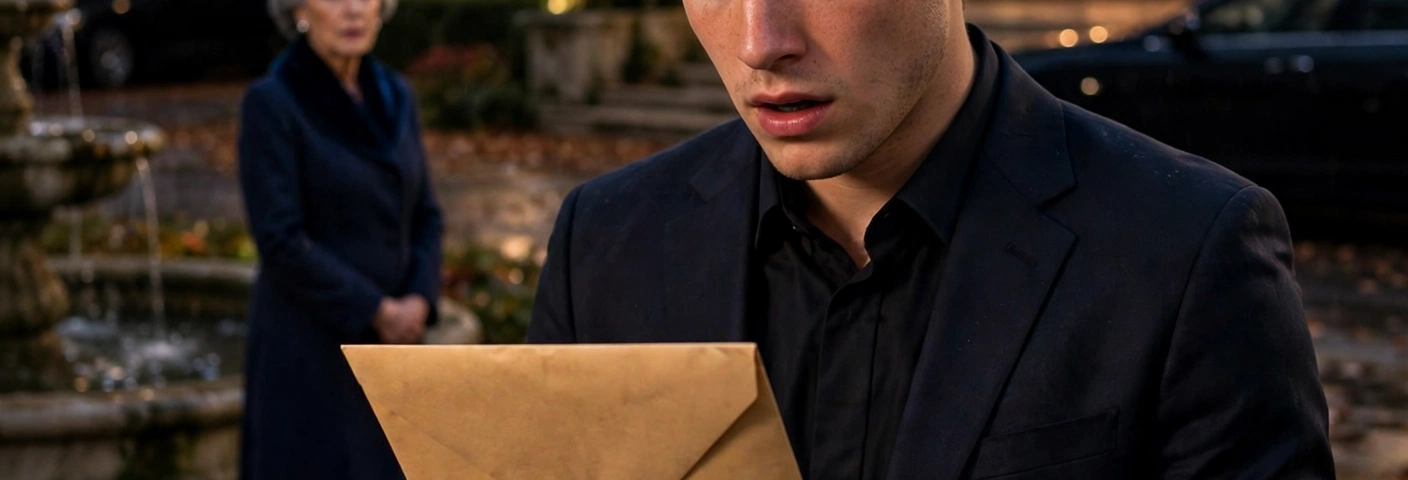
I sat down on the edge of the fountain and broke the wax seal.
To understand what happened next, you need to understand what the Parker empire really was — and what I was inside it.
The Parker fortune began seventy-five years ago with my grandfather Thomas, who opened a two-bay repair shop in Cleveland with nothing but a toolbox and a reputation for honesty. He built it, bolt by bolt, into something respectable. Then my father, William, took the reins and turned those humble beginnings into fourteen dealerships, and then — through a decade of aggressive acquisitions — into more than fifty dealerships across five states, plus financing arms, service centers, and a logistics division. Ninety-five million dollars of gleaming American success. And every brick of it, according to every story my father ever told, was a monument to his own genius.
Logan was the heir that mythology required. Three years older than me, Harvard-educated, married to Rachel Cromwell, whose family practically owned the east side of Columbus. Logan looked like a Parker was supposed to look — tall, confident, golden. Board members adored him. Bankers trusted him. My father introduced him at every charity gala as “the future of this company,” usually while I was standing ten feet away holding a tray of canapés from my catering side job.
I was the other one. The community college dropout. The kid who had walked away from a half-finished engineering degree because the tuition math never worked and the family money, somehow, was never available for me. What nobody in that ballroom seemed to know — or care to know — was that I had spent my teenage years taking apart engines in our garage and putting them back together better than the factory had built them. A community college physics professor named Chen once told me, after watching me solve a thermodynamics problem three different ways on a whiteboard, that I had the finest intuitive grasp of mechanical systems he had seen in thirty years of teaching. I had devoured textbooks on quantum mechanics for fun. I could look at a hybrid drivetrain and see the future in it the way other people read the weather.
None of that mattered at Parker Automotive. For three years I had worked in the back office, buried in inventory systems, while Logan learned the business from the executive suite. In my second year, I rewrote the company’s entire inventory management software on weekends — a system so efficient it saved the company nearly half a million dollars in its first twelve months. When I showed the numbers to my father, he glanced at the report for maybe ten seconds.
“That’s what we pay you for,” he said, and went back to his phone call.
Logan got a Ferrari for existing. I got a sentence.
The only person who had ever truly seen me was my mother, Margaret — née Aldridge, a name that was barely ever spoken in our house. She was quiet the way deep water is quiet. She never raised her voice, never demanded attention, never needed to. But she was, I slowly came to realize, the smartest person in every room she entered. She read engineering journals the way other women read magazines. She could do calculus in her head while frosting a birthday cake.
There were mysteries about her that I only pieced together years later. How was it that a quiet Ohio housewife had personal relationships with the chairmen of three Japanese automakers? Once, when I was sixteen, I overheard my father on the phone, furious about a supply contract that was falling apart. My mother took the phone from his hand, spoke softly in Japanese for eleven minutes, and handed it back. The contract was signed the next morning. When I asked her how she had done it, she just smiled and said, “I asked nicely.”
Her father — my grandfather, a man I never met — had served in Korea and, according to family whispers, had once saved the life of a young Japanese officer who went on to become the CEO of one of Japan’s largest manufacturers. That single act of wartime humanity became a bridge of loyalty that spanned generations. My mother inherited those relationships the way other people inherit china.
She died when I was twelve. Pancreatic cancer, the kind that doesn’t negotiate. Seven weeks from diagnosis to funeral. I sat beside her hospital bed every afternoon that final month, doing my homework while the machines beeped, pretending I didn’t understand what the doctors’ faces meant.
Three nights before she died, she asked the nurse to leave us alone, took my hand in both of hers, and looked at me with a clarity that cut through all the morphine.
“Ethan,” she said, “you have my mind. Never let anyone convince you otherwise — especially not the people in this house.” She squeezed my fingers. “When you turn twenty-one, everything will make sense. Until then, survive. Watch. Learn. And remember that the people who underestimate you are giving you the greatest gift of all.”
I didn’t understand a word of it. I was twelve. I just cried and told her I loved her, and she smiled and told me she had loved me since before I was born, and that some kinds of love are stronger than death.
After she was gone, the house reorganized itself around Logan like a solar system around its sun. My father threw himself into work and into his golden heir. Family dinners became strategy sessions for Logan’s future. My report cards went unmentioned; Logan’s Harvard acceptance got a full-page spread in the local paper, framed in the foyer.
The only adults who seemed to notice I was drowning were my uncle Henry and my grandfather Thomas. Uncle Henry — my father’s younger brother — had scandalized the family by going to art school instead of business school, then built a wildly successful advertising agency and ran media strategy for two presidential campaigns. He was the family’s cheerful black sheep, and he never bought into the Logan mythology.
“Your father’s an ass,” he told me once when I was seventeen, sprawled across his studio couch, “but he’s a successful ass, which in this family counts as a virtue. Don’t let him decide what you’re worth, kid. He couldn’t price water in a desert.”
And Grandpa Thomas, ninety-four years old and sharp as a tack, would study my face every Thanksgiving with those pale blue eyes and say the same thing: “You look like her. Like Margaret. Thank God for that.”