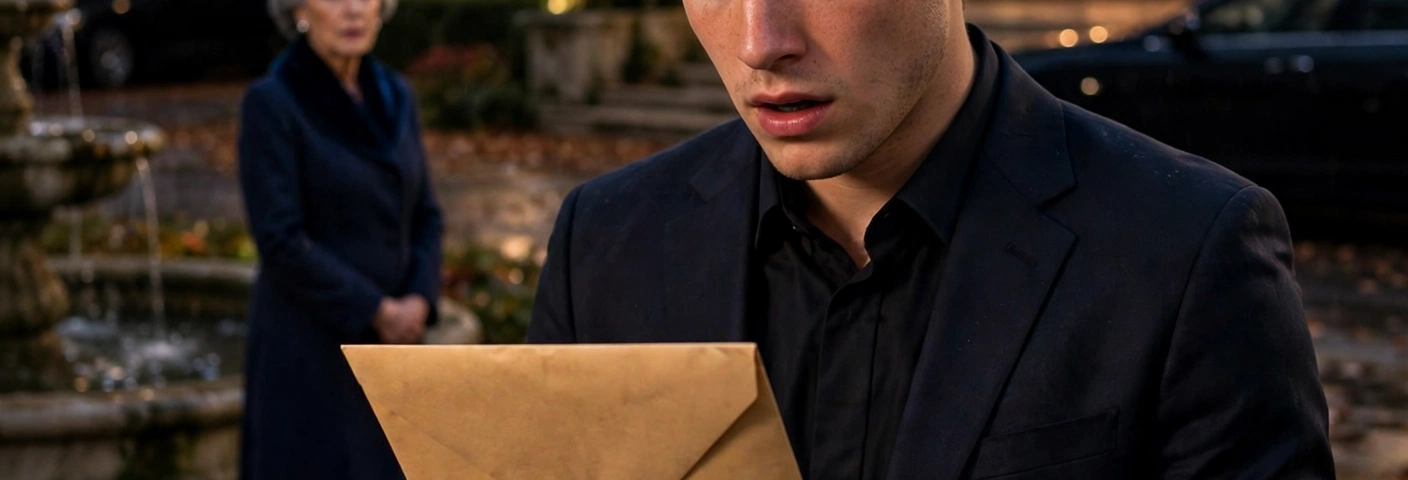
I never understood what he meant. Not until the night of the fountain.
My hands were shaking so badly I could barely get the letter out of the envelope. The paper was heavy cream stock, the handwriting unmistakably hers — the same looping script that had labeled every birthday present of my childhood.
“My dearest Ethan,” it began. “If you are reading this, then your father has finally shown you his true colors on the night he was always going to choose. I am sorry I could not be there to hold your hand through it. But I prepared for this night for ten years, because I have known William Parker far longer than you have, and I knew exactly what he would do.”
“Everything you have been told about this family is a lie,” the letter continued. “Everything — except my love for you. That was the truest thing I ever owned.”
What followed rewrote my entire understanding of my life. The Parker Automotive empire, my mother wrote, had not been built by my father’s genius at all. The patents that powered the company’s most profitable divisions — a revolutionary hybrid engine management system filed in 1997, along with eleven related drivetrain patents — had been designed by her, at MIT, where she had studied mechanical engineering under a different name before she ever met my father. The flagship dealership properties, the crown jewels of the portfolio, sat on land that had been in the Aldridge family for six generations, transferred into trusts she controlled before her marriage. The Japanese supply relationships that underpinned the entire import division existed because of her father’s wartime bonds and her own decades of careful cultivation — not because of anything William Parker had ever done.
“Your father was a talented salesman who married a strategist,” she wrote. “He has spent thirty years taking credit for a machine he never understood. I let him, because it kept the peace, and because I was playing a longer game than he could comprehend.”
Inside the envelope, beneath the letter, was a USB drive. “Everything is documented,” she wrote. “Every patent filing, every deed, every trust instrument, every recording. I have kept copies in five locations. James Wittman, of Wittman and Associates, has been waiting ten years for your call. Call him tonight, Ethan. Do not wait until morning.”
The letter ended with a paragraph I have read a thousand times since: “Fifty-five percent of Parker Automotive Group is held in Aldridge family trusts, and those trusts name you — not your father, not your brother — as the controlling beneficiary upon your twenty-first birthday. The board does not know. Your father does not know. Only James, Clara, and I have ever known. The quiet ones, my love, are the ones who change the world. Your father shouts. I whispered. Watch what the whisper built.”
I sat on that fountain for a long time, the letter trembling in my hands, while the party glittered on behind the glass without me. Then I took out my phone and dialed the number at the bottom of the page.
It was nearly midnight. The phone was answered on the second ring by a voice that sounded wide awake, as if the man had been waiting by the phone for a decade — which, I would learn, he essentially had.
“Wittman and Associates,” the voice said. “I’ve been expecting your call, Mr. Parker. Your mother was very precise about the timing.”
James Wittman met me at his office in the Reynolds Tower at one in the morning. He was a small, meticulous man in his sixties with the air of a chess grandmaster. Three of his attorneys were already there, and the conference table was covered with boxes — ten years of documentation, organized with librarian precision. Patent filings with my mother’s maiden name on them. Trust instruments signed before my parents’ wedding. Land deeds tracing back to 1888. And on the USB drive, in a folder marked simply “For Ethan,” a video file: my mother, frail but fierce, recorded in her hospital bed three weeks before she died, explaining everything in her own voice, calmly, methodically, like the engineer she had always been.
“She came to me ten years ago,” James told me as I watched my mother’s face flicker on the laptop screen, “and said, ‘Mr. Wittman, my husband is going to try to erase my son. I want you to make that impossible.’ We have been ready ever since.”
By four in the morning, I understood the full architecture of what my mother had built: a legal fortress, invisible from the outside, designed for exactly one purpose — to activate on my twenty-first birthday and place the empire in the hands of the son my father had called a mistake.
Monday morning arrived like a held breath. The board meeting was scheduled for nine o’clock in the executive boardroom on the forty-second floor — the same room where, I had no doubt, my father and Logan had planned a tidy coronation ceremony, complete with press photographers and a cake shaped like a Ferrari.
I arrived at 8:55. The boardroom had been decorated with gold balloons. Logan was standing at the head of the table practicing his acceptance speech in front of the darkened windows. My father was beaming beside him, surrounded by board members — Edward Blackwell, Judge Mitchell, Senator Reynolds — all of them laughing, all of them certain about how the morning would go.
Then the doors opened, and I walked in with James Wittman and three federal attorneys in dark suits.
The laughter died the way a candle dies when you close your hand around it.
“What is the meaning of this?” my father demanded, rising from his chair, his face flushing the particular shade of red I remembered from every childhood scolding.