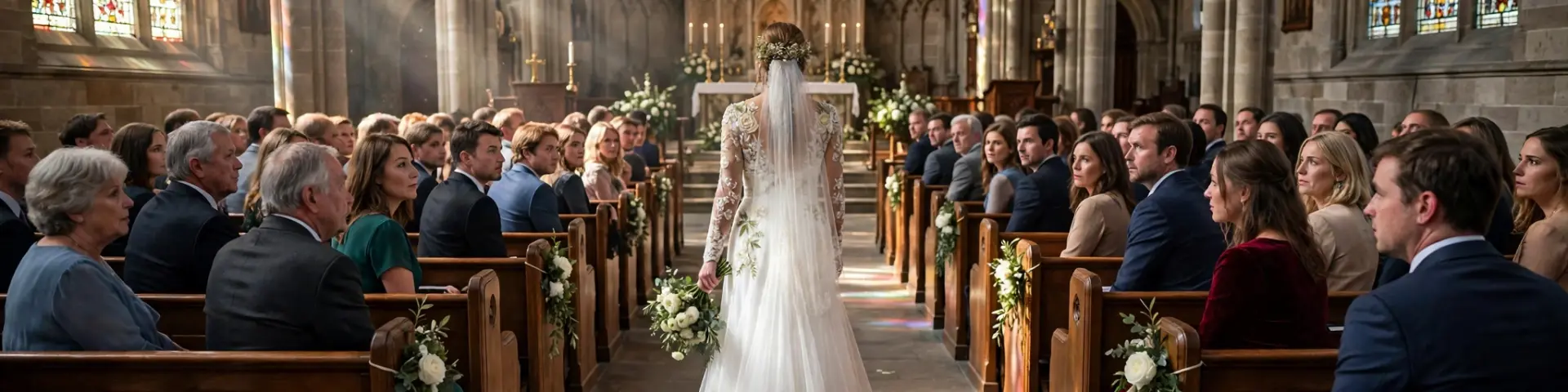
My Sister Walked Down the Aisle Wearing My Custom Wedding Dress
My sister took my custom wedding dress and walked down the aisle wearing it as though it had always belonged to her. The silk that my grandmother had helped me design, the embroidered sleeves that carried her roses, the covered buttons running down the back — all of it moved beneath the church lights on someone else’s body. Everyone kept watching me, expecting me to cause a scene, waiting for the older sister to finally break. But I remained completely silent, my hands folded in my lap, my expression unreadable. She believed she had taken the one thing that could ruin my day, the one thing that would make the whole event impossible for me to forget. What she didn’t know — what none of them knew — was that a sealed envelope had reached the altar before the ceremony began. Just as she prepared to say “I do,” the officiant paused, opened it, and asked a question that brought the entire wedding to a standstill.
The Dress She Tried to Make Hers
My sister looked directly into my eyes from the church aisle, wearing the wedding dress my grandmother had helped me design, and whispered, “Now everyone will remember me instead of you.” Her voice was low, meant only for me, but the triumph in it filled the space between us like something physical.
Two hundred guests waited for me to break. I could feel their attention like a weight, two hundred pairs of eyes flicking between the bride in my dress and the sister sitting motionless in the pew. The air in the church felt thick, heavy with perfume and anticipation and the particular electricity that fills a room when everyone senses that something is about to go wrong but no one knows what.
My mother sat in the front pew with both hands wrapped around her program, her knuckles white. She stared straight ahead, refusing to look at either of her daughters. My father stared at the white silk moving beneath the lights, his face a mask of confusion, as though he couldn’t quite process what he was seeing. The string quartet continued playing because no one had yet told them to stop — the music floated on, oblivious, a cheerful counterpoint to the tension freezing the room.
Chloe smiled as if she had finally won something we had been competing over our entire lives. And in a way, perhaps we had been. Not a competition I had ever agreed to, but one she had been running alone for years, keeping score in a game only she was playing.
I smiled back. It was not the smile she expected. There was no rage in it, no tears, no pleading. Just a calm, steady certainty that made her smile falter for just a fraction of a second.
She had no idea that the sealed envelope beneath my arm contained her signature, the boutique’s security photographs, the original ownership certificate, and one message she had sent to the wrong person. Every piece of evidence, carefully collected, meticulously documented, sealed and ready.
She also did not know that I had already made the call that would prevent the ceremony from continuing until the truth was addressed. The venue manager had the paperwork. The officiant had been briefed. Everything was in place.
My name is Victoria Monroe. I was thirty-two years old that spring, an interior designer in Charlotte, and six months away from marrying Alexander Reed when my younger sister decided that my wedding should become the stage for hers. What happened next would divide our family, end an engagement, and force every one of us to confront truths we had spent years avoiding. But to understand how she reached that church wearing my dress, you have to understand the shape of our childhood — the long, quiet history of two sisters who grew up in the same house but lived in entirely different worlds.
Two Sisters, Two Rules
Chloe was three years younger than me and seemed to enter every room already certain it belonged to her. It wasn’t arrogance, exactly — or rather, it wasn’t only arrogance. It was a kind of gravitational confidence, as though the universe had been arranged for her convenience and she simply expected it to continue. She was beautiful in a way people noticed immediately — golden-brown hair that caught the light, bright green eyes that seemed to see straight through you, and a smile that made adults forgive things before she even apologized. That smile had gotten her out of more trouble than I could count.
At family gatherings, she told stories louder than everyone else, holding court at the dinner table while the adults laughed and refilled her plate. At school events, she knew where every camera was, angling herself instinctively toward the lens. When she forgot an assignment, a teacher usually allowed her to turn it in late because she looked so sincerely disappointed in herself — those green eyes welling up, that lower lip trembling just slightly. It was a performance, but it was a flawless one.
When I forgot something, which was rare, my mother reminded me that responsibility was a habit. There was no trembling lip for me, no extension, no second chance wrapped in sympathy. Just the cool reminder that I should have known better, delivered with the expectation that I would, in fact, do better next time. And I did. I always did.
That difference — that fundamental, unspoken difference in how we were treated — followed us into adulthood like a shadow we couldn’t shake. It shaped everything: how we saw ourselves, how we moved through the world, what we believed we deserved.
Chloe believed wanting something was the beginning of receiving it. She had been taught, through years of indulgence and rescue, that desire was sufficient — that if she wanted something badly enough, someone would eventually make it happen for her. And for most of her life, someone had.
I believed wanting something was the beginning of working for it. I had been taught, through years of expectation and self-reliance, that nothing would be handed to me — that if I wanted something, I would have to earn it, build it, or create it myself. And so I did, over and over again, until hard work became not just a habit but an identity.
I paid my way through design school with scholarships, weekend shifts at a furniture showroom, and late-night freelance projects that left my eyes burning and my hands cramped. I graduated with honors and a portfolio I had built from nothing. After graduation, I joined a small residential design firm and spent years building a client list one renovated kitchen and carefully staged living room at a time. Every client was earned. Every referral was deserved. I built my career the way I built everything: slowly, carefully, and entirely on my own.
Chloe changed jobs often. She worked in public relations, then event planning, then luxury retail — each position starting with excitement and ending with a story about a difficult manager, an unfair policy, or a company that had simply failed to recognize her potential. The stories were always vivid, always sympathetic, and always placed the blame somewhere other than on Chloe herself.
My parents rarely challenged those explanations. They accepted each new narrative with the same weary indulgence, the same willingness to believe that the world had been unfair to their younger daughter once again.
“Chloe is finding herself,” my mother would say, as though self-discovery were a valid excuse for a pattern of behavior that had repeated itself half a dozen times.
When I worked sixty-hour weeks, I was doing what adults did. No praise, no concern, just the quiet assumption that of course I would handle it — I always did.
When Chloe went three months without income, the family rearranged itself around her. My parents covered her rent. My father made phone calls to friends who might have openings. My mother cooked extra food and invited her over “just to make sure she’s eating.” The entire family mobilized, as though Chloe’s unemployment were a natural disaster that had struck without warning, rather than the predictable result of quitting yet another job.
I resented that pattern more than I wanted to admit, but I had become skilled at hiding resentment beneath competence. It was easier to be the capable one, the reliable one, the daughter who never needed rescuing. It was easier than admitting that sometimes I wanted to be the one who was taken care of, even just once.
Then I met Alexander, and for the first time in my life, I felt like someone saw me — not the competent daughter, not the reliable sister, but me.
He was a landscape architect with a patient voice, thoughtful gray eyes, and the unusual ability to listen without preparing his next sentence. In a world full of people waiting for their turn to speak, Alexander actually heard you. We met while collaborating on a historic-home renovation near Myers Park. I was redesigning the interior; he was restoring the gardens. It was the kind of project where every decision mattered, where the house itself seemed to have opinions about what it wanted to become.
Our first argument concerned a wall of windows. I wanted more light in the breakfast room — the space felt dark and closed, and I could see exactly how morning light would transform it. He believed the proposed window placement would damage the view of a mature magnolia that had stood on the property for decades.
“The tree was here first,” he said, with the quiet conviction of someone who had spent his career thinking about the relationship between buildings and the land they occupied.
“The clients live inside,” I countered. “They need light. They need to feel connected to the outdoors, not separated from it by a wall.”
“The clients hired us to respect the property.”
“So did the house.”
He smiled. It was not a charming smile meant to end the disagreement, not the kind of smile men use when they want a woman to stop arguing. It was the smile of someone genuinely delighted to discover that I cared as much as he did — that I was willing to fight for what I believed was right, even when it meant fighting him.
We compromised. The magnolia stayed, its branches spreading wide and generous. The breakfast room received narrower windows positioned carefully around it, framing the tree like a living painting. Months later, the homeowners sent us a photograph of morning sunlight falling across the table while the tree bloomed outside, white flowers scattered like stars against the green.
Alexander framed it and hung it in his office.
We dated for three years before he proposed at the same house, beneath the magnolia we had both refused to sacrifice. It was perfect — not grand or showy, but deeply, quietly right. The tree that had started our first argument became the witness to our commitment.
My grandmother Rose was still alive then. She was eighty-four, sharp-minded, elegant, and convinced that every important family occasion required proper stationery. She had taught me to sew straight seams when I was nine and to notice quality by looking inside a garment rather than at the label — a lesson that would stay with me for the rest of my life.
“A beautiful outside can hide careless work,” she used to say, turning a blouse inside out to show me the stitching. “Turn it over. Examine the stitching. That’s where the truth is.”
Grandma Rose never distrusted Chloe, but she understood her in a way my parents never quite managed. She saw through the charm to the insecurity underneath, the desperate need to be seen that drove so much of Chloe’s behavior.
“Your sister enters life through open doors,” she once told me, her voice gentle but clear. “You build the door, hang it correctly, and make sure it closes.”
It was not criticism. It was observation — the kind of clear-eyed assessment that only someone who loved us both could make.
When Alexander and I became engaged, Grandma asked what kind of dress I wanted. It was a simple question, but it opened a door to something I hadn’t fully admitted to myself: I had been thinking about this dress for years.
I had saved magazine clippings and sketches since college, not because I dreamed of an extravagant wedding, but because clothing design fascinated me. The architecture of a garment — how fabric could be structured to flatter, to move, to tell a story — felt like an extension of the interior design work I did every day. I wanted a gown that felt architectural without being severe, romantic without becoming delicate. Something that looked like me.
Grandma and I spent a rainy Sunday at her kitchen table drawing ideas on tracing paper, the rain pattering against the windows while we worked. It was one of those perfect afternoons that you don’t recognize as perfect until much later, when you’re looking back and wishing you had paid more attention.
She suggested a structured silk bodice with a gentle square neckline — classic, timeless, elegant.
I added long sleeves made from nearly transparent embroidered tulle, delicate as a whisper.