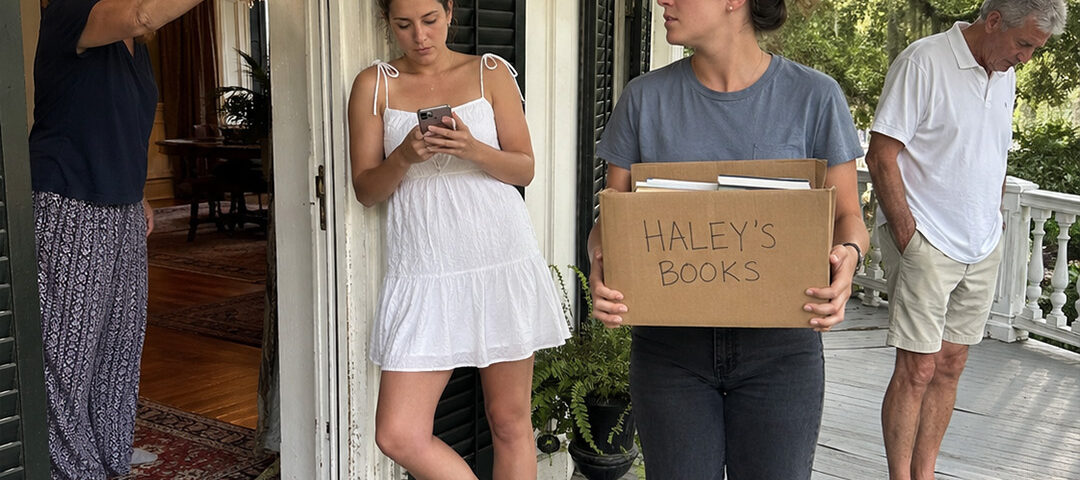
Mom Yelled: “You Have 48 Hours To Get Your Stuff Out. That House Is Your Sister’s…”
The thing about being thrown out of a house you rebuilt with your own hands is that the words do not hit right away.
My mother stood in the front hall of the old Victorian on East Bolton Street, one hand braced on the carved newel post I had stripped, sanded, stained, and sealed myself, and she yelled, “You have forty-eight hours to get your stuff out. That house is your sister’s now.”
Outside, Savannah heat pressed against the windows like a wet towel. A tour trolley rattled somewhere beyond the live oaks, and the brass mail slot I had ordered from a restoration shop in Charleston glowed in the afternoon light.
I did not argue.
I looked at my father, waiting for him to say my name.
He looked at the floor.
That was my answer.
—
My name is Haley Whitmore, and for most of my life, I believed love was something you earned by being useful.
Not beautiful. Not easy. Not adored.
Useful.
I was twenty-nine the day my mother, Sharon Whitmore, gave me two days to disappear from the house I had spent five years saving. My younger sister, Kelsey, was twenty-six, newly engaged, and already treating her wedding like a brand launch. Her phone was always in her hand. Her smile was always half aimed at a camera. Her whole life looked like it had been staged under warm lighting.
Mine looked like receipts, contractor dust, permit applications, and the dull ache in my wrists from sanding century-old trim after midnight.
The house had belonged to my grandmother Eleanor, my father’s mother. It was a tall, tired Victorian with a sagging porch, narrow windows, a slate roof that had once been elegant, and enough rot behind the walls to scare off every investor who toured it. When Eleanor died, she left the property to my father, Ryan, or at least that was what I had always been told.
By then the house was not a legacy. It was a liability.
The roof leaked into the upstairs hall. The back foundation wall had separated enough that you could slide your fingers into the crack. The electrical system looked like something a haunted-house inspector would use as evidence. The city had sent notices. The insurance company had threatened to drop the policy. My parents said they were broke, tied up in a lawsuit with one of my father’s old suppliers, and unable to put another dollar into the place.
Then my father sat across from me at the kitchen table with his hands folded like he was praying.
“Haley,” he said, his voice thick, “this house is your grandmother’s last gift to us. If we lose it, we lose her.”
My mother dabbed at the corner of her eye with a tissue she did not need. Kelsey was upstairs getting ready for some weekend trip to Hilton Head, unconcerned, untouched.
I was twenty-four, freshly licensed, trying to turn my small interior architecture business into something that could survive past its first year. I had savings because I had always saved. I had credit because I had never missed a payment. I had a dangerous need to be chosen.
So when my father said, “You’re the only one who can save us,” I believed him.
That sentence became a chain around my neck.
I paid the first emergency invoice for the roof. Then the structural engineer. Then the electrician. Then the plumber. Then the mold remediation crew. Every time I thought the bleeding had stopped, the house opened another wound.
By the end of the second year, I had put $165,000 into a property that, according to my family, was “ours,” which meant theirs when it mattered and mine when the bill came due.
One hundred sixty-five thousand dollars.
The first time I said the number out loud, it sounded like pride.
The second time, it sounded like panic.
The third time, years later, it would sound like evidence.
—
When my mother told me I had forty-eight hours, she did it in the same foyer where I had once slept on a drop cloth because the plaster crew had arrived at dawn and I was too exhausted to drive home.
She had dressed for the confrontation like she was attending a luncheon: linen pants, gold hoops, pale lipstick, a little perfume that smelled like gardenias and judgment. My father stood behind her, hands in his pockets. His jaw worked once, twice, but he said nothing.
Kelsey leaned against the entrance to the parlor in a white sundress, her engagement ring flashing every time she lifted her phone.
“Mom,” she said, not looking up from the screen, “we don’t have time for this energy. The bridal brunch is next weekend, and I cannot have boxes and tools in the guest room.”
Boxes and tools.
That was what five years had become.
I looked at the wainscoting in the hall. It had been buried under seven coats of paint, some of it lead-based. I had stripped it inch by inch under plastic sheeting while sweat ran into my eyes. I remembered my father walking through one evening, seeing the raw wood emerge, and saying, “Your grandmother would be proud.”
He did not say that now.
“Kelsey needs the space,” my mother said. “This is not personal.”
I laughed once, softly.
That was the first sound I made.
My mother’s face tightened. “Don’t start.”
“I didn’t say anything.”
“You never have to,” Kelsey muttered. “You just stand there making everyone feel guilty.”
I turned to her. “Do you feel guilty?”
Her eyes flicked up then, sharp and blue and empty. “I feel like you’re ruining something important because you always need to be the victim.”
My father finally spoke. “Enough.”
For one foolish second, I thought he meant them.
He meant me.
“Haley, don’t make this harder than it has to be.”
The hallway seemed to narrow around me.
“Harder?” I asked.
He rubbed his forehead. “You’ve been staying here while things got settled. Kelsey is starting her life. She and Brendan need the house for the wedding events, and after that, they may move in for a while.”
“Move in.”
“It makes sense,” my mother said quickly. “They’re newlyweds. They need a place. You have your business. You’ll be fine.”
There it was. The oldest family math.
Kelsey needed, so Haley gave.
Kelsey wanted, so Haley adjusted.
Kelsey cried, so Haley apologized.
I looked at my father again. “You promised me this would always be my home.”
He swallowed.
My mother rolled her eyes. “Your father was emotional. People say things during a crisis.”
“And the $165,000?”
Kelsey made a small disgusted sound. “Here we go.”
My mother lifted her chin. “No one forced you to help this family.”
That sentence did something to me.
It did not break me. I had been breaking for years.
It finished the job.
I stood very still in the foyer, hearing the ceiling fan tick above us, hearing a dog bark somewhere down the block, hearing my own pulse settle instead of rise.
“Fine,” I said.
My mother blinked. “Fine?”
“Forty-eight hours.”
Kelsey’s mouth curved. “Great. Make sure the blue room is empty first. My makeup artist needs natural light.”
I nodded once.
Then I walked upstairs.
Behind me, I heard my mother exhale like she had won.
She had no idea what winning was going to cost.
—
My bedroom was at the back of the second floor, facing the alley and a magnolia tree that dropped leaves onto the roof no matter how often I cleared the gutters. When I first moved into that room, the ceiling had a brown water stain shaped like the state of Georgia. The windows stuck. The closet smelled like damp plaster. The door had no knob.
Now it had linen curtains, refinished heart-pine floors, and a vintage brass doorknob I had found after three weeks of searching architectural salvage listings online.
I sat on the edge of the bed and looked at that doorknob.
It was ridiculous, maybe, that a knob could hurt me.
But I remembered buying it with money I should have used for health insurance. I remembered opening the box at my old apartment and holding it like treasure. I remembered thinking, someday, when I turn this knob, I will be entering a room where I belong.
For five years, that had been my secret prayer.
I did not cry.
Crying would have required surprise.
I opened my phone and scrolled past moving companies, past storage units, past hotels. Then I found the number I wanted.
Mike Alvarez answered on the third ring.
“Haley,” he said. “Tell me you’re not calling about another clawfoot tub.”
“Not this time.”
“What’s up?”
“I need a rush job.”
“How rush?”
“Forty-eight hours.”
There was a pause. Mike owned a small architectural salvage and restoration company out near Garden City. We had worked together on hotel renovations, historic homes, two restaurant buildouts, and one insane project where a client wanted an entire 1920s bank teller cage rebuilt inside a wine bar.
“What are we removing?” he asked.
“Everything I bought.”
Another pause.
“Define everything.”
“The chandelier. The sconces. The brass hardware. The marble island top. Faucets. Appliances. Cabinet pulls. Smart thermostats. Drapes. Blinds. Mirrors. Anything I paid for and can be removed without damaging the structure.”
“Haley.” His voice changed. “Is this legal?”
“I have receipts.”
“That is not exactly the same thing.”
“I know.”
I looked at the doorknob again.
“My family just gave me forty-eight hours to leave the house I saved. They want my sister to have it.”
Mike was silent.
Then he said, “I’ll bring a careful crew.”
“Careful matters.”
“With you, it always does.”
“I don’t want vandalism. I don’t want broken walls. I want surgical removal.”
“Understood.”
“And Mike?”
“Yeah?”
“Even the doorknobs.”
He let out a slow breath. “Okay.”
When I hung up, my hands were shaking for the first time.
Not from fear.
From the strange, clean terror of choosing myself.
—
For the next forty-eight hours, I became polite.
That was what unsettled them most.
I did not slam doors. I did not accuse. I did not remind my mother that I had spent Christmas Eve under the kitchen sink fixing a burst line while Kelsey drank peppermint cocktails with her friends in the parlor. I did not remind my father that he had called me his miracle when the city inspector finally cleared the structural repairs. I did not tell Kelsey that the “aesthetic” she claimed as hers had been built out of my sacrificed sleep, my unpaid labor, and my invoices.
I simply packed.
My mother moved through the house with a yellow legal pad, making lists for the bridal brunch.
“We’ll put the champagne wall here,” she said to Kelsey, standing in the dining room under the crystal chandelier I had bought at an estate sale in Buckhead. “And flowers all along the mantel.”
“White flowers,” Kelsey said. “Nothing grandma-looking.”
I carried a box of books past them.
My mother looked at me. “Be careful with the floors.”
I almost smiled.
“The floors I paid to refinish?”
Her eyes hardened. “This attitude is exactly why this arrangement was never going to work.”
I kept walking.
Downstairs, in the kitchen, blue painter’s tape appeared quietly on certain objects.
A strip on the Wolf range.
A strip on the Sub-Zero refrigerator.
A strip on the Italian faucet, the cabinet pulls, the pendant lights over the island, the marble slab that had taken four men and two dollies to install.
In the downstairs powder room, blue tape marked the gilt mirror, the sconces, the towel ring, the faucet shaped like a small piece of sculpture.
Upstairs, it marked the drapes, the light fixtures, the custom rods, the antique knobs.
Every strip of blue tape was a receipt made visible.
My mother noticed none of it.
Or maybe she saw it and assumed it was part of packing, because in her world, my labor had always existed without needing explanation.
The salvage crew arrived before sunrise on the second day, parking in the alley instead of the front drive. Mike came himself, wearing jeans, a faded Braves cap, and the expression of a man who knew better than to ask too many questions.
He looked at the house and whistled under his breath.
“You did good work here.”
“I know.”
He glanced at me. “That wasn’t a compliment you were supposed to deflect.”
I looked up at the back of the house, at the windows I had restored, at the porch rail I had repaired, at the painted trim Kelsey had once called “cute” in a video without mentioning my name.
“I know,” I said again.
That time, I meant it.
The crew worked like surgeons.
No smashing. No rage. No ugly destruction.
They uninstalled.
The dining room chandelier came down first, each crystal wrapped and boxed. My mother walked in halfway through and froze.
“What is happening?”
I turned from where I was labeling a crate. “I’m removing my property.”
Her mouth opened. Closed. Opened again.
“You can’t take that.”
“I bought it.”
“It belongs to the house.”
“Then the house should have paid for it.”
Her face flushed. “Ryan!”
My father came in from the porch, saw the chandelier half lowered, and stopped like he had walked into a crime scene.
“What the hell is this?”
“Exactly what Mom asked for,” I said. “My stuff out in forty-eight hours.”
Kelsey appeared behind him, still in pajamas, hair twisted up, phone in hand. “Are you serious?”
I did not answer her. Mike’s crew kept working.
“Stop them,” my mother snapped at my father.
My father squared his shoulders. For a moment, old instinct flickered in me. The child part of my brain still believed his anger could rewrite reality.
“You need to put that back,” he said.
“No.”
His eyes narrowed. “Haley.”
“No.”
It was one syllable, but it took twenty-nine years to learn.
Kelsey looked from me to the crew. “My brunch is tomorrow.”
“I know.”
“You are doing this on purpose.”
“Yes.”
The room went silent except for the soft metallic clink of crystals being wrapped.
Kelsey’s face changed. She was not used to hearing the truth without apology.
My mother pointed at me. “This is spite.”
“No,” I said. “Spite would be breaking what I built. I’m only taking what I paid for.”
My father stepped closer. “Those are fixtures, Haley. You are stealing from this property.”
“Then call the police.”
The dare landed between us.
He did not move.
Not yet.
—
By noon, the house began to lose its mask.
The kitchen went first. Without the marble island top, it looked unfinished and embarrassed, all plywood edges and screw holes. The high-end appliances disappeared into padded moving blankets. The faucet left behind a dark opening in the counter. The pendant lights came down, exposing capped wires and pale circles on the ceiling.
My mother stood in the doorway, clutching her phone so tightly her knuckles blanched.
“You are sick,” she whispered.
I carried a box of cabinet pulls past her. “No. I am organized.”
Kelsey was crying by then, but not the kind of crying that comes from grief. It was angry crying. Performance crying. The kind that looks around for witnesses.
“You’re jealous,” she said. “You have always been jealous of me.”
I set the box down.
“You’re right.”
That stopped her.
I looked at her, really looked. At the perfect blowout. The delicate gold necklace. The nails she had photographed against coffee cups and steering wheels and my restored staircase.
“I was jealous,” I said. “Not because you had more. Because you never had to ask why.”
She stared at me.
“You were loved like breathing,” I said. “I was loved like a utility bill.”
Her face twisted. “That is dramatic even for you.”
“Maybe.”
I picked up the box again.
“But the bill is due.”
Upstairs, Mike’s crew removed the drapery rods from the guest room Kelsey wanted for her makeup station. Sunlight fell naked through the windows. Without fabric, without rugs, without furniture, every room echoed.
The house had great bones because I had paid to save them.
But beauty is not bones.
Beauty is the thousand choices no one notices until they are gone.
The antique glass knobs came off last.
I removed the one from my bedroom myself.
The screws resisted at first. I sat cross-legged on the floor with a small screwdriver, turning slowly, feeling the metal loosen beneath my hand. When the knob came free, it rested in my palm warm from my skin.
For a moment, I nearly put it back.
Not for them.
For the girl I had been when I bought it.
The girl who thought belonging could be installed if she just found the right hardware.
I wrapped the knob in a towel and placed it in my suitcase.
Some doors are not meant to open again.
—
At exactly 5:42 p.m. on the second day, I stood in the foyer with my two suitcases, one banker’s box of documents, my laptop bag, and the brass doorknob wrapped in a towel.
The house was not destroyed.
That was important.
The floors were intact. The walls stood. The structure remained sound. The roof would not leak. The foundation would not split. No pipe was broken. No wire was ripped. Every removal had been documented with photographs, timestamps, and itemized receipts, because I had learned a long time ago that feelings did not hold up in court.
Paper did.
But the house was bare in a way that felt almost indecent.
The dining room ceiling showed four screw holes where the chandelier had hung. The kitchen island was a plywood slab. The parlor windows stared without curtains. Cheap contractor-grade knobs sat where the antique brass had been. The powder room mirror was gone, leaving a pale rectangle on the wallpaper.
My mother walked through the rooms with one hand over her mouth.
My father stood at the bottom of the stairs, rigid.
Kelsey had locked herself in the upstairs bathroom until she realized I had removed the mirror from there, too.
“This is what you wanted,” I said.
My mother looked at me with raw hatred. “You ruined this house.”
“No,” I said. “I revealed it.”
My father’s voice came out low. “You will regret this.”
I met his eyes. Finally, he had no floorboards to look at.
“I already do.”
For a second, something like pain crossed his face. Not enough to matter.
I set my key on the foyer floor.
It landed with a small, lonely sound.
Forty-eight hours earlier, my mother had told me to get my stuff out.
I had obeyed.
—
I checked into a hotel near River Street under a name no one in my family would think to use: H. Eleanor.
The room was too clean, too quiet, too impersonal. The kind of room people complain about because the art is boring and the pillows are too firm. To me, it felt like a country where no one knew my job description.
I took a shower so hot the mirror fogged over. I ordered shrimp and grits from room service and ate in a bathrobe with my feet tucked under me. For the first time in five years, I did not listen for a drip inside a wall. I did not make a note about a cracked tile. I did not calculate whether I could postpone paying myself for another month to cover a repair.
I slept nine hours.
When I turned my phone back on the next morning, it shuddered alive with notifications.
Seventeen missed calls from my mother.
Twelve from my father.
Thirty-four texts from Kelsey.
Three from Brendan, her fiancé, a man who had once asked me if restoring old houses was “basically like fancy decorating.”
I opened Kelsey’s texts first.
You psycho.
Put everything back.
You ruined my bridal content.
Do you understand how many people were supposed to see this house?
This is actually abusive.
The word abusive sat there on the screen, glowing under my thumb.
I almost laughed.
Then I opened my father’s voicemail.
His voice filled the hotel room, shaking with fury.
“Haley, you listen to me. What you did is theft. Those fixtures belong to the property. You stripped value from this house, and if you do not return every item immediately, I am calling the police and filing charges. You hear me? I will not protect you from consequences this time.”
This time.
As if he ever had.
I played it again.
Not because I enjoyed it.
Because I needed to hear the shape of his outrage. He was not worried about where I was. He did not ask if I had somewhere safe to sleep. He did not say, Your mother went too far. He did not say, We should talk.
He said theft.
He said value.
He said consequences.
They had not lost a daughter.
They had lost amenities.
That was the cleanest grief I had ever felt.
—
The process server found me in the hotel lobby at 10:17 a.m.
I was drinking bad coffee from a paper cup, wearing jeans and a black blazer because I had a client call at eleven. A man in khakis approached, said my name like a question, and handed me a thick envelope.
“Haley Whitmore?”
“Yes.”
“You’ve been served.”
The old me would have felt shame first.
The new me felt irritation that my coffee was still too hot to drink.
Then I opened the envelope.
The lawsuit was ridiculous and terrifying in equal measure. My father claimed destruction of property, theft of fixtures, intentional infliction of emotional distress, and damages exceeding $200,000. He accused me of maliciously rendering the property uninhabitable, which was impressive considering he had once asked me to help him fight a city notice that actually said the property was unsafe before I intervened.
Still, fear knows how to find old doors.
Fixtures are complicated. I knew that. In real estate, attached items can become part of the property. I had receipts, yes, but receipts do not automatically grant the right to remove. The more I read, the colder my hands became.
For the first time since my mother’s deadline, doubt slid in.
Maybe I had miscalculated.
Maybe being right emotionally did not mean being protected legally.
Maybe my family had finally found a way to make my leaving cost more than staying.
I went back upstairs, locked the hotel room door, and called Grace Bell.
Grace answered like she had been expecting a disaster.
“Tell me who died or who sued you.”
“My father sued me.”
“Ah,” she said. “So nobody died, but someone is trying.”
I almost cried then. Not because the joke was funny, though it was. Because Grace did not sound surprised by my family’s cruelty. She sounded ready to work.
Grace was my best friend and an estate attorney with a reputation in Savannah that made wealthy cousins nervous at funerals. She had also been my grandmother Eleanor’s executor. If my family had legal ghosts, Grace knew which closets they lived in.
“Meet me at the office,” she said. “Bring every receipt, every email, every permit, every scrap of paper that has a date on it.”
“I have a box.”
“Of course you do. You’re you.”
“Grace?”
“Yes?”
“Did I go too far?”
There was a pause.
Then she said, “That depends on what we can prove.”
I stared at the lawsuit on the bed.
Proof.
The only language my family had never expected me to speak fluently.
—
Grace’s office was on the third floor of a restored building not far from Forsyth Park, with tall windows, old pine floors, and shelves full of estate files that looked harmless until opened.
She was waiting in a glass-walled conference room with her hair twisted into a clip and reading glasses perched low on her nose. She had already cleared the table.
“Dump it,” she said.
I placed the banker’s box between us.
For the next three hours, my life came out in paper form.
Invoices for the roof.
Bank transfers for the foundation repair.
Receipts for appliances.
Emails with contractors.
Text messages from my father saying things like, You’re saving us, kiddo, and We’ll make it right when things settle.
Photos from before the renovation: water-stained ceilings, exposed wiring, cracked plaster, rotten porch boards, the kitchen half gutted and swarmed with dust.
Photos from after: the same rooms transformed.
Grace sorted everything with terrifying calm.
“This helps,” she said.
“Helps how much?”
“Enough to make your father’s complaint look less like righteous injury and more like a man suing his own daughter because she stopped subsidizing him.”
“That’s good?”
“That’s satisfying. Good depends on the deed.”
I frowned. “What about the deed?”
“The lawsuit assumes your father owns the house. I want the property file.”
“He inherited it from Grandma.”
“Did he?”
The question made me uneasy.
Grace turned to a cabinet behind her and pulled a file storage box labeled E. Whitmore Estate / 2019. I had seen boxes like that before, but never with my name living somewhere inside them. She flipped through folders with the speed of someone who knew exactly where paper liked to hide.
“Your grandmother’s will left the house to Ryan,” she said. “That part is true.”
“Okay.”
“But there was a creditor issue around the same time.”
“My father’s supplier lawsuit.”
Grace nodded. “He was trying to shield assets.”
“He said everything was frozen.”
“That was one version.”
She opened a manila folder marked simply Ryan / Property Transfer.
Her expression changed.
“What?” I asked.
She did not answer right away.
She pulled out a document, laid it flat, and turned it toward me.
It was a quitclaim deed.
At the top was the property description. Beneath it, legal language. Then my father’s name. My mother’s name. My name.
I stared until the words rearranged themselves into something impossible.
“Grace.”
She tapped the grantee line with one red fingernail.
“You.”
“No.”
“Yes.”
“No, they said that was temporary.”
Grace’s eyes lifted to mine.
I remembered suddenly.
Not clearly at first. Then all at once.
Five years earlier, before the first roof payment, my parents had sat me down at the kitchen table. My father looked exhausted. My mother spoke in the bright, brittle tone she used when she wanted panic to look like strategy. They said the supplier lawsuit could jeopardize the property. They said the house needed to be placed in my name briefly to protect it. They called it a family safeguard. A technicality. Just paperwork.
“You sign here,” my father had said. “It doesn’t change anything.”
I had signed because he sounded afraid.
I had signed because I thought helping meant obedience.
I had signed because nobody had ever taught me that paperwork can be a door with a lock on both sides.
Grace turned the next page.
“It was recorded with Chatham County.”
My mouth went dry. “Did they transfer it back?”
“No.”
“Maybe there’s another document.”
“There isn’t.”
“You’re sure?”
She gave me a look.
Right. Grace did not do unsure.
“Why wouldn’t they transfer it back?” I asked.
“Recording fees. Transfer taxes. Laziness. Arrogance. Pick your favorite.”
The room seemed to tilt.
Grace folded her hands. “Haley, legally, you are the owner of the East Bolton property.”
I sat back slowly.
My mother’s voice returned to me.
That house is your sister’s now.
My father’s voicemail.
Get off my property.
Kelsey’s texts.
My bridal content.
Every sentence collapsed under the weight of that paper.
“They’ve been living there,” I said.
“Yes.”
“Rent-free.”
“Yes.”
“Calling it theirs.”
“Yes.”
“Threatening to have me arrested for taking things out of my own house.”
Grace smiled, but it was not warm.
“Now you’re catching up.”
I looked at the deed again. The notary stamp. The signatures. The date.
One hundred sixty-five thousand dollars had saved the house.
But one forgotten deed had changed the battlefield.
—
I did not feel triumphant right away.
That surprises people when I tell the story.
They expect the discovery to feel like fireworks, like a movie scene where the heroine stands up with perfect hair and says something devastating. In reality, I sat in Grace’s conference room with my hands in my lap and felt hollow.
For five years, my parents had known the house was legally in my name.
Maybe they forgot the details. Maybe they lied to themselves. Maybe they believed family control mattered more than county records.
But they had known enough to hide it.
They had watched me pay taxes. They had watched me pay contractors. They had watched me restore a property that belonged to me while telling me my contribution was emotional rent.
Then they had tried to evict me from it.
Grace slid a legal pad toward herself. “We have several options.”
I stared at the brass doorknob sitting beside my banker’s box. I had brought it without knowing why.
“What options?”
“We can respond to the lawsuit and bury your father in his own paperwork. We can send a demand letter requiring them to vacate. We can negotiate a formal move-out. Or, given that they have already told you to leave and are hosting an event on property they do not own, we can involve law enforcement for trespass if they refuse to vacate after notice.”
“My sister’s bridal brunch is tomorrow.”
Grace leaned back. “Of course it is.”
“She’s bringing people. Vendors. Caterers. Probably half her Instagram followers.”
“Do not say Instagram in my conference room like it has legal authority.”
Despite everything, I laughed.
Grace’s face softened slightly. “What do you want, Haley?”
The question was harder than it should have been.
For most of my life, wanting had been unsafe. If I wanted rest, I was selfish. If I wanted credit, I was dramatic. If I wanted repayment, I was greedy. I had trained myself to want only what could be justified as useful to someone else.
Now Grace asked what I wanted, and no answer came quickly.
I looked at the deed.
I looked at the lawsuit.
I looked at the doorknob.
“I want them out,” I said.
Grace nodded once.
“Then we do it clean.”
“Not cruel?”
“Clean is not cruel. Clean is what cruel people call cruel when they can no longer make a mess on your floor.”
I breathed out.
She picked up the phone.
By evening, Grace had filed the necessary response, contacted the county, prepared certified copies of the deed, and arranged for a deputy to accompany us if my family refused to leave. She also sent my father’s attorney a letter that I read three times because it was the closest I had ever seen to a legal slap.
It stated that Ryan and Sharon Whitmore had no ownership interest in the property, that I was the sole recorded owner, that their lawsuit was factually defective, and that any continued occupation after notice would be treated accordingly.
Factually defective.
Such a calm phrase for a family lie.
That night, I did not sleep much.
I kept thinking of my grandmother Eleanor.
She had smelled like rose soap and coffee. She had taught me how to polish silver and how to tell when a floorboard was original by the grain. When I was little, she would let me sit beside her on the porch with a glass of sweet tea while the neighborhood walked by under the live oaks.
“People think houses are walls,” she once told me. “They’re not. They’re witnesses.”
At the time, I thought she meant history.
Now I understood she meant truth.
The house had witnessed every check I wrote, every promise my father made, every quiet theft of my labor.
Tomorrow, it would witness one more thing.
A daughter returning as the owner.
—
The next morning, Savannah looked offensively beautiful.
Sunlight filtered through Spanish moss. The sidewalks shimmered with heat. Somewhere, a church bell rang ten o’clock as I turned onto East Bolton Street in my black Honda Accord with Grace beside me and my heart beating so hard I could feel it in my throat.
The house was chaos dressed as celebration.
A florist van blocked the curb. Two caterers carried trays up the porch steps. White folding chairs covered the lawn in uneven rows. Someone had tied gauzy ribbon to the banister. A rental company was unloading a champagne display near the side gate.
The stripped house stood behind it all like an old actor forced into bad makeup.
Kelsey had tried to hide the damage.
Area rugs covered pale spots. Rental mirrors leaned against walls. Cheap pendant lights hung where mine had been. Potted ferns stood in corners where there used to be furniture. It looked passable if you filmed fast and never showed the ceiling.
My mother stood on the porch giving instructions with the frantic authority of a woman trying to control reality by speaking louder.
My father was near the walkway, arguing with Brendan about parking.
Kelsey appeared in a satin robe, hair clipped up, makeup half done, holding a champagne flute though it was barely morning.
When she saw me, her face hardened.
“Oh my God,” she snapped. “Why are you here?”
Grace stepped out of the car behind me.
Then the sheriff’s cruiser pulled up.
No siren. No drama. Just blue lights flashing silently in the sun.
The whole lawn seemed to inhale.
My father turned.
For one second, confusion crossed his face.
Then anger took over because anger was easier.
He came down the walkway fast.
“You have some nerve showing up here,” he barked. “After what you did, you bring cops to your sister’s wedding event?”
“It is not a wedding event,” Grace said calmly. “It is an unauthorized gathering on my client’s property.”
My father barely looked at her. “Stay out of this.”
Grace smiled the way sharks probably smile at swimmers who think splashing helps.
“No.”
My mother hurried down the steps. “Haley, whatever little stunt this is, stop it right now.”
Kelsey came behind her, robe fluttering, champagne sloshing over her fingers.
“You already ruined the house,” she said. “Isn’t that enough for you?”
I looked at her and felt strangely calm.
“No.”
The deputy, a broad man with a patient face, approached with his partner. Grace handed him the certified deed.
My father saw the paper and stopped.
Something in him recognized danger before his pride did.
“What is that?” he asked.
I took the copy from Grace and held it out.
“The deed.”
His face changed.
My mother’s eyes darted to his.
Kelsey frowned. “What deed?”
I kept looking at my father. “Tell her.”
He said nothing.
So I did.
“Five years ago, when Dad was being sued by that supplier, you transferred this house into my name to shield it. You told me it was temporary. You told me it didn’t change anything. Then you never transferred it back.”
Kelsey stared. “What?”
My mother made a strangled sound. “That is not—Haley, that was a family arrangement.”
“It was recorded with the county.”
My father’s face had gone gray beneath the anger.
I held up the paper, the notary stamp visible in the bright morning light.
“This house has been mine for five years.”
The words rang out over the lawn, cutting through vendor chatter, through the hum of a generator, through the brittle fantasy my sister had built for her followers.
One hundred sixty-five thousand dollars had saved the house.
Forty-eight hours had emptied it.
One deed took it back.
—
The deputy examined the paper, then looked at my father.
“Sir, is this your signature?”
My father did not answer.
The deputy repeated, “Sir.”
My mother stepped forward. “This is a misunderstanding. We are her parents.”
“That wasn’t the question,” Grace said.
My father looked at the deed like it had betrayed him personally.
Finally, he whispered, “Yes.”
Kelsey turned on him. “Dad?”
“It was paperwork,” he snapped, too quickly. “It was supposed to protect the family.”
“From your creditors,” I said.
His eyes flashed. “Do not stand there and lecture me after what you did.”
“What I did was leave with my things.”
“You stripped the house.”
“My house.”
The silence after that was brutal.
My mother recoiled as if I had slapped her.
“You would do this to your own family?” she asked.
I almost admired the efficiency of it. Even exposed, even standing on legal quicksand, she still reached for guilt like it was a weapon kept loaded in her purse.
“You gave me forty-eight hours,” I said.
Her lips parted.
“You stood in that foyer and told me to get my stuff out because this house was Kelsey’s now.”
“That was different.”
“How?”
“She needed it.”
There it was again.
Need.
The word my family used whenever they wanted me to disappear politely.
I turned to the deputy. “I am the owner. I want them removed from the property.”
Kelsey gasped. “You cannot kick us out. My brunch starts in twenty minutes.”
I looked at her silk robe, her half-done makeup, the champagne on her fingers.
“Then you should move quickly.”
My father stepped toward me. The second deputy moved too, just enough.
“Haley,” my father said, lowering his voice now. “Do not do this. We can talk.”
I thought of all the years I had begged silently for a talk. Not a transaction. Not a lecture. Not a demand disguised as family. Just a conversation where my pain counted as much as their inconvenience.
Now, when the deed was in my hand and a deputy stood beside me, suddenly he wanted words.
“No,” I said.
His face folded in anger, then fear, then something almost like pleading.
“We are your parents.”
“I know.”
“Your grandmother would be ashamed.”
That one landed.
For a second, the lawn blurred.
Then I remembered Eleanor’s porch, Eleanor’s rose soap, Eleanor telling me houses were witnesses.
“No,” I said. “She would ask why you made me buy my place in a family I was born into.”
My mother began to cry.
It did not move me the way it used to.
Not because I had become cruel.
Because I had become free.
—
They did not get forty-eight hours.
I gave them forty-eight minutes.
It was more generous than they had been, considering I had legal authority and they had given me only cruelty.
The deputies supervised. Grace documented. Vendors whispered. A bridesmaid in matching pink pajamas filmed until Grace turned and said, “I would reconsider that,” with such calm menace that the phone vanished instantly.
My mother stormed through the house gathering jewelry, makeup bags, framed photos, and a small porcelain angel from the mantel she had once told me not to touch because it was “family.”
Kelsey screamed into her phone at Brendan, then at my father, then at nobody in particular.
“You said this was handled!” she shouted. “You said she couldn’t do anything!”
Brendan stood near the rental chairs looking pale and smaller than usual.
My father moved through the foyer with a cardboard box, avoiding my eyes.
I stood by the staircase.
The staircase I had reinforced.
The staircase Kelsey had posed on.
The staircase my mother had descended like a queen while telling me to leave.
Now my father carried his things down it under the watch of deputies.
There is a kind of justice that does not roar.
It clicks, one step at a time.
At minute thirty-two, my mother stopped in front of me with a tote bag over her shoulder.
“You will regret humiliating us.”
I looked at her.
“You confused humiliation with exposure.”
Her eyes filled with something darker than tears.
“We gave you life.”
“And I gave you a house.”
She flinched.
I did not.
Kelsey came last, still barefoot, robe tied tight, face blotched with rage. She paused on the porch and looked back at the stripped entry hall.
“You ruined my wedding.”
“No,” I said. “I ruined your backdrop.”
Her mouth twisted. “You’re going to be alone forever.”
The old wound opened automatically, but this time nothing poured out.
“Maybe,” I said. “But I won’t be useful to people who hate me anymore.”
She had no answer for that.
They left in a convoy of cars, my mother in the passenger seat of my father’s SUV, Kelsey in Brendan’s truck, several bridesmaids following behind with stiff faces and gossip already burning in their phones.
The caterers packed up.
The florist removed the arrangements.
The rental company loaded the white chairs back into the truck.
By noon, the lawn was empty.
The house stood quiet.
Mine.
That word did not feel like victory.
It felt like responsibility finally wearing the right name.
—
I walked through the house alone after everyone left.
The rooms echoed, but differently now. Not hollow. Honest.
In the dining room, pale marks showed where the chandelier had been. In the kitchen, the plywood island waited under dusty light. Upstairs, my old bedroom door wore a cheap knob that did not fit the style of the house at all.
I took the brass doorknob from my suitcase and held it up against the plate.
For a moment, I considered reinstalling it.
Then I lowered my hand.
Not yet.
Some things needed to remain unfixed until I knew why I wanted them repaired.
Grace found me in the hallway.
“You okay?”
“No.”
“Good. Honest answer.”
I leaned against the wall. “What happens now?”
“Your father’s lawsuit collapses or gets withdrawn. If he pushes, we counter. You decide whether to sell, rent, renovate again, or keep it.”
“Can they come back?”
“Not legally.”
Legally.
A narrow word. A beautiful word.
My phone buzzed. A text from my father.
You have destroyed this family.
I showed it to Grace.
She read it and handed the phone back.
“No,” she said. “You stopped funding the illusion.”
I looked around at the stripped walls.
The illusion had been expensive.
One hundred sixty-five thousand dollars.
Five years.
Forty-eight hours.
A lifetime of thinking love meant staying available for harm.
That afternoon, I changed the locks.
Not because I was afraid they would come back, though part of me was. Not because Grace insisted, though she did. I changed them because keys are symbolic even when they are practical.
My family had treated access to me like a birthright.
The new lock clicked into place at 3:08 p.m.
I stood on the porch under the Savannah heat and listened to the sound settle.
For the first time, the house was quiet because I had chosen silence.
—
The public fallout was uglier than the legal one.
Kelsey posted first.
Not the truth, of course. A soft-focus photo of her hand over her eyes with a caption about betrayal, narcissistic family members, and learning who really supports you during your bridal season. She did not mention the deed. She did not mention the lawsuit. She did not mention my $165,000.
She did mention “sabotage.”
My mother commented with three broken-heart emojis.
Brendan’s aunt wrote, Some people are jealous of joy.
By evening, people from church, old neighbors, and acquaintances I had not seen since high school were liking, reacting, and circling the story like gulls over a parking lot French fry.
The old Haley would have panicked. She would have called. Explained. Apologized for tone. Offered context to people who had already decided they preferred a simpler villain.
Instead, I opened my laptop.
I did not write a rant.
I wrote a timeline.
No insults. No adjectives I could not prove. Just dates, amounts, documents, and photographs.
2019: Property transferred by quitclaim deed to Haley Whitmore, recorded with Chatham County.
2019–2024: Haley Whitmore paid $165,000 in structural repairs, roof replacement, electrical, plumbing, restoration, fixtures, and interior renovation.
2024: Haley Whitmore was told to vacate within forty-eight hours so the property could be used by another family member.
Attached: deed, selected receipts, before-and-after photos, demand letter excerpt.
I stared at the post for a long time before publishing.
Grace reviewed it first.
“Dry,” she said.
“Is that bad?”
“For them? Yes.”
I posted it at 8:12 p.m.
By 8:40, Kelsey’s caption was gone.
By 9:15, my mother had deleted her comment.
By midnight, three people from my father’s old business circle had messaged me privately.
I always wondered what happened with that supplier lawsuit.
Did Ryan really transfer the house?
Call me when you can.
Exposure does not need to be loud.
Sometimes it only needs a timestamp.
—
My father withdrew the lawsuit ten days later.
He did not apologize.
The notice came through his attorney, phrased in the bloodless language of strategic retreat. Each party would bear its own costs. No admission of liability. No further claims at that time.
Grace laughed when she read it.
“At that time,” she said. “Adorable.”
“Can they sue again?”
“They can try to sue the moon if they pay a filing fee. Winning is different.”
My parents moved into a two-bedroom apartment near Pooler. I heard that through someone else, because by then I had blocked them everywhere except email. Kelsey’s wedding moved to a motel banquet hall off the highway after two venues refused to accommodate the last-minute changes. She did get married. The photos were tightly cropped.
In one, if you looked carefully, you could see a beige wall outlet behind the arch of white flowers.
I did not laugh when I saw it.
Okay. I laughed once.
Then I closed the app.
The house sat empty for six weeks while I decided what to do.
At first, I thought I might restore it again, this time for myself. I walked through with contractors. I priced replacements. I made lists. I told myself the house was mine now, really mine, and that should change how it felt.
But ownership does not erase echoes.
In the foyer, I still heard my mother’s voice.
In the dining room, I still saw my father refusing to meet my eyes.
On the staircase, I still saw Kelsey posing in borrowed beauty.
The house had witnessed the truth, yes.
But witnesses are not always homes.
One afternoon, I sat on the front steps with the brass doorknob beside me and called a realtor.
“As is?” she asked.
“As is.”
“Even stripped, it’ll sell. The structural work is excellent. Location is strong. Historic district buyers love a project.”
I looked up at the porch ceiling I had painted haint blue because Eleanor said it kept bad spirits away.
Some spirits had stayed anyway.
“List it,” I said.
The house sold in eighteen days.
The profit was more than I expected, even after legal fees, closing costs, and the emotional tax no accountant can deduct. The buyer was a couple from Atlanta who wanted to restore it as a bed-and-breakfast. They loved the bones. They loved the history. They asked if the house had a name.
I said, “Not anymore.”
Then I took the money and did something my family had never imagined.
I invested in myself without asking permission.
—
Eleanor Design opened six months later in a small brick office with tall windows overlooking a narrow Savannah street where horse carriages sometimes passed and tourists took photos of doors.
I chose the name carefully.
Not Whitmore.
Never Whitmore.
Eleanor.
The woman who taught me houses were witnesses. The woman who loved old things without using people up to preserve them.
The brass doorknob sat on my desk as a paperweight.
Clients asked about it sometimes.
“First piece of hardware I ever learned not to install too soon,” I would say.
They usually laughed politely, not understanding.
That was fine.
Some symbols are not for visitors.
My firm grew faster than I expected. Not overnight, not in a movie montage, but steadily. A boutique hotel hired me after seeing photos of the East Bolton restoration. Then a restaurant group. Then a couple restoring a house in Ardsley Park who told me they wanted “historic, not haunted.” I knew exactly what they meant.
I hired two designers, then an office manager, then Mike’s crew on retainer for salvage projects.
For the first time in my life, useful became something I chose to be, not something I had to perform to survive.
That distinction changed everything.
My parents tried contacting me occasionally through email.
My mother wrote first.
Your father’s blood pressure has been terrible. I hope you’re proud.
I did not answer.
Then my father.
We need to settle this like adults.
I did not answer.
Then, months later, Kelsey.
I’m pregnant. You should know before you hear it from someone else.
I stared at that one longer.
A niece or nephew. A new child being born into the old machine. For one dangerous moment, guilt reached for me with familiar hands.
Then I thought of the house.
I thought of forty-eight hours.
I thought of a little girl who might one day be told love was earned by disappearing.
I wrote back one sentence.
I hope your child is loved without being used.
Then I blocked that address too.
Sometimes mercy is a closed door.
—
A year after the eviction, I drove past East Bolton Street.
I had not planned to. A client meeting ran long, traffic on Bay Street was a mess, and my GPS rerouted me through the historic district. Suddenly there it was.
The house.
Fresh paint. Restored windows. New landscaping. A discreet sign by the gate with the bed-and-breakfast name. The porch lights glowed warm in the early evening. Through the front window, I saw a chandelier—not mine—hanging in the dining room.
It was beautiful.
It did not hurt the way I expected.
I pulled over for a minute beneath the live oaks.
A couple came out laughing, carrying overnight bags. The new owners had put rocking chairs on the porch. Someone had planted jasmine near the fence. The house looked cared for without looking hungry.
For years, I had believed selling it would mean losing.
But sitting there, watching strangers enjoy a place that no longer had teeth in me, I understood something.
I had not lost the house.
I had escaped the role it had been used to keep me in.
The brass doorknob was back at my office, not on any door. That was where it belonged. Not as an entry point into an old life, but as a reminder of the moment I stopped trying to belong where I was only valued for what I could provide.
My phone buzzed with a message from Grace.
Dinner? I know a place that pours heavy and judges lightly.
I smiled.
On my way, I typed.
Before I pulled back into traffic, I looked once more at the house Eleanor had loved, the house my parents had hidden, the house I had saved, stripped, reclaimed, and released.
The porch light flickered on.
Not for me.
That was the point.
—
People ask me if revenge felt good.
That is the wrong question.
Revenge is hot. It burns fast. It wants an audience.
What saved me was not revenge.
It was accounting.
It was adding up the years, the dollars, the lies, the promises, the forty-eight hours, the $165,000, the deed, the silence, the lawsuit, the porch, the key on the floor, the doorknob in my hand.
It was finally seeing the full ledger and refusing to keep paying a debt I never owed.
My mother thought she was giving me a deadline.
My father thought he was protecting his property.
My sister thought she was inheriting a backdrop.
They were all wrong.
They gave me the one thing I had never been able to give myself.
Permission to leave clean.
Now, when a client tells me they want to restore an old house, I ask what they want to keep and what they are only afraid to remove. It sounds like a design question. It is not always.
Sometimes the rotted beam is family guilt.
Sometimes the bad wiring is a promise made by someone who never intended to honor it.
Sometimes the thing you are most afraid to strip out is the only thing making the whole structure unsafe.
I still have the brass doorknob on my desk.
On hard days, I pick it up and feel its weight.
It reminds me that a door can be beautiful and still lead to a room where you are not loved properly. It reminds me that leaving is not always abandonment. Sometimes it is the first honest act of construction.
My family wanted me out in forty-eight hours.
So I left.
But I took my name, my money, my work, my proof, and my future with me.
And two days later, when my sister walked into that house expecting a bridal dream, she found bare walls, empty rooms, and the shape of everything I had been carrying for them.
For the first time, they saw what life looked like without me holding it together.
That was not destruction.
That was truth with the fixtures removed.