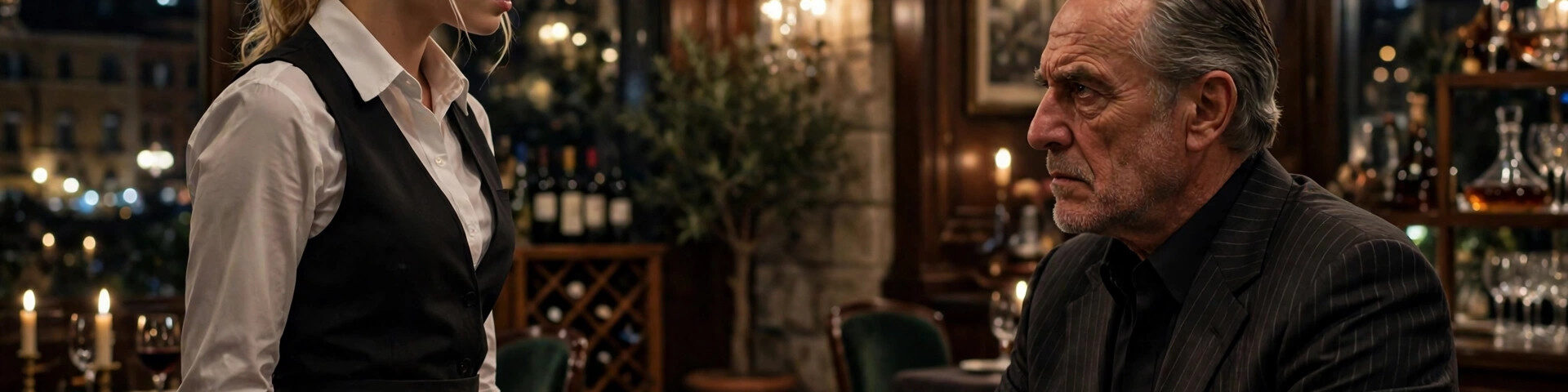
Then a waiter hurried in holding Elena’s handbag. “It was open in your locker. You need to see this.” Inside, beneath her wallet and keys, lay her mother’s old recipe notebook — the one she never brought to work, the one she kept in her apartment. Someone had broken into her home and planted it in her bag. She opened the cover, and a photograph slipped out and fell to the floor. Matteo bent, picked it up, and his face changed completely. The photograph showed Isabella Rossi at twenty-four, radiant and unmistakably pregnant — standing beside a much younger Matteo De Luca, his arm around her waist. On the back, three words in faded ink. Matteo read them, and looked up at Elena. Before he could speak, the locked front door rattled. Once. Twice. Then three slow knocks. Every man in the room reached inside his jacket. A voice came through the glass: “Matteo. Open the door.” Matteo went pale. “Who is that?” Elena whispered. He stared at the entrance. “My brother.”
While they waited for the test results, Matteo questioned her with the patience of a man who had interrogated professionals. Where had she learned the recipe? At home, from her mother, since she was eight. Why had she cooked tonight? Because the sous-chef was in the emergency room and Table Twelve’s order had come back. Who had handed her the ticket? Marco — and here Elena remembered the detail that made her blood run cold: the ticket had said SPECIAL REQUEST, for a dish that wasn’t on Bellavita’s menu at all. A dish that had appeared from nowhere, for Matteo De Luca’s table, on the one night Elena happened to be behind the line. “Someone wanted me to cook it,” she whispered. Matteo’s eyes narrowed. “Or someone wanted you to be the one holding the plate when it arrived.”
Luca returned with a folder — a background check assembled in under an hour. Elena Rossi, twenty-five. Mother deceased, cancer, eleven years ago. Father: Anthony Rossi, truck driver, died when she was twelve — at least, that was the official story. No criminal record. Two years of community college, dropped out to work. Three years at Bellavita, never late, never complained about. “She’s clean,” Luca said. Matteo didn’t look up from the photograph. “Nobody in this room is clean, Luca. She’s innocent. Those are different things.” Then the man with the black case returned, and the word he used made Elena’s knees weaken: the sauce had contained a compound that wouldn’t kill quickly — it would mimic a heart event hours later, far from the restaurant, far from witnesses. A professional’s poison. “Whoever did this,” Matteo said softly, “didn’t just want me dead. They wanted it to look like an accident — and they wanted you to be the accident’s author.”
The Man at the Door
The door opened three inches before Luca slammed his palm against it. Carlo De Luca stood in the hallway — fifty-six, silver-haired, broad-shouldered, a charcoal overcoat over a suit that cost more than Elena’s car. “You haven’t called me Matteo since our mother died,” Carlo said, and Elena realized she was watching an old war resume in real time. “Why would anyone care about a waitress?” Carlo asked. Matteo didn’t look away from his brother. “Because you already know exactly who she is.”
Carlo’s smile never reached his eyes. “Enlighten me.” “No,” Matteo said. “You’re going to tell me about her mother.” He nodded toward the private dining room, and Carlo followed him inside with the weary patience of a man who had rehearsed this conversation for decades. Elena waited in the corridor with Luca, her mind rejecting the obvious conclusion the photograph had forced on her. When Matteo finally emerged, his face was gray. “Anthony Rossi was your mother’s husband,” he began. “Anthony married Isabella when she was already pregnant.”
Elena’s fingers tightened around the photograph until the edges bent. Small things she had never noticed suddenly sharpened — the way her mother’s handwriting in the recipe notebook slanted exactly like the note on the photograph’s back. “My mother raised me alone while you became whatever this is,” she said. Matteo’s voice dropped. “A man came to me once. He told me Isabella had married him and wanted nothing more to do with the De Luca family. I was twenty-five. My father had just been killed. There was a war happening around us.” He looked at the torn half of a matching photograph he carried in his wallet — Matteo’s copy, ripped in two twenty-five years ago. “I believed him. I have spent twenty-five years believing him.”
That night, after the restaurant emptied and the police contacts Matteo trusted had taken statements, Elena went home to find her apartment door’s lock scratched and her mother’s recipe notebook gone from its drawer — the same notebook someone had slipped into her work bag. Her mother’s handwriting ached to look at. Between the cards tucked in the back was a folded page of translucent paper covered in columns of numbers. “These numbers may be part of the missing ledger,” Matteo said when she showed him. “My father had been stealing from his own partners. Isabella discovered where the money went.” A disposable phone found near the restaurant had placed a call two blocks away; the shell company behind it had been created three weeks earlier. Someone was dragging a dead woman’s name through every piece of evidence — and Elena was starting to understand why.