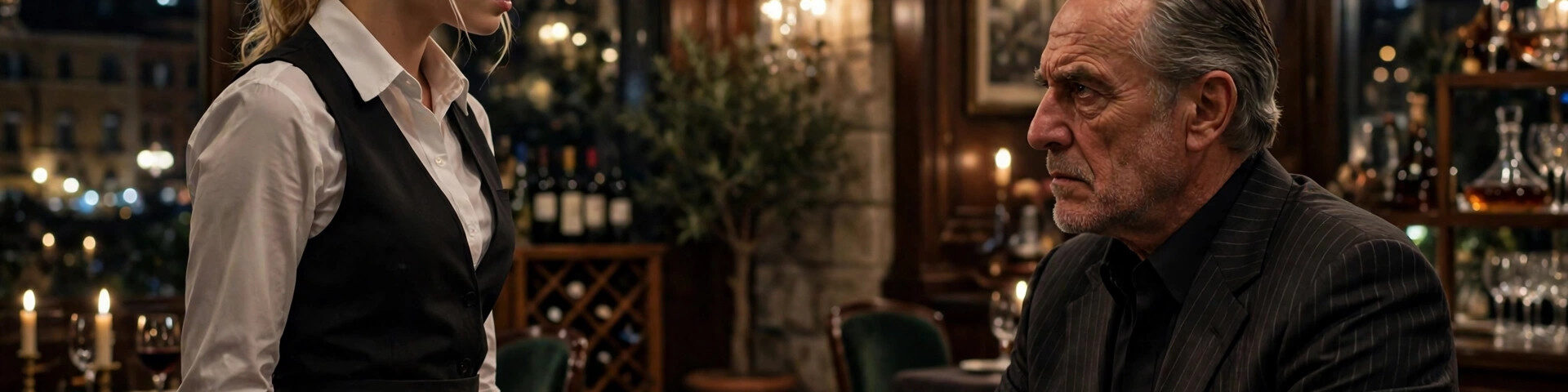
The moment Matteo De Luca lifted the fork to his mouth, thirty years of violence held its breath. He took one bite of the pasta, chewed once, and the entire dining room of Bellavita — Chicago’s most feared restaurant and its most famous front — fell into a silence so absolute that Elena Rossi could hear the wine cooler humming behind the mahogany bar. Across the room, every armed man at the table reached inside his jacket at the same instant, fingers finding steel. Matteo set the fork down gently on white porcelain, wiped his mouth with a linen napkin, and looked straight at the staff. “Who cooked this,” he said, “step forward now.”
Elena’s hands were shaking so hard she had to press them against her apron. She was twenty-five years old, bone-tired from a double shift, and she was only supposed to be carrying plates. But the sous-chef had scalded his hand during the dinner rush, Table Twelve had sent a dish back because the sauce had broken, and Elena — who had known one recipe by heart since she was eight — had stepped behind the line to fix it. Garlic, white wine, parsley, lemon, a little butter, and the one final ingredient her mother had always added last. Her mother, Isabella Rossi, had been dead eleven years. On her last night in the hospital, she had made Elena promise one thing: never change the recipe.
Elena stepped forward. “I did, sir.”
Matteo De Luca rose from his chair. He was taller than the rumors had made him — late forties, hair swept back with silver at the temples, a black pinstripe suit cut to the millimeter. Men like him never needed to raise their voices; everyone else lowered theirs. He picked up the silver fork she had used and turned it over. Beneath the handle, three tiny scratches caught the candlelight: M.D.L. “From whose recipe?” he asked. “My mother’s,” Elena said. Something crossed his face too fast to name — recognition, then something that looked almost like fear. Not the fear of a poisoned man. Something older.
“Your mother’s name.” Elena hesitated. He repeated it, harder. “Isabella Rossi.” The color drained from Matteo De Luca’s face. He glanced at her brass name badge, then back at her eyes. “Lock the doors,” he told his men. A businessman protested and was told to sit down with such quiet force that he folded back into his chair. The brass lock clicked. Then Matteo turned to the kitchen doors. “Who touched this plate after she cooked?” The head chef stammered: he had plated it, a young assistant named Marco had garnished it, Elena had carried it. “No one else?” “No, sir.”
A man emerged from the private dining room with a small black case, pulled on gloves, and scraped a sample of sauce into a vial. Elena’s mouth went dry. “What is happening?” Nobody answered. Then the man murmured something to Matteo, and Matteo’s jaw set. “What was in it?” Elena whispered. The man with the case said, at last, “Something that shouldn’t have been.” “I didn’t put anything in there,” Elena said, and Matteo studied her a long moment before answering, “I believe you.” That frightened her more than anything else. “How can you possibly believe that?” “Because if you had wanted me dead,” he said, “you would never have stepped forward.”
A crash came from the kitchen. Men moved like water through the swinging doors. Shouting. Running. Someone yelled, “Back door!” Matteo did not move — he watched Elena, and she understood with a cold jolt that he wasn’t guarding himself against her. He was guarding her against whoever was running. Luca Ferraro, his right hand, returned a minute later. “Marco’s gone. Left his phone. Back alley door was open.” “Find him,” Matteo said. Then Elena’s own phone rang at the service station. UNKNOWN CALLER. She answered against Luca’s warning. Breathing. Then a distorted whisper: “Isabella should have kept her promise. And so should her daughter.” The line went dead.