
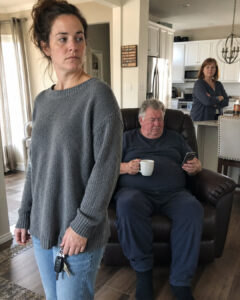
The morning my father-in-law told me to pack my things, he was sitting in the recliner I had bought him for Christmas.
That is the detail I keep coming back to.
Not the words themselves, though they were cruel enough.
Not the fact that my husband stood in the doorway and let it happen.
Not even the way my mother-in-law crossed her arms at the kitchen counter and looked at me like I had been taking up space in a home I had been quietly keeping alive.
It was the recliner.
Dark brown leather. Wide arms. Heat and massage settings. Bought online during a Black Friday sale because Gene had complained for months that his back ached in the old chair and that no one made furniture for “real men” anymore. I paid extra for white-glove delivery because the living room doorway was narrow and I knew Travis and his father would scratch the frame if they tried to move it themselves.
Gene was sitting in that recliner, drinking coffee from a pot I had replaced when the old one died, in a kitchen I had personally remodeled eighteen months earlier, when he said, without looking up from his phone, “Claire, you should start packing your things.”
He did not even look at me.
That is the part I still return to.
My name is Claire Donovan. I am thirty-one years old, and for almost three years, I had been quietly carrying a household of five adults on my back without a single one of them truly knowing it.
I do not say that for sympathy.
I say it because it is the only way to understand what happened next and why, when it finally happened, I felt nothing but a strange, cold calm.
Let me back up.
I married my husband, Travis Hollis, when I was twenty-seven. He was charming in that easy way some men are, the kind who makes you feel like the only person in a crowded room. He laughed with his whole face. He remembered little things at first. The coffee I liked. The music I played when I cooked. The fact that I hated lilies because their smell reminded me of funeral homes.
I fell hard.
Too hard, probably, though nobody wants to hear that from a woman in love.
His family came as part of the package, and I told myself that was fine. More than fine, actually. I grew up an only child with a mother who worked nights and a father I barely remember. My childhood house was quiet because nobody was home. We ate dinner together only when my mother’s shift schedule allowed it, and even then, she often fell asleep halfway through a TV show with her shoes still on.
So the idea of a big, loud, lived-in family felt like a gift.
The Hollises had Sunday dinners. They had inside jokes that went back decades. They had a house outside Columbus, Ohio, that had been in the family since Travis’s grandfather built the back addition with his own hands. There were framed photos everywhere. Kids with missing teeth, Christmas mornings, graduation gowns, camping trips, birthday cakes. Evidence, I thought, of a kind of belonging I had always wanted.
When Travis and I got engaged, his mother suggested we move in.
“Just to save for a place of your own,” Brenda said, patting my hand. “Family helps family.”
I thought it was generous.
I had no idea it was a trap with a kitchen table in the middle of it.
The arrangement was supposed to be temporary.
Six months, maybe a year.
We would stack up our savings, find something nearby, and Sunday dinners would be a drive away instead of down the hall.
That was the plan I agreed to.
That was not the plan that happened.
Within the first six months, Travis got laid off from the dealership where he sold trucks. He took it hard, harder than I expected. I watched a confident man fold into himself on the couch for weeks, remote in hand, job listings open on his phone but never submitted, coffee going cold beside him.
I did not push.
I told myself grief comes in many forms. Losing work can bruise a man’s pride. He needed time. He needed patience. He needed to feel safe.
I am a software engineer. I work remotely for a healthcare data company, and my income was not just steady. It was good. Better than good, honestly, though I never made a thing of it. I came from not having enough, so talking about money out loud always felt like tempting fate.
I picked up the slack the way you grab someone’s hand when they slip on ice.
Instinct.
Love.
I did not think twice.
The mortgage was already paid off. The house had been free and clear for years. That fact was repeated often, usually with pride. Gene had inherited the place from his parents, and Brenda liked to say, “At least we’ll never have to worry about a roof over our heads.”
But everything else was not free.
Property taxes, which in Franklin County ran close to nine thousand dollars a year.
Homeowners insurance.
The electric and gas bills that two air conditioners, three televisions, a basement freezer, and Gene’s habit of leaving every light on chewed through.
Water.
Trash.
Internet.
Cell phone add-ons.
The streaming services nobody could agree on but everybody used.
The grocery bill that somehow doubled after Megan and Doug moved in.
Brenda had a habit of running short before the property tax bill came due, and somehow I always covered it.
Gene’s truck needed a new transmission, and I paid for that too because Travis asked me quietly in the dark, the way he asked for everything that came with shame attached.
“Babe, Dad’s already embarrassed. Can we just handle it this once?”
This once became a phrase with no meaning.
Then there was Travis’s younger sister, Megan, who had moved back in after a breakup and never left. Megan was twenty-six, pretty in an unfocused way, always starting something and never finishing it. A certification program. A fitness challenge. A candle business. A plan to become a real estate agent. A plan to become a dental hygienist. A plan to move to Arizona.
And then Doug appeared.
Doug was Megan’s boyfriend. He showed up one Thanksgiving wearing a football jersey and carrying a gas station pie, then somehow became a permanent fixture. I am fairly certain he did not hold a job for longer than a month at any point during the time I knew him. He had opinions about cryptocurrency, barbecue, and how women should “relax more.”
So there we were.
Five adults plus me.
Gene and Brenda.
Travis.
Megan and Doug.
And me paying for nearly all of it.
I added it up once on a slow Tuesday afternoon while a deployment was running and I had twenty minutes to kill. I opened a spreadsheet because that is how my brain works. Old habit. Occupational hazard. When something feels wrong, I make a table and let the numbers tell the truth.
Recurring transfers.
“Claire, can you spot me?” payments.
Groceries I bought because somehow I was always the one at the store.
Property taxes.
Insurance.
Utilities.
Repairs.
Streaming subscriptions.
Appliances.
Medical copays.
The new washer.
The kitchen renovation.
The transmission.
The number that came back made me sit very still.
Just under fifty-three hundred dollars a month.
Sixty-two thousand dollars a year, give or take, flowing out of my account and into the maintenance of a life where I was increasingly treated like staff.
I closed the spreadsheet.
I did not tell anyone.
I am not proud of that.
But I want to be honest.
Part of me kept paying because I genuinely loved them, or loved the idea of them. The warmth. The noise. The belonging. The Sunday dinners I had mistaken for family instead of appetite.
And part of me kept paying because I had built my whole sense of belonging around being useful.
I was terrified of what I would be if I stopped.
Here is the thing about being the quiet one who handles everything.
People stop seeing you.
You become the air in the room. Necessary. Invisible. Taken completely for granted until somebody cannot breathe.
It started small.
Brenda began referring to “her house” and “her kitchen,” even though I had paid for the renovation that turned that cramped galley into the open, sunlit space everyone now gathered in. I paid for the quartz counters, the new cabinets, the farmhouse sink Brenda had pinned online and then told everyone she “finally decided to do.”
Megan borrowed my car without asking and returned it on empty.
Doug ate my leftovers clearly labeled with my name, and when I mentioned it gently, he laughed like I had told a joke.
Gene started calling me “the breadwinner” with a little edge to it. A word that should have been a compliment but landed like an accusation.
And Travis, my Travis, stopped being my partner somewhere in there and became something else.
A translator.
A courier.
A man who delivered his family’s wishes to me and my paycheck to his family.
He rarely said we anymore.
He said, “Mom thinks.”
“Megan needs.”
“Dad was wondering.”
“Doug said.”
“Could you just this once?”
I was a resource being managed, and the manager was the man I had promised to love.
The breaking point came on a Saturday in October.
I remember the day clearly because the leaves had just turned and I had taken a rare day off. I planned to drive to the orchards an hour east, alone if I had to, just to feel like a person again instead of a function. I wanted apples, cider, cold air, and silence. I wanted to walk between trees and not hear anyone ask what was for dinner.
I came downstairs in jeans and a sweater, holding my car keys, and found the whole family already in the kitchen.
Not unusual, but there was a stillness to it.
A meeting just ended quality that made the back of my neck prickle.
Gene was in the recliner with his coffee.
Brenda stood at the counter, arms crossed.
Megan and Doug sat at the oak table.
My table.
The heavy one I bought when the old particleboard thing finally collapsed under a Thanksgiving spread and Doug made jokes about “cheap furniture” while eating food I had purchased.
Travis leaned against the doorframe, looking everywhere but at me.
“Claire,” Gene said, still not looking up from his phone. “We’ve been talking.”
My keys felt suddenly heavy in my hand.
“Megan and Doug are going to start trying for a baby,” he said. “They need real space, not just a bedroom. We’re going to convert the master and the upstairs office into a little suite for them. So we’re going to need you to find your own place sooner rather than later.”
I stood there in my socks on cold tile, holding my keys, and for a second the whole kitchen tilted.
“You want me to move out?” I said.
It was not really a question.
I needed to hear it in my own voice to believe it.
“It’s not personal,” Brenda said quickly, in the tone people use right before they say something deeply personal. “You’re young. You can rent something. Megan is establishing herself here. This is her home.”
Her home.
I had bought the granite Brenda was leaning against.
I had paid the property tax that kept the county from putting a lien on her home two springs in a row.
I looked at Travis.
I gave him every chance.
I held his eyes, waited, and watched him do the math behind his face.
And choose them.
“It might be good for us,” he said finally. “Get a place that’s just ours.”
Just ours.
Funded, I assumed, by the same magical account that funded everything else, with him contributing exactly what he always had.
Nothing.
I did not yell.
I want you to know that.
There was a younger version of me who would have cried, begged to understand what she had done wrong, negotiated for kindness like it was a bill with late fees.
But that woman had been worn down to something harder over three years.
What surfaced instead was a quiet so complete it almost frightened me.
“Okay,” I said.
Megan actually smiled.
“No hard feelings, right? We can still do Sunday dinners.”
“Sure,” I said. “Sunday dinners.”
I went back upstairs.
I sat on the edge of the bed for a long time.
Somewhere in that silence, the love I had been propping up with my own two hands quietly set itself down.
And I let it.
Then I opened my laptop and started making a list.
The thing about being the person who handles everything is that you know where everything is.
Every account.
Every autopay.
Every login.
Every renewal date.
Every receipt.
I had set up most of it myself because nobody else could be bothered, and now that thoroughness was about to become the most useful thing I had ever done.
I started with the boring, careful lawyer-brain part because I had watched enough of the world to know that anger without documentation is just noise.
That night, after the house went quiet, I sat in the glow of my screen and built a record.
Every recurring transfer going back three years, exported and saved.
Every payment to Gene for the truck transmission.
Every transfer to Brenda before property taxes.
Every payment to Megan for dental work she had never mentioned paying back.
Receipts for appliances.
The kitchen renovation.
The dining table.
The recliner.
Utilities.
Insurance.
The water softener.
The lawn service.
The snow removal contract.
I had texts.
Texts from Travis saying, “Babe, you’re a lifesaver. Send it to Mom’s account?”
Texts from Brenda saying, “We’ll pay you back after tax season.”
Texts from Megan saying, “Can you cover this and I’ll Venmo you Friday?”
Screenshots of tax bills.
Invoices.
Bank confirmations.
I saved all of it to a drive, then to a second drive, then emailed copies to myself because I trust very few things more than redundancy.
The next morning, I made coffee like always.
I kissed Travis on the cheek like always.
I felt him not notice like always.
I waited until the house emptied.
Gene had a card game.
Brenda had church group.
Megan and Doug went wherever Megan and Doug went during the day when neither of them had jobs.
Travis had “a lead on something,” which I had long since stopped believing meant anything.
Then I made two phone calls.
The first was to a divorce attorney recommended by a coworker who had been through her own quiet war.
I expected to leave a message.
Instead, a calm, unhurried woman answered on the second ring, listened to me for ten minutes without interrupting, and then said something I will never forget.
“Ms. Donovan, you have been remarkably organized for someone going through this. That is going to matter a great deal.”
Ms. Donovan.
I had kept my maiden name when we married. Travis had pouted about it for a week, saying it made him feel like I had one foot out the door. At the time, I felt guilty.
Now my name sat in my chest like a small hard stone I was grateful I had never let anyone take.
The second call was to a moving company.
Full service.
“Pack everything that is mine,” I said. “Furniture, office equipment, kitchen equipment, personal items. I have receipts.”
“How soon do you need us?”
“How soon can you come?”
“We have an opening Thursday morning.”
I booked it.
I had three days.
I spent them being the most pleasant, agreeable version of myself the Hollis family had ever seen.
I said yes to dinner.
I laughed at Doug’s terrible jokes.
When Brenda mentioned with great satisfaction that she had already started looking at paint colors for the suite, I told her sage green sounded lovely.
Every single one of them relaxed because they thought it meant I had accepted my place.
They had no idea I was waiting for the truck.
On Wednesday night, the night before the move, I did the part that required the steadiest hands.
One by one, I went into the autopay systems I had built.
The property tax escrow I funded manually each quarter.
The electric.
Gas.
Water.
Trash.
Internet.
The four streaming accounts.
The security monitoring Gene was so proud of.
The lawn service.
The snow removal contract that had just renewed for winter.
Every one of them was in my name, paid from my account, tied to my email.
I did not shut them off in the night like a thief.
I am not a thief.
I scheduled formal cancellations and changes, properly dated, fully documented, set to take effect at the end of the current billing periods, thirty days out, exactly as my attorney advised.
They would have a full month.
They simply would not have me after it.
Then I drafted one email.
Short.
Polite.
No insults, because insults give people something to argue with, and I was not interested in arguing.
It went to Gene, Brenda, Travis, and Megan all at once. It explained that as of the date I was vacating the home I had been asked to leave, I would no longer be responsible for the household expenses I had been voluntarily covering.
It listed them.
It noted that all accounts in my name would lapse at the end of their current cycles.
It wished them well.
I set it to send Thursday at nine a.m., one hour after the movers were scheduled to arrive.
I slept better that night than I had in years.
Thursday morning, the truck pulled up at eight sharp.
I told no one.
The crew was efficient and kind. Two men and one woman who moved through the house with brown paper, tape, and practiced gentle speed.
I directed them quietly.
My clothes.
My books.
The standing desk and three monitors I worked on every day.
The leather chair.
The good knives I bought because nobody in that house knew the difference between a paring knife and a chef’s knife.
The oak dining table.
The recliner Gene was sitting in.
The mover paused near him.
“Ma’am,” he said carefully. “He’s, uh, in the chair.”
“Move it,” I said.
Gene looked up then for the first time in what felt like days.
He actually looked at me.
“What in the hell is this?”
“I’m moving out,” I said. “Like you asked.”
He laughed, that same dismissive bark I had heard a hundred times.
“We didn’t mean today. And you’re not taking my recliner.”
“I bought it,” I said. “Get up, please. They’re on a schedule.”
His face reddened.
Brenda came down the stairs in her robe, took one look at the bare living room, the stacked boxes, the movers carrying out the bookcase, and her face did something I had never seen it do.
It came apart.
“Stop them,” she said. “Stop them right now. Those are— That is my furniture.”
I reached into my bag and pulled out a folder.
Tabbed.
Organized.
Copies.
“These are the receipts,” I said, handing her one neat page. “Everything they are carrying out, I can show you exactly when I bought it and what I paid. I left everything that was here before me. Your family photos, your grandmother’s china, the couch from before I moved in. All yours. The rest is mine, and it is leaving with me.”
That was when Travis came downstairs.
I watched him understand in stages.
The boxes.
The folder in his mother’s shaking hands.
The movers.
The empty spaces.
The truck in the driveway.
“Claire,” he said. “Claire, come on. Let’s talk about this.”
“You talked,” I said. “Saturday in the kitchen. I was there for the whole thing.”
“I didn’t mean—”
“Yes,” I said. “You did. You just didn’t expect me to believe you.”
I checked my watch.
8:55.
“You may want to check your email in about five minutes.”
By the time the truck was loaded and I climbed into my car, all four of their phones had chimed in the house behind me.
I did not go back inside.
I had already said everything I needed to say.
Most of it was in a spreadsheet.
I checked into a clean, quiet hotel on the north side of town. The kind with a little desk by the window, decent coffee in the lobby, and white sheets nobody else expected me to wash.
I laid everything out.
The divorce paperwork my attorney had started.
The financial records.
The timeline.
The receipt folder.
The cancellation confirmations.
For the first time in three years, I felt the specific peace of a problem that finally had edges.
The calls started that afternoon.
Travis first.
Then Brenda.
Then Travis again.
Eleven times.
I let every call go to voicemail and saved each one.
The messages tracked the stages of grief in real time.
Denial.
“This is a misunderstanding. Just come home and we’ll figure it out.”
Anger.
Gene’s voice telling me I was vindictive and tearing this family apart. A phrase that almost made me laugh out loud in the hotel room because the family had torn itself apart at a kitchen table while I stood in my socks.
Bargaining.
Brenda, sweeter than she had been in years, talking about how I had always been “like a daughter.”
I had been like a checking account.
There is a difference.
Then Travis again, his voice smaller.
“Claire, I don’t know what you want me to say.”
That was the first honest thing he had said in months.
He did not know.
He had never had to know.
Here is what they did not understand.
What people who have never had to count never understand.
The money was the smallest part.
The water did not get shut off because I was cruel.
It lapsed because it had always, every single month, been kept on by someone they decided was disposable.
The proof of how much I carried was not in any speech I could have made.
It was in the silence after I left.
I heard the rest in pieces over the following weeks, mostly from Travis’s increasingly frantic messages, which I read but did not answer.
The property tax bill came due, and there was no escrow funded to meet it. The county does not care about family tension.
The internet lapsed, and Doug, it turned out, had been running some kind of online resale hustle that depended entirely on it.
The security system went dark.
Megan’s painted suite sat half-finished because, as it happened, paint and lumber and labor cost money.
The household’s actual income, Gene’s pension, Brenda’s part-time hours, whatever Travis and Megan and Doug did or did not bring in, could not stretch to cover a life that had been built on top of my salary like a house built over a hidden spring.
When the spring dried up, the foundation cracked.
Then came the part I genuinely had not planned.
The part my attorney called me about with something close to light in her voice.
When I remodeled the kitchen two years earlier, I had pulled permits and paid for the work in my name. Brenda had insisted, actually, because she thought it would “help for taxes,” some half-understood idea she had gotten from a friend.
At the time, I signed where I was told.
But that paper trail, combined with the substantial, documented, sustained financial contributions I made to the property, the taxes I paid directly, the major repairs, the improvements, gave me, my attorney explained, a legitimate claim.
Not to the whole house.
That was always going to remain with the Hollises.
But to a real, calculable equitable interest in the increased property value and reimbursable expenditures.
Enough that when the dust settled, they owed me a sum that made Gene’s “vindictive” sound very quiet indeed.
We did not go to court in the end.
People rarely want a judge to read aloud in public the text where they called their daughter-in-law a lifesaver while planning to evict her.
We settled.
They agreed to repay a meaningful portion of what I had put in, on a schedule, in writing.
To do it, I am told, they had to take out a loan against the house that had been free and clear since before Travis was born.
The one thing that family had truly owned outright was now mortgaged to repay the woman they decided did not belong in it.
The divorce was clean by divorce standards.
I asked for nothing of Travis’s because Travis had nothing, which had always been the problem.
I kept my name.
My savings.
My work.
My furniture.
He kept his family.
I think in the end, that was the trade each of us actually wanted.
I see them sometimes in the small-world way of a mid-size city.
I heard Megan and Doug split up before the baby they had talked about ever existed.
I heard Brenda tells people I abandoned them, and I have made peace with being the villain in a story narrated by people who never asked who was paying the bills.
Travis sent a long message a few months later.
The kind men send when consequences finally catch up to the choice.
He said he did not know it would go this way.
I read it twice.
Then I typed the only true thing I had left for him.
“You did not want to know. There is a difference between not knowing and not looking. You stopped looking the day you started saying, ‘Mom thinks.’”
I never sent another word after that.
I rent a one-bedroom now near the river, with too much light and a kitchen barely big enough to turn around in, and it is the first space in my adult life that is entirely, uncomplicatedly mine.
I cook for one, and I like it.
My good knives finally live somewhere they are appreciated.
My standing desk faces a window where I watch the seasons turn.
When property taxes come due on a place I buy someday, I will pay them gladly because they will be mine.
People ask me sometimes if I feel guilty.
The water.
The lights.
The family left scrambling.
I used to brace for that question.
Now I answer honestly.
No.
I gave that household three years, more than sixty thousand dollars a year, and the best of my quiet, steady self. The moment they decided I was furniture, they taught me the most expensive lesson of their lives.
The cheapest thing in any house is the person everyone assumes will always pay.
I was not thrown out.
I was finally free to go.
For three years, I confused being needed with being loved. That confusion cost me almost everything before it taught me something worth keeping.
When Gene sat in that recliner and told me to find my own place, he was not making a sudden decision. He was saying out loud what the whole family had quietly believed for a long time.
That I was a function instead of a person.
An account with a face.
The cruelty was not an accident. It grew slowly and naturally out of every month I paid without a word and every “Mom thinks” I let Travis hand me instead of an honest conversation.
Causes have consequences.
I had taught them with my own silence that I would always pay and never push back.
People will take exactly as much as you train them to take.
What changed things was not the money I had.
It was the moment I stopped mistaking my own kindness for weakness.
I want to be careful here because I do not think the lesson is to harden your heart.
Brenda hardened hers, and look what it bought her.
The real shift was learning that being a good person does not require you to be a doormat. You can be generous and still have a line. The day someone steps over that line, you are allowed to pick yourself up and walk.
Honesty with others starts with honesty with yourself.
For years, I lied to myself about what that house was costing me.
I think often about the part of me that opened a spreadsheet on a slow Tuesday and saw the truth in plain numbers. That clear-eyed look at reality saved me. Not anger. Not revenge. Just the willingness to see things exactly as they were and think two steps ahead instead of reacting.
I kept records when I wanted to scream.
I scheduled cancellations properly instead of shutting off the lights in the night like a thief.
I called a lawyer before I called anyone a name.
Good judgment is quiet.
It does not feel dramatic in the moment. It just keeps you from setting fire to your own future on the way out the door.
None of it would have mattered without the part that is hardest to talk about.
The steadiness it took to smile at Doug’s jokes for three days while I waited for the moving truck.
Walking away from people you genuinely loved, even after they have shown you who they are, takes a strength that has nothing to do with being loud. It is the strength to sit in the discomfort, to grieve the family you thought you had, and to keep moving toward the life that is actually yours.
I rent a small place by the river now, and I pay my own bills gladly because they are mine.
If I could hand you one thing from all of this, it would be this:
Be kind, but keep your spine.
See clearly, even when it hurts.
And when the moment comes to choose yourself, find the nerve to do it.
Nobody is coming to do it for you.
I know that sounds harsh.
It is also freedom.
The morning Gene told me to pack my things, he thought he was removing me from his home.
He did not understand that he was giving me the first honest permission I had been waiting three years to give myself.
Leave.
So I did.
And I took my recliner with me.