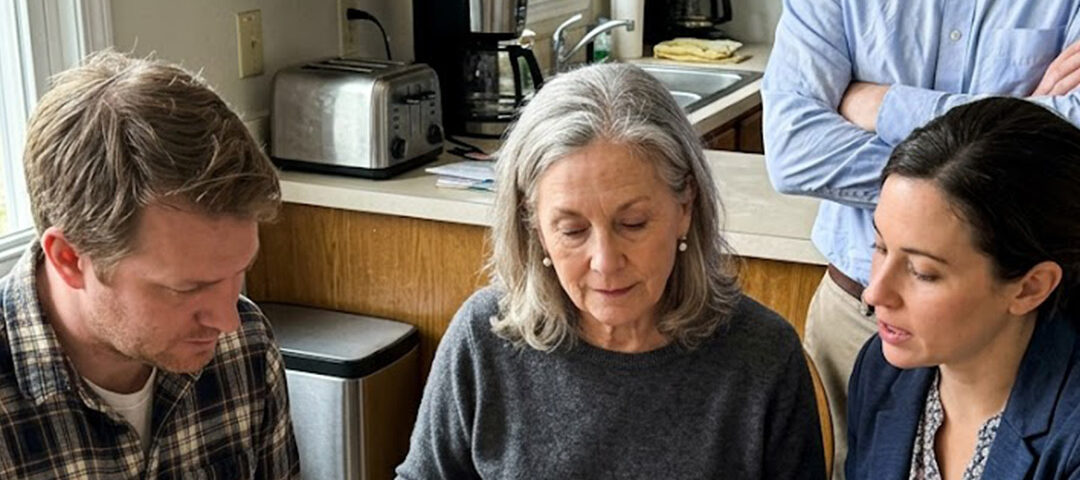
The signature looked almost like mine.
Almost.
Whoever had copied it knew I formed the M in Margaret with a long first stroke.
They knew I connected the G and the r in Gray.
But the hand was too smooth, too deliberate.
My real signature had a slight break where arthritis sometimes stiffened my index finger.
This one had no hesitation.
I looked from the page to my son.
Danny’s face had gone gray.
“Mom,” he said, “I can explain.”
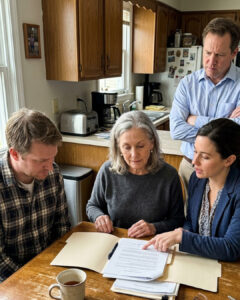
Linda closed one hand over the document before he could reach for it.
“No,” she said.
“You can answer questions after your mother understands what was done in her name.”
Richard straightened beside my kitchen table.
The confidence he had carried into my house was slipping, but he still tried to sound offended.
“This was a preliminary business matter,” he said.
“No money was taken.
No harm was done.”
Linda looked at him with the patience of someone listening to a child lie about a broken window.
“A lender received an application listing Margaret’s property as collateral.
The application included a signature purporting to be hers.
That is not harmless.”
Sarah folded her arms tighter.
“My father never said the loan was complete.”
“That is not the defense you think it is,” Linda replied.
I sat in the chair at the end of the table and placed both hands around my teacup.
The porcelain was warm.
Everything else inside me had gone cold.
One week earlier, I had stood in Linda’s office and signed documents intended to give my son a home.
I remembered Danny hugging me afterward.
Sarah had kissed my cheek and called me an angel.
Richard had sent a message saying he was glad the younger generation would finally have something solid.
At the time, I thought he meant security.
Now I understood he had meant collateral.
Linda turned a second page toward me.
It was a printed email from the lender’s compliance department.
The application had triggered a title discrepancy because the property remained in my name while the supporting documents suggested an imminent transfer.
Attached to the email was the message that had accompanied the application.
The property will belong to Daniel and Sarah Gray shortly.
Margaret Gray is old, agreeable, and unlikely to object.
We expect the deed to record before closing.
I read the words twice.
Old.
Agreeable.
Unlikely to object.
At the bottom of the page was the sender’s email address.
Danny recognized it first.
“Sarah,” he whispered.
She stared at the floor.
Richard stepped between her and the table.
“She was helping me organize documents.
She did not understand the wording.”
Sarah looked up sharply.
“You dictated that email.”
The room changed.
Until that moment, they had arrived as a united front.
Richard was the authority, Sarah was the injured daughter, and Danny was the son sent to pressure his difficult mother.
But fear has a way of dissolving alliances built on convenience.
Richard turned on her.
“Do not be ridiculous.”
“You told me the house was basically ours already.”
“It would have been if your husband knew how to control his mother.”
Danny flinched as if he had been slapped.
I did not.
For years, I had confused silence with peace.
I had swallowed hurt to keep birthdays pleasant, paid
bills to prevent arguments, and said yes because no made Danny anxious.
Richard mistook that habit for weakness.
So had my son.
Linda removed another document from the folder.
“This is a preservation notice,” she said.
“The lender has retained the application, the email, the attachments, and the electronic submission records.
Margaret has not yet decided whether to make a formal complaint.”
Richard’s face hardened.
“Is that a threat?”
“No,” I said.
“It is information.”
He looked at me then, truly looked at me, and for the first time I saw uncertainty behind his eyes.
I continued calmly.
“You came here to tell me I could not reclaim my own property.
Now I know you planned to borrow against it before the deed was even recorded.”
Richard pointed at Linda.
“She is filling your head with legal nonsense because she wants fees.”
Linda did not react.
I did.
“Leave my house.”
Danny took one step toward me.
“Mom, please.
We can fix this.”
I met his eyes.
“When you received my message saying ‘Okay,’ did you call to ask whether I was hurt?”
His mouth opened, but no answer came.
“Did you tell Sarah or Richard that excluding me from Thanksgiving in the home I bought was wrong?”
He looked down.
“Did you know they wanted to use the house for Richard’s loan?”
His silence lasted too long.
That hurt more than the text.
Sarah stared at him.
“You said she knew.”
Danny rubbed both hands over his face.
“I said Mom usually agrees when I explain things.”
The truth arrived without drama.
My son had not forged my signature.
He had not written the email.
But he had offered me to them as the easiest obstacle to move.
He believed I would object, cry, forgive him, and eventually sign whatever made his life simpler.
I stood.
“The transfer is canceled,” I said.
“You will collect your belongings from the house under written arrangements from Linda.
You will not enter it without permission.
The documented loans remain due.”
Danny’s eyes filled.
“Where are we supposed to live?”
It was the kind of question that had controlled me for years.
Whenever he faced a consequence, he placed it in my hands as if I had created it.
“I do not know,” I said.
“You are thirty-five years old.
You and your wife will decide.”
Sarah’s sadness vanished.
“You would make your own son homeless over a dinner invitation?”
“No.
You lost access to a house because you attempted to use property you did not own to secure your father’s debt.
The dinner invitation simply made me read the documents.”
Richard slammed his palm against the table.
“This family will never forgive you.”
I looked at the man who had entered my home without permission, dismissed my sacrifices, and treated my retirement as a financial opportunity.
“You are not my family.”
Linda opened the front door.
Richard left first.
Sarah followed after grabbing her purse.
Danny remained in the kitchen, staring at the stack of evidence.
For one impossible second, I saw him at eight years old, standing in our old apartment with a broken science project, certain I could repair anything before school.
I had spent nearly three decades proving him right.
“Mom,” he whispered, “I never thought it would go
this far.”
“That is because you never thought I would stop it.”
He nodded as tears slipped down his cheeks.
I wanted to hold him.
The instinct was immediate and physical.
But love did not require me to protect him from the truth.
“Go with your wife,” I said.
After the door closed, the kitchen fell silent.
Linda stayed until my hands stopped shaking.
The next several days were ugly.
Sarah sent long messages accusing me of destroying her marriage.
Richard left voicemails from unfamiliar numbers, alternately threatening to sue and offering to “resolve the misunderstanding privately.” Danny called every morning, sometimes apologizing and sometimes asking me to reconsider.
I saved every message and answered none without Linda.
The deed cancellation was completed before the property could be transferred.
The house remained mine.
Linda formally notified the lender that I had not authorized the collateral application or the signature attached to it.
The lender froze Richard’s application and referred the matter to its fraud department.
Richard’s business was already in worse condition than anyone had admitted.
He owned a small event-supply company that had lost several major contracts.
He owed vendors, had fallen behind on warehouse rent, and needed the proposed loan to keep operating.
The $350,000 house had looked like his escape.
He had not excluded me from Thanksgiving because he feared tension.
He wanted me away because he planned to invite a business adviser to dinner and discuss renovations, appraisals, and the loan in the house he assumed would soon belong to Danny and Sarah.
My presence would have made the performance difficult.
Sarah had helped because Richard promised the loan would save the family company and eventually produce enough money to repay me.
Danny had agreed because Sarah threatened to leave if he refused to support her father.
Each of them had a reason.
None of them had an excuse.
A week after Thanksgiving, Danny and Sarah returned to the house with a moving company.
Linda had arranged a four-hour window and hired an independent property manager to supervise.
I chose to be there.
The house looked different without the fantasy I had attached to it.
The gray sofa I purchased sat beneath framed wedding photographs.
The dining table had place settings for eight.
Sarah had already placed small gold name cards around it for Thanksgiving.
There was one for Richard.
One for his business adviser.
None for me.
Danny found me staring at the table.
“I should have stopped it,” he said.
“Yes.”
“I kept telling myself it was just one holiday.”
“It was never just one holiday.”
He nodded.
“I know that now.”
I walked into the kitchen, where boxes were stacked beside the refrigerator.
“When did Richard first mention the loan?”
Danny leaned against the counter.
“The night after you offered to buy the house.
He said owning property would finally let us build wealth instead of wasting money on rent.”
“And you told him he could borrow against it?”
“I told him I would ask you after the deed transferred.”
“But Sarah sent the application before asking me.”
He closed his eyes.
“She said it would save time.”
“And when you learned she used my signature?”
“I did not know she had attached that page.
I knew they submitted something, but I thought
it was only a draft.”
I believed he was telling the truth.
That did not make him innocent.
He had known enough to warn me.
He had chosen comfort instead.
“Why did you agree to keep me away from Thanksgiving?” I asked.
Danny stared at the floor.
“Richard said you would ask questions if you heard them discussing the loan.
Sarah said she was tired of every family event becoming about how much you had done for us.”
I felt the words settle.
“Did I make events about the money?”
“No,” he said quickly.
“You never mentioned it.
That was the problem.”
I frowned.
He looked at me with red-rimmed eyes.
“Every time you walked into a room, we knew.
The wedding, the car, the furniture, the house—we knew what you had done.
Sarah felt judged even when you said nothing.”
“So she removed the person who reminded her.”
“Yes.”
It was a cruel answer, but at least it was honest.
The movers carried out the sofa, bed, dishes, and unopened wedding gifts that had followed Danny through three apartments.
I had paid for much of it, but I did not claim it.
I wanted the house back, not every object I had ever purchased.
Before leaving, Danny placed his key on the kitchen counter.
“I am sorry,” he said.
I looked at him for a long moment.
“I believe you are sorry this happened.”
He winced.
“One day,” I continued, “I hope you become sorry for the choices that caused it.”
He left without asking me for anything.
That was the first sign that something in him might still change.
Richard’s situation unraveled quickly.
The lender’s investigation confirmed that the signature page had been created from a scan of my name taken from an earlier document.
Electronic records showed Sarah had sent the application from her personal account after receiving the file from Richard’s office computer.
On Linda’s advice, I filed a formal report.
I did not do it for revenge.
I did it because Richard continued insisting he had done nothing serious, and because people who treat one person’s property as available often do the same to others.
The matter did not end with a dramatic arrest in my driveway.
Real consequences moved more slowly.
Richard’s loan was denied.
His business partners learned why.
A vendor filed suit over unpaid invoices.
His attorney negotiated with investigators and the lender while he faced potential charges connected to the false application.
Sarah accepted responsibility for submitting the documents and entered an agreement that required cooperation, restitution for legal costs, and financial-fraud counseling.
Richard blamed her publicly until emails showed he had directed nearly every step.
Their relationship fractured under the weight of the evidence.
Danny and Sarah moved into a small apartment across town.
Three months later, they separated.
Danny did not ask me to pay his deposit.
He sold his expensive truck, bought a used sedan, and began sending Linda monthly payments toward the $28,000 in documented loans.
The first check was only $300.
I kept a copy because it was the first money my son had ever returned without being chased.
He started seeing a counselor through his employer.
He also stopped calling me whenever something broke.
For a while, that meant he barely called at all.
The silence hurt, but it was cleaner than being needed only as a wallet.
I had decisions to make about the house.
I could move into it, rent it, or sell it.
At first, I thought I would sell immediately because every room carried the memory of betrayal.
Then I received a call from Elena Ruiz, a teacher I had known during my years working for the school district.
Elena and her husband had two children and had been searching for a rental after their landlord announced plans to sell.
They could not afford the market price of the house, but they could afford a fair rent.
I met them there on a Saturday morning.
Their youngest daughter ran straight to the small bedroom overlooking the backyard and asked whether she could put glow-in-the-dark stars on the ceiling.
Elena apologized, embarrassed.
I laughed for the first time in weeks.
“Only if she makes a proper constellation,” I said.
I rented the house to them at a rate that covered taxes, insurance, and maintenance without draining their savings.
Linda prepared a real lease, with clear terms and no emotional debts hidden inside it.
The first evening they moved in, Elena invited me to dinner.
I almost declined out of habit.
Then I realized she was not inviting my bank account.
She was inviting me.
I brought a pie.
Months passed.
Danny continued making payments.
Sometimes he called simply to ask how I was doing.
The first few conversations were awkward because neither of us knew how to speak without a crisis between us.
One Sunday, he asked whether he could visit.
He arrived carrying groceries instead of a problem.
We cooked soup in my kitchen.
He chopped carrots badly.
I corrected him twice, then forced myself to stop.
When we sat down, he placed an envelope beside my bowl.
Inside was a letter written in his own hand.
He apologized for treating my help as an obligation, for allowing Sarah and Richard to exclude me, and for knowing about the loan discussion without warning me.
He did not ask for the house back.
He did not ask me to forgive him immediately.
The final line said, “I am learning that being your son does not entitle me to the life you built.”
I folded the letter and returned it to the envelope.
“This is a beginning,” I told him.
He nodded.
“That is all I am asking for.”
The following Thanksgiving, I did not host a large family dinner.
I volunteered at a community center in the morning and ate with Elena’s family in the house I still owned that evening.
Danny came too.
He arrived early, carried folding chairs from the garage, and brought a sweet potato dish he had made himself.
It was too salty, but everyone ate it.
There were no gold name cards on the table.
No one discussed loans.
No one decided another person was too inconvenient to include.
Before dinner, Elena’s daughter handed me a construction-paper card.
On the front she had drawn the house beneath a sky crowded with uneven stars.
Inside she had written, “Thank you for letting our family feel safe here.”
I excused myself and stood alone in the hallway for a moment, holding the card against my chest.
I had once believed the greatest expression of love was giving until nothing remained for me.
I was wrong.
Love without boundaries had not made Danny stronger.
It had taught him that my sacrifices appeared automatically and carried no cost.
Taking the house back was not the moment I stopped loving my son.
It was the moment I stopped helping him become someone who could not love me properly.
After dinner, Danny joined me on the back patio.
The Phoenix air was cool, and laughter drifted through the open door behind us.
“I think about that message every day,” he said.
“So do I.”
“I wish I had never sent it.”
I looked through the window at the family gathered around the table.
“I do not,” I said.
He stared at me in surprise.
“That message told me the truth before I gave away the last thing I had left to protect.”
He lowered his eyes.
“Your house?”
I shook my head.
“Myself.”
Danny stood quietly beside me.
Then, without excuses or promises, he reached for my hand.
I let him hold it.
The house remained mine, but the anger no longer did.
If you came here from Facebook because of this story, return to the Facebook post, tap Like, and comment exactly “Amazing” to support the storyteller. That small action means more than it seems and gives the writer genuine encouragement to keep sharing more stories about family pressure, firm boundaries, and finally protecting what you worked so hard to build.
Disclaimer: This story is a work of fiction created for entertainment purposes. Any resemblance to real persons, events, or places is coincidental.