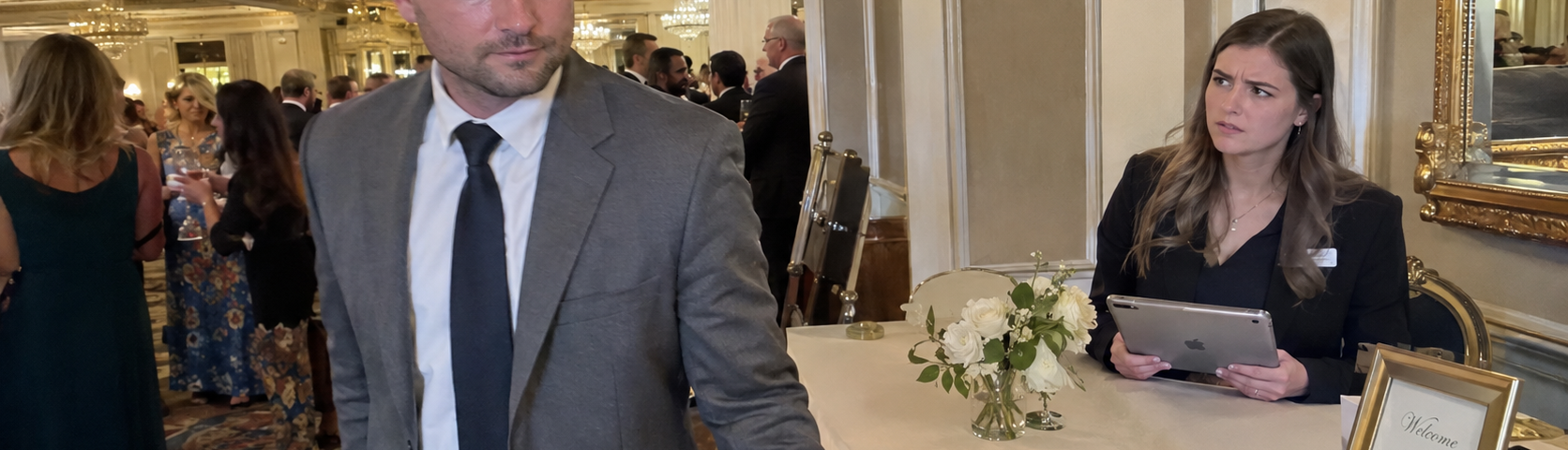
Somewhere in that ballroom, the truth had finally walked in without me. You do not have to be in the room for them to see you. Sometimes silence is the loudest microphone in the world. I have thought about that night many times since, and I have come to believe that my absence did more than my presence ever could have. If I had stayed and argued, I would have been the difficult brother, the scene-maker, the problem. By leaving, I became the question nobody could answer.
Three days after the wedding, the Cole House in Tacoma became a courtroom. I was not there. I knew every word through Noah, my cousin, who texted live updates from the couch. “They started without you,” he wrote. “Mom setting out coffee like this is Sunday brunch.” I was in my office at Summit Bridge. A spreadsheet open, numbers scrolling like static. The snow outside was a blur of white lines on glass. I kept working. The numbers didn’t care about family drama. That was one of the things I loved about them.
Back home, the air must have been thicker. Noah’s first message came fast. Aunt Margaret asked the question, “Why was not your name on the guest list?” A pause. Then Lauren said, “I removed his name myself. I did not want him to embarrass us.” I stared at the screen. Even through text, I could hear the silence that followed. The air pulled out of the room. Noah sent another line. “Everyone looked at your mom.” I pictured it — the living room I grew up in, the couch with the floral pattern, my mother holding a coffee cup she had forgotten to drink, everyone looking at her, waiting. Thirty years of family choreography, and suddenly nobody knew the steps.
Aunt Margaret’s reply came next, typed word for word by Noah. “You erased a Summit Bridge executive from your guest list to impress people who already invest with him.” The sentence hit the group chat like glass breaking. Uncle David added, “Some people only recognize success when it comes with a spotlight.” I read those texts three times. Aunt Margaret — who had always been kind to me in a distant, distracted way — had just defended me more fiercely than my own parents ever had. And Uncle David, who barely spoke at family events, had landed the cleanest punch of the afternoon.
I pictured my mother’s hands twisting the napkin, her voice still clipped with pride. “It is his fault, too,” she said, according to Noah. “Ethan should have told us.” Another message from him. “She is saying you hid your job.” I smiled at the phone. Let her say it. I did not need their belief anymore. Truth does not demand witnesses. But I will admit — I will admit that it stung, just a little, that even now, even with everything exposed, her first instinct was to make it my fault. Some patterns are carved too deep to sand out.
The arguments overlapped until Noah wrote, “Hang on, Aunt Margaret is reading your email.” I had sent it to her that morning. A clean document. Confirmation of the donation transfer to Harbor Light Haven. The full appraisal of the penthouse. The letter of thanks from the nonprofit. I had sent it not as an attack, but as evidence — the quiet, boring, undeniable kind. Numbers. Dates. Signatures. The things that don’t argue back. “Everyone is quiet,” Noah texted. “Like funeral quiet. Then Lauren is crying.” She said, “He donated my apartment.” And Aunt Margaret, always precise, corrected her. “He donated his apartment. You just mistook it for yours.” I laughed out loud in my office when I read that. It was the first time I’d laughed in days. Trust Aunt Margaret to reduce the whole saga to a matter of correct pronouns.
I leaned back in my chair, the fluorescent light humming above me. Outside the window, the skyline faded into snowfall. My phone buzzed again. “They know now,” Noah said. I closed the laptop, watching my reflection in the dark screen. No satisfaction, no anger, just the kind of calm that comes when a storm finally stops needing your participation. I had spent so long bracing for impact that I didn’t know what to do with the stillness. So I just sat there, and breathed, and watched the snow.
The next message from him read, “Daniel’s investors are questioning him. Something big is coming.” I didn’t reply. I didn’t need to. The wheels were already turning — they had been turning since the moment that envelope was opened. I had set something in motion that night, and like all the best deals, it was now running on its own momentum.
I opened the sent folder on my email and reread the last line of the message to Aunt Margaret. “Some gifts find better homes,” I whispered to the window. And some lessons only happen in rooms where the right person is not there to hear them. The snow kept falling. Somewhere in Tacoma, the family that once measured me was now measuring themselves against a truth they could not control. The ruler had finally been turned around.
I let the phone go dark. For once, silence did not mean absence. It meant closure. I sat in the quiet of my office, the city humming below, and felt something I hadn’t felt in years: finished. Not happy, not sad — finished. The way you feel after signing a deal that’s been eighteen months in the making. The work is done. Whatever happens next is just paperwork.
Two weeks later, the echo started. The first ripple came quietly, a forwarded email from one of Summit Bridge’s partners. “Thought you would want to see this.” Attached was a headline. “Three Investors Withdraw From Daniel Mercer’s Series B Over Concerns of Personal Integrity.” Both names I recognized. Both had attended the wedding. I read the article twice, standing in my kitchen, coffee going cold in my hand. It was careful, corporate language — “concerns of personal integrity,” “reputational risk,” “fiduciary reassessment” — but I knew what it meant. They had watched Lauren read that envelope. They had watched the room go silent. And they had decided that a man who would erase his own brother from a guest list to impress investors was not someone they wanted managing their money.
That same morning, one of them sent me a direct note. “We respect how you handled that night. Integrity does not need a microphone.” I did not reply. What was there to say? Thank you for noticing that I didn’t make a scene? I had spent my whole life not making scenes. It was nice, finally, that someone considered it a virtue instead of a weakness. I saved the email in a folder I never named. Some things you keep not because you need them, but because they prove that the world occasionally works the way it should.
At the office, people had started looking at me differently, not with curiosity, but recognition. In finance, silence is rare. When you practice it, people assume depth. Colleagues who had barely nodded at me in the hallway now stopped to ask my opinion on deals. The partner who had interviewed me in round six invited me to lunch. Nobody mentioned the wedding — but I could feel it in the room, the unspoken knowledge, the way people treat you when they’ve heard the story and decided you’re the hero of it. It was strange, and not entirely comfortable. I had spent years being invisible. Being seen took some getting used to.
By Friday, a rumor slid through the network that Daniel’s board was meeting about reputation management. Monday confirmed it. A memo leaked. “Effective immediately, the company will implement a spousal conduct policy to ensure professionalism at all investor events following recent events at the Crescent Bay Hotel.” The sentence circulated like wildfire. It was sterile. Corporate. Devastating. I read it on my phone during a meeting and had to suppress a reaction. A “spousal conduct policy” — an entire corporate governance document, created because of one wedding, one envelope, one sister who couldn’t resist performing her cruelty in front of an audience.
The irony was not lost on me. The same world Lauren had tried to enter through perfection now had a door closed with her name on it. She traded love for access and lost both. She had spent a year cultivating those investors — the dinners, the charity galas, the careful networking — and it had all evaporated in the time it took to read two sentences out loud. I didn’t feel sorry for her. I didn’t feel glad, either. I felt the particular emptiness of watching someone get exactly what their choices earned them.
That Tuesday morning, security buzzed my office line. “Mr. Cole, there is a woman downstairs asking for you. She says she is your sister and she is insisting.” I looked at the monitor. Lauren stood in the lobby wearing a white coat, eyes hollow, clutching a cream envelope. She looked smaller than I remembered. The camera angle was unflattering — top-down, fluorescent — but it wasn’t the camera. She had the look of someone who hadn’t been sleeping, who had been crying and then trying to cover it up and then crying again. The cream envelope in her hands was a mirror of the one I had left on that table. I wondered if she understood the symmetry. Probably not. Lauren had never been one for symmetry unless she was the center of it.
“She does not have an appointment,” I said. “Follow the policy.” The guard nodded. I watched her argue, then deflate, and finally walk toward the revolving door. It was the same revolving door I had pushed through on the wedding night, though a different building, a different city of the soul. Five minutes later, an automatic email arrived from her phone. “Please, just five minutes.” I archived it. I didn’t delete it — I archived it, which is the digital equivalent of putting something in a drawer. Not gone, just filed away where I wouldn’t have to look at it.
That night, a new headline appeared in my feed. “From Uninvited Guest to Philanthropist: The Quiet Power of Ethan Cole.” The subheading read, “The man whose absence ruined a wedding but built 50 new homes.” My assistant printed it out and left it on my desk like a trophy I never asked for. I stared at the photo. Harbor Heights Residences gleaming against the winter sky. My reflection merged with it in the glass. The article got some things wrong — my absence didn’t “ruin” the wedding; Lauren did that herself, with an RSVP list and a laugh — but it got the important thing right. The quiet part. The power of it.
For years, I had believed success was when people finally saw you. But as I read, I realized something different. Real success is when they can no longer look down on you. There’s a difference — a crucial one — between being seen and being undeniable. Being seen is about their eyes. Being undeniable is about your foundation. I had spent years building a foundation nobody looked at. Now the building was so tall they couldn’t help but see it.
I set the article aside and turned to the window. Seattle shimmered below, alive, uncaring, honest. An email pinged from Julia Rivera, the director of Harbor Light Haven. “We would love you to visit the place your gift rebuilt.” I read that line twice. The place your gift rebuilt. Outside, a snowplow scraped along the street, its blade catching light. Somewhere, a handful of women were sleeping in beds funded by a gesture meant to be a toast. And somewhere else, a sister was learning how small a world can feel when it stops orbiting her. I wrote back the same day: I would come. I wanted to see it — not for vindication, but because I needed to know that the key, the penthouse, the plan, had become something real. Something that wasn’t about Lauren at all.
“Some gifts echo louder than applause,” I thought. “Not for their value, but for who is forced to hear them.” I wrote that in my notebook, under the bridge I had drawn on the wedding night. It felt like a companion sentence — the other half of something I had started.
June’s sunlight shimmered across Puget Sound like glass. It is the kind of morning that made the city look reborn. Six months had passed since the wedding, but that night had folded itself into memory like a sealed envelope, something I could look at without needing to open again. The taxi dropped me at a quiet block in the South Waterfront, where an old brick building now bore a polished plaque. “Harbor Light Haven. Transitional Housing for Women and Children.” This was where the penthouse had gone, transmuted into something alive. I stood on the sidewalk for a moment, just looking at the plaque. Six months ago, this had been a key in a wooden box in the back of a drawer. Now it was a building with people in it.