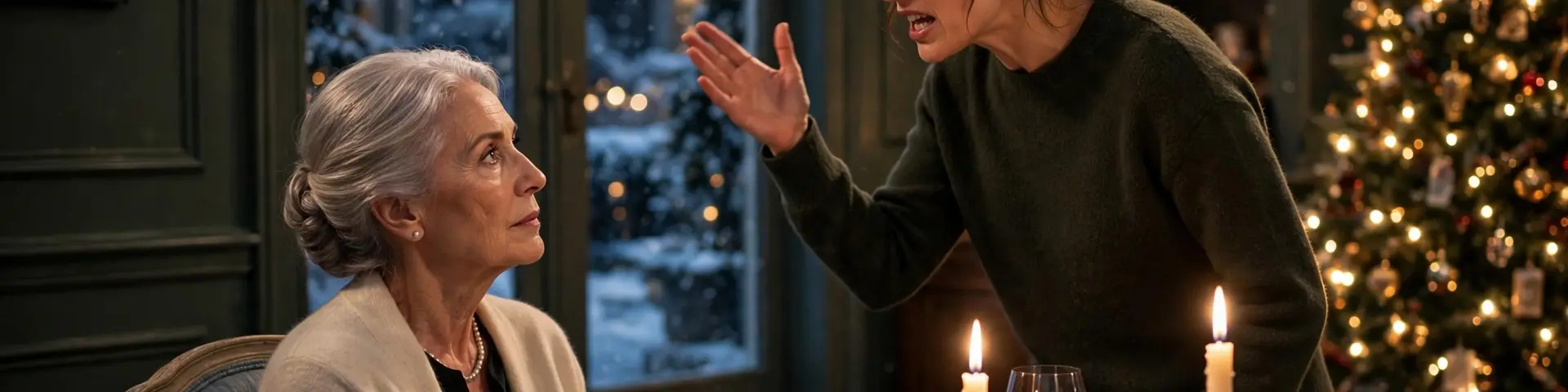
For one second, I thought Madison might run.
I watched her shoulders tense, her eyes dart toward the hallway, and her fingers curl around the edge of her coat.
But she didn’t move.
Instead, she turned slowly toward Ethan and looked at him with such sharp contempt that even Harold looked away.
“This is your fault,” she said. “You were born into money and still acted poor.”
Ethan flinched as though the words had landed physically.
She wasn’t finished.
“Your mother trained you to ask permission. To be grateful. To wait. I was trying to make you a man.”
Ethan’s voice came out barely above a whisper.
“No. You were trying to make me useful.”
Madison gave him a thin, humorless smile.
“At least now you understand something.”
The officer escorted her toward the entryway.
She didn’t cry. She didn’t apologize. She didn’t look at Daniel or ask me to reconsider anything.
Instead, she lifted her chin, wrapped her white cashmere coat tightly around herself, and walked out into the snow as if she were leaving a party that had failed to meet her expectations.
The front door closed behind her.
And suddenly, the house became terribly quiet.
Nobody looked at me.
The roast had gone cold on its platter. The candles were burning low, their wax gathering around the bases. A phone vibrated against the table, buzzing briefly against the wood before falling silent without anyone reaching for it.
The relatives who had celebrated Madison’s announcement now seemed unsure where to put their hands or their eyes.
Beverly cleared her throat.
“Margaret, we didn’t know.”
I turned toward her.
“You knew enough to clap.”
She looked down at her wineglass and said nothing more.
Harold tried next, adopting the familiar tone of someone who hoped a little humor might smooth over an ugly truth.
“Come on, Maggie. It was awkward. People react strangely.”
“People reveal themselves strangely,” I replied.
He looked at me for a moment, then lowered his eyes.
My niece Claire, who had posted two photographs of Madison’s speech to social media before realizing what was happening, quietly slipped her phone into her purse.
I noticed that too.
There were so many small revelations that evening. So many little moments in which people showed me exactly who they were when they believed I had no power left to protect myself.
I had spent years overlooking such moments.
I wouldn’t do that anymore.
Daniel gathered his folders and returned them to his leather case.
“Mrs. Whitaker, I’ll coordinate with the bank in the morning. The police will contact us after the initial interview.”
“Thank you, Daniel.”
He paused, then gave me a look that softened around the edges.
“Will you be all right tonight?”
I turned toward my son.
Ethan stood near the fireplace, staring at the stockings hanging from the mantel. His name was embroidered in green thread on one. Madison’s name appeared in red on another. Mine had been placed at the far end, half-hidden behind a brass angel.
Even the stockings had reflected the arrangement of power in that house.
Ethan and Madison had occupied the center.
I had been placed where I would be noticed only if someone looked carefully.
“I’ll be fine,” I told Daniel.
He nodded and left.
For several minutes, nobody spoke.
Then I walked to the mantel and removed Madison’s stocking. I folded it once, neatly, and set it on the armchair beside the fireplace.
It was such a small gesture that nobody else seemed to understand its significance.
But I did.
I was finished pretending that the place someone occupied in my family mattered more than the choices they made.
That was when Ethan finally broke.
“Mom,” he said, his voice cracking. “I didn’t know she went that far.”
I turned toward him.
“But you knew she was planning something.”
He stared at the floor.
His silence answered for him.
I moved toward the fireplace and sat down, choosing the chair closest to the warmth rather than the seat at the head of the dining table.
“Tell me.”
Ethan swallowed.
“She said you were controlling everything. That you were keeping me dependent. She said the trust should have been transferred when I turned forty.”
“You turned forty six years ago.”
“I know.”
“And did you ever ask me why it wasn’t transferred?”
His shoulders sagged.
“No.”
I nodded slowly.
“Because if you had asked, I would have told you.”
He lifted his eyes toward me.
“Told me what?”
I reached into my handbag once more and removed a photograph. It was old and creased at the corners, the colors fading slightly around the edges. It had been taken in 1998 outside a courthouse in Hartford.
Ethan was eighteen in the picture, thin and angry, standing beside me in a borrowed suit. His expression was hard, his shoulders stiff, his hands hanging awkwardly at his sides.
I remembered the day clearly.
He had been young enough to believe that anger could protect him from disappointment and old enough to resent every answer I couldn’t give him.
I placed the photograph on the coffee table between us.
“Your father did not die leaving a fortune,” I said. “He died leaving debt. Gambling debt. Business debt. Tax debt. The Whitaker name looked rich because I spent fifteen years making sure no one saw the cracks.”
Ethan stared at the photograph.
He looked at the young man beside me, then back at my face, as if trying to reconcile the history he had believed with the history I was finally telling him.
“I sold my jewelry,” I continued. “I sold the lake house. I negotiated with creditors. I worked with Daniel until midnight for months, going through records and agreements I barely understood when I first began. I built the trust after your father died, not before, because I wanted you protected from the kind of men who had nearly destroyed him.”
Ethan’s voice was small.
“My father gambled?”
“Yes.”
He sat down heavily, the realization seeming to take more out of him than the evening’s confrontation had.
“You told me he was unlucky in business.”
“He was. But luck was not the main problem.”