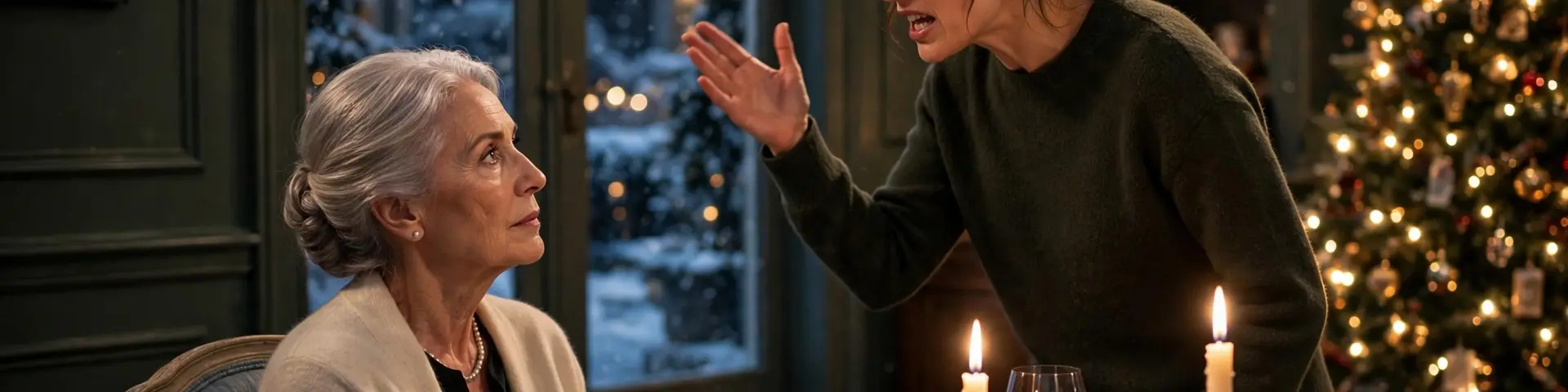
At Christmas dinner, my daughter-in-law rose slowly from her chair, lifted her glass, and announced, “I control this family now. Your cards are shut off.”
For one suspended second, the entire dining room went silent.
Then the room burst into applause.
My nieces clapped first, their hands striking together with an enthusiasm that felt almost rehearsed. My brother Harold, already flushed from too much wine, joined them with a broad grin. Even my sister-in-law Beverly lifted her glass, smiling as though Madison had just liberated them all from some terrible oppression.
The dining room in my son’s Westchester house glowed with candles, silver garland, and expensive holiday decorations. Everything looked perfect, from the gold-rimmed china to the enormous Christmas tree standing near the windows. It was the kind of lavish holiday cheer people use to disguise unpaid bills, strained relationships, and secrets they hope nobody will uncover.
Madison stood at the center of it all, soaking in the applause as if she had just delivered a speech that would be remembered for generations.
I sat quietly at my place, my hands resting beside my untouched plate.
I didn’t argue. I didn’t raise my voice. I didn’t ask her to explain herself.
I only smiled at my son and said, “You really don’t know, do you?”
Ethan went pale.
Not the ordinary pallor of someone embarrassed in front of relatives. His face lost its color so quickly that he looked as though the blood had drained straight out of him.
Madison’s smile cracked at the edges.
“Know what?!” she demanded.
I folded my napkin carefully, smoothing one corner before placing it beside my plate. I had learned long ago that people who expected you to lose control were often unsettled when you refused to give them the satisfaction.
“That the cards you shut off were never mine.”
The applause died as abruptly as it had begun.
My nieces lowered their hands. Harold’s grin faded. Beverly slowly lowered her wineglass, her expression shifting from smug satisfaction to confusion.
Madison stared at me, her eyes narrowing.
“Don’t play games, Margaret.”
“I’m not.”
I turned toward Ethan, my only child, the boy I had raised alone after his father died when he was ten. I had spent decades protecting him from the consequences of a life he wasn’t old enough to understand, and later from consequences he was old enough to face but too unwilling to acknowledge.
Now, sitting across from me in his own dining room, he looked like a stranger who had stumbled into a conversation he should have understood years ago.
“Your wife called Brighton Private Bank at 4:12 this afternoon,” I said. “She used your security phrase and told them to freeze every family-authorized card linked to the household trust.”
Ethan blinked several times.
“How do you know that?”
“Because the bank called me at 4:18.”
Madison’s voice sharpened, losing the polished confidence she had worn like jewelry all evening.
“That’s impossible. Ethan is the trustee.”
“No,” I said gently. “Ethan is a beneficiary. A generous one, for now. The trustee is me.”
A chair scraped backward across the hardwood floor.
Harold muttered, “What the hell?”
Madison looked around the table, apparently expecting someone to rescue her from the conversation. Only moments earlier, she had been the center of everyone’s admiration. Now every pair of eyes had turned toward her, and nobody seemed eager to applaud again.
“Ethan told me the money was his,” she said, her voice suddenly defensive.
“No,” I replied. “Ethan told you what you wanted to hear.”
Ethan swallowed hard. His face had gone from pale to gray, and I watched him struggle to understand how quickly the life he believed he owned was coming apart.
I reached into my handbag and removed a cream envelope bearing my attorney’s letterhead. I had brought it with me deliberately, knowing there was a possibility that the evening would unfold exactly as it had.
I placed it on the table between the cranberry sauce and the gold-rimmed platter.
“Last month,” I said, “after Madison asked me to transfer the Cape Cod house into her name for ‘tax reasons,’ I asked my attorney to review all family accounts. I wanted to understand why she had suddenly become so interested in the legal structure of our property.”
I paused, letting the silence settle over the table.
“What we found was interesting.”
Madison’s mouth opened, but nothing came out.
“Eight unauthorized withdrawals. Two fake consulting invoices. One attempted lien against my home in Connecticut. And today, a theatrical announcement designed to humiliate me in front of people who believed I was dependent on your charity.”
I let my gaze travel briefly around the table.
“Apparently, the best way to convince people you’re powerful is to make someone else look powerless.”
Ethan whispered, “Mom…”
I looked directly at him.
“You signed three of those documents.”
His eyes widened.
Madison slammed her palm against the table, rattling the silverware.
“You old witch. You can’t prove anything.”
I looked at her for a moment.
Then I smiled again.
From the hallway, the doorbell rang.
Madison turned toward the sound. So did everyone else.
“That,” I said, “should be Mr. Calloway, my attorney. And the two officers he asked to accompany him.”
For the first time that evening, nobody moved.
Not Harold. Not Beverly. Not my nieces. Not even Ethan.
Madison remained standing beside her chair, her hand still resting against the table, while the confidence slowly drained from her face.
The doorbell rang again, followed by three firm knocks.
Outside, through the frosted glass beside the front door, I could see the dark outline of a man in an overcoat. Two uniformed police officers stood behind him beneath the porch light, their shoulders dusted with snow.
Thin silver lines of snow drifted across the walkway, softening the edges of the carefully maintained garden.
It was a beautiful Christmas night.
And inside that beautiful house, the truth had finally arrived.
Madison looked at Ethan.
“Tell them to leave.”
Ethan did not move.
“Ethan,” she hissed, lowering her voice as though she could still control him through sheer force of habit, “tell them this is a family matter.”
I answered before he could.
“It stopped being a family matter when someone tried to borrow against my house using a forged authorization.”
Harold pushed his chair back and raised both hands, trying to insert himself into the situation as though he had been a reasonable observer all along.
“Margaret, maybe we should all calm down.”
I turned toward him.
“You clapped.”
His face darkened.
“I didn’t know what was going on.”
“No,” I said. “You knew exactly what you wanted to be true.”
He opened his mouth, then closed it again.
That silenced him more effectively than an argument would have.
Ethan finally began walking toward the front door. His steps were slow and uncertain, like those of a man walking toward his own sentencing. When he opened it, a rush of cold air swept through the warm house, making the nearest candle flames tremble.
My attorney, Daniel Calloway, stepped inside first.
He was seventy-two, tall, precise, and calm in the way only a lawyer with forty years of evidence in his briefcase could be calm. He wore a dark overcoat and carried a leather case that looked as though it had survived decades of difficult conversations.
“Mrs. Whitaker,” he said, nodding toward me.
“Daniel.”
The officers remained near the entryway. They didn’t rush into the dining room or raise their voices. They simply stood alert and patient, allowing the situation to reveal itself.
That seemed to make Madison more nervous than shouting ever could have.