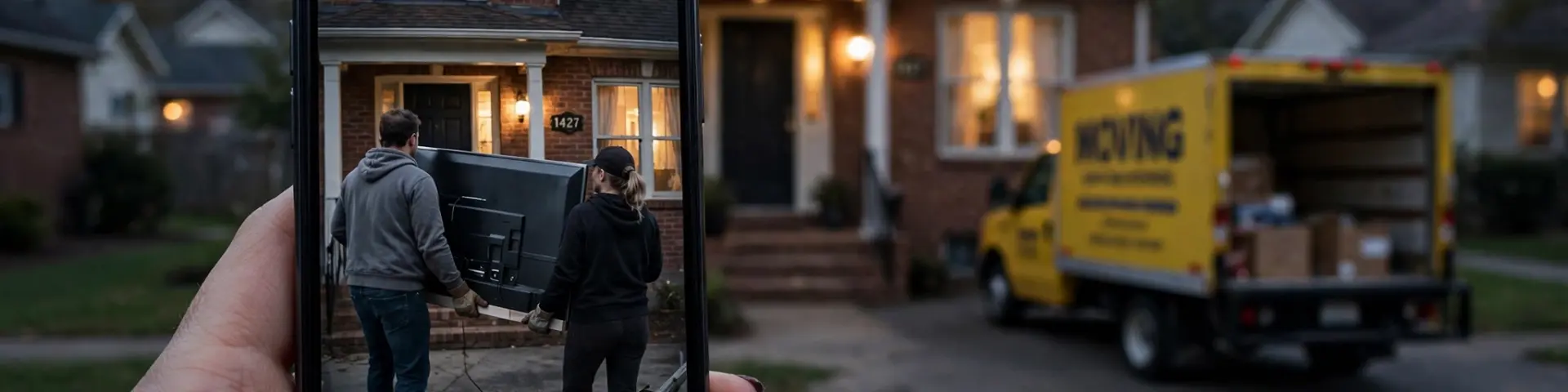
Rachel frowned at me.
“Today?”
“Yes.”
“You only got here yesterday.”
“I know.”
She glanced toward the kitchen window, then back at me. “Do you want me to come with you?”
Every instinct I had told me to say yes. The drive was long, the situation was unsettling, and I knew there would be questions waiting for me when I reached the house. Part of me wanted another person beside me, someone who could confirm that what I had seen was as unreasonable as it felt.
But I thought about the empty rooms I had walked through after closing. I thought about the deed, the keys, and the reason I had chosen to buy the house in the first place. I had spent years making room for other people’s opinions until I sometimes struggled to recognize my own preferences. I didn’t want this first difficult moment in my new home to become another occasion when I relied on someone else to stand between me and a decision I needed to make.
“No,” I said. “I need to do this one myself.”
Rachel didn’t argue. She understood me well enough to know when an offer of help had been heard and appreciated, even if it wasn’t accepted.
She packed two blueberry muffins for the drive. My sister has always believed carbohydrates constitute a legitimate emergency service, and under the circumstances, I was willing to accept her professional judgment.
I left before noon and headed toward I-71.
The first part of the drive passed in a blur of highway signs, traffic, and the steady hum of tires against the road. The muffins sat beside me, wrapped in a paper towel. Every so often, I checked my phone, half expecting another message from Mark or an update about the house. Mostly, though, I kept thinking about how quickly a familiar person could make an unfamiliar situation feel like an old one.
Eleven days earlier, I had believed I was beginning a life in which my decisions belonged to me. Now I was driving home to find out what had happened in my absence, and I could not stop wondering how Mark had known where to go.
About an hour into the drive, Emily called.
She was twenty-eight, old enough to understand what divorce meant in practical terms and mature enough to recognize that her parents no longer shared a life. But she was also still young enough to wish that the people who had raised her could somehow stop making reality complicated by insisting on separate versions of it.
“Mom.”
“Hi, sweetheart.”
There was a pause. I could hear the carefulness in her voice before she spoke again, the familiar hesitation of someone who had already heard one side of a story and was trying to decide how to approach the other.
“Dad says you had people stop him from moving into a house.”
“My house.”
The silence that followed was long enough for me to hear the faint rush of traffic through my open awareness, the engine humming steadily beneath the conversation.
“Your what?”
“I bought a house.”
“You bought a house?”
“Eleven days ago.”
“Why didn’t you tell me?”
I tightened my fingers around the steering wheel. Of all the questions she might have asked, that was the one I had expected least and dreaded most. I had kept the purchase private because I wanted the space to make the decision without outside commentary. I had not imagined that the privacy itself would become another thing I needed to defend.
“I was going to.”
“Dad knew?”
“Apparently.”
“But you didn’t tell him?”
I almost laughed, though there wasn’t much humor in it.
“Emily, one of the advantages of divorce is that I no longer have to notify your father when I purchase real estate.”
She didn’t laugh. I could picture her sitting somewhere with her phone against her ear, trying to arrange the information into a shape that didn’t require her to be angry with either of us.
“He said you told him they could stay there.”
“I did not.”
“Then why would he think that?”
“I don’t know.”
That answer was only partly honest. I understood enough about Mark to recognize how he could persuade himself that something was reasonable, even when the facts didn’t support it. He had always been capable of moving from what he wanted to what he believed he was entitled to, sometimes so smoothly that the distinction seemed to disappear for him.
But I did not understand how he had found the house. I did not understand how he had obtained the temporary access code. And I had not yet discovered the full extent of what he had done before the moving truck appeared.
“Mom,” Emily said, “I really don’t want this getting ugly.”
I watched the road ahead, the traffic flowing in front of me and the green signs rising above the lanes.
“Neither do I.”
“I just want everyone to calm down.”
There was nothing unkind in her request. I knew she wanted peace, and I understood why she hoped that the right words might bring it about. She had spent enough of her life watching two people who once loved each other struggle to share a reality that no longer fit them both. It was natural that she wanted the conflict to stop before it spread into every corner of the family.
But peace and the absence of disagreement were not always the same thing. I had spent years learning that lesson, and I wasn’t sure how to explain it to her without making her feel as though I were asking her to choose between us.
“Emily, there are situations that are already wrong before anybody reacts to them.”
She went quiet.
“I’m not asking you to choose sides,” I added.
“I know.”
I hoped she did. More than anything, I wanted her to understand that I was not trying to punish her father or turn the divorce into a continuing battle. I was trying to protect the one thing I had acquired for myself after years of sharing nearly every significant decision with another person.
“I’ll call you when I’m home,” I said.
“Okay, Mom.”
We ended the call, and I continued driving.
By the time I reached Worthington, the moving truck was gone. The driveway was empty, and the street looked as peaceful as it had when I first visited the property with my realtor. The maple tree stood over the front yard, its branches casting familiar shadows across the lawn. From the road, nothing suggested that my morning had involved an unauthorized move, a call to the authorities, or a conversation with my daughter in which I had tried to defend the basic right to own a house without seeking my ex-husband’s approval.
For a moment, the ordinary appearance of the place almost reassured me.
Then a man from the neighboring property began walking across the lawn toward me.
He looked to be in his early sixties, with gray hair and reading glasses hanging from the collar of his shirt. He approached with the cautious friendliness of someone who knew that a conversation might be welcome but could also arrive at a difficult moment.
“Claire?”
“Yes.”
“Tom Weaver.”
We shook hands. His grip was firm, and his expression held a mixture of concern and curiosity that made me suspect he had already heard enough about the morning to know it had been unusual.
“Quite a morning,” he said.
“So I heard.”
He glanced toward the house, then back at me.
“I figured you knew they were coming.”
Something tightened in my stomach.
“Knew what?”
Tom seemed to register the change in my expression. He paused before answering, as though he were deciding how much of the story I already understood.
“That your former husband had been here.”
I stared at him.
“When?”
“Wednesday.”
Three days earlier.
The words seemed to settle between us with an unpleasant finality. I had been thinking of the morning’s events as a sudden, irrational decision, something Mark had arranged without considering how I might react. But if he had already been to the property on Wednesday, the moving truck was not the beginning of the story.
It was simply the part I had witnessed.
“Was he alone?” I asked.
Tom hesitated.
“No.”
“Was Vanessa with him?”
“No.”
I waited.
Tom looked toward the side of the house before giving me the answer.
“A locksmith.”
For a few seconds, the sound of traffic from the larger road behind us seemed to fill the entire neighborhood. I could hear the passing cars, the faint rush of tires over pavement, and the wind moving through the maple branches. Everything around me continued as usual, while the facts I had thought I understood began rearranging themselves into something far more troubling.
Three days earlier, Mark had been at my house with a locksmith. That meant he had not merely arrived with furniture and assumed I would welcome him. Someone had changed the locks before the moving truck appeared.
I walked toward the side entrance.
The electronic keypad was still there, its dark surface reflecting a little of the afternoon light. I entered the contractor code I had created for the flooring crew: 0-4-2-7.
The indicator turned red.
I waited a moment, then tried again, pressing each number carefully.
Red.
I made a third attempt, more slowly than the first two, because some small, unreasonable part of me still hoped that the problem was a mistyped digit or a technical glitch that could be corrected by trying once more.
Nothing changed.
Tom stood behind me, watching.
“Problem?”
I kept my eyes on the keypad.
“He changed the lock.”
The realization did more than explain why the code no longer worked. It changed the meaning of everything I had seen that morning. Someone who mistakenly believed he had permission might show up with a suitcase and expect an awkward conversation. Someone who arranged to have the locks changed three days before arriving with a moving truck had taken steps to make his presence possible before asking whether it was welcome.
And Mark had done that to a house I had purchased with my own money, after a divorce that had been final since January, without a single conversation in which I had agreed to any of it.
Tom reached into his pocket and held out a garage remote. The previous owner had accidentally left it with him months earlier, and he had kept it in case it proved useful to whoever eventually bought the house.
“You can try this,” he said.
I pressed the button.
Nothing happened.
We tried once more. The garage remained shut. Whatever had been done to the side entrance, the garage access had been reset as well.
Tom lowered the remote and studied it for a moment.
“Well,” he said, “that’s rude.”
Under different circumstances, I might have laughed. The simplicity of the remark was almost comforting. There was no attempt to excuse what had happened or suggest that I might have misunderstood somebody’s intentions. Tom had heard the facts and arrived at the same conclusion I had.
I took out my phone and called a locksmith.
While I waited for him to arrive, I began documenting the property. I photographed the front door, the side entrance, the keypad, and the garage. I moved slowly around the exterior, making sure each photograph clearly showed the area I wanted to record. There was no obvious damage to the doors. No splintered frame or broken glass. Nothing that would have suggested an ordinary forced entry.
That, in its own way, made the situation feel worse. The house had not been visibly damaged to gain access. Someone had simply changed the means by which I was allowed inside.
The locksmith arrived a little after six.
His name was Pete. He wore a navy work shirt and carried himself with the calm, unhurried manner of someone who had spent enough years dealing with locks to know that the mechanism in front of him was rarely the most complicated part of the job. He had the expression of a man whose work had introduced him to plenty of family disputes, and my circumstances seemed to register as unusual without quite qualifying as extraordinary.
I showed him my identification, then the deed and closing statement. He examined the documents before turning his attention to the electronic lock.
“New place?” he asked.
“Eleven days.”
He glanced at the lock again.
“That’s a short honeymoon.”
I let out a small breath that might have been a laugh under less exhausting circumstances.
“You have no idea.”
Pete got to work restoring my access. I watched him examine the hardware, check the mechanism, and make the adjustments necessary to put the entrance back under my control. His movements were efficient and practiced. There was something reassuring about watching a problem be treated as a problem, without an argument about whether it existed or an explanation of why I should accept it.
When he finished, I could enter my own house again.
I stepped inside.
The first thing I noticed was the mud on the entry floor. Dark marks crossed the surface near the doorway, interrupting the clean appearance of the floor I had been so pleased to have refinished. I moved farther into the hall and saw a long scrape across one of the newly sanded boards. It caught the light at an angle, making the damage impossible to overlook.
There was a dent in the hallway wall at about dresser height. Flattened cardboard boxes had been left in the dining room, their creased sides collapsed inward as though somebody had emptied them in a hurry. The room that had seemed so open and full of promise when I bought the house now looked as if it had been used as a temporary storage space by people who had never considered whether they were entitled to be there.
On the kitchen counter stood a decorative wooden sign.
HOME SWEET HOME.
I stopped and stared at it.
The lettering was neat and cheerful, the sort of decoration designed to make an unfamiliar room feel welcoming. Someone had placed it on my counter as though the question of whose home this was had already been answered.
I picked it up and examined it for a moment. Then I set it down again.
Apparently, Vanessa had already progressed to the decorating stage.
Pete came into the kitchen after checking the side lock. He looked at the hardware surrounding the cylinder and studied the difference between the newer mechanism and the older fittings.
“This cylinder is newer than the hardware around it,” he said.
I thought of Tom standing in the yard, telling me about Wednesday. I thought of Mark at the keypad that morning, entering the code without hesitation, and the green light flashing before he opened the door. I thought of the moving truck, the television, the boxes, and Vanessa carrying the lamp into a house she had apparently been told was available to her.
“My neighbor saw a locksmith here on Wednesday,” I told him.
Pete gave a small nod as he continued examining the lock.
“That fits.”
I stood in the kitchen of the house I had owned for eleven days, surrounded by evidence that someone had already begun treating it as his own. The muddy floor, the scraped board, the dent in the hallway wall, and the cheerful sign on the counter all seemed to tell the same story in different ways.
And for the first time since the doorbell camera had shown me Mark stepping out of that yellow truck, I began to understand that the morning’s events had not happened by accident.
The Cost of Taking Back My Own House
I had every exterior lock changed again. Pete replaced the hardware, reset the electronic keypad from scratch, and made sure the garage access codes were no longer connected to anything Mark might have known or once had permission to use. We went through each entrance method carefully, checking that the new settings worked before moving on to the next. By the time he finished, I had spent another several hundred dollars securing a house I had barely begun to occupy.
It was a peculiar expense to absorb eleven days after closing. I had budgeted for paint, flooring, a few repairs, and the ordinary inconveniences that came with buying an older house. I had not budgeted for paying someone to restore my right to enter my own front door.
After Pete left, I sat on the living-room floor. The room was still empty because I hadn’t moved my furniture in yet. The walls were freshly painted, the refinished oak floors reflected the evening light, and the air held the faint smell of sawdust and cleaning products. Somewhere outside, a car passed along the road. Inside, there was nothing to interrupt the quiet except the occasional creak of the house settling around me.
That was when my anger began to give way to something less comfortable.
Doubt.
I was embarrassed by how quickly it arrived. Mark had changed my locks. He had attempted to move himself and Vanessa into my house without permission. He had apparently misrepresented the arrangement to his own wife. I had the deed, the closing statement, the security footage, and the locksmith’s observations. The facts were not especially difficult to arrange into a coherent picture.
And yet I found myself asking whether I had somehow contributed to the confusion.
Had I mentioned the house in a conversation and forgotten? Had Emily told him something without realizing its significance? Had I left information available somewhere that Mark could reasonably have assumed he was entitled to see? Was there a discussion I remembered one way that he remembered another?
These questions were not evidence that I had done anything wrong. I knew that, at least in the abstract. But twenty-seven years with Mark had trained me to look for the explanation that made his behavior understandable before I allowed myself to accept the explanation that he had crossed a boundary.
I had become remarkably skilled at examining my own memory for defects whenever his actions left me uncomfortable. It was a habit I thought I had begun to leave behind with the divorce. Sitting on that empty floor, I discovered that a legal separation could end a marriage without immediately ending all the reflexes built inside it.
I took out my phone and called Rachel.
“You inside?” she asked as soon as she answered.
“Yes.”
“Anything missing?”
I glanced around the room.
“My peace and one floorboard.”
“Claire.”