“I’ve been thinking about something.”
“What?”
She rolled the paint slowly along the wall before answering.
“What I said about everything becoming a war.”
I kept painting. “You were upset.”
“I was still asking you to fix it.”
My roller paused halfway up the wall.
Emily continued, her eyes on the paint rather than on me.
“I’ve done that for years, haven’t I?”
“Done what?”
“Expected you to be the reasonable one because Dad wouldn’t be.”
Her words landed harder than anything Mark had said at the cookout. There had been years of holidays, birthdays, college decisions, and the slow unraveling of my marriage behind that one sentence. Emily had called me after disagreements because she knew I would listen. She knew I would take time to understand what had happened, consider what everyone was feeling, and try to find a way forward that didn’t leave someone hurt.
Those were qualities I’d once considered strengths without asking what they cost me when everyone around me learned to depend on them.
“You were the child,” I said. “Even when you were twenty-eight.”
She looked at me then.
“I think sometimes I was asking you to lose quietly so I didn’t have to feel like Dad was losing.”
I swallowed before answering. It wasn’t an accusation, exactly, but it carried the weight of something we had both been avoiding.
“Maybe I taught you that was okay.”
Her forehead creased.
“How?”
“I spent a lot of years confusing everyone being comfortable with everyone being healthy.”
She set her roller against the tray and looked at me carefully.
“Are you angry with me?”
“No.”
“You probably should be a little.”
I considered that for a moment.
“I’ll schedule it for Thursday.”
She laughed, the tension in her face finally easing. Then she pointed the roller at me.
“Not on the shared calendar.”
I laughed, too. We laughed hard enough that I had to look down at the tray to make sure the paint wasn’t about to spill over the edge. For a few seconds, we were simply a mother and daughter making a mess of a hallway, rather than two people trying to understand the complicated habits a family can carry for years.
That was the first moment the whole episode began to feel like something that had happened instead of something that was still happening.
It was a small shift, but I noticed it. The story no longer occupied every quiet space in my mind. I could think about something else without feeling that I was neglecting a problem. I could paint a wall without imagining Mark’s belongings being carried through my front door. I could laugh with Emily and let the sound stand on its own.
An Apology That Took Responsibility
A week later, Vanessa sent me a handwritten letter. The return address belonged to her sister in Dublin.
The note was short. She didn’t try to explain every decision Mark had made, and she didn’t ask me to understand the pressure they had been under. She wrote that she was sorry for entering my home and moving her belongings into it. Mark had misled her, she acknowledged, but she had still walked through my door without ever hearing permission directly from me.
Then she mentioned the dresser.
“I carried the dresser that damaged your hallway. That part belongs to me.”
She enclosed a check to cover the wall repair.
I read the letter more than once. What struck me wasn’t that Vanessa had suddenly become someone I wanted in my life. We had no relationship that needed to be repaired, and I had no desire to create one out of the wreckage of what had happened. It was the way she had separated what Mark had told her from what she herself had done.
She had been misled, but she didn’t use that fact to erase her own part in the situation.
I called Susan before depositing the check, because apparently divorce had turned me into a woman who consulted an attorney about ordinary checks.
Susan listened to my question and gave me the sort of answer that reminded me why I’d hired her.
“Deposit it.”
So I did.
I didn’t call Vanessa. We didn’t become friends, and we didn’t arrange to meet for cocktails and compare stories about Mark. I didn’t need to know what happened next in their marriage, either. That belonged to them.
I could respect an apology that included responsibility without opening a door to a new relationship. The two things were not the same, and I was finally getting better at recognizing the difference.
Eventually, I also stopped asking Emily for updates about her father.
That was another boundary, quieter than the ones involving locks and legal letters, but important all the same. I no longer needed to monitor Mark’s reactions to know whether I was allowed to move forward. I didn’t need to hear what he was telling relatives or learn whether he had changed his version of events. His story was no longer mine to manage.
The Sign in the Laundry Room
Diane came by one Sunday carrying a gift bag. She held it out to me with an expression that suggested she was pleased with herself but wasn’t entirely certain I would agree.
“I brought something.”
I eyed the bag.
“That sounds dangerous.”
“It may be.”
Inside was a small wooden sign.
HOME SWEET HOME.
I stared at it for a moment. It was the same kind of sign I’d found among the things Vanessa and Mark had brought into my house, the one that had seemed to announce an arrangement I had never agreed to.
Diane began laughing before I could say anything.
“Too soon?”
“By at least six months.”
Then I started laughing, too.
Eventually, I hung the sign in the laundry room.
The first time those words had appeared in my kitchen, Vanessa had brought them because she believed the house was available to her. The sign had become an accidental symbol of everything Mark assumed he could decide on my behalf. It had been placed inside my home without my permission, as though a few familiar words could make an unwanted arrangement feel natural.
Now it stayed because I had chosen to put it there.
The words hadn’t changed. The meaning had.
By Thanksgiving, the house looked properly lived in. Rachel left a casserole dish in my sink for three days. Emily placed a crooked turkey magnet on the refrigerator. Diane brought pecan pie and complained about store-bought whipped cream.
Nobody mentioned Mark.
Nobody asked whether he should be invited or wondered if his absence needed to be explained. We ate too much, argued about the thermostat, and spent fifteen minutes looking for Diane’s reading glasses before Emily discovered them sitting on top of her head.
It was wonderfully ordinary.
After everyone left, I stood alone in the kitchen with a cup of coffee. The rooms were quiet again, but the silence no longer felt like a space where I needed to prepare for the next disagreement. It was simply the peaceful aftermath of a holiday with people I loved.
For most of my marriage, I had believed a boundary worked only when the other person understood it. If Mark agreed I had a right to be upset, then I could remain upset. If he understood why I needed something, then I could ask for it. If he thought my reaction was unreasonable, I would search for a softer way to express myself, a more acceptable explanation, or a compromise that might persuade him to see my point.
I know better now.
A boundary does not need agreement. It needs clarity.
Mark didn’t have to agree that changing my locks was the right decision for me to change them again. He didn’t need to appreciate why the house mattered before I could keep him out. He didn’t need to understand why I attended the cookout before I could correct the story he had told about me.
My right to make those decisions did not depend on his approval.
And if I am being fair, Mark had not completely miscalculated me. There had once been a Claire Bennett who would have watched that moving truck arrive and called him first. She would have listened to his explanation, asked where he and Vanessa would stay if she said no, and worried about embarrassing him in front of his new wife.
She would have accepted the word “temporary.”
She might have allowed one night, telling herself that helping someone in a difficult situation was the decent thing to do. Then one night might have become a week. A week might have stretched into something longer. Before she fully understood how it had happened, she could have found herself standing in her own kitchen, wondering how long the people who had moved in without permission intended to remain.
Mark had counted on that woman.
He was eight months too late.
I still believe in kindness. I still believe misunderstandings happen and that second chances can matter. I haven’t become suspicious of every request for help, and I don’t believe every difficult conversation must end with someone walking away.
But kindness is not advance permission.
Understanding someone’s explanation does not require surrendering your own facts. And forgiveness, whenever it comes, does not come with a duplicate key.
The Last Conversation with Mark
About a year later, I saw Mark at Emily’s birthday dinner. It was held at a neutral restaurant, with ten people around the table and enough ordinary conversation to make the occasion feel uncomplicated.
I had wondered whether seeing him again would bring back the old tension. I wondered whether I would find myself watching his face for signs of irritation, anticipating an argument that never arrived, or mentally preparing answers to questions he might ask.
None of that happened.
He looked older. Probably so did I.
We exchanged a polite hello and took our places. The evening moved along without incident, and I found myself listening to the conversations around me instead of measuring every word Mark said. When Emily went to the restroom later in the evening, he stood near my chair.
“House working out?”
“Yes.”
He nodded, looking down briefly before speaking again.
“I was wrong.”
I looked at him and waited.
“About more than the moving truck.”
He didn’t rush to fill the silence. For once, he seemed to understand that an explanation needed room to exist without immediately being defended.
“I knew you hadn’t invited us,” he said.
There was no satisfaction in hearing it. No sudden rush of triumph, no sense that the past had been repaired by the admission. I had spent months collecting proof of something he was now acknowledging in a few quiet words.
It was confirmation, not a victory.
“I convinced myself you’d eventually say yes because you always hated conflict.”
I considered that. “That was true.”
He lowered his eyes.
“I used that.”
“Yes.”
He took a breath.
“I’m sorry.”
The apology was specific enough to mean something. It was late, but lateness didn’t automatically make it useless. I could acknowledge that he had finally named what he’d done without pretending that the admission erased the damage.
“Thank you,” I said.
That was all.
He didn’t ask me to forgive him, and I didn’t offer him a reunion of any kind. We returned to our seats when Emily came back, and dinner continued. Someone changed the subject. Someone else asked about dessert. The ordinary rhythm of the evening resumed without requiring us to make a ceremony of the conversation.
That became the final reversal, though nobody else at the table noticed it.
It wasn’t the officers in my driveway. It wasn’t the documents I had placed on the cookout table, or the reimbursement, or the moment Vanessa put her key beside Mark’s beer. Those things had mattered, but they had all been part of proving something I already knew.
The real change was quieter.
The man who had once counted on explaining me out of my own boundary finally offered an explanation I no longer needed.
My life had already moved forward.
The House I Chose to Keep
I am fifty-four now, and I still live in the Worthington house.
The maple tree shades half the front lawn. Last winter, I replaced the stubborn kitchen cabinets because, after everything that had happened, I decided I had earned drawers that closed properly. The hallway has been repainted, and the repaired floorboard is almost impossible to find unless you know exactly where to look.
I know where it is.
I leave it that way.
Not as a scar. As perspective.
The doorbell camera still sends notifications, but I no longer feel compelled to check every one the instant it arrives. My passwords are mine. My calendar is private. The garage remote works the way it should. Tom next door still watches enough neighborhood activity that formal security sometimes feels almost redundant.
Rachel visits and complains that Kentucky has better bourbon. Emily has a key now. I gave it to her two years after I moved in, and the distinction matters to me more than I can easily explain.
I didn’t give her a key simply because she was my daughter. I gave it to her because I chose to.
I handed it over at the kitchen table.
“This is for emergencies and when you’re invited.”
She smiled.
“Not for moving trucks?”
“Especially not moving trucks.”
Then her expression grew serious.
“Thank you.”
That word mattered. Access should feel like trust, not inheritance. It should be something given willingly, with an understanding that the person receiving it respects what the key opens and the life that happens behind the door.
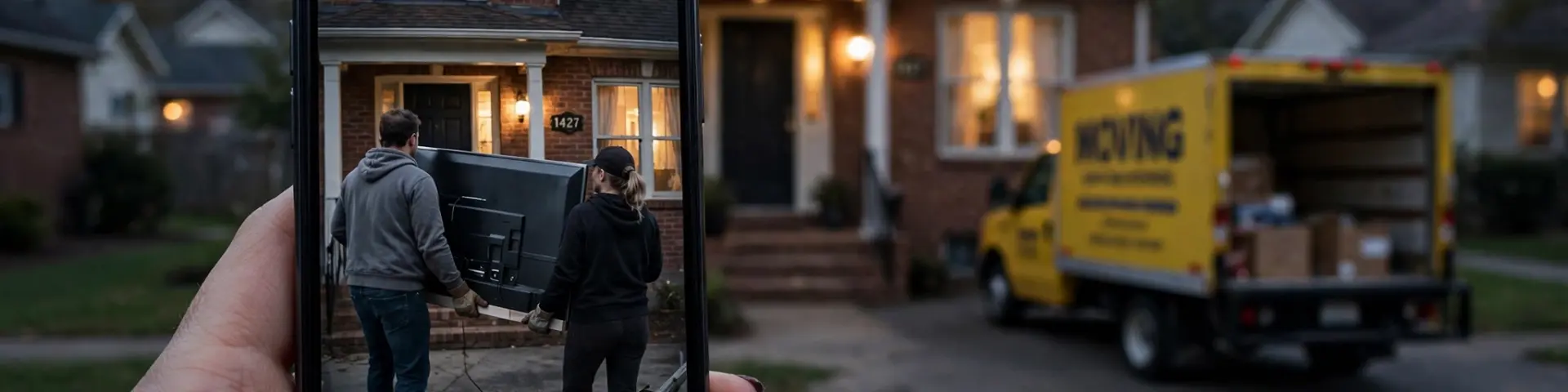
Sometimes I still think about that morning in Rachel’s kitchen, four hours away from my new house. I remember the phone in my hand, Mark carrying his television, and Vanessa following behind him with the lamp. I remember the instant when my thumb hovered over his name and I considered calling him to ask what he thought he was doing.
That small decision not to press his name may have been the most important thing I did.
Not because calling him would have made me weak. It wouldn’t have. I could have asked questions, listened to his answers, and still made the right decision afterward. But I already had the information I needed.
The deed was in my name. The camera showed what was happening. The furniture was being carried inside. The door had opened under a code I had never shared with Mark.
For once, I allowed the evidence to reach me before the explanation did.
That changed everything that followed.
I did not become harder. I became clearer.
There is a difference. Hardness assumes that everyone will cross your boundaries and treats every request as a threat. Clarity simply knows what to do when somebody crosses a line. It allows you to remain kind without confusing kindness with permission, and to hear someone’s reasons without letting those reasons replace your own judgment.
These days, when I lock the front door at night, I rarely check it twice.
The house settles around me. The refrigerator hums in the kitchen. The furnace clicks as it comes on. Occasionally, a branch brushes the window, making a faint sound that I have come to recognize without looking up.
They are small, familiar sounds. They belong to a home occupied by the person who chose it, paid for it, and decided how she wanted to live in it.
Sometimes I make coffee and stand over the same sink where I ate that turkey sandwich on closing day. I remember the excitement I felt then, the quiet satisfaction of knowing that I had bought a house for myself after years of sharing a life with someone else.
Back then, the house was technically mine. I had the deed, the keys, and the closing statement. I had the legal documents to establish ownership and the money records to explain how I had paid for it.
But ownership took longer to settle inside me.
It became mine the morning I refused to negotiate with a moving truck. It became mine again when I changed the locks. It became mine when I showed up at the cookout and corrected the story Mark had told about me. And it became mine once more when I chose to move in instead of selling the house simply because someone else had made its rooms feel unsafe.
Home is not merely the place where your name appears on a piece of paper. It is the place where your no is allowed to mean no.
Mark once believed I would surrender the house because I disliked conflict. He had twenty-seven years of evidence to support that theory. He had watched me smooth over arguments, search for compromises, and take responsibility for making difficult situations easier for everyone else.
What he failed to account for was that people can change after the paperwork is final.
I had spent most of my marriage believing that peace meant keeping doors open. I thought a good person remained available, heard every explanation, and tried to understand even when understanding came at a cost. I thought that if I could only find the right words, the right tone, or the right compromise, everyone might eventually agree that I deserved the space I was asking for.
Now I know that peace can mean something different.
It can sound like a deadbolt clicking into place behind you at night, followed by silence. It can mean a house where you no longer rehearse conversations before they happen or wonder whether the person standing outside your door has already decided what you’re going to allow.
It can mean finally understanding that the person on the inside gets to decide who receives a key.
And for the first time in a very long time, that person is me.
If you came here from Facebook because of this story, return to the Facebook post, tap Like, and comment exactly “Amazing” to support the storyteller. That small action means more than it seems and gives the writer genuine encouragement to keep sharing more stories about family pressure, firm boundaries, and finally protecting what you worked so hard to build.
Disclaimer: This story is a work of fiction created for entertainment purposes. Any resemblance to real persons, events, or places is coincidental.