The House That Was Supposed to Be Mine
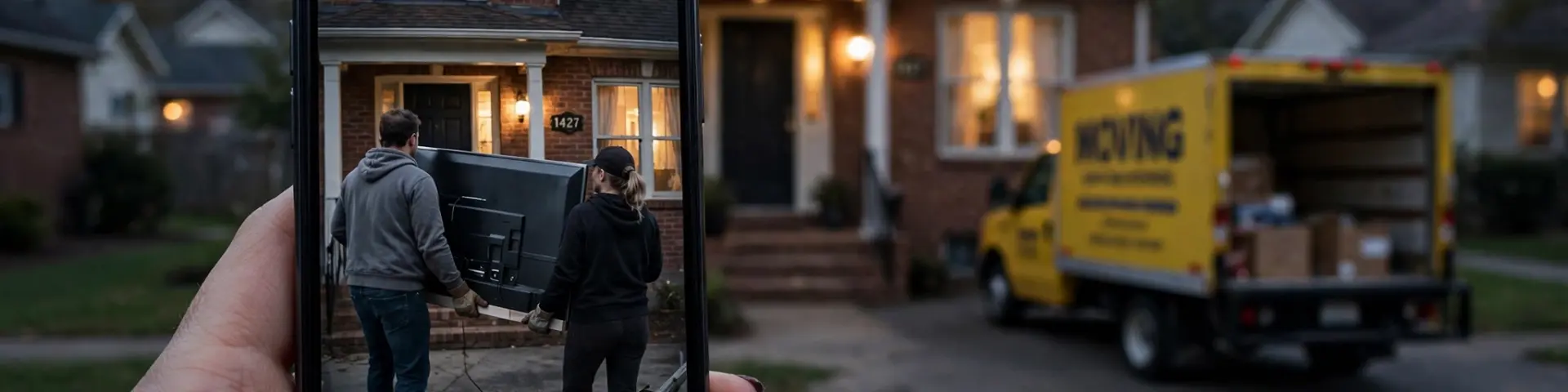
My ex-husband arrived at the house I had purchased eleven days earlier with his new wife and a moving truck, as though the place had been waiting for him all along. I was four hours away, watching through my doorbell camera as they carried a television, cardboard boxes, and a sectional sofa across the threshold of my front door. I didn’t call him. I didn’t argue with him through a phone screen or demand an explanation while he was in the middle of doing something that had never been his decision to make. Instead, I verified the deed, contacted the authorities, and had the move stopped. When I finally returned home, I discovered that he had changed my locks three days before bringing the truck.
At first, I thought the security camera had somehow connected me to the wrong property. I was standing barefoot in my sister Rachel’s kitchen outside Louisville, a mug of coffee warming one hand while she used a butter knife to cut a blueberry muffin in half. It was an ordinary morning, the kind that should have contained nothing more consequential than breakfast and a conversation about the weather. Then my phone vibrated against the counter.
The notification was brief and unremarkable: person detected in driveway.
I had expected the flooring contractor at my new house in Worthington. There was still work to be done before I could settle in properly, and contractors coming and going had become part of the routine. I glanced at the screen without much interest, expecting to see a familiar work van or somebody carrying a toolbox. Instead, a yellow moving truck appeared in the driveway, backing toward the garage with the deliberate, lumbering caution of a vehicle that had every intention of staying awhile.
Then Mark stepped out.
My ex-husband wore khaki shorts and a gray Ohio State T-shirt our daughter, Emily, had given him several Christmases earlier. He looked entirely at ease. He walked around to the back of the truck, glanced toward the house, and began directing the unloading as casually as if he were arriving at a place where his name was already on the mailbox.
Rachel leaned over my shoulder, bringing with her the warm, buttery smell of the muffin she had just cut.
“Is that Mark?”
“Yes.”
“What is Mark doing at your house?”
I kept my eyes on the screen. “I was hoping you knew.”
“I live in Kentucky, Claire.”
“Then we’re equally informed.”
The passenger door opened. Vanessa climbed down from the truck, smoothing her clothes before walking around to meet Mark at the rear. His new wife and I had met twice. Both encounters had been sufficiently civil to suggest that society’s basic rules were still intact, although neither of us had displayed any particular desire to become friends. I knew little about her beyond what Mark had told me, and until that morning, I had never had a reason to learn more.
On the screen, Vanessa reached for a tall brass floor lamp Mark was lifting out of the truck. I recognized it immediately. It had stood beside the couch in his apartment, one of those pieces of furniture that had acquired a permanent place in the background of his life. She carried it toward my front door without hesitation.
Next came the television. Then a box with BOOKS printed across its side in thick black marker. Another box followed, labeled KITCHEN. Mark lifted something from the truck while Vanessa moved past the camera with a cardboard box tucked against her chest.
MASTER BEDROOM.
I read the words once, then again, as though a second look might rearrange them into something less absurd.
Rachel lowered her muffin to the counter. Her expression had changed from curiosity to disbelief.
“Claire.”
“I see it.”
“They’re moving in.”
“I see that too.”
My voice sounded surprisingly level. I remember that more clearly than I remember what I was feeling, because I had expected anger to arrive first. Instead, there was a strange, suspended moment in which my mind seemed to be waiting for somebody to explain the scene before it would agree to believe it.
I had owned the house for eleven days. Eleven.
It was a three-bedroom brick house in Worthington, built in the late 1980s, with oak cabinets that had stubbornly survived several decades of changing tastes, a broad maple tree shading the front yard, and a dining room that filled with lovely afternoon light. It wasn’t extravagant, and it wasn’t perfect. The cabinets needed work. A few rooms would require patience and money before they looked the way I wanted them to look. But the house had a solid, welcoming quality that made me feel I could grow comfortable there without having to apologize for any of my choices.
I had paid $327,500 for it, using my share of the equity from the marital home Mark and I had sold during our divorce, along with savings I had accumulated in the months following the settlement. It was a considerable amount of money, enough to make me read the closing documents more than once and check every figure with the careful attention of someone who knew there was no longer another person beside her to catch an error.
Still, the price was not the part that mattered most.
The name on the deed was.
Claire Bennett. Sole owner.
After twenty-seven years of marriage, discovering what it felt like to purchase something entirely on my own had been almost embarrassingly emotional. I had expected relief, perhaps satisfaction, and the practical pleasure of having a place of my own. I had not expected to feel so deeply moved by a signature on a document.
At closing, the title representative handed me the keys and congratulated me. I thanked her, walked outside, and drove straight to the empty house with a turkey sandwich wrapped in paper. There wasn’t a chair in the kitchen yet, so I stood at the sink and ate my lunch while looking out at the backyard. The bread was slightly dry, and I had forgotten to ask for mustard. It was not a particularly memorable meal by any ordinary measure.
But I was alone in a house that belonged to me.
There was no husband asking whether we had chosen the right neighborhood. No discussion about whether the kitchen needed repainting or whether we could live with the existing cabinets for another five years. No debate about the necessity of an extra bedroom, the cost of a particular fixture, or whether I was being practical enough. I could walk from the kitchen to the dining room, stop in the doorway, and decide that I liked the afternoon light without explaining my reasoning to anybody.
I wandered through the rooms, listening to my footsteps on the bare floors. The house smelled faintly of fresh paint and sawdust. Sunlight rested against the walls in long, pale rectangles, and every room seemed to hold the quiet possibility of a life that had not yet been arranged.
I remember thinking that I had finally chosen a place without having to negotiate away pieces of myself to make the decision acceptable to someone else.
That was what the house meant to me. It wasn’t merely a financial purchase or a sensible next step after a divorce. It was proof, in brick and wood and paperwork, that I could make a decision and let it belong to me.
I had not told Mark about the purchase. There had been no reason to tell him.
Our divorce had been final since January. By August, I had become thoroughly tired of the apartment I rented during the separation, particularly after the man who lived above me began exercising around midnight with equipment that sounded, on some nights, remarkably like bowling balls being rolled across the ceiling. I had endured enough sleepless evenings to develop an intimate knowledge of every creak in the apartment and a strong preference for ceilings that remained quiet after ten.
Rachel knew I was looking at houses. Emily knew I was considering my options. My realtor knew, naturally, and so did the flooring contractor. Beyond them, there was very little to tell. I wasn’t concealing the purchase as some elaborate maneuver against Mark. I simply wanted to keep the decision to myself until it had become something solid, something I could touch and walk through and call mine without inviting opinions from people who no longer had a say in my life.
On my phone, Mark approached the side entrance.
That door had an electronic keypad because the contractors were still working inside. To make access easier, I had set up a temporary four-digit entry code, allowing the flooring crew to come and go without carrying a physical key. It was a practical arrangement, nothing more. I had assumed that a code was useful precisely because I could control who used it.
Mark stopped in front of the lock and raised his hand.
He pressed four numbers.
The keypad flashed green. A small mechanical click followed, and the door opened.
Rachel leaned so close that I could feel her shoulder against mine.
“He knows your code.”
“I noticed.”
“Did you give it to him?”
I turned to look at her. “Rachel, I sometimes forget why I walked into Kroger, but I am quite certain I did not give my ex-husband the code to a house he doesn’t even know I own.”
She looked back at the screen, apparently unable to find anything reassuring in the answer.
Mark stepped inside. Vanessa followed, carrying the brass lamp into my house as if she had been helping arrange the rooms for weeks. The camera caught the movement of her shoulder as she passed through the doorway, then showed the door swinging closed behind her.
That was when the feeling in my chest changed.
Anger would have been easier. Anger has a familiar shape, and after twenty-seven years with Mark, I knew how to handle the beginning of an argument. I knew the familiar heat in my face, the urge to make a point, the sentences that rose quickly to my tongue. But what I felt instead was the cold, unmistakable recognition that something private had been entered without my permission.
Violation can sound like an overly dramatic word when applied to an ordinary house, especially one with no broken windows or forced doors. But the word seemed exactly right to me. I had chosen those rooms when they were empty. I had signed every document myself. I had arranged the sanding of the oak floors because I wanted them refinished. I had selected the paint and scheduled the work. Every decision had been small enough to seem ordinary in isolation, yet together they had begun to form a life that was mine.
Now Mark was walking through those rooms with the assurance of a man who believed the place had been made available to him.
On the screen, he carried a coffee maker toward my kitchen.
I felt my thumb drift toward his contact information.
Call Mark. Ask what he thought he was doing. Give him an opportunity to explain himself.
It was such an automatic response that I nearly followed through without thinking. For most of our marriage, that had been the beginning of everything: a question, an explanation, and a conversation that seemed reasonable until I realized I had somehow arrived at the end of it without making the decision I had intended to make.
Mark was not a man who raised his voice often. He rarely needed to. His preferred method was explanation. He could explain why a purchase I hadn’t agreed to was sensible. He could explain why he had forgotten a conversation I remembered clearly. He could describe an argument in such careful detail that the version he offered sounded more coherent than the one I had experienced. Sometimes he acknowledged that I was technically correct before adding that I had failed to understand the larger issue.
By the end of these discussions, I often understood his position so thoroughly that I had forgotten to ask myself whether I agreed with it.
Twenty-seven years together had trained me in habits that my judgment had long since outgrown. Even after the divorce, some part of me still believed that a difficult situation required a conversation with Mark before I could decide what to do about it.
I watched him carry the coffee maker into my kitchen, and then I closed his contact information without pressing the call button.
Rachel glanced at me.
“Who are you calling?”
“My closing documents.”
She blinked. “That’s not a person.”
“It’s more useful right now.”
The deed was saved in a secure folder on my phone. I opened it and checked the information I already knew by heart. Claire Bennett. Sole owner. The closing date was eleven days earlier. There was no ambiguity, no missing signature, and no second name tucked somewhere in the fine print.
I opened the settlement statement as well, making sure I had the supporting paperwork ready. Then I contacted the local non-emergency line and explained what I could see through the camera: two people were carrying possessions into a home I owned, without my permission, while I was four hours away.
The dispatcher remained calm, which was a kindness I appreciated more than I could have said at the time. She asked a series of straightforward questions, and I answered each one as clearly as I could.
“Does your former husband live at that address?”
“No.”
“Has he ever lived there?”
“No.”
“Does he have a lease?”
“No.”
“Any ownership interest in the property?”
“No.”
“Have you given him permission to enter?”
“No.”
She asked how he had managed to get inside. I returned to the camera footage and replayed the moment when Mark approached the side door. The four digits appeared clearly enough in the recording. His hand moved across the keypad, the light turned green, and the lock released.
I watched it again, hoping I might notice something that would explain the situation. I didn’t.
“I don’t know how he got the code,” I said.
Then, after a moment, I added, “And that may be the part that concerns me most.”
The officer arrived while Mark and Vanessa were trying to maneuver a sectional sofa through the front doorway. The couch was large enough to require the kind of careful coordination that makes strangers suddenly dependent on one another’s good judgment. One person had to lift while the other adjusted the angle. The doorway allowed little room for error.
I watched them struggle with it through the camera. A second vehicle pulled up behind the moving truck, and the officer approached the house.
Mark lowered his end of the sofa. Vanessa turned toward the newcomer. Even on the small screen, I could see the moment her expression changed. First came confusion, then something guarded and defensive. The distinction caught my attention, though I didn’t yet understand what it meant.
The officer spoke with them for a few minutes before my phone rang. The number was unfamiliar, and I answered immediately.
“Ms. Bennett?”
“Yes.”
“I’m at the Worthington property. Can you confirm that you’re the owner?”
“Absolutely.”
I emailed the deed and closing statement while he remained on the line. My hands were steady enough to type, although I had become aware of a tightness in my shoulders that hadn’t been there when I first saw the truck.
As the officer reviewed the documents, I could hear Mark speaking nearby.
“My ex-wife knows we’re staying here.”
The officer’s response was direct.
“Did she agree to that?”
“Yes.”
Then Vanessa spoke.
“You told me she bought it as an investment.”
There was a pause. I watched Mark turn toward her.
“It is.”
“That isn’t what he asked.”
“Vanessa.”
I knew that tone. It was quiet, controlled, and tight around the edges. Mark could fit an entire warning into the simple act of saying someone’s name. He had used it throughout our marriage whenever he wanted a conversation to end without having to admit that he was ending it.
The officer returned his attention to me.
“Ms. Bennett, the documents show that you purchased the property after your divorce was finalized.”
“That’s correct.”
“Did Mr. Bennett contribute to the purchase?”
“No.”
“Has he ever had permission to occupy the home?”
“No.”
Then Mark’s voice came through the phone, closer and sharper than before.
“Claire, stop making this something it isn’t.”
Beside me, Rachel sat down and covered her mouth with one hand. She wasn’t laughing. She was trying, I think, to keep herself from saying something that would make the situation worse, although I knew she had several opinions she would have been happy to contribute.
I looked at the camera again. The moving truck stood in my driveway. The television stand and cardboard boxes were still visible inside the open rear doors, and half the sectional sofa remained suspended at an awkward angle near my entrance.
“You are moving furniture into my house, Mark,” I said.
“I’m comfortable with what it is.”
“What exactly is it?”
“We need somewhere to stay for a few weeks.”
“That would have been a useful conversation to have before the truck arrived.”
“You knew.”
“No, I didn’t.”
“Claire.”
In the background, Vanessa’s voice rose above his.
“You told me she offered it.”
Mark turned toward her. I could hear the movement in his voice, the sudden shift in his attention.
“I told you she knew.”
“No,” Vanessa said, more sharply now. “You said she agreed.”
For a moment, neither of them seemed to remember that the officer was standing there. The argument was familiar in structure, even though I was hearing it from a distance and through a phone. Mark was trying to replace one claim with another. Vanessa was insisting that she had been given a different version. Each of them was discovering that the story they had brought to the house might not survive contact with the actual facts.
The officer interrupted before the exchange could become another twenty-seven-year negotiation conducted in my presence.
The practical situation was straightforward. I was the documented owner. I was explicitly denying that I had granted anyone permission to occupy the property. Mark and Vanessa could not continue bringing their possessions inside, and the items they had already carried through the doors needed to be removed while the circumstances were being documented.
That was all I wanted at that moment. No crowd gathering on the sidewalk. No theatrical confrontation. No raised voices echoing through the neighborhood. I wanted the truck unloaded of my ex-husband’s belongings, my doors left accessible to me, and the right to return to the home I had purchased without having to negotiate for it.
On the screen, the brass floor lamp emerged first. Vanessa carried it back toward the truck, her movements stiff with embarrassment. The television followed, then the coffee maker, then the boxes labeled BOOKS and KITCHEN. One by one, the things they had brought inside returned to the driveway.
Finally, the sectional sofa came back out through the front doorway. Its passage looked no easier in reverse.
Rachel watched it disappear from view and shook her head.
“I realize this isn’t the important part,” she said, “but that couch has always been terrible.”
I looked at her.
“You told me that before the divorce.”
“And yet you let him keep it.”
“I was thinking strategically.”
“You were surrendering.”
“Let me have this.”
For about ten seconds, we laughed. It wasn’t the kind of laughter that made the problem disappear, but it loosened something in my chest. Rachel had always possessed the gift of finding the ridiculous edge of a miserable situation, and I was grateful for it then. The couch was terrible. It had been terrible for years. There was a certain comfort in discovering that at least one fact in the world had remained unchanged.
Then my phone vibrated again.
Mark had sent a text.
You humiliated Vanessa in front of strangers and half the neighborhood.
I read it once, then read it again, searching for some indication that I had misunderstood what he was trying to say. There was no apology. No acknowledgment that he had arrived at my property without asking. No suggestion that he recognized the difference between knowing someone and having permission to use what belonged to them.
His complaint was embarrassment.
That, apparently, was the injury he considered most urgent.
I opened the reply field and began typing. The first response was too angry. I deleted it. The second was too long, full of explanations I suddenly understood he had not earned. I deleted that one too.
For years, I had spent an extraordinary amount of time searching for the right words to make Mark understand why something he had done was hurtful or unfair. I had treated his understanding as the final step in resolving a disagreement, as though a situation could not be considered settled until he agreed with my account of it.
Standing in Rachel’s kitchen, watching the empty space where his message had appeared, I realized I did not need to explain my ownership of the house to the person whose name was not on the deed.
I put the phone down and stood up.
“I’m going home.”