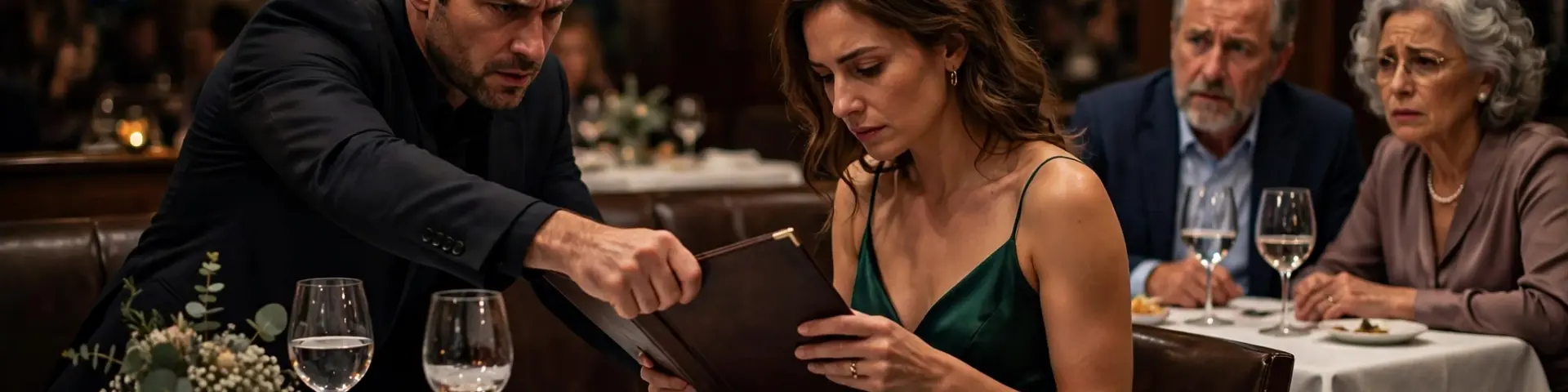
Paul opened his banking app again and started scrolling through old purchases, holding the phone up like a prosecutor presenting exhibits.
“Look at this,” he said. “Sixty dollars on groceries.”
The woman at the next table frowned. “You mean groceries for your household?”
Paul turned toward her, unbothered. “With my money.”
I looked at him. “That was back when we still had shared accounts.”
He kept scrolling. “Gas. Medication. More groceries.” Things I had once considered the most ordinary parts of running a home together were now being read aloud like charges on an indictment.
The waiter tried one more time, gently. “Sir, perhaps I could bring her a small salad?”
Paul gave him an irritated look. “I’ve explained this.”
Then he looked back at me, and his voice took on the tone of a man delivering wisdom.
“Maybe this will motivate you.”
That sentence landed harder than anything else that night. Not because I believed him, but because I understood, with sudden and terrible clarity, that he meant it. He genuinely believed that humiliating me in public was a reasonable management strategy for our marriage.
I had worked through most of our marriage. I had contributed to our home. I had paid bills and built a life and never once kept a ledger of who owed whom, because that isn’t what partners do.
The woman beside us was openly watching now. Paul noticed, and instead of lowering his voice, he grew louder.
“I’m teaching financial responsibility,” he announced to the room.
Her husband lowered his fork and looked at him. “You’re doing this at your anniversary dinner?”
Paul smiled. “She needs to understand consequences.”
I wanted to disappear into my chair. The waiter stepped away, probably to find his manager. Paul kept talking, kept performing, kept explaining to anyone who would listen why his wife didn’t deserve to eat.
I stared at my hands in my lap. For months the rules around money had been changing one piece at a time, and I had adjusted to each new rule like a frog in slowly heating water. First the separated accounts. Then the itemized questions about every purchase. Then the “suggestions” about what I was allowed to buy. Then the passwords he changed without telling me.
I told myself I could sit there until Paul finished his steak. I could eat something at home. I could survive this evening the way I had survived the last six months: quietly.
Then I heard the scrape of a chair from the table beside us.
I looked up.
The woman had stood. She was in her sixties, silver-haired, wearing a simple blue dress and the kind of calm expression that comes from having seen enough of life to know exactly when to act. Her husband stood beside her, a tall man with kind eyes and his napkin still in his hand.
She walked around their table, took hold of the empty chair at their table, and pulled it out.
Paul stopped talking mid-sentence.
The waiter, halfway across the dining room, looked back over his shoulder.
The woman’s voice was calm and clear. “Would you like to join us? There’s plenty of room, and I won’t take no for an answer.”
Paul found his voice. “She’s fine where she is.”
The woman didn’t look at him. She kept her eyes on me. “The offer stands. No one should sit through that. Not on any night, and especially not tonight.”
Her husband nodded. “Please. We insist.”
Something loosened in my chest, something that had been knotted tight for months. I stood up. My legs were shaking so badly I was sure everyone could see it.
Paul’s face went through several expressions at once. “Sit down. You’re embarrassing yourself.”
I looked at him, really looked at him, and for the first time that evening, I wasn’t afraid of his reaction. I was just done.
“No,” I said. “I’m not.”
I walked to their table. The woman pulled the chair out a little further and smiled at me, a real smile, warm and steady.
“I’m Natasha,” she said. “This is my husband, Matt.”
“Order whatever you’d like,” Natasha said. “And I mean whatever.”
I ordered the ribeye. Medium rare. With the loaded baked potato. The exact meal Paul had ordered for himself, and I didn’t feel a flicker of guilt.
Paul sat alone at our anniversary table for a while, staring at his phone, his hundred-dollar steak going cold in front of him. Then the manager arrived, a composed man in a dark suit, and spoke to Paul quietly. Two security guards appeared near the entrance, not approaching, just present.
Paul stood up so fast his chair scraped loudly against the floor. He threw his napkin down.
“This is ridiculous,” he said. “She’s my wife.”
The manager’s voice was low and professional. “Sir, I’m going to have to ask you to leave.”
Paul looked at me across the room. “Fine. She’s walking home. Gas costs money.”
Then he walked out.
The dining room exhaled.