Natasha reached across the table and put her hand over mine. Her hand was warm and dry and steady.
“Are you all right?” she asked.
I laughed, a sound that came out half-sob. “I don’t know. I think so. I think I might be.”
Matt signaled the waiter. “We’ll take care of her check,” he said quietly. “All of it.”
“You don’t have to do that,” I said.
“We want to,” Natasha said firmly.
They didn’t pry. They didn’t ask for the whole story or offer loud opinions about my marriage. They just made space for me at their table and treated me like a person who mattered. When my steak arrived, Natasha insisted I take the first bite while it was hot. When the bread basket came, she put it directly in front of me.
“Eat,” she said gently. “You’ve earned it.”
Over the course of the meal, the story came out in pieces. The layoff. The separated accounts. The way Paul had started calling my unemployment “quitting,” as if I had chosen it. The passwords. The itemized interrogations. The slow, grinding erosion of my sense of self.
Natasha listened without interrupting. When I finished, she was quiet for a long moment.
“What he’s doing has a name,” she said finally. “It’s called financial abuse. And it’s not about money. It’s about control.”
I stared at her. “Financial abuse?”
“Yes,” she said. “Using money to trap you, to shrink your world until you can’t leave. The separate accounts. The public humiliation. Making you ask permission to exist. That’s not budgeting. That’s abuse.”
Matt nodded. “We volunteer with an organization that helps women in exactly this situation. We’ve seen it before. You’re not the first, and you’re not alone.”
Something cracked open inside me. For months I had told myself that this was just a rough patch, that Paul was stressed, that I needed to try harder. Hearing it named, plainly and without drama, felt like someone had finally turned on a light in a room I’d been stumbling around in for half a year.
Before we left the restaurant, Natasha pressed a business card into my hand. Her name, a phone number, and the name of the organization.
“Call me,” she said. “Any time. Day or night. I mean that.”
Matt wrote his cell number on the back of a receipt. “If you ever need someone to just show up, call me.”
I drove home that night with the card burning a hole in my purse.
Paul’s car wasn’t in the driveway when I got home. The house was dark and silent. I stood in the entryway for a long moment, just breathing, letting the quiet settle around me.
Then I did something I hadn’t done in months: I acted without asking permission.
I went to the filing cabinet and pulled out every important document I could find. Birth certificate. Social Security card. Our marriage certificate. I made copies and put the originals in a folder, and I hid the folder in the trunk of my car under the spare tire.
In the pocket of my winter coat, I found a forty-dollar bill I had forgotten about. I stared at it for a long time. Forty dollars. My own money, money Paul didn’t know about. I almost put it in my wallet. Then I thought about the separate accounts, the interrogations, the way he monitored everything, and I put it back. It wasn’t safe yet. But knowing it was there felt like a tiny ember of something I hadn’t felt in a long time: possibility.
Paul came home at 12:30. I heard his key in the lock, heard him drop his shoes by the door.
He found me in the kitchen, sitting at the table with a glass of water.
“What did you make for dinner?” he asked, as if the evening had been normal.
“I wasn’t home,” I said.
“You made a scene,” he said, opening the refrigerator. “At our anniversary dinner. Do you have any idea how that looked?”
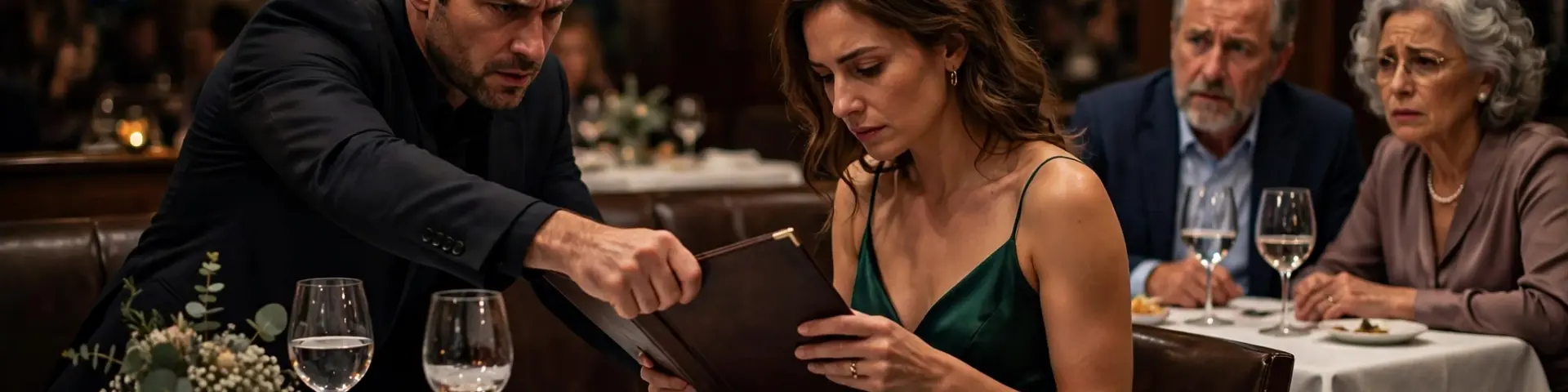
“You told the waiter I wasn’t eating,” I said. “You took my menu away. Paul, people were staring.”
“You’re being dramatic,” he said, pulling out a slice of cold pizza and eating it standing up. “I was trying to help you. Maybe now you’ll actually get serious about finding work instead of sitting around the house.”
I looked at this man I had married ten years ago, this man who had once held my hand through my father’s funeral and danced with me in our kitchen to no music at all, and I didn’t recognize him.
Or maybe I was finally seeing him clearly for the first time.
“I’m going to bed,” I said.
“Good,” he said. “Sleep it off. You’ll feel differently in the morning.”
I didn’t. I felt exactly the same in the morning. Clearer, if anything.