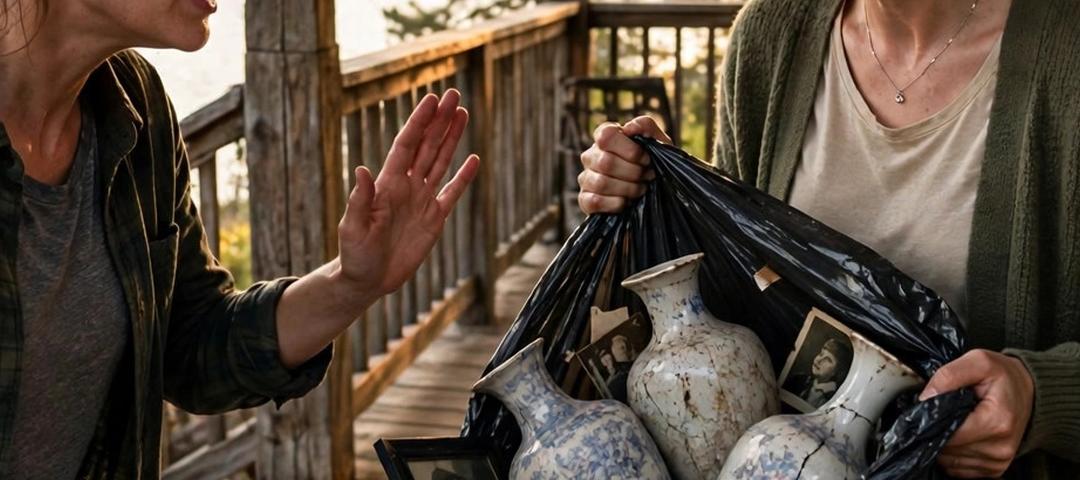
My sister-in-law was throwing away my family heirlooms when I arrived at my lake house after a two-hour drive.
The contractor handed me a document bearing my signature and told me my parents had the authority to tear apart my house.
“This is what we were given,” he said. “We have a signed contract.”
I stared at the page, then looked past him into the kitchen. The cabinets I had spent months restoring were gone. Pieces of the countertop lay scattered beneath a thick coating of dust. In the next room, my family photographs, personal journals, and treasured keepsakes had been shoved into black garbage bags as though they were nothing more than unwanted trash.
Then I noticed the impression of my notary seal.
I recognized it immediately. I also knew, with absolute certainty, that I had never signed the power of attorney bearing that seal.
My parents had just walked out, furious because I had ordered them to leave my property. Until the contractor placed that document in my hands, I had believed they had simply decided to give my lake house to my brother because they valued his needs more than mine.
I had been wrong.
Now I was holding something that threatened to cost me far more than the house itself. Someone had used my professional identity to make an illegal decision appear legitimate, and the consequences could reach into every part of my life.
My name is Bella. I am a licensed real estate broker in Texas, and I had driven to the lake after completing six exhausting months of work on one of the biggest commercial deals of my career.
By the time the transaction finally closed, I felt as though I had spent half a year carrying the weight of everyone else’s expectations. Every day brought another call, another document, another decision that demanded my full attention. I was proud of what I had accomplished, but I was also exhausted in a way that sleep alone couldn’t fix.
All I wanted was a quiet weekend.
I wanted to drop my bag by the door, sit outside with a cup of coffee, and watch the water without checking my phone every few minutes. I wanted a place where nobody needed me to solve a problem, approve a contract, or explain why something couldn’t be done.
My lake house had always been that place.
I had purchased it with savings I earned myself. My parents had contributed money toward the down payment as a birthday gift, and I had always acknowledged their generosity. I was grateful for what they had given me.
But the mortgage payments came from my income. So did the property taxes, repairs, maintenance, and restoration expenses. Every improvement had been paid for through my own work, one project at a time.
I had rebuilt the house according to what I could afford. I restored the kitchen cabinets, repaired worn surfaces, and chose each detail carefully. I didn’t have the money to transform every room at once, so I worked steadily, completing one section before moving on to the next.
The house became more than an investment. It became proof that I could build something lasting through my own effort.
I filled it with family photographs because, despite the difficulties between us, I still cared about my history. I kept journals and keepsakes there because I wanted a place where the things that mattered to me would remain safe.
I never imagined that my own family would treat those belongings as disposable.
My brother, Jacob, had always occupied a different position in our family. His needs were discussed as though they were urgent responsibilities everyone shared. If he wanted something, my parents immediately considered how to make it happen.
If I objected to what his needs required from me, the conversation changed. Suddenly, I was selfish. I was ungrateful. I wasn’t thinking about family.
Over the years, I had learned to recognize the pattern, even when I still found myself hoping that things might be different the next time.
What I hadn’t expected was to find that pattern waiting in my own front yard in the form of a commercial moving truck.
The truck’s heavy wheels had crushed the flower beds I had planted just a few months earlier. A construction dumpster stood near the driveway, already filling with debris. Before I even reached the front steps, I could hear power tools running inside.
I stopped for a moment, trying to make sense of what I was seeing.
Perhaps someone had mistaken the address. Perhaps the crew had been hired for a nearby property and unloaded at the wrong house. I searched for any explanation that would allow me to believe my home was still untouched.
Then I saw the front door standing open.
I walked inside.
Sections of wall had been exposed. Dust coated the floor and furniture. Where my kitchen cabinets had been, there were broken edges, loose wires, and construction debris. The furniture I had carefully arranged had been pushed aside to make room for the workers.
My belongings were being sorted into piles, and black bags filled with things I had spent years collecting stood among materials destined for the dumpster.
I felt something tighten in my chest.
Then I saw Victoria, Jacob’s wife, standing in the middle of the destruction.
“Bella. We weren’t expecting you this weekend.”
She said it with a pleasant smile, as if I had arrived at an inconvenient moment during preparations for a family celebration.
I stared at her, waiting for an explanation that would somehow make the scene less unbelievable.
“What are you doing?”
Before Victoria could answer, my parents came through the doorway carrying boxes marked with Jacob’s belongings. My mother set her box down and looked around the room with an expression of satisfaction.
“It will be beautiful when they’re finished,” she said.
I glanced at the missing cabinets, the broken countertop, and the dust covering the floor.
“When who’s finished?”
“The renovations.”
For a moment, I genuinely thought I had misunderstood her.
“I didn’t order renovations.”
My mother sighed as though I were making an unnecessarily complicated situation out of something simple. She began explaining that Jacob’s marketing company needed more space. He and Victoria would be living in the lake house, and he would use it as his office.
Since I only visited occasionally, she explained, allowing Jacob to use the property permanently made more sense than leaving it empty.
She spoke with the confidence of someone describing an arrangement that had already been approved.
I looked at her and then at my father.
“Who decided that?”