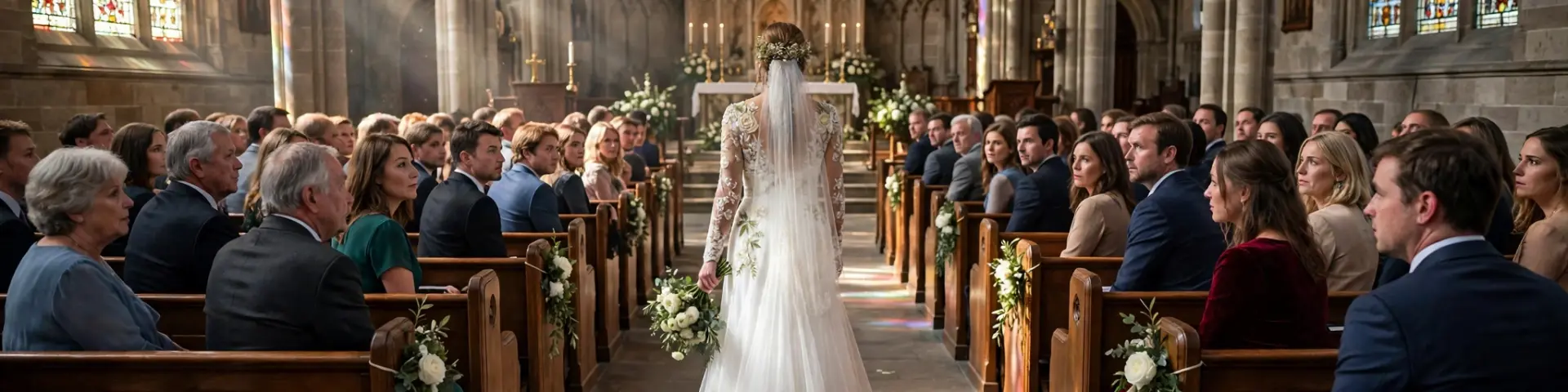
She drew a narrow row of covered buttons down the back, each one precise and perfect.
I wanted the skirt to move cleanly rather than overwhelm me — no massive ballgown, no layers of tulle that would swallow me whole. Just clean lines and beautiful fabric.
“Something that looks like you,” she said, studying our sketch. “Not like a costume you rented for the day.”
We created the first complete sketch together, our two visions merging on the tracing paper. It was beautiful. It was exactly right.
Grandma died six weeks later. She had gone to sleep after watching an old movie and did not wake the next morning. There was no long hospital stay, no final conversation, no chance for me to ask whether she knew how much that afternoon at the kitchen table would come to mean — how that rainy Sunday would become one of the most precious memories of my life.
There was no warning, no goodbye. Just an empty chair at the breakfast table and a silence in the house that felt wrong.
After the memorial, I placed our sketch inside a cream folder and did not open it for three months. I couldn’t bear to look at it — the blue pencil notes in her handwriting, the careful lines we had drawn together. It hurt too much.
When I finally did, Alexander sat beside me, his presence steady and warm.
“You should make it,” he said quietly, looking at the sketch.
“I don’t know if I can,” I whispered. “It feels too… I don’t know. Too final. Like if I make it without her, I’m admitting she’s really gone.”
“You already made the important part with her,” he said. “The dress is just the rest of the work. She’d want you to finish it.”
That was how I found Margaret Ellison.
Mrs. Ellison owned a bridal atelier in SouthPark, a bright, beautiful space where dresses were designed and constructed in a studio above the showroom. Large windows overlooked a courtyard filled with crepe myrtles, and the whole place smelled faintly of lavender and fresh fabric.
She examined Grandma’s sketch without speaking, her eyes moving carefully over every line, every notation. Then she turned the page over, studying the back as though it might contain additional secrets.
“Who drew the notes in blue pencil?” she asked.
“My grandmother.”
“She understood garment structure.” It wasn’t a question.
“She made half her own clothes.”
Mrs. Ellison touched one corner of the paper with something like reverence.
“We can honor this,” she said. “We can make this real.”
The gown took almost a year. I approved fabric swatches, adjusted the neckline by fractions of an inch, and changed the embroidery pattern twice before we got it exactly right. Mrs. Ellison found an artisan who could recreate a small rose motif based on flowers from Grandma’s garden — tiny, perfect roses that would climb up the sleeves like a memory made visible.
The final design was not flashy. It did not sparkle beneath every light or demand attention from across the room. But the silk held a quiet glow, luminous and warm, and the embroidered sleeves seemed to disappear against the skin until the roses caught the light and suddenly bloomed into visibility.
The covered buttons ran from the back of the neck to the waist, each one hand-sewn, each one perfect.
Inside the hem, Mrs. Ellison embroidered Grandma’s initials in pale blue thread. R.M. Rose Monroe. Hidden where only I would know to look, a secret between me and the woman who had helped me dream the dress into existence.
When I tried on the completed gown, I could not speak. The showroom mirrors reflected me from three angles. The skirt fell exactly as I had imagined all those months ago at Grandma’s kitchen table. The sleeves carried Grandma’s roses along my arms like a blessing.
Mrs. Ellison stood behind me and adjusted one shoulder, her hands gentle.
“It was made for you,” she said.
I looked at the initials hidden near the hem, visible only when I lifted the fabric.
“No,” I whispered, tears blurring my vision. “It was made with her.”
Mrs. Ellison understood. She didn’t try to fill the silence with empty comfort. She just stood there with me, honoring the moment.
The gown remained at the atelier for final steaming and insured storage while alterations were completed. I paid the last installment and signed the ownership certificate. The design was registered under my name because several elements were original to the commission — the specific embroidery pattern, the construction details, the overall design.
I did not think of the documents as important. They were paperwork, administrative details, the boring business side of something deeply personal.
The dress was personal. The certificate seemed administrative. That distinction — between what felt meaningful and what was legally significant — would later protect me in ways I couldn’t have imagined.
A week after my final fitting, Chloe came to my apartment carrying iced coffee and a bag of pastries from my favorite bakery. She was unusually affectionate, unusually attentive, hovering around me with a brightness that felt slightly forced.
“I feel like we haven’t spent time together,” she said, setting the coffee on my kitchen island.
“We had lunch last Sunday.”
“With Mom and Dad. That doesn’t count.” She looked around my apartment, her eyes scanning the space. “Where’s the dress?”
“At the boutique.”
“I thought you picked it up.”
“Not until closer to the wedding. Mrs. Ellison is storing it.” I watched her face carefully. “Why?”
Chloe’s mouth tightened for half a second — so brief I almost missed it. Then she smiled, wide and bright.
“I’m dying to see it.”
“I showed you the sketches.”
“Sketches are not the same.” She leaned across the island, her eyes intense. “There are photographs from the fitting.”
“I want to see it in person.” Her voice dropped, became softer, more vulnerable. “Please, Victoria. I’m your sister. I won’t touch it. I just want to understand what Grandma helped you make.”
The mention of Grandma weakened me. Chloe knew it would. She knew exactly which buttons to push, which memories to invoke, which vulnerabilities to exploit. It was a skill she had honed over years of practice.
Two days later, against my better judgment, I arranged for her to accompany me to the atelier. I told myself it would be fine — that I was being paranoid, that she was my sister and she just wanted to share in my happiness.
Mrs. Ellison had the gown displayed on a padded form near the center mirror. Afternoon sunlight entered through the tall windows and softened every surface, making the silk glow like something lit from within.
Chloe stopped in the doorway. For once, she had no immediate comment, no quick quip, no performative enthusiasm. She just stared.
She walked slowly around the gown, her eyes moving over the neckline, sleeves, covered buttons, and full skirt with an intensity that made me uneasy. She crouched to examine the embroidered initials inside the hem.
“R.M.,” she said quietly.
“Rose Monroe.”
“I know.” She stood and looked at the dress in the mirror, her reflection overlapping with the gown. “This should have been mine.”
I laughed because the alternative was acknowledging the strange seriousness in her voice, the flat certainty of the statement.
“You’re not even engaged.”
“I will be.”
“You’ve been dating Ethan for eight months.”
“That is long enough to know.” She reached toward one sleeve, her fingers extended toward the delicate embroidery.
I caught her wrist gently before her fingers touched the fabric. “Please don’t.”
Her eyes met mine in the mirror, and for a moment I saw something raw and unguarded there — not the charming Chloe, not the performative Chloe, but someone hungrier and more desperate.
“I wasn’t going to damage it.”
“I didn’t say you were.”
“You acted like it.”
Mrs. Ellison entered with a garment cover, and the tension disappeared beneath Chloe’s smile like it had never existed. “It’s incredible,” she told Mrs. Ellison. “Victoria always gets the meaningful things.”
Mrs. Ellison looked at me, then back at Chloe, her expression carefully neutral. “This gown exists because Victoria and her grandmother spent time building the idea together.”
“I know,” Chloe said. “I’m happy for her.” But she continued watching the dress as Mrs. Ellison covered it, her eyes tracking every fold of fabric until it disappeared from view.
The following morning, Chloe sent me a photograph from a bridal magazine. A model wore a gown with a similar neckline.
Would something like this work on me?
I replied: Probably. Are you planning something?
Her answer came ten minutes later. Just one word: Maybe.
One month later, Chloe announced her engagement. Ethan Cole proposed during a weekend trip to Charleston. He worked in commercial insurance, came from a kind family, and had always treated me politely. He was steady where Chloe was impulsive, grounded where she was flighty, which made my parents believe they balanced each other perfectly.
At Sunday dinner, Chloe held out her ring before she had even removed her coat, the diamond catching the light as she waved her hand dramatically.
My mother cried. My father opened a bottle of champagne. Alexander hugged Ethan warmly. I hugged Chloe and meant it — despite everything, despite the unease I felt, she was my sister and I wanted her to be happy.
Then she announced the date. Two weeks before mine.
The room became quiet for a moment, the celebration freezing mid-motion.
My mother recovered first, her social instincts kicking in. “How exciting,” she said brightly. “Two weddings in one month.”
Alexander looked at me, his eyes asking the question he wouldn’t voice aloud.
I kept my expression neutral. “Why so soon?” I asked.
Chloe lifted one shoulder in a careless shrug. “The church had a cancellation.”
“What church?”
“St. Matthew’s.”
It was the same church where Grandma’s memorial had been held. The same church where Alexander and I had planned to marry. Not on the same day, but close enough that every family conversation, vendor appointment, and celebration would overlap, would compete, would become a comparison.
My father looked uncomfortable. “Would waiting until fall be easier?”
“We don’t want to wait.”
Ethan squeezed Chloe’s hand. “We know it’s fast, but the date became available.” He smiled apologetically, clearly unaware of the undercurrents swirling around the table.
Chloe watched me, her eyes challenging. “It’s not a competition.”
“No one said it was.”
“You looked like you wanted to.”
I smiled carefully, keeping my voice even. “Congratulations.”
The weeks that followed became a blur of shared relatives, overlapping appointments, and constant comparison. Every decision Chloe made seemed calibrated to mirror mine.
Chloe chose white roses after hearing they were part of my plan. She booked a string quartet after my mother mentioned Alexander and I had hired one. She selected a reception venue with tall arched windows similar to ours.
Whenever I raised an eyebrow, my mother told me bridal trends were popular because many people liked them.
“You don’t own white flowers,” she said, as though I were being petty.
“I didn’t say I did.”
“Then stop looking hurt.”
That was our family’s familiar pattern, the dynamic we had been rehearsing since childhood: Chloe copied. I noticed. My noticing became the problem. I was always the one who was “too sensitive,” “too competitive,” “reading too much into things.” Chloe was always just innocently making her own choices that happened to look exactly like mine.
Three weeks before Chloe’s wedding, Mrs. Ellison called to confirm my pickup appointment.
“I thought we agreed on the Thursday before my ceremony,” I said.
“We did. I’m confirming because someone called asking to move it earlier.”
My stomach tightened. “Who?”
“She identified herself as your assistant.”
“I don’t have an assistant.”
Mrs. Ellison became quiet, and I could hear the concern in her silence. “What did she ask?”
“Whether the gown could be picked up next Wednesday.”
“Did you change anything?”
“No. I told her I needed your written confirmation.”
“Did she give a name?”
“Madison.”
I knew no Madison. The name meant nothing to me, but the implications were starting to crystallize into something cold and hard in my chest.
Mrs. Ellison promised to flag the file, to watch for any further attempts. I should have treated the call as a warning — a blaring alarm telling me that something was very wrong.
Instead, I assumed Chloe had asked one of my bridesmaids for information or that a vendor had become confused. I minimized it, explained it away, told myself I was being paranoid. At the time, I was managing three design projects, reviewing final wedding details, and trying to keep my mother from combining our bridal showers “for convenience.” I had too much on my plate to properly investigate a strange phone call.
I told myself the gown was safe at the atelier. Mrs. Ellison was professional. The dress was insured. Everything would be fine.