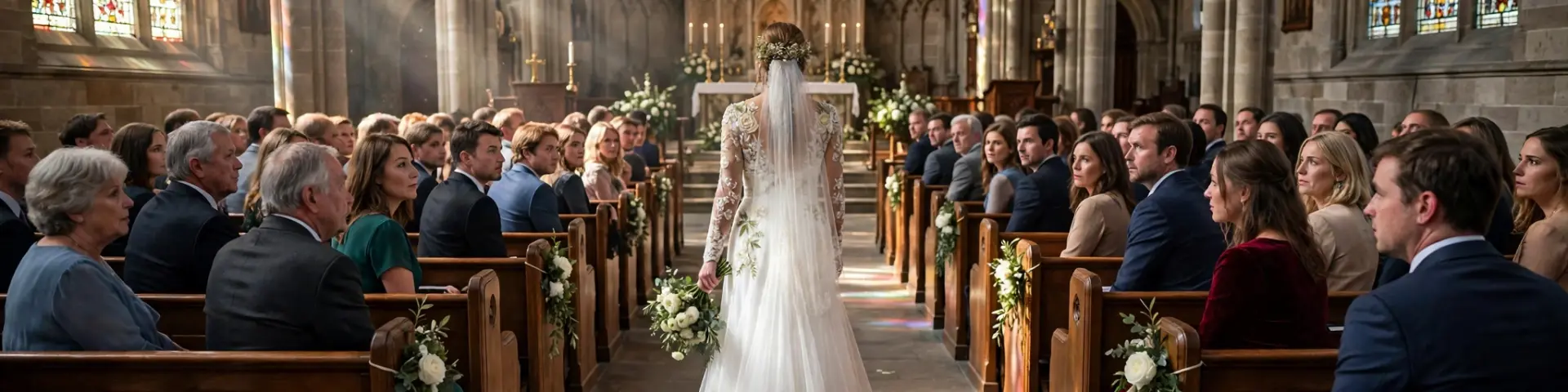
Mrs. Ellison held the gown beneath the studio lights, examining every inch. “We can restore it.”
“Will it still feel like mine?” I asked.
She looked at me directly. “That is not a tailoring question.”
“No.” She touched Grandma’s initials inside the hem. “The dress did not choose what happened while someone else wore it.”
I looked at the gown, at the silk that had been through so much. For days, I had imagined I would never want to see it again — the church, Chloe’s whisper, and the silent guests had become tangled with the fabric in my mind. Then I noticed the small blue R.M. inside the hem. Grandma’s initials remained exactly where they had always been, untouched, unchanged.
“She taught me to examine the stitching,” I said.
Mrs. Ellison smiled faintly. “Then examine it.”
The structure remained sound. The meaning had not disappeared. It had been tested — and it had held.
Alexander and I postponed our wedding by one month. Not because of scandal or family pressure, but because I needed time to separate my marriage from the conflict, to make sure that when I walked down the aisle, I was thinking about love and not about everything that had happened.
We changed the ceremony location. Instead of St. Matthew’s, with all its painful associations, we married in the garden of the historic house where Alexander and I first worked together — the house with the magnolia we had both refused to sacrifice.
The magnolia had bloomed early, white flowers heavy on the branches.
Mrs. Ellison repaired the gown and added one detail with my permission: a narrow blue ribbon sewn inside the waist, cut from the fabric case that had protected Grandma’s original sketch. A hidden tribute, a secret layer of meaning.
On the morning of the wedding, my mother arrived quietly. She did not offer instructions. She did not ask me to contact Chloe. She simply helped fasten the covered buttons, her fingers steady, and stopped when she reached the last one.
“I failed both of you,” she said quietly.
I looked at her in the mirror. “How?”
“I taught Chloe that you would always absorb the consequence because you were stronger. I taught you that strength meant accepting it.” The truth of the sentence settled between us, heavy and undeniable.
“I don’t know how to fix that,” she continued.
“You stop asking me to make things easier for her.”
“And Chloe?”
“She decides what she does next.”
My father walked me through the garden, his arm steady beneath my hand. Before we reached the aisle, he stopped.
“Your grandmother would recognize this dress.”
I touched the embroidered sleeve. “I hope so.”
“She would also recognize you.”
Alexander waited beneath the magnolia. There were no chandeliers, no crowded church, no audience waiting for a family drama. Only people we had invited because they understood the difference between witnessing a marriage and watching a performance.
When Alexander saw me, his expression softened in the same way it had years earlier when we argued about the tree.
“You kept the magnolia,” I whispered when I reached him.
“You kept the dress.”
We smiled, and in that smile was everything — the years of work, the fights, the compromises, the love that had been tested and had held.
The ceremony was simple. Our vows were not perfect. Alexander lost his place once. I laughed before I meant to. A breeze lifted my veil and wrapped it briefly around my father’s shoulder. Nothing was staged enough to impress everyone. Everything was honest enough to matter.
Chloe did not attend. She sent a letter the week before. It was handwritten, six pages long, and contained no request for immediate forgiveness — just honesty, raw and unflinching.
She admitted she had scheduled her wedding before mine deliberately. She admitted copying the license from a family file at our parents’ house. She admitted she had studied the atelier’s process during my fitting, learning exactly how to remove the dress.
She wrote that the dress had become, in her mind, proof that Grandma had loved me more. Then she wrote something I had not expected, something that made me put the letter down and stare out the window for a long time:
“I know now that I did not want your dress. I wanted your certainty. I wanted to walk into a room believing I deserved to be there without needing everyone to stop looking at you first.”
I read that line several times, letting it sink in.
Chloe had begun counseling. Ethan had ended the engagement, though he agreed to speak with her after several months if she continued taking responsibility without turning recovery into another performance. My parents stopped paying her bills after learning how much debt she had hidden while planning the wedding. For the first time in her life, Chloe faced a reality she could not charm into rearranging itself.
I did not respond to her letter before my wedding. Forgiveness did not require immediate access, and I needed the space to have my own day without the weight of hers.
Two months later, I asked her to meet me at a quiet coffee shop. She arrived early. I almost did not recognize her at first — her hair was tied back simply, she wore no dramatic makeup, no designer jacket, and no expression prepared for an audience. She looked, for the first time in years, like herself.
She stood when I approached. “Thank you for coming.”
I sat across from her. “You wrote that you wanted my certainty.”
“I did.”
“I was never certain.” She looked surprised. “You always seemed certain.”
“I worked constantly because I was afraid that if I stopped being useful, people would stop needing me.”
Chloe stared at the table, absorbing this. “I thought everyone respected you.”
“They did. That isn’t the same as feeling loved.”
For the first time in our lives, we spoke about our childhood without arguing over whose version was correct. Chloe remembered being compared to me, always coming up short. I remembered being held responsible for her, always having to be the strong one. She felt like the family disappointment. I felt like the family employee. Our parents’ favoritism had not been as simple as one loved child and one ignored child — they had admired my reliability and indulged Chloe’s charm, then allowed both of us to become trapped inside those roles, unable to be anything else.
Understanding the pattern did not erase her decision. But it gave the decision a history, a context, a humanity that made it possible to move forward.
“I am sorry,” she said. “Not only about the dress.”
“What else?”
“For needing you to become smaller so I could feel visible.”
I looked through the window at cars moving along the street, ordinary life continuing outside. “I’m not ready to trust you.”
“I know.”
“I don’t want updates through Mom.”
“I told her not to carry messages.”
“I won’t protect you from what people think.”
“I’m trying to stop protecting myself from it.”
That answer mattered. It was the first truly adult thing I had ever heard her say.
We left without hugging. It wasn’t time for that yet. But it was a beginning.
Three months later, Chloe sent me a photograph of Grandma’s original sketch. She had found a second page inside an old sewing book at our parents’ house. It showed another gown — different from mine, softer, with movement. The notes were in Grandma’s blue pencil: “For Chloe someday — soft neckline, movement, nothing too heavy. She should be able to dance.”
My throat tightened as I read it. Grandma had thought of her too. She had simply died before the design became a conversation, before she had the chance to share it.
I called Chloe immediately. She answered on the first ring.
“Where did you find this?”
“In Grandma’s copy of The Complete Guide to Sewing. Mom was clearing a shelf.”
Neither of us spoke for a moment, the significance settling over us.
“She did imagine something for you,” I said quietly.
Chloe began crying quietly. “I spent years believing she didn’t.”
“I wish she had shown you.”
“So do I.”
“What will you do with the sketch?”
“I don’t know.”
“Keep it.”
“I don’t deserve it.”
“That isn’t how love works.”
The words surprised me as they left my mouth. Perhaps Grandma had been teaching both of us through the things she left unfinished — lessons we were only now ready to learn.
A year later, Chloe was not engaged. She worked steadily at a nonprofit arts organization and lived in a smaller apartment she paid for herself — no parental subsidies, no rescue missions. She and Ethan did not reconcile romantically, but he eventually accepted her apology, and they parted with something like respect.
Our relationship remained cautious, careful, but it was real in a way it had never been before.
Then one autumn afternoon, Chloe asked whether I would visit Mrs. Ellison’s atelier with her.
“Why?”
“I want to preserve Grandma’s second design. Not make it yet. Just document it properly.”
At the atelier, Mrs. Ellison examined the sketch with the same care she had given mine years before. “She understood both of you,” she said.
Chloe looked at me. “I thought she only understood Victoria.”
Mrs. Ellison shook her head. “Victoria’s design was structured. Yours moves.”
Chloe touched one corner of the paper gently. “That sounds like her.”
“It sounds like you,” I said.
She smiled. Not the bright smile she once used to control a room, to charm and manipulate and perform. A smaller one. A real one.
Mrs. Ellison created a formal design record under Chloe’s name and placed the original sketch in an archival sleeve. There was no dress yet. No ceremony. No audience. Only ownership of something that had always been intended for her — a gift from a grandmother who had seen her clearly, even if she hadn’t lived long enough to tell her so.
As we left, Chloe stopped beside the gown display where mine had once stood.
“I used to think beauty was being remembered,” she said quietly.
“What do you think now?”
“That being remembered for the wrong thing is its own kind of loneliness.”
Outside, the late-afternoon light reflected against the boutique windows. I thought about the church aisle, the sealed envelope, Ethan walking away, and the dress returning to the studio. I thought about everything that had happened, everything we had lost and found.
For a long time, I believed Chloe had taken the most important object I owned. She had not.
The gown was valuable because Grandma and I created it together, but its meaning never lived entirely in the silk. It lived in the patience of the sketch. The careful stitching. The initials inside the hem. The woman who taught me to turn beautiful things over and inspect how they were made.
Chloe wore my dress, but she could not wear the history that made it mine. She could not take the afternoon at Grandma’s kitchen table. She could not take Alexander waiting beneath the magnolia. She could not take the life I built through choices no one applauded.
And I could not take from Chloe the painful work of becoming someone who no longer needed what belonged to another person.
The most satisfying part of the story was not that her wedding stopped. It was not the silent church, the security photographs, or the moment her confidence disappeared.
It was the year afterward. The smaller apartment. The steady job. The apology that did not demand an answer. The sketch she chose to preserve rather than turn immediately into another performance.
Consequences did what our family’s endless forgiveness never had. They introduced Chloe to herself.
My wedding dress now rests in a preservation box inside my closet. Mrs. Ellison included the original ownership certificate, Grandma’s sketch, and a photograph from our garden ceremony. In the picture, Alexander and I stand beneath the magnolia while sunlight filters through the leaves. My veil is slightly crooked. His boutonniere leans to one side. My father is laughing in the background.
Nothing is perfect. Everything is ours.
Sometimes I open the box and look at the blue initials inside the hem. R.M. Grandma once said beautiful work should remain honest when turned inside out. I understand now that she was not only talking about clothing.
A marriage must survive inspection. A family must survive truth. A person’s character must remain recognizable when the audience leaves.
My sister believed wearing my dress would make people remember her. She was right. They remembered the choice.
But over time, if she continues doing the quiet work no one applauds, they may also remember what she built after it. That part belongs to her.
And this life — the one Alexander and I created, the one in which my no finally meant no — belongs to me.
If you came here from Facebook because of this story, return to the Facebook post, tap Like, and comment exactly “Amazing” to support the storyteller. That small action means more than it seems and gives the writer genuine encouragement to keep sharing more stories about family pressure, firm boundaries, and finally protecting what you worked so hard to build.
Disclaimer: This story is a work of fiction created for entertainment purposes. Any resemblance to real persons, events, or places is coincidental.