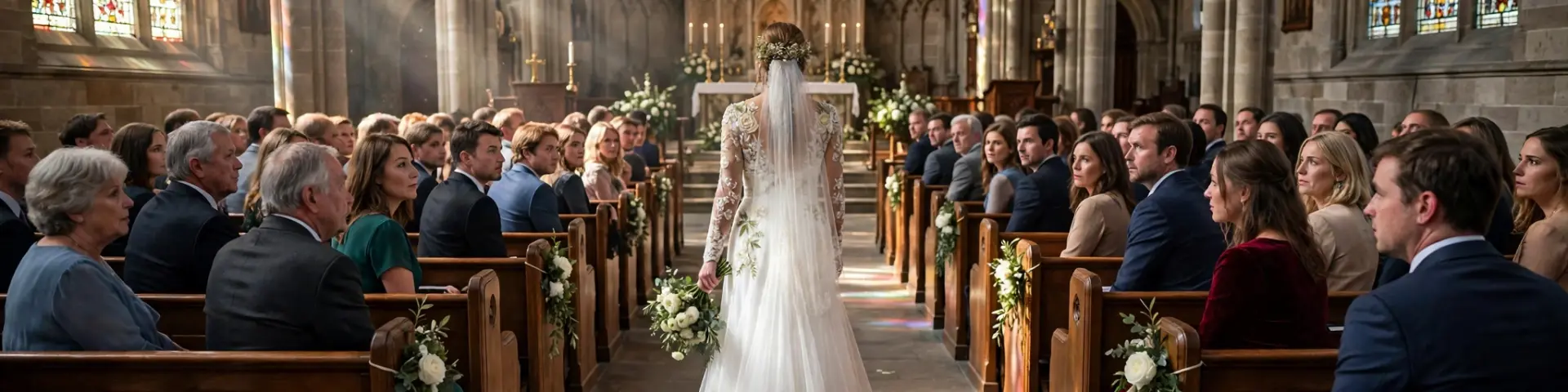
Then, three days before Chloe’s wedding, Mrs. Ellison called again. Her voice sounded different — strained, urgent, afraid.
“Victoria, can you come here?”
“What happened?”
“I would rather explain in person.”
I left a client meeting early and drove across town, my hands shaking on the steering wheel. Mrs. Ellison waited behind the locked showroom door. Her assistant lowered the blinds after I entered, the gesture feeling ominous, secretive.
The gown was gone.
The padded form stood empty near the center mirror, a ghostly absence where my dress should have been. The garment cover lay folded on a chair, neatly, deliberately.
For several seconds, I could not process the space where the dress had been. My mind refused to accept what my eyes were seeing.
“When?” I asked, my voice barely audible.
“Yesterday morning.”
“You released it?”
“One of my newer employees did.” Mrs. Ellison’s face was pale. “To whom?”
She turned a computer monitor toward me. A digital pickup form displayed my order number, my measurements, my final payment receipt, and a scanned copy of my driver’s license.
At the bottom, someone had signed the name Madison Blake, Personal Assistant to Victoria Monroe.
I stared at the license image. It was a copy from the folder I kept at home — the folder with all my important documents, the one I thought was private and secure.
Only three people knew where that folder was. Alexander. My mother. Chloe.
“Do you have cameras?” I asked, though I already knew the answer would change everything.
“Yes.”
Mrs. Ellison opened the recording. The footage showed the showroom at 9:14 the previous morning.
Chloe entered wearing sunglasses and a beige trench coat, looking like a spy in a bad movie. She smiled at the receptionist, presented the copied license with complete confidence, signed the form with a flourish, and waited while an employee brought out the garment bag.
She carried my wedding dress through the front door.
There was no hesitation. No confusion. No moment when she appeared to believe she had permission. She knew exactly what she was doing, and she did it with the calm assurance of someone who had planned every detail.
Mrs. Ellison stopped the video. “I am so sorry.”
I could hear the ventilation system above us. A delivery truck moved through the alley outside. Every ordinary sound seemed strangely clear, amplified by the surreal horror of what I had just witnessed.
“She knew the order number,” Mrs. Ellison continued. “She knew the final fitting date, the storage fee, and the name of the employee who assisted you last time.”
“She was here,” I said dully.
“She must have watched the staff while you were changing.” I remembered Chloe wandering through the showroom during our visit. Talking to the receptionist. Asking where completed gowns were stored. Laughing with a new employee about how organized the boutique seemed.
She had not been admiring the dress. She had been learning how to remove it. Every question, every smile, every casual conversation had been reconnaissance.
Mrs. Ellison reached for the phone. “I can contact the appropriate property office and our attorney immediately.”
“Wait.” She looked at me, surprised. I needed to think. A formal complaint would be justified — the gown had been released through false authorization, Chloe had used my identification and removed property registered under my name. The law was entirely on my side.
But the ceremony was three days away. If I confronted her privately, she would deny everything until evidence forced her to adjust the story — and even then, she would find a way to make herself the victim. If I called my parents first, my mother would ask me to protect Chloe from embarrassment, to think about the family, to be the bigger person. If I called Ethan, he might believe I was trying to interfere with their wedding out of jealousy.
The security footage existed. The signed pickup form existed. For once, the truth did not depend on whether my family found my feelings reasonable. The evidence was undeniable.
“Make copies of everything,” I said.
Mrs. Ellison studied me carefully. “What are you planning?”
“I’m not sure yet.”
“Victoria, the dress is insured.”
“I know.”
“We can begin recreating it.”
“In three weeks?”
“We still have the original pattern. The embroidery will be difficult, but not impossible.”
The thought of another gown hurt — not because it would be less beautiful, but because the original had carried Grandma’s sketch through every fitting. It had been touched by all the decisions we made together, all the afternoons we spent dreaming. A replacement could reproduce the design. It could not reproduce the time, the love, the history woven into every stitch.
“I need the ownership certificate,” I said. “The design registration, insurance documents, and any record showing she requested a transfer.”
Mrs. Ellison’s eyes narrowed. “A transfer?”
“My sister said something when she saw the dress. She believed it should have been hers.”
Mrs. Ellison opened another file on her computer. “There was a call yesterday afternoon.” She played a recorded office message. A woman’s voice asked whether the gown’s ownership documents could be updated after pickup because “the bride had changed.” The caller did not identify herself, but I recognized Chloe’s voice immediately.
Chloe did not understand that the certificate was not a decorative card inside the garment bag. The original remained with the atelier. A certified copy traveled with the dress for insurance purposes. She had tried to steal not just the dress, but the legal ownership of it.
“She tried to put it in her name,” I said, the audacity of it taking my breath away.
“Yes.”
I almost laughed. The nerve of it was so complete, so absolute, that it moved beyond anger into a kind of disbelief. She hadn’t just taken the dress — she had tried to erase me from its history entirely.
“Can you prepare a sealed packet?” I asked. “Of everything?”
“Of course.”
“And contact your attorney. Ask what can be shared with the church and venue manager.”
Mrs. Ellison nodded grimly. “I will do that today.”
My mother called before I reached my car. “Victoria, please don’t create a scene this weekend.”
I stopped beside the driver’s door, the phone pressed to my ear. “What did Chloe tell you?”
“That there is confusion about a dress.”
“She removed my gown from the boutique using a copy of my license.”
“She says you offered to let her borrow it.”
“She is not borrowing it.” My voice was flat, controlled.
My mother exhaled, and I could hear the familiar shift into mediation mode. “Could you allow her to use it for one day?”
I closed my eyes, leaning against the car. “Mom.”
“She will return it immediately after the reception.”
“It was designed for my wedding.”
“You still have time to find something else.”
The parking lot seemed to tilt beneath my feet. “You think I should find another dress?”
“I think we have two daughters getting married, and one wedding is three days away. Sometimes the practical solution is not the emotionally perfect one.”
“Chloe planned this.”
“You don’t know that.”
“I watched the security footage.”
Silence. Then my mother said, her voice tight, “Please don’t tell Ethan before the ceremony.”
“Why?”
“Because this could destroy everything.”
“Her decision created the problem.”
“Victoria, you have always been the reasonable one.”
There it was. The compliment that functioned like a sentence, the praise that was really a cage. Reasonable meant absorb the damage. Responsible meant repair it quietly. Mature meant accept less so Chloe could avoid consequences. I had been “the reasonable one” my entire life, and it had cost me more than anyone would ever know.
“I will not create a scene,” I said.
“Thank you.”
“I didn’t say I would protect her from the truth.”
My mother’s voice tightened with fear. “What does that mean?”
“It means I’m done discussing this with you.”
I ended the call.
That evening, the family group chat filled with messages about the wedding schedule. My aunt reminded everyone to arrive early. My father asked who was bringing Grandma Rose’s framed photograph for the memorial table. Chloe posted a picture of white roses beneath the caption “Almost time.”
Then she sent me a private message: You should still come. It will look strange if you don’t.
I replied: I’ll be there.
Three dots appeared. Then disappeared. She called. I answered.
“Why are you acting like this?” she asked.
“Like what?”
“Calm.”
“What did you expect?”
“I expected you to understand.”
“Explain it.” She went silent. “Explain why you removed my dress from the boutique.”
“You were going to wear it once.”
“So are you.”
“People have already seen your fitting photos. It’s not like I’m taking a surprise.”
“That is your explanation?”
“You always get the sentimental things. Grandma worked on your dress. Mom gave you her earrings. Dad paid for design school when you needed help.”
“I repaid Dad.”
“That isn’t the point.”
“What is the point?”
“You get to be the capable one. The talented one. The one everyone trusts.” Her voice shook, and for a moment I heard the real Chloe underneath the performance — the scared, insecure girl who had always felt like she was coming in second. “For once, I wanted people to walk into a room and remember me.”
“They already do.”
“Not the way they remember you.”
I leaned against my kitchen counter, suddenly exhausted. “This isn’t about a dress.”
“No.”
“Then what is it?”
“You’ve spent our entire lives making me feel like the lesser sister.”
I almost answered defensively, almost launched into a recitation of all the ways that wasn’t true. Then I stopped. Perhaps Chloe truly felt that way. Perhaps my competence had cast a shadow I never saw, and she had been living in it for years.
But feelings did not turn her choice into permission. Understanding her pain did not excuse what she had done.
“I’m sorry you felt compared to me,” I said quietly. “Taking my gown does not repair that.”
“You can have it back after Sunday.”
“No.”
“You can’t stop me from wearing it.”
“I’m not going to argue with you.”
She laughed softly, but there was no humor in it. “You always do that.”
“Do what?”
“Talk like you’re above everyone.”
“I’m giving you one opportunity. Return the gown to Mrs. Ellison tonight.”
“And if I don’t?”
“The next conversation will not happen privately.”
Her breathing changed, quickened. “You wouldn’t.”
“Return it.”
She ended the call. The gown did not return.
The next morning, Mrs. Ellison’s attorney sent a formal notice confirming that the dress remained my registered property and had been released through unauthorized documentation. The letter requested immediate return and warned that any public use could deepen the ownership dispute.
A courier delivered one copy to Chloe’s apartment. Another went to the church’s administrative office because the reception venue shared management with the church event center.
At noon, David Carter, the venue manager, called me. “I received documentation from Ellison Bridal and their attorney.”
“Yes.”
“Are you asking us to cancel the wedding?”
“No.” That answer surprised him. “What are you requesting?”
“That my property not be used during the event.” He paused, and I could hear him thinking. “Our policy requires us to stop the use of disputed personal property when credible ownership documents are presented. We cannot determine guilt. We can require the item to be removed until the dispute is resolved.”
“That’s all I’m asking.”
“If the bride changes gowns, the ceremony can proceed.”
“I understand.”
“Will you be present?”
“Yes.”
“Please meet me thirty minutes before the ceremony.”
The policy was not dramatic. It was not designed for family conflict. It existed because private events sometimes included borrowed jewelry, rental equipment, disputed artwork, or other items whose use became legally uncertain. The church would not become a stage for an ownership argument after receiving formal notice.
Chloe could wear another dress. She had options. What she did not have was the right to stand before everyone wearing mine as though no one could challenge her.
Alexander came to my apartment that evening. He found me sitting on the floor beside the empty space in my closet where I had planned to hang the gown after pickup. He sat beside me without speaking, just being there, solid and warm.
After several minutes, I said, “I don’t know what I’m supposed to feel.”
“Whatever is true.”
“I’m furious.”
“That sounds true.”
“I’m also sad for her.”
“That can be true too.”
“If her wedding falls apart, everyone will say I caused it.”
“Did you take the dress?”
“No.”
“Did you lie to Ethan?”
“I don’t know what she told him.”
“Did you schedule the wedding two weeks before hers?”
“No.”
He took my hand, his fingers warm around mine. “You are not responsible for making the consequences of her decisions look graceful.”