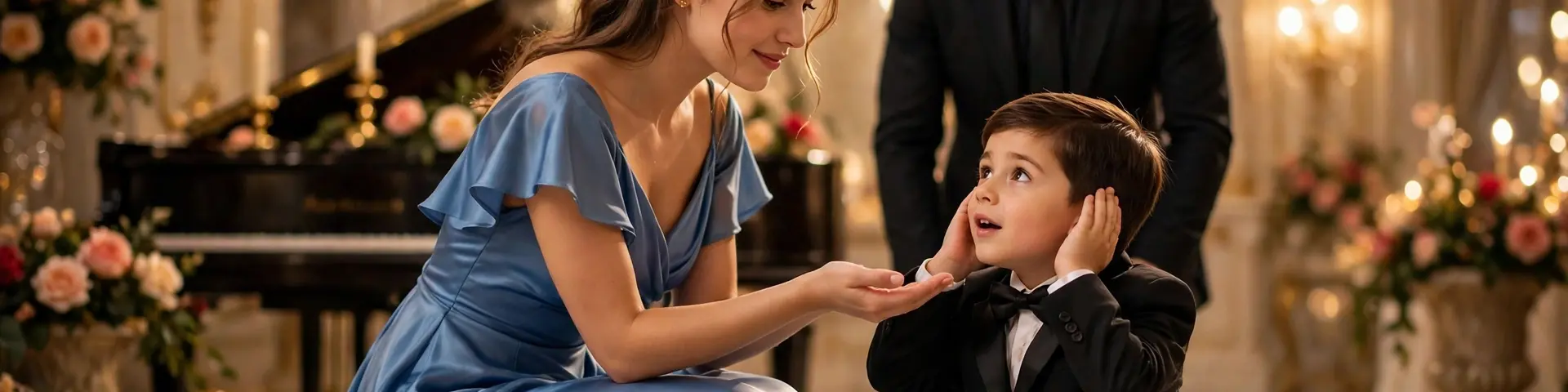
For the first time that evening, Dante Moretti smiled — a real one, unguarded and almost boyish.
“Done,” he said. “And Clara —”
“Yes?”
“The boy who mocked him tonight? His father will be teaching him manners personally. Starting tomorrow. I insisted.”
The Girl From Nowhere
To understand why Clara Bennett crossed that ballroom, you have to understand who she was before the music stopped.
She was twenty-nine, a conservatory graduate with a degree gathering dust in a drawer and a talent that had never quite found its stage. For six years she had played weddings, corporate dinners, hotel lobbies — anywhere that needed beautiful sound without a visible source. The agencies called girls like her “atmosphere.” She had learned to smile while being scenery.
Her sister Mia, three years younger, had been the bright one — the laughter in every room — until the diagnosis came two years ago. Since then, Clara’s life had reorganized itself around hospital corridors, treatment schedules, and bills that arrived with terrifying regularity. The fee for tonight’s wedding, modest as it was, would cover Monday’s payment. Barely.
That was why her manager’s frantic head-shaking had landed so hard. Clara knew exactly what stopping the music would cost her. She did it anyway, because some prices are higher than money: the price of watching a child be erased in front of a hundred adults and doing nothing.
She had been that child once, in smaller ways — the scholarship girl at the conservatory, the one the wealthy students spoke about in the same tone the catering staff had used for Leo. A difficulty. Something to manage. She remembered what it felt like to be looked over. She had sworn she would never be the person doing the overlooking.
What Dante Carried
Dante Moretti had built an empire on control. Restaurants, warehouses, private clubs across the city — every one of them ran because Dante noticed everything and forgave nothing. Control was his armor, his language, his religion.
But control had failed him completely with his son.
Leo’s autism had arrived like weather — not anyone’s fault, not anything to fix, just a different sky the family had to learn to live under. Dante had tried to manage it the only way he knew: specialists, schedules, staff, discretion. Keep the boy comfortable. Keep the boy private. Keep the boy safe — which, in the Moretti world, had quietly become keep the boy hidden.
He had told himself it was protection. That night, watching a hired pianist do in thirty seconds what he had failed to do in eight years — simply walk up to his son and offer him a choice — Dante understood it had been fear. His own fear. Fear of doing it wrong, of being the wrong father for this particular child, of a world that would devour any softness it found in a Moretti.
So he had stood across the ballroom, watching, not knowing how to approach his own boy — until Clara showed him. Not with power. With patience. With a sleeve instead of a demand.
The First Lesson
The music room was on the third floor of the Moretti house, all morning light and polished wood. Leo arrived holding his father’s hand — a new thing, Dante told Clara quietly, the hand-holding. It had started the morning after the wedding.
Clara had set two piano benches side by side, not one shared bench. Side by side, like the dance.
“Hi, Leo,” she said. “This is your room. You choose what we play. Or whether we play at all.”