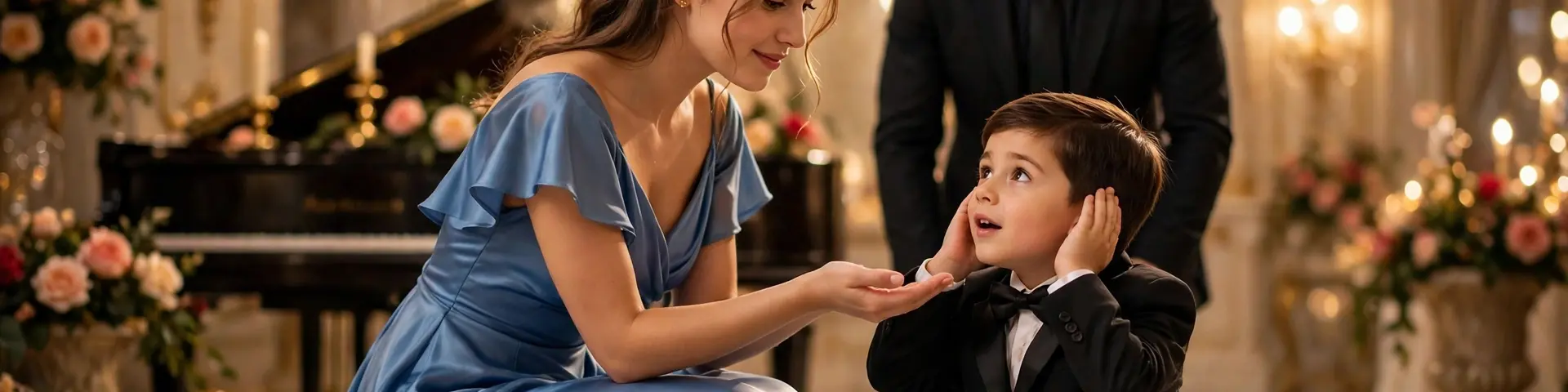
She Saw Everyone Ignore the Mafia Boss’s Autistic Son… Until She Asked Him to Dance
The crystal glass hit the marble floor and shattered, and the small boy behind the pillar flinched as if the sound had struck him physically. His hands flew to his ears. Around him, the ballroom carried on as though nothing had happened — a waiter glided over with a dustpan, guests lifted their champagne a little higher, and nobody, not one person, bent down to check on the child.
At the white grand piano, Clara Bennett’s fingers stumbled over a note. She had been hired to be invisible: play beautifully, smile politely, and vanish into the background of the Moretti wedding. But her eyes had found the boy, and once they had, she could not look away.
He was eight years old, maybe, swallowed by a black suit whose stiff collar chafed his neck. He had pressed himself into the narrow shadow behind a pillar wound with blush roses, as if trying to fold himself out of existence. His palms were clamped hard over his ears.
A woman in diamonds glanced at him, offered a thin pitying smile, and immediately turned back to a more useful conversation.
From the far wall, Clara’s agency manager caught her eye and mouthed two words: Keep playing.
That had been the entire briefing for the evening. Play. Smile. Disappear. The wedding belonged to Luca, Dante Moretti’s cousin, but everyone in the room understood that the real gravity in the ballroom came from Dante himself — the man whose name made people lower their voices, whose silence at a table could ruin a man’s month.
And across that glittering room, Dante Moretti stood watching his own son from a distance, the way a man watches something precious through glass he does not know how to break.
The Name the Staff Whispered
Clara had heard the boy’s name in the service corridor before the reception began. The catering staff had said it the way people say things they think no guest will overhear.
Leo.
They had spoken about his autism as if it were a stain the family needed to hide — a problem to be managed, concealed, apologized for — rather than simply a part of who he was. Clara had felt something cold settle in her stomach. She knew what it was like to be discussed in that tone. She had spent her whole adult life being the girl from nowhere, the hired hands, the background.
Then one of the older boys — thirteen, maybe fourteen, drunk on his father’s importance — drifted over to Leo’s pillar with a friend in tow. He planted himself in the boy’s narrow strip of refuge and bowed with theatrical mockery.
“Do you even know how to dance, freak?”
His companion snickered.
Leo’s shoulders climbed toward his ears. His palms pressed harder. He made himself smaller.
Clara’s hands stopped on the keys.
She had already run the calculation in her head, the way she always did before doing something brave: the agency would blacklist her, the fee for tonight — smaller than the hospital bill due Monday — would vanish, her manager would never call again. None of it mattered. None of it seemed worse than sitting at that piano and continuing to play while a child stood alone in a room full of adults.
The unfinished chord hung in the air beneath the chandelier like a held breath.