“What are you remembering?” Evan asked.
I folded my arms, partly to settle myself and partly to keep from reaching toward the instruments before I understood exactly what I was seeing.
“An evaluation flight outside Wichita. Six years ago.”
His eyes narrowed slightly as the significance of my answer became clear.
“The Whitaker event.”
Of course that was what they called it.
Not the sensor event.
Not the software discrepancy.
The Whitaker event.
Even now, the name bothered me. A technical failure could be examined, measured, and investigated. It could be reduced to data, reproduced under controlled conditions, and traced through a system until the underlying cause became apparent. But attaching a person’s name to the incident made the entire matter feel different.
A person was easier to remember than a line of faulty code.
A name gave people something simple to repeat, something they could associate with a problem without having to understand the complicated chain of technical circumstances behind it. The label had followed me long after I had left Skybridge, and hearing Evan use it brought back more than I wanted to remember.
Celia glanced between us, apparently aware that she had entered a conversation with a history she didn’t fully understand. She remained silent, allowing me to continue.
I turned my attention back to the displays.
“Same general conditions,” I explained. “Cold moisture. Multiple channels disagreeing after prolonged cruise. One signal appearing normal enough that the computers prioritize it.”
I spoke carefully, choosing my words as I compared the current readings with the pattern I remembered from the evaluation flight. The similarities were concerning, but I knew better than to treat an early resemblance as proof. I needed to separate what I could verify from what my experience suggested might be happening.
Evan looked toward the center screen, his expression growing more serious.
“That incident was classified as pilot overcorrection.”
“I know what it was classified as.”
My voice came out flatter than I intended. I had not meant to sound defensive, but the phrase brought back years of frustration that I had never entirely managed to put behind me.
Evan didn’t respond immediately. He simply waited, giving me the opportunity to say what I had left unsaid.
I took a breath before continuing.
“That doesn’t mean the classification was right.”
Five years earlier, I had been flying a Skybridge test aircraft with two engineers and another pilot when our air-data systems began feeding contradictory information into the flight computers. The readings should have agreed closely enough to provide a dependable picture of the aircraft’s condition, but instead they began to diverge in ways that made the situation increasingly difficult to interpret.
The aircraft had remained controllable throughout the incident.
We landed safely.
No one was physically harmed.
Those facts should have mattered. They should have formed the starting point for a careful investigation into why the systems had behaved as they did and what could be done to prevent the same problem from happening again.
But the company had been only weeks away from a major contract decision, and an unexplained systems problem was precisely the sort of complication senior management did not want attached to the program. There was too much at stake, too much pressure to demonstrate that the aircraft was ready, and too little patience for a technical failure that threatened to delay the decision.
I had written a thirty-seven-page report documenting what I believed had happened.
My conclusion was straightforward, even if the underlying problem was not. Under a narrow combination of temperature, moisture, and software logic, one air-data source could freeze into a state that looked believable despite being inaccurate. Its readings would remain consistent enough to appear trustworthy, while the other channels fluctuated and drew attention to themselves.
Because its signal looked cleaner than the others, the system could give it too much authority.
That was the danger I had tried to explain. The problem wasn’t necessarily that the system had no warning signs. It was that the information that appeared most reliable could, under those particular conditions, be the information that deserved the greatest suspicion.
Management disagreed with my conclusion.
They said the data was inconclusive.
Rather than accepting my explanation and investigating the possibility that the system itself was contributing to the event, they directed their attention toward a different part of the incident. A review panel focused on one manual control input I had made while trying to manage the aircraft’s conflicting information.
Too abrupt, they said.
Unnecessary, they said.
Human factors, they said.
Each phrase became another reason to examine my actions instead of the technical problem I had been trying to identify. The more the investigation focused on my response, the less attention seemed to be paid to the possibility that the aircraft’s systems had supplied misleading information in the first place.
Within six weeks, my name had disappeared from the program.
Within three months, I had resigned.
A year later, I stopped renewing half of my professional credentials. One by one, I let the qualifications that had once defined my career lapse, no longer seeing a reason to maintain the formal connection to a world I had worked so hard to leave behind.
People assumed I had walked away because I was angry.
That was only partly true.
There had certainly been anger in those first months. I was angry about the report, about the review panel, and about how quickly years of careful work had been overshadowed by a single disputed control input. I was angry that the people making decisions seemed more concerned with protecting the program than understanding what had gone wrong.
But anger alone did not explain why I stayed away.
Mostly, I left because, after enough time had passed, I began to wonder whether they might have been right. Perhaps I had reacted too quickly. Perhaps my interpretation of the data had been wrong. Perhaps the control input they criticized had contributed more to the incident than I wanted to admit.
I had spent years trusting my ability to recognize patterns and make decisions under pressure. Once that confidence was shaken, I found it difficult to know where my professional judgment ended and my own need to defend myself began.
That uncertainty followed me much longer than the anger ever did. Anger could fade with time, but doubt had a way of returning whenever I least expected it, quietly undermining the confidence I had once taken for granted.
Now I was sitting in the cockpit of a passenger aircraft, watching the same troubling pattern crawl across another screen.
Evan turned toward Celia.
“Pull the environmental history.”
She responded immediately, bringing up the relevant information on the display. I leaned closer, trying to absorb the readings and compare them with the conditions I remembered from the old evaluation flight.
I read the numbers twice.
Then I read them again, more slowly, paying attention to the relationships between the values rather than treating each one as an isolated measurement.
The resemblance was becoming harder to dismiss.
“Do you still carry the manual pitch-and-power tables onboard?” I asked.
Evan gave me a faint smile. There was a trace of amusement in his expression, although the seriousness of the situation kept it from becoming anything more.
“You really have been away.”
“Answer the question.”
His smile faded into a more practical expression.
“Yes.”
“Good.”
That was all I needed to know. I wasn’t interested in discussing how long I had been gone or what I might have forgotten during those years. I needed to establish which references were available and what information we could use to evaluate the aircraft’s behavior without relying entirely on the conflicting readings.
Evan reached toward the electronic reference system, preparing to open the material.
Before he could do so, a soft chime sounded inside the cockpit.
A message had arrived from Meridian operations.
Celia opened it and began reading through the contents. At first, her expression remained neutral, but as she continued, the corners of her mouth tightened and her attention shifted toward the displays in front of her.
I noticed the change immediately.
“What?” Evan asked.
Celia hesitated for a moment, apparently deciding how best to summarize the message.
“Operations reviewed the data we transmitted. Engineering recommends maintaining present altitude while they continue evaluating.”
I looked back at the instrument panel, where the three air-data channels continued to present information that did not agree.
“How long will that take?” I asked.
Celia checked the message again, as though there might be a more definite answer buried in the text.
“No estimate.”
I felt my concern deepen. We were being asked to maintain the current altitude while an engineering team on the ground continued examining the information, but no one could tell us how long that process might take. Meanwhile, the aircraft was still producing the same troubling pattern that had brought me into the cockpit in the first place.
Another disagreement warning appeared.
I watched channel three remain perfectly smooth, its line continuing across the display with an almost unnatural consistency.
The other channels were telling us that something was wrong. Channel three was offering the reassuring appearance of normality, but I had already seen enough to suspect that its apparent stability was part of the problem.
“Captain,” I said, turning toward Evan, “I would not stay here.”
He stared straight ahead for a moment, his attention still on the instruments.
It was his aircraft.
His decision.
That distinction mattered more than anything else I could say in that moment.
One of the first lessons I had learned during my years in flight testing was that expertise did not automatically confer authority. Knowing how to interpret a technical problem did not mean I could take responsibility away from the person operating the aircraft. The captain had to evaluate the available information, weigh the risks, and make the decision he believed was appropriate.
He would be accountable for that decision, and he needed to be the one who owned it.
I understood that, so I didn’t tell him what to do.
Instead, I explained what I saw and why it concerned me.
“The conditions that produced my old incident became less stable the longer we stayed in that temperature band,” I said. “If this is the same failure mode, waiting for cleaner data may give you worse data instead.”
I kept my voice measured, resisting the urge to make the warning sound more dramatic than it needed to be. I couldn’t prove yet that the two events were identical, and I wasn’t going to pretend otherwise. But the similarities were significant enough that I believed remaining at the current altitude carried a risk we shouldn’t ignore.
Celia looked at Evan, waiting for his response.
He rubbed his thumb slowly across the edge of the control panel, considering the information in front of him. For a few seconds, nobody spoke. The cockpit remained filled with the low hum of the aircraft and the quiet electronic sounds of the instruments.
Then Evan nodded once.
“We descend.”
There was no drama in the words, no raised voice, and no attempt to make the decision seem more significant than it was.
That was what professionalism usually looked like.
Short sentences.
Clear decisions.
No performance.
Evan requested a lower altitude through the appropriate channel while Celia began preparing the aircraft for the descent. Their movements remained deliberate and coordinated, each of them concentrating on the tasks that needed to be completed rather than wasting time discussing the decision they had already made.
I turned my attention to the manual tables.
The numbers came back to me faster than I wanted them to. As I worked through the references, I recognized how much of my old training had remained intact beneath the years of avoidance and uncertainty. I had spent a long time telling myself that this part of my life was behind me, but the information in front of me still made sense in a way that felt almost instinctive.
Pitch.
Power.
Expected performance.
Cross-check.
Ignore the temptation to chase every disagreement.
Fly what you can verify.
I repeated the principles silently as I compared the available information, reminding myself to remain disciplined. The conflicting readings were unsettling, but reacting to every fluctuation would only make the situation harder to assess. We needed to rely on what could be confirmed and resist the impulse to treat every new warning as a reason to change course.
The aircraft began a slow, controlled descent.
Beyond the cockpit windows, the darkness offered almost nothing to see. The black sky blended with the black ocean below, leaving no visible horizon to help distinguish one from the other.
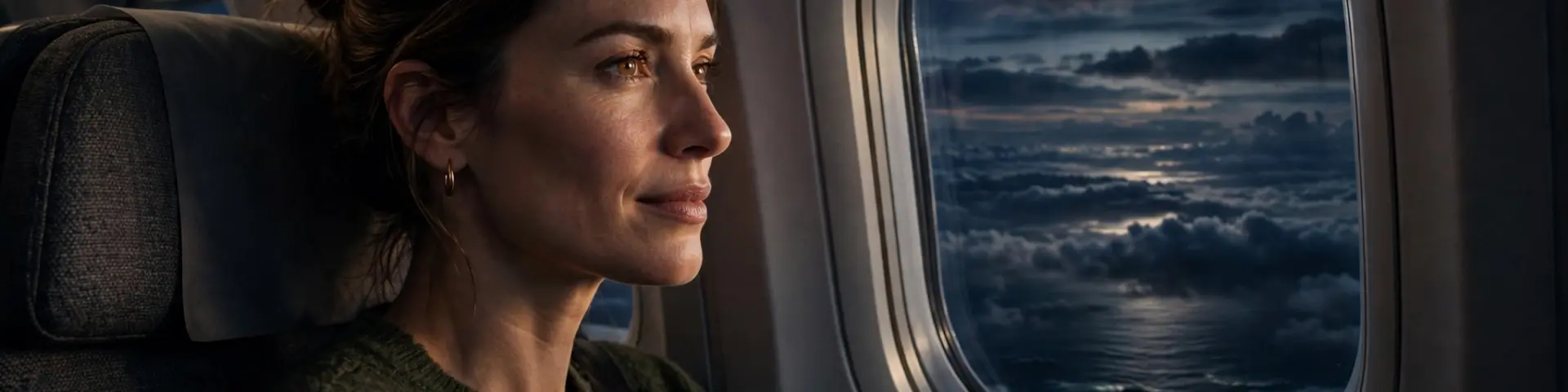
Twenty minutes earlier, I had been sitting beside that same darkness, trying to fall asleep while the aircraft carried me toward Ireland. I had expected nothing more from the flight than an uncomfortable night and an eventual reunion with my family.
Now I was comparing engine settings against standby instruments, concentrating on aircraft performance as though the previous five years had been nothing more than a strange interruption in a life I had never truly left.
At thirty-four thousand feet, channel one stabilized briefly.
For a moment, its readings moved closer to what we expected, offering a small indication that the situation might be improving.
Then the channel failed again.
I kept my attention on the display, refusing to let that brief improvement reassure me too quickly. A temporary return to normal values was not enough to establish that the underlying problem had disappeared.
At thirty-two thousand feet, channel two began returning closer to expected values.
Its readings were still something we needed to evaluate, but the change was encouraging. I compared them against the other available information, checking whether the improvement was consistent with the aircraft’s behavior during the descent.
Channel three remained smooth.
Too smooth.
Celia pointed toward its line on the display, drawing my attention to the same detail I had been watching.
“You were right.”
I didn’t look away from the instruments.
“Not yet.”
I had learned not to celebrate early, especially when dealing with a problem that could produce convincing but misleading information. One channel behaving as expected did not mean the entire system was healthy, and a brief improvement did not prove that we had fully escaped the conditions causing the disagreement.
I needed more than a promising change in the readings before I could trust what I was seeing.
At thirty thousand feet, the cloud began to thin around us. The aircraft continued its controlled descent, and the conditions visible through the windows gradually became less uniform.
The aircraft settled.
The warnings slowed.
For several seconds, nobody said anything. We watched the instruments, each of us waiting to see whether the improvement would continue or whether another warning would appear to undo the fragile sense of progress.
The silence felt longer than it probably was. After the steady sequence of questions, observations, and decisions, the absence of new alarms left us with nothing to do but monitor the displays and wait.
Then Evan exhaled.