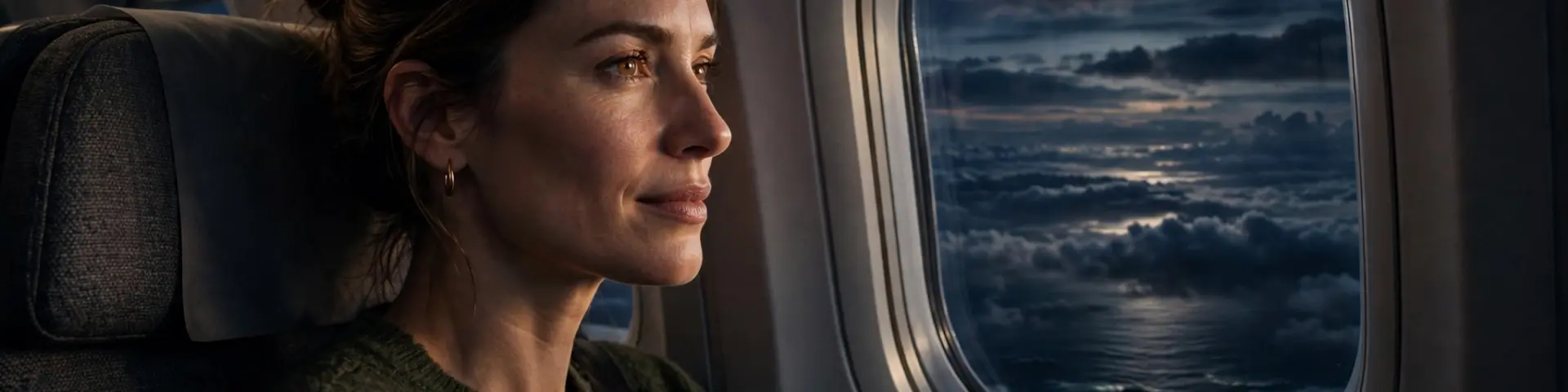
“When did the company revisit it?”
“About two years after you left,” he answered. “There were two additional incidents in simulation and one operational discrepancy. Nothing severe, but enough to reopen the data.”
I studied his face, trying to understand what those words meant beyond their carefully measured delivery. Two years after I had left. Two years after the arguments, the meetings, and the final decisions that had ended my career there, someone had finally gone back to examine the evidence I had spent so much time trying to defend.
“And they confirmed it.”
“Yes.”
The answer was simple, almost matter-of-fact, but I felt something tighten in my throat. Even after all these years, hearing someone acknowledge that my concerns had been valid carried a weight I hadn’t expected. I had spent so long learning to live without that confirmation that I wasn’t entirely sure what to do with it now that it had finally arrived.
I swallowed before speaking again.
“Why didn’t anyone tell me?”
His expression changed, and for a brief moment, I could see that he understood the question was bigger than the technical findings. I wasn’t asking why nobody had sent me a routine update. I was asking why no one had thought I deserved to know that the work I had been dismissed for was eventually recognized as important.
His expression answered before he did.
“I don’t know.”
I looked at him, searching his face for some indication that he might offer more, that he might explain what had happened behind the closed doors I had never been allowed to enter again.
He didn’t.
That was corporate language for something much less innocent: somebody had decided not to tell me.
Perhaps it had been a deliberate choice. Perhaps it had been easier for everyone involved to leave the past undisturbed. Whatever the explanation, the result was the same. The information had existed, the findings had been confirmed, and I had been left outside the conversation.
A voice behind him interrupted my thoughts.
“Nora.”
I knew the voice immediately, before I even turned around.
Adrian Kessler looked older.
Of course he did.
So did I.
Five years had passed since I had last seen him, and time had left its marks on both of us. His hairline had receded slightly, and the lines around his mouth had deepened, giving his face a more weathered appearance than I remembered. Yet his posture remained exactly the same, as though the years had changed everything about him except the way he occupied a room.
Controlled.
Measured.
Certain that every room had a correct temperature and that he was the person who knew what it should be.
Even standing in an airport terminal after an unexpected diversion, surrounded by passengers collecting their belongings and crew members finishing their duties, he carried himself with the same carefully maintained composure.
“Adrian,” I said.
Passengers were still gathering their bags around us. Overhead bins opened and closed, and the sounds of luggage shifting through the cabin mixed with conversations that had gradually grown louder now that we were safely on the ground. Julia stood several feet away, helping an elderly couple retrieve their belongings.
The ordinary activity around us made the encounter feel strangely unreal. Five years of unresolved history had followed me into this moment, yet the people moving past us had no idea what our conversation meant or how much had been left unsaid between us.
Kessler glanced toward Samir’s tablet before returning his attention to me.
“I understand there was some consultation during the diversion.”
“Some,” I answered. I kept my tone neutral, offering him no invitation to turn the conversation into an argument about my involvement or the extent of my contribution. The airplane had landed safely. The technical problem had been managed, and there was no need to exaggerate what I had done.
“I’m glad you were available,” he said.
The sentence sounded generous, almost gracious, as though he were acknowledging a fortunate circumstance rather than the expertise of someone whose warnings had once been treated as a problem.
It also sounded prepared. The words had the smooth, polished quality of a statement someone might have rehearsed before approaching an uncomfortable conversation. They conveyed appreciation without requiring him to acknowledge anything that might make that appreciation complicated.
Beside him, Samir looked down at his tablet.
Kessler continued, his voice taking on the careful, professional tone I remembered from meetings where every sentence seemed designed to leave room for a different interpretation later.
“I think we should be careful about drawing broad conclusions until engineering reviews the full event data.”
Five years earlier, that sentence would have made me furious. I could almost feel the old reaction rising automatically, the familiar heat of frustration at hearing a legitimate concern wrapped in language that made it sound premature to draw any conclusions at all. I remembered what it had felt like to sit in rooms where I had been expected to defend every observation while other people were permitted to postpone acknowledging what the evidence suggested.
But this time, the anger didn’t arrive with the same force. Instead, I felt tired. Not defeated, and not resigned to accepting whatever he said, but tired in a way that came from finally understanding how much energy I had once spent trying to make people acknowledge things they were determined to avoid.
“I agree,” I said.
Kessler appeared surprised by my response. His eyes remained on me, as though he were checking whether he had heard correctly.
“We do?”
“Of course,” I replied. “One event should be reviewed properly.”
I could see some of the tension leave his shoulders. He seemed to interpret my agreement as a sign that we were approaching common ground, that I was willing to accept the careful boundaries he had placed around the discussion.
For a moment, I let him believe that was where the conversation would end.
Then I continued.
“But this isn’t one event anymore.”
Samir looked up from the tablet. Kessler did not move, but something in his expression tightened. The small relaxation I had noticed in his shoulders disappeared, replaced by the rigid composure he had worn when he first approached me.
I nodded toward the tablet Samir was holding.
“Your current service bulletin cites my original memorandum.”
The words were neither loud nor accusatory. I simply stated what I knew, allowing the document itself to carry the weight of the point I was making.
Kessler remained quiet. For the first time since he had begun speaking, he seemed uncertain about which response would serve him best.
“I saw it,” he finally said.
Another pause followed. The terminal continued moving around us. Bags were being lifted from overhead compartments, passengers were making their way toward the exits, and Julia remained occupied with the elderly couple. Yet our small group seemed separated from the rest of the cabin by an invisible boundary, as though the conversation had become too important for anyone standing within it to pretend it was merely casual.
Kessler cleared his throat slightly before speaking again.
“That report was always considered part of the technical record.”
I looked directly at him.
“No,” I said. “It was considered part of the record after I was considered the problem.”
He started to respond almost immediately.
“Nora—”
“I’m not trying to reopen an argument in an airplane aisle,” I interrupted, keeping my voice controlled. “I’m not asking to turn this into a scene, and I’m certainly not interested in making the people around us listen to five years of history they had nothing to do with.”
His expression hardened slightly, though I couldn’t tell whether he was relieved by the clarification or irritated that I had interrupted him.
“Good,” he said. The word came quickly, almost as though he wanted to close the subject before it could develop into anything more difficult.
I held his gaze.
“But I am done pretending I don’t remember what happened.”
His jaw shifted. For a moment, he said nothing. Around us, passengers continued moving through the aisle, occasionally slowing to make room for someone retrieving a bag. The noise of the cabin carried on, but an odd pocket of stillness had formed near the galley, where our conversation seemed to hold everyone’s attention without anyone openly acknowledging it.
Samir remained beside me, his tablet held against his chest. He made no attempt to intervene or redirect the discussion.
Julia, a few feet away, continued helping the elderly couple with their bags. She appeared determined not to listen, although the careful way she kept her attention on the task suggested she was aware of every word.
Kessler lowered his voice.
“The program was under enormous pressure.”
“I know,” I replied. I remembered the deadlines, the meetings, and the constant concern about keeping everything on schedule. I had understood the pressures surrounding the program even when I was still working there. I had never believed the people making those decisions were operating in a world without constraints.
“There were commercial commitments,” he continued. “Certification timelines. Hundreds of jobs attached to decisions we were making.”
“I know that too.” I wasn’t dismissing the importance of those things. Commercial commitments mattered. Certification schedules mattered. The livelihoods of hundreds of people mattered, and I had never pretended otherwise.
But none of those realities changed the evidence I had presented or erased the consequences of the decisions that followed.
Kessler seemed to search my face, perhaps hoping to find some sign that I had finally accepted his explanation as sufficient.
“Then you understand it wasn’t personal.”
I looked at him for a long moment.
“That was the problem.”
The words came out quietly, without the sharpness I might once have put into them. I didn’t need to raise my voice to make the point, and I no longer felt compelled to win the exchange by delivering the most devastating response.
For the first time since he had approached me, Kessler had no immediate answer.
I continued, speaking more quietly still.
“You made a decision that changed a person’s life and convinced yourself it wasn’t personal because a company made it.”
I watched the words reach him. His expression shifted, though he tried to maintain the composure that had always served him so well. He had spent years thinking in terms of programs, schedules, commitments, and organizational decisions. Those things had allowed him to understand difficult choices as parts of a larger system, where responsibility could be divided until no individual felt entirely accountable.
But I had been the person who had lived with the consequences. I had lost my place in the profession. I had spent five years carrying the uncertainty, the frustration, and the knowledge that the concerns I had raised were eventually supported by evidence that no one had thought to share with me.
From his perspective, the decision might have belonged to the company. From mine, it had changed the course of my life.
He glanced toward the window, briefly breaking eye contact. The terminal lights reflected faintly in the glass, creating pale points of illumination against the dark beyond it.
For a moment, I wondered whether he was searching for the right words or simply trying to collect himself before responding.
Then he spoke.
“I could have handled things differently,” he said.
It was not an apology.
Not really. He had not said he was sorry, and he had not acknowledged all the damage his decisions had caused. There were still five years of silence between us, five years of consequences that could not be undone by a few carefully chosen words.
But it was closer than anything I had received from him in all that time.
For the first time, I could hear something in his voice that sounded like an acknowledgment, even if he could not bring himself to say everything outright.
I nodded slowly.
“So could I.”
He looked back at me, his expression shifting as he tried to understand what I meant.
That surprised him even more than my first response.
“I was angry,” I continued, keeping my voice steady. “And difficult. I convinced myself that I had to defend every decision I made, every conclusion I reached. I stopped listening because I thought being right meant I didn’t have to listen to anyone else.”
The words felt strange coming out of my mouth. I had spent so long carrying the weight of what happened that admitting my own shortcomings should have felt like surrender. Instead, it felt like setting down something I no longer needed to hold.
Samir shifted his weight beside me, watching the exchange without interrupting.
Kessler studied me carefully, as though he was waiting for the rest of my confession, perhaps expecting me to soften my position now that I had admitted my own mistakes.
“But the report was right,” I added.
There was the line. The distinction that mattered more than anything else I had said. I was willing to acknowledge my mistakes, but I would not pretend the facts had changed simply because the truth was uncomfortable. I would not make my own imperfections an excuse for what had happened, nor would I allow them to erase the evidence I had presented five years earlier.
There was no anger in my voice. No attempt to overpower him or force him into a corner. Just the truth, spoken plainly enough that neither of us could pretend to misunderstand it.
Kessler’s eyes dropped briefly toward the tablet in his hands. For a moment, he seemed to find something there that required his attention, though I suspected he was simply gathering himself before answering.
“Yes,” he said.
Samir remained completely still.
Julia, who had been adjusting the service cart nearby, stopped moving her hands. Even she seemed to recognize that something important had just happened, something that deserved a moment of silence rather than the ordinary noise of an aircraft cabin.
Somewhere behind us, a suitcase wheel bumped against a seat, followed by the faint shuffle of passengers preparing to leave.
The ordinary sounds of the world continued around us, almost absurdly indifferent to the significance of those two words.
Kessler lifted his eyes again and repeated himself.
“Yes. It was.”
Five years.
Two words.
I had imagined hearing them in countless different ways. In some versions, I had pictured a long explanation, a detailed acknowledgment of every mistake, perhaps even an admission that would finally make the people responsible understand what they had taken from me. In others, I had imagined myself standing before him with a list of everything I had lost, forcing him to confront each consequence.
Instead, it came down to this brief exchange in an aircraft cabin after an emergency landing.
They did not restore my career.
They did not return the mornings I had spent waking at 4:00 a.m., my heart already racing, replaying that test flight in my head before I was fully awake. I could still remember lying in bed, staring into the darkness, examining every decision I had made and wondering whether there had been something else I could have done.
They did not erase the look on my mother’s face when I told her I had resigned. I could still remember the confusion in her eyes, the questions she struggled to ask, and the disappointment I had imagined she was trying not to show.
Nor did those two words give back the months when Rachel kept inviting me to family dinners, hoping I would eventually agree to come. I had refused again and again because I could not bear the thought of sitting around a table with people who might ask questions I did not know how to answer. I had convinced myself that avoiding those conversations was easier than explaining what had happened, even as the distance between us grew.
None of that disappeared because Kessler had finally acknowledged the truth.
But something shifted inside me all the same. For five years, I had carried the knowledge that I had been right alongside the suspicion that no one would ever admit it. I had learned to live with that contradiction, though living with it was not the same as making peace with it.
Now, for the first time, I no longer had to wonder whether the truth would ever be spoken aloud by the person who had spent so long avoiding it.
Something had been put back where it belonged.
The truth.
Not as revenge. Not as a victory to celebrate or a score to settle. I did not need Kessler to suffer for me to know what had happened. I did not need him to lose anything for my own judgment to be validated.
The truth was enough, simply because it had finally been allowed to occupy its proper place.
Passengers began leaving the aircraft, their movements gradually breaking the stillness that had settled around us. The narrow aisle filled with people collecting their belongings, checking their phones, and preparing to step into the jet bridge. The moment that had felt suspended in time was giving way to the practical business of getting everyone safely off the plane.
Beth found me before she stepped into the jet bridge. She wrapped her arms around me in a warm, spontaneous hug that caught me slightly off guard.
For a moment, I simply stood there, surprised by the gesture. Then I returned it, feeling the tension in my shoulders ease a little.
“You should tell people what you used to do,” she said as she pulled back to look at me. Her words were simple, but there was something encouraging in the way she said them, as though she had decided that the part of my life I had tried to keep hidden deserved to be brought back into the open.
I glanced toward the aisle, then back at her.
“I’m starting to think maybe I should.”
The admission came more easily than I expected. I had spent years avoiding that part of my past, treating it like something dangerous that needed to remain buried. Now I found myself wondering whether hiding it had only made it harder to move forward.