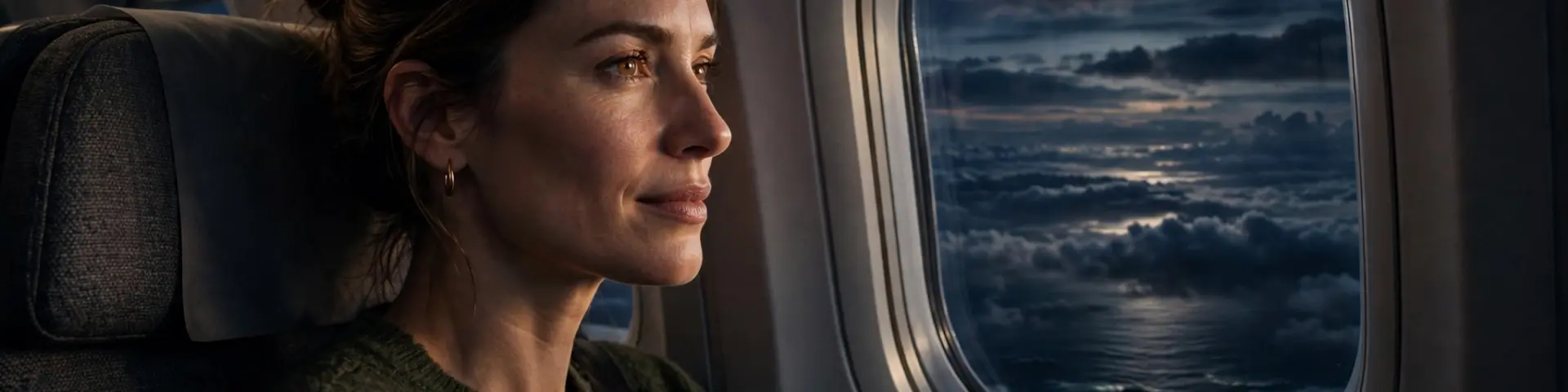
After Beth continued toward the exit, Samir approached and handed me his business card. I accepted it, turning it briefly between my fingers before looking up at him.
“Meridian is building a new independent training group around unreliable-data events and manual systems management,” he explained.
I stared at him, trying to decide whether he was serious. The words took a moment to settle. After everything that had happened, after years of telling myself that my professional life was behind me, he was standing in front of me and offering a possible way back into it.
“Are you recruiting me thirty minutes after an unscheduled landing?”
Samir gave me a perfectly straight look.
“I’m an engineer. We’re not known for timing.”
I laughed before I could stop myself. It was a genuine laugh, the kind that came without effort or the need to consider how it might sound to anyone listening.
For a moment, the tension of the last several hours seemed to loosen its grip on me.
“Send me the details,” I said.
He nodded, accepting the answer without pressing me for anything more. There was no demand for a decision, no expectation that I would suddenly know what I wanted to do with the rest of my life. It was simply an opening, a possibility I had not expected to find.
Kessler heard our exchange. I noticed him looking in our direction, but he did not interrupt. He did not question Samir’s offer or attempt to steer the conversation elsewhere.
That mattered too. It was a small thing, perhaps, but after years of feeling that my professional future had been decided for me, I found myself appreciating the simple fact that someone was allowing me to make my own choices.
Eventually, I walked out of the aircraft carrying the same small bag I had brought onboard. It rested against my side just as it had when I first boarded, holding the same belongings and weighing no more than it had before. Nothing about the bag had changed. There were no visible signs of the events that had unfolded, no indication of the conversation that had finally taken place or the unexpected opportunity Samir had offered me.
But everything inside me was different. The woman who had boarded the aircraft had spent years trying to convince herself that the safest thing she could do was leave her past behind. The woman walking away now was beginning to understand that she might not have to choose between remembering what had happened and finding a future beyond it.
I was still carrying the same history. I simply no longer felt that I had to carry it in the same way.
Rachel called while I was standing near a large terminal window, watching the ground crews move beneath the floodlights. Their figures crossed the illuminated pavement as they worked around the aircraft, their movements small and purposeful against the darkness beyond the glass.
My phone vibrated in my hand, and Rachel’s face appeared on the screen. I answered.
“You landed in Shannon?”
“Apparently I like making travel complicated.”
I tried to make the response sound casual, as though an unscheduled landing in a different place were merely another inconvenience to add to a long day. It was easier than explaining everything at once, especially when I was still sorting through the experience myself.
“Nora.”
There was concern in the way she said my name, and I could hear the questions gathering behind it.
“I’m fine.”
She looked at me through the screen, clearly unconvinced that those two words were enough.
“What happened?”
I turned my head and looked back toward the aircraft through the terminal window. From where I stood, I could still see parts of the plane beneath the bright lights.
Evan was visible through the cockpit window, his figure framed by the glass as he moved inside. Seeing him there brought the events of the flight back into focus, along with the decisions we had made and the problem we had managed to handle.
Near the gate, Samir had joined two Meridian staff members. They appeared to be discussing something together, their attention focused on the aircraft and the work that remained to be done.
Farther down the concourse, Kessler stood alone with his phone in his hand. He was separated from the others by several yards of open space, looking as though he had retreated into his own thoughts.
For a moment, I watched them all without speaking. Each of them had been part of the same chain of events, but each would leave the experience carrying something different.
“An old problem came back,” I said at last.
Rachel frowned, trying to make sense of my answer.
“Your old problem?”
I understood why she asked. For years, the problem had been inseparable from me in her mind, from the career I had lost to the person I had become afterward. She had watched me struggle with it, even when I refused to tell her exactly how much it continued to affect me.
“No.”
The answer came quickly, and as soon as I said it, I realized how clearly I understood the distinction. For so long, I had thought of what happened as my problem, something I had to carry alone because it had shaped so much of my life. I had allowed it to define my choices, my silences, and even the relationships I kept at a distance.
But the problem had existed before me. It had not been created by my refusal to accept what others wanted me to believe, and it did not belong to me simply because I had been the one to speak up about it.
That was the difference I had failed to see for five years.
“Just an old problem.”
Rachel remained quiet, giving me time to explain if I wanted to. She had always known when pushing me for answers would only make me withdraw further, and this time she seemed willing to let me find the words at my own pace.
She waited.
“And?”
I looked once more toward the aircraft, then back at her face on the screen.
“We handled it.”
Her expression softened, the concern around her eyes easing as she took in my answer. She seemed to hear something beyond the words themselves, something in the steadiness of my voice that had not been there in our earlier conversations.
“You flew?”
The question was quiet, but I could hear what it meant to her. She was not asking only about what had happened on the aircraft. She was asking whether I had stepped back into a part of myself I had spent years trying not to remember.
“I helped.”
I did not know how else to explain it yet. The details could wait until I was home, until I had time to sit with her and tell her the story from beginning to end.
“Nora.”
“What?”
She studied my face for another moment, and then a small smile appeared on hers.
“You’re smiling.”
I touched my face instinctively, my fingertips brushing my cheek as though I might discover something there I had not noticed myself.
She was right. I was smiling. It was not a forced expression or an attempt to reassure her that everything was fine. I had not planned it, and I had not even realized it was there until she pointed it out.
For the first time in a long while, I did not have to remind myself to keep going or pretend that I was managing better than I felt. The smile had simply appeared, as natural as breathing, and I found that I did not want to hide it.
“I’ll explain when I get there.”
“You’d better.”
“I will,” I promised, and this time I meant it without hesitation.
There was a pause between us, the kind that seemed to hold more than either of us knew how to say. Neither of us rushed to fill it. After everything that had happened, silence no longer felt like something that needed to be repaired.
Then she said, “I’m glad you got on the plane.”
For once, I did not reach for a joke to soften the moment or hide behind a clever remark. I let her words settle between us, allowing myself to feel the warmth behind them.
“So am I.”
Meridian provided hotel rooms while replacement transportation was arranged for the stranded passengers and crew. After the exhausting hours we had endured, I knew I should have welcomed the chance to rest somewhere quiet and comfortable.
I should have slept.
My body was tired enough to ache, and my mind had every reason to demand a few uninterrupted hours of peace. But sleep remained stubbornly out of reach, as though some part of me understood that the night was not quite finished.
Instead, I sat beside the window in a small airport hotel room, watching the faint reflections of distant lights shimmer against the dark glass. A cup of tea sat on the table beside me, its warmth long gone, the surface growing cold while I stared into the distance and tried to make sense of everything that had happened.
At 2:18 a.m., an email arrived. The notification appeared on my screen, its quiet arrival startling me out of my thoughts.
It was from Samir.
Attached was Bulletin 41C. For several seconds, I simply looked at the attachment, remembering the chain of events that had brought me back to a problem I had once believed was buried beyond reach.
Below it was another document.
My original memorandum.
Thirty-seven pages. I recognized the length immediately, along with the familiar structure of the report I had spent so much time preparing years ago. I opened the file, and the pages appeared one after another, carrying me back to a period of my life I had worked so hard to put behind me.
The same title.
The same charts.
The same conclusion.
And my name. There was something almost unsettling about seeing it all preserved so precisely. Time had passed, circumstances had changed, and I had spent years convincing myself that the work no longer mattered. Yet there it was, intact and unmistakable, waiting for me as though those five years had never happened.
I opened the final page.
There was my signature from five years earlier, clear and permanent beneath the words I had once believed would speak for themselves.
Nora Elaine Whitaker.
Senior Flight Evaluation Pilot.
I had not seen that title in years. For a long time, I stared at the screen, reading the words again and again. They belonged to a version of me I had tried to forget, a woman who had trusted her training, believed in the value of evidence, and assumed that telling the truth would be enough. I remembered how easily that confidence had been taken from me. I remembered the years of silence that followed, and all the times I had avoided acknowledging what I had once been. But the name and title remained, unaffected by the years I had spent refusing to look at them.
For a long time, I did nothing but stare.
Then I did something small.
I downloaded the document. The progress indicator appeared, moved across the screen, and disappeared. The file settled into my computer, where I could return to it whenever I wanted.
Not because I needed proof anymore. The events of Flight 602 had already shown me that the truth could survive even when the people responsible for protecting it failed to do so. I no longer needed to keep searching for confirmation that my work had mattered.
Because I was finally willing to keep it. I was willing to let that part of my life remain mine, without treating it as a wound I had to hide or a mistake I needed to explain away.
Six months later, I stood at the front of a civilian flight simulator classroom outside Boston. The room smelled faintly of electronics and fresh coffee, and the soft hum of the equipment filled the spaces between conversations. Twelve airline pilots sat in two rows facing me, their attention divided between the simulator displays and the large screen mounted on the wall behind me. I looked over the group, taking in their expressions and the familiar mixture of curiosity and professional confidence that came with experienced pilots preparing to learn something new.
On the wall behind them was a large screen showing three conflicting air-data traces. The lines moved across the display with subtle differences, each presenting its own version of what the aircraft’s systems appeared to be reporting. To an inexperienced observer, the distinctions might have seemed insignificant. To someone responsible for making decisions in a cockpit, those differences could matter enormously.
I pointed toward the smoothest line.
“Which one do you trust?”
A pilot near the back raised his hand, answering with the certainty I had expected.
“Channel three. It’s stable.”
I smiled, recognizing the familiar instinct to trust the information that appeared the most consistent and reassuring.
“That’s exactly why we’re going to question it.”
A few people laughed, and the tension in the room eased. I let the moment breathe before turning my attention back to the display. The lesson was not about teaching pilots to distrust every instrument or doubt every decision. It was about understanding that a convincing signal was not necessarily an accurate one, and that professional judgment sometimes required the courage to challenge the information that looked most dependable. I knew how difficult that could be. I had learned it the hard way.
There had been offers after Flight 602. Interviews with people who wanted to hear my account of what had happened, often asking questions that returned me to moments I had spent years trying not to revisit. Consulting roles had followed, along with opportunities to speak about the technical issues and the decisions made under pressure. A formal written acknowledgment from Skybridge arrived, recognizing what should have been acknowledged long before. Even a carefully worded note from Adrian Kessler found its way to me. Each of those things carried a different meaning. Some offered recognition, some suggested opportunities, and others seemed designed to close a chapter that had remained open for far too long.
I accepted the acknowledgment. I read it carefully and allowed myself to appreciate the fact that the record had finally been corrected in a way that mattered. I did not need to pretend it made up for everything that had happened, but I no longer felt compelled to reject recognition simply because it had arrived late.
I declined the job. Returning to Skybridge might have seemed like the natural next step. It would have offered a familiar environment, a chance to resume a career that had once defined me, and perhaps the satisfaction of seeing the company acknowledge my value.
Going back to the company would have been easy to mistake for justice. For a while, I understood why other people might see it that way. From the outside, returning could have looked like a triumphant ending, the wrong corrected and the person who had suffered finally restored to her former position.
But it was not what I wanted. I had spent too many years measuring my life against something that had been taken away from me. I did not want the next chapter to depend on returning to the place where I had lost my footing, or on convincing the same institution that had once dismissed me that I deserved to be there.
Instead, I joined Meridian’s independent training group and helped design courses that taught crews how to recognize misleading system behavior without losing confidence in their own judgment. The work felt different from anything I had done before. I was no longer simply evaluating systems or documenting their weaknesses. I was helping other pilots understand how those weaknesses could appear in real situations, and how to respond when the instruments they trusted began telling conflicting stories. I wanted them to leave the classroom knowing that uncertainty did not automatically mean incompetence. Questioning a system was not a failure of confidence. Sometimes it was the clearest expression of professional responsibility. And I wanted them to understand that the person in the cockpit still had a responsibility to think, even when the machines offered an answer that seemed perfectly reasonable.
Rachel said I had become impossible to schedule again. She said it with the kind of exasperation that made it clear she had noticed how often my work threatened to take over my calendar. The difference, however, was that I no longer felt as though I had to choose between my career and the people who mattered to me.
This time, though, I went to Thanksgiving. I made room for the gathering instead of searching for reasons I could not attend. I allowed myself to be present, to listen to conversations that had nothing to do with aircraft systems, technical reports, or the complicated history I had once carried everywhere.
I attended Lily’s next school concert. I sat among the other people watching the performance, paying attention to the music and the small details of the occasion instead of allowing my thoughts to drift toward work. It was an ordinary event, the sort of thing that could easily disappear beneath the demands of a busy life. That was precisely why it mattered.
I answered when people asked what I did for a living. I no longer hesitated before responding, and I stopped trying to soften the answer into something less complicated or less likely to invite questions.
And I stopped saying “I used to be a pilot.” The words had once seemed harmless, a convenient way to explain the distance between the woman I had been and the person I had become. But every time I said them, I was reinforcing the idea that my career belonged entirely to the past, that everything I had learned and everything I had accomplished had ended with the loss of my former position. That was no longer true. My work had changed. My circumstances had changed. I had changed, too. But I had never stopped being the person who understood what she was seeing when the instruments disagreed.
One afternoon after class, I found an envelope on my desk. The room had begun to empty, leaving behind the quiet rustle of papers and the low mechanical hum of the equipment. I noticed the envelope when I returned to my desk, its plain exterior standing out among the training materials scattered across the surface.
Inside was a photocopy of the Flight 602 technical review. I lifted the pages carefully and began looking through them. There was nothing dramatic about the presentation, nothing designed to turn the report into a story of heroes and villains or transform a technical investigation into a public declaration of vindication.
No dramatic language.
No praise.
Just procedures, data, findings, and recommendations. The facts were laid out in the measured, deliberate language of technical work. Each conclusion rested on evidence, and each recommendation addressed the problems the review had identified. There were no grand statements about courage, no attempts to decorate the findings with emotion.
Exactly the kind of document I had once thought would be enough to protect the truth by itself. I had believed that if the evidence was clear and the analysis was sound, the truth would eventually prevail without anyone needing to fight for it. I had assumed that a carefully documented conclusion would be difficult to ignore, that facts would carry their own authority. I knew better now. Evidence mattered, but so did the people willing to examine it honestly. Reports could be filed away, conclusions could be challenged, and the people who had done the work could be silenced or dismissed. The document alone could not guarantee that the truth would be heard.
A yellow sticky note was attached to the front. Its bright color stood out against the otherwise plain pages, a small, almost ordinary addition to a report that had carried so much weight in my life.
It was from Evan Cole.
Three words.
You were right.
I stared at it. The message was simple enough to read in an instant, but I remained there for a while, looking at those three words as though they contained something I had not expected to find. There was no elaborate explanation attached, no attempt to revisit the past or account for every decision that had been made. Evan had written only what he wanted me to know. And somehow, the simplicity made it more meaningful.
Then I smiled and placed the note inside my desk drawer. I did not need to display it where everyone could see it or turn it into a reminder that I had been vindicated. It was enough to have it somewhere I could find it again, a small acknowledgment of something I had already begun to accept about myself.
The report went into the training archive where it belonged. It was the proper place for the technical record, where it could be preserved and used by people who needed to understand what had happened and what could be learned from it. The findings were no longer simply a part of my personal history. They were part of the material that could help other crews recognize the same kinds of problems before they became something far more serious.
The note stayed with me.
Not because I needed someone else to tell me I had been right. For years, I had waited for other people to recognize what I knew, as though their approval could restore something I had lost. I had allowed their judgment to become the measure by which I judged myself, giving their decisions more authority over my life than they had ever deserved.
I had spent too many years giving other people that authority.
I kept it because of what happened afterward. Because the story had never truly been about receiving an apology or winning back a title. It was about what I did when the past returned, when the work I had abandoned came back into my life and demanded that I decide what it meant to me.
A flight attendant stopped beside seat 8A.
A cockpit door opened.
A problem I thought had ended my life returned in another form.
And when it did, I finally learned that leaving the past behind did not require pretending it never happened. For so long, I had believed that moving forward meant putting as much distance as possible between myself and the person I had been. I thought I needed to become someone entirely different, someone who no longer carried the weight of those years or remembered how deeply the loss had affected me. But the past did not have to remain a place I feared returning to. The things that had happened could still hurt without defining every part of who I was. I could acknowledge the damage without allowing it to decide what came next.
Sometimes moving forward means taking the part of yourself you abandoned, looking at it without shame, and deciding it is yours again.
The next morning, I entered the simulator before the students arrived and sat in the left seat while pale winter light spread across the empty room. The classroom was quiet, the rows of seats waiting for the day’s lessons to begin. On the screens, the instruments rested in their orderly arrangements, ready to present information that would need to be interpreted, questioned, and understood. I placed my hands on the controls and sat still for a moment, letting myself experience the familiar position without rushing to do anything with it. For years, I had associated that seat with the career I had lost and the life I had been unable to imagine recovering. Returning to it had once seemed like the only way to prove that those years had not defeated me. Now I understood that I had nothing left to prove by going backward. I was there because I had chosen to be there, because the knowledge I carried still had value, and because I wanted to help others trust their training without surrendering their judgment to the systems in front of them.
For the first time in five years, the controls beneath my hands did not feel like a doorway backward. They felt like exactly where I was supposed to begin.
If you came here from Facebook because of this story, return to the Facebook post, tap Like, and comment exactly “Amazing” to support the storyteller. That small action means more than it seems and gives the writer genuine encouragement to keep sharing more stories about family pressure, firm boundaries, and finally protecting what you worked so hard to build.
Disclaimer: This story is a work of fiction created for entertainment purposes. Any resemblance to real persons, events, or places is coincidental.