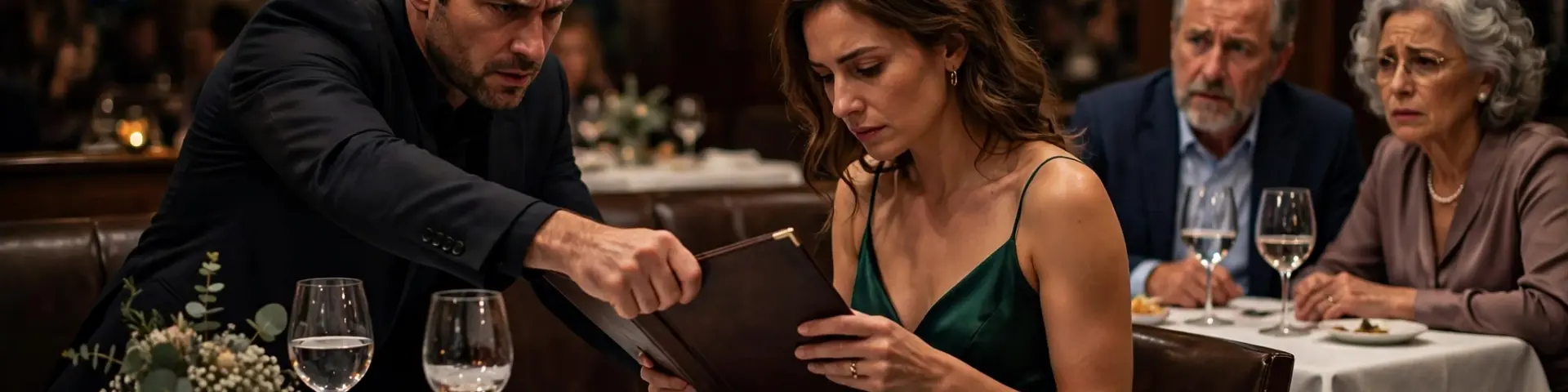
“She’s not eating. She didn’t contribute to the bill.”
My husband said it to the waiter at our tenth anniversary dinner, loud enough for the tables around us to hear every single word.
I sat there staring at the empty white tablecloth in front of me, and I thought I would have to get through the rest of the evening on willpower alone.
The waiter was still holding his order pad when Paul reached across the table and took my menu away. He didn’t ask. He just slid it out from under my hands as if it had never belonged to me in the first place.
“She’s not eating,” he said.
The young waiter hesitated, pen hovering over the pad. “Sir?”
Paul added, almost casually, as if he were commenting on the weather, “She didn’t contribute to the bill.”
For one strange second, I honestly thought it had to be some kind of anniversary joke. A bad one, but a joke. Ten years of marriage, and surely he wouldn’t do this in front of strangers.
It wasn’t a joke.
We were sitting in the steakhouse Paul had picked for our tenth anniversary. White tablecloths. Warm lighting. The kind of place where the chairs are heavy and the silverware is real and the menu doesn’t list prices because if you have to ask, you shouldn’t be there. I had dressed carefully that evening, chosen the navy dress he used to say brought out my eyes, done my hair the way he liked.
And my husband had just informed a waiter that his wife would not be ordering dinner.
“Ma’am,” the waiter said carefully, turning to me, “would you like to look at the menu?”
Paul answered before I could open my mouth.
“She’s fine.”
Then he turned back to the waiter and ordered a ribeye, medium rare, with a loaded baked potato and a side of creamed spinach. A hundred-dollar steak. He said it with the easy confidence of a man who had never once doubted that the world would serve him exactly what he wanted.
The waiter glanced at me, uncertain. “Will the lady be dining?”
Paul leaned back in his chair, completely at ease. “She didn’t bring money.”
I felt heads turn at the nearby tables. A woman two tables over stopped mid-sentence. A man put down his wine glass a little too carefully. The hum of the dining room seemed to dip, as if the whole restaurant were holding its breath.
“Paul,” I said quietly. “It’s our anniversary.”
He unlocked his phone and set it on the table between us like evidence in a courtroom. The screen glowed up at me, harsh and bright against the candlelight.
“That doesn’t change how money works,” he said.
Six months earlier, I had lost my job when my company downsized my entire department. Fifteen people gone in a single Friday afternoon meeting. I had cried in my car in the parking lot, then driven home and started updating my resume that same night.
I hadn’t stopped trying since. I sent out applications almost every single day. I went through rounds of interviews. I got close twice. I did everything right, and the job market did what it wanted anyway.
Paul told me not to take a retail job that was offered to me in month three. He said working a register would be beneath the image we had built together. He said it would look bad. He said I should hold out for something worthy of my experience.
Then, without ever discussing it with me, he separated our finances.
For years we had shared everything. The mortgage. Groceries. Gas. Utilities. Medication. One household, one team, one account that we both fed and both drew from. That was the deal we had made when we got married, and it had worked for a decade.
Suddenly his account was his and mine was mine. The problem was that six months of unemployment had drained mine to almost nothing, while his kept filling up with every paycheck.
At the table, Paul turned his phone toward me and tapped the screen.
“My account has twelve thousand dollars.”
He tapped again, and his voice carried just enough for the table beside us to hear every word.
“Yours has fourteen.”
Fourteen dollars.
“You wanted independence,” he said. “There it is.”
“I was laid off, Paul.”
He shrugged. “You should’ve found something else by now.”
The waiter shifted awkwardly on his feet. “I could bring some bread for the table,” he offered, clearly trying to defuse the situation.
Paul shook his head. “No.”
The waiter paused, thrown. Paul repeated himself, slower this time, as if speaking to someone who didn’t understand English.
“She isn’t ordering.”
I looked down at my empty place setting. No menu. No plate coming. Nothing. Just white tablecloth and the reflection of the candle flame.
I told myself to keep the evening quiet. That had become one of my habits over the previous few months: make myself small, don’t argue, don’t give him a reason to escalate. Endure.
That was the plan. It lasted about four more minutes.