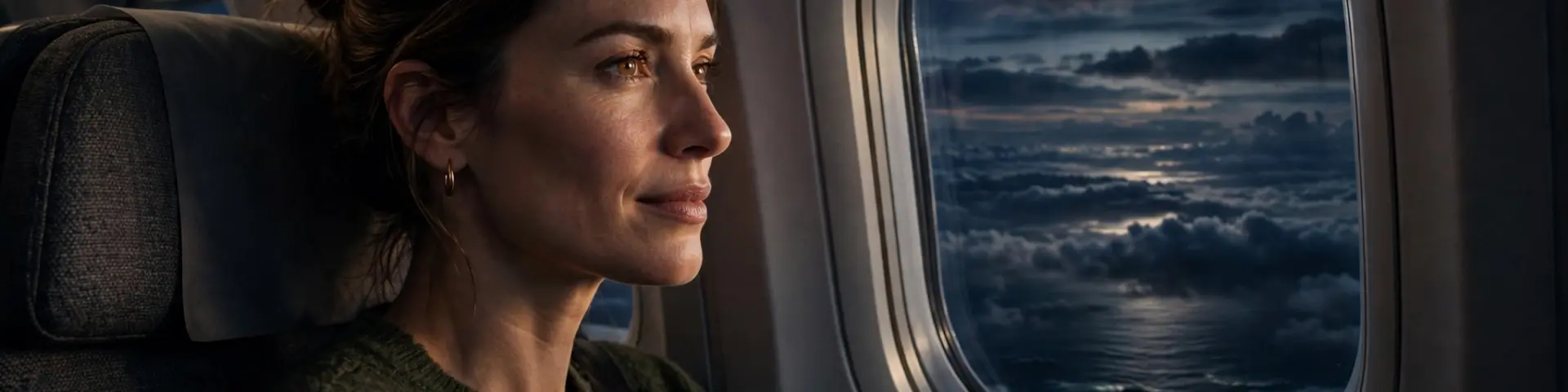
The Passenger in 8A
She had been dozing in seat 8A when the captain’s voice came through the overhead speakers, asking whether any highly trained pilots were on board. Until that moment, she had appeared to be just another passenger on an overnight flight—quiet, exhausted, and easy to overlook among the rows of travelers settling into their seats. But when she opened her eyes and calmly raised her hand, the passengers around her began to realize that the person the crew desperately needed had been sitting there all along, unnoticed.
At 36,000 feet over the Atlantic, the captain asked whether anyone on board had advanced flight-test experience. I kept my eyes fixed on the dark window beside me, watching the faint reflection of my face hover against the endless blackness outside, until the flight attendant stopped beside my seat and spoke in a quiet voice.
“Ms. Whitaker, they already know your name.”
For a moment, I wondered whether I had heard her correctly. The announcement itself had been strange enough, but this was something I hadn’t expected. I turned my head toward her, trying to make sense of what she had just said and why she looked so serious.
The cabin of Meridian Flight 602 looked almost painfully ordinary. Reading lights glowed softly above scattered seats, illuminating the occasional sleeping face or open book. A little boy across the aisle slept with his forehead pressed against his mother’s arm, completely unaware of anything happening around him. Somewhere behind me, someone was tapping steadily on a laptop keyboard, the repetitive clicking barely audible beneath the low, constant hum of the engines. Half-finished cups of coffee rested on tray tables, abandoned by passengers who had grown too tired to finish them as the aircraft carried more than two hundred people from Boston to Dublin through a moonless stretch of sky.
It was an ordinary scene, the kind I had witnessed countless times before. People were sleeping, reading, working, or simply waiting for the hours to pass. Nothing about the cabin suggested that anything unusual was happening.
And yet nothing in that familiar setting matched the expression on the flight attendant’s face.
Her name tag read JULIA.
She leaned closer to me, lowering her voice as though she didn’t want to attract the attention of the other passengers.
“The captain asked for you specifically.”
I looked down at my hands, resting quietly in my lap.
They were still.
That surprised me more than I could explain.
Five years earlier, those same hands had known the controls of nearly every aircraft Skybridge Aviation had put through certification testing. They had guided aircraft through difficult manual approaches, evaluated prototype systems, and spent hundreds of hours in simulators recreating complicated failures and unusual situations that most airline passengers would never even know existed. I had once been comfortable surrounded by unfamiliar instruments and demanding technical problems, relying on training and experience to understand what an aircraft was telling me.
I had trusted those hands. I had trusted my judgment.
Then one bad morning had ended all of it.
Or, at least, I had believed it had.
“I don’t work in aviation anymore,” I said, keeping my voice low.
Julia glanced toward the front of the cabin before looking back at me.
“He knows.”
That was worse than I had expected. If the captain already knew who I was and what I had done, then this wasn’t a misunderstanding or a casual request for assistance. Somehow, my past had caught up with me in the middle of an overnight flight across the Atlantic.
I slowly unfastened my seat belt, taking a moment longer than necessary to release the buckle.
The woman sitting beside me opened her eyes and turned toward me. Before takeoff, she had introduced herself as Beth, a school principal from Rhode Island who was traveling to visit her daughter in Galway. We had exchanged a few polite words earlier, but neither of us had expected the journey to become anything more interesting than a long, uncomfortable night in the air.
Now she studied my face with concern.
“Everything okay?” she whispered.
“I’m sure it is.”
It was the kind of lie people told when the truth would take too long to explain. Sometimes, it was easier to offer reassurance than to admit that you had no idea what was happening or what might come next.
I rose from my seat and stepped into the aisle.
Julia moved ahead of me, guiding me toward the front of the aircraft. I followed without asking any more questions, although each step brought a growing sense of unease. I had spent five years deliberately avoiding the world I was now being asked to reenter, and I had never imagined that the decision would be taken out of my hands so suddenly.
Every step toward the cockpit felt like walking backward through five years of my life.
My name is Nora Whitaker.
I was thirty-nine years old that night, although I had spent the previous five years trying to become someone whose age, résumé, and past no longer mattered. I wanted to believe that a person could leave an entire career behind, build a different life, and eventually stop thinking about everything she had lost.
I had worked hard to make that belief seem convincing.
I rented a narrow second-floor apartment outside Providence, a modest place where my routines were predictable and my surroundings rarely demanded anything unexpected of me. From a desk facing a brick wall, I edited technical manuals for an engineering publisher. Most days, I spent hours checking terminology, correcting unclear instructions, and making complicated information easier for other people to understand.
I bought groceries on Saturday mornings, called my younger sister every Sunday, and kept my life arranged around small, familiar habits. I had become particularly skilled at giving vague answers whenever someone asked what I had done before I started publishing.
Engineering.
Consulting.
Aviation work.
Those were the words I used when I needed an answer that sounded professional without inviting further questions. Each one was technically true, but none came close to explaining the life I had once lived.
Never pilot.
Never flight test.
Never Skybridge.
I avoided those words whenever I could. They belonged to a version of me I had carefully packed away, a person I had once understood completely and then spent years trying not to remember.
I had been on my way to Dublin because my sister, Rachel, had finally stopped accepting my excuses. She had been patient for a long time, allowing me to cancel plans and postpone visits while pretending that everything was fine. Eventually, even her patience had reached its limit.
“You’ve skipped Christmas twice,” she had told me over the phone three weeks earlier. Her voice had carried the unmistakable frustration of someone who had repeated herself too many times. “You missed Lily’s school concert. You mailed Mom’s birthday present instead of coming to dinner. I’m not asking you to fix your life, Nora. I’m asking you to get on an airplane and have breakfast with your own family.”
“I have work,” I had replied, falling back on the explanation I used whenever I wanted to end a conversation.
“You work from a laptop.”
“I have deadlines.”
“You always have deadlines.”
There had been a pause, and I had hoped the conversation might end there. I knew Rachel well enough to recognize when she was gathering her thoughts, and I suspected she wasn’t finished.
Then she said something that irritated me precisely because I knew it was true.
“You’re not hiding from aviation anymore. You’re hiding from everybody.”
I had wanted to argue. I had wanted to tell her that she didn’t understand what had happened or how difficult it had been to put my life back together afterward. But the words never came, because somewhere beneath my defensiveness, I knew she had identified the problem I had spent years avoiding.
So I bought the ticket.
Flight 602.
Seat 8A.
Window.
I had almost switched to an aisle seat when I noticed the aircraft type on the reservation page. For a moment, I had stared at the information, wondering whether the coincidence was worth thinking about.
A Meridian 900.
Skybridge avionics package.
My old systems.
I recognized the connection immediately. The aircraft’s systems belonged to the same technological family I had once spent so much of my life studying, testing, and evaluating. Seeing those words had stirred something in me that I had hoped was long gone.
I told myself that was exactly why I should keep the reservation. Avoiding an aircraft simply because it reminded me of my past would have meant admitting that the past still controlled my choices.
I wanted to believe I had moved beyond that.
Then, somewhere over the Atlantic, the captain asked for me by name.
Julia entered a code into the access panel and opened the cockpit door. I followed her through the doorway, and the atmosphere changed almost immediately.
The cabin had been filled with the subdued, unfocused quiet of sleeping passengers. Inside the cockpit, there was no such atmosphere. The space felt tense, but not panicked. Every movement seemed deliberate, and every person appeared to be concentrating on something specific.
Focused.
The captain sat on the left, his shoulders held rigid beneath his white uniform shirt. Beside him, the first officer studied the numbers on one display, then compared them against another, repeating the process with the careful attention of someone trying to determine which information could be trusted.
Several amber messages glowed across the center panel, their warnings standing out against the darker displays.
The captain turned toward me.
I recognized him.
“Evan Cole?”
His expression changed slightly when he saw that I remembered him. It wasn’t quite surprise, but there was a moment of recognition in his eyes, as though he had been uncertain whether I would remember the people and places from my former career.
“You remember me.”
“You sat in on one of my systems evaluations.”
“Three of them.”
I studied his face, trying to recall the circumstances of those meetings. The years had blurred some details, but his name and face had remained familiar.
“That was a long time ago,” I said.
“Not tonight.”
There was no humor in his response. Whatever history connected us, it wasn’t the reason he had asked for me. He had brought me into the cockpit because something was happening that required my attention, and the seriousness in his voice made that much clear.
He gestured toward the jump seat.
“Please.”
I sat down, fastening myself into the seat as I tried to set aside the uncomfortable thoughts crowding my mind. For the first time since leaving my own seat, I allowed myself to examine the cockpit displays properly rather than looking only at the people around them.
My stomach tightened.
There were three air-data channels feeding the aircraft’s computers. Each was providing information that the aircraft’s systems relied on to understand the conditions in which it was flying.
Two disagreed.
The third was stable.
Too stable.
“Autopilot?” I asked, keeping my attention fixed on the instruments as I tried to understand how serious the situation might be.
“Disconnected twenty-eight minutes ago,” Evan replied.
“By itself?”
“Yes.”
I let the answer settle for a moment, then moved to the next question.
“Primary flight director?”
“Intermittent.”
“Standby instruments?”
“Working.”
The first officer, a woman named Celia Grant, turned slightly toward me. Her expression was controlled, but I could see the concern behind her careful professionalism. She had been monitoring the situation long before I arrived, and whatever she had seen on those displays had prompted the crew to seek help from someone with my background.
“We’ve also had two altitude disagreement warnings,” she added.
I leaned forward in my seat, bringing myself closer to the instrument panel so I could examine the information directly.
“Show me the last ten minutes.”
Evan brought up the recorded trend page, revealing the recent behavior of the aircraft’s data channels. I studied the display without speaking, following each line as it moved across the screen and comparing its behavior with the others.
One climbed.
One dipped.
One remained almost perfectly smooth, showing none of the fluctuations visible in the other two.
Outside the cockpit windows, the aircraft was moving through a broad band of high cloud. There was no dramatic shaking or violent turbulence, just the occasional soft tremor as air passed over the wings. Nothing about the aircraft’s movement seemed especially alarming on its own, which made the conflicting information on the displays all the more important.
“Did this start after entering the cloud layer?” I asked.
Celia nodded.
“Within three minutes.”
“Temperature?”
She gave me the reading without hesitation.
As I listened, I felt something old and unwelcome begin to stir inside my chest. It was a sensation I recognized immediately, even though I had spent years trying to forget what it meant.
Recognition.
Not exactly a memory of a particular moment or a specific conversation.
A pattern.
The numbers, the timing, and the way the three channels behaved were coming together in my mind. I had encountered something similar before, under circumstances that had once changed the course of my entire career. I couldn’t yet say with certainty that we were dealing with the same problem, but the resemblance was too strong to ignore.
Evan noticed the change in my expression.
“That look,” he said quietly.
I kept my eyes on the display.
“What look?”
“The one you used to get in the simulator right before telling everyone the problem wasn’t where we thought it was.”
His words brought back an uncomfortable sense of familiarity. Apparently, some habits were difficult to erase, no matter how thoroughly a person tried to distance herself from her former life.
I stared at the steady data line for another moment, paying attention to its suspiciously consistent behavior.
“Don’t trust channel three.”
Celia frowned and glanced back at the display.
“It’s the only one not fluctuating.”
“That’s why I don’t trust it.”
The cockpit fell silent. The only sounds were the soft electronic tones of the instrument panel and the steady background noise of the aircraft continuing through the darkness. I could feel both pilots waiting for me to explain what I had seen, but I wanted to be certain of my reasoning before I said anything more.
A stable signal could be reassuring. Under ordinary circumstances, consistency was exactly what you wanted from an instrument. But if the information was inaccurate and the system had no reliable way to recognize that fact, a perfectly smooth line could be more dangerous than one that openly showed something was wrong.
Evan turned toward me, studying my face with the careful attention of someone who knew there was more behind my reaction than a technical observation.
“Nora.”
I hated hearing my first name in that room.
There was something about the way he said it that made the distance I had worked so hard to establish between my present life and my former career suddenly disappear. For five years, I had managed to keep those worlds separate. Now, sitting in the cockpit of a passenger aircraft, I was no longer simply a technical editor who happened to recognize an unusual pattern.
I was Nora Whitaker again, the person whose professional history was tied to a failure that had never been properly resolved in my own mind.