\I flipped through the pages. Dad — Founder / Managing Partner. Mom — Finance / Administration. Camille — Director of Hospitality and Brand.\
\Then came a slide titled Culinary Program — Bennett House Kitchen Team.\
\No name.\
\I stared at it long enough for the paper to begin feeling heavy in my hands. The next slide quoted the regional critic: “The menu displays remarkable restraint and technical confidence.” No chef attached. Another slide showed revenue growth after my return. No chef attached. A supplier page described “newly developed local sourcing relationships.” Those were relationships I had personally negotiated, sometimes before sunrise and sometimes after a fourteen-hour shift.\
\No name.\
\Camille came into the office while I was still looking at the pages.\
\“You’re reading the old version.”\
\I looked at her.\
\“Where am I?”\
\“In the culinary section.”\
\“There is no culinary section with my name.”\
\“We’re simplifying.”\
\“Why?”\
\She crossed her arms, a gesture I recognized from childhood arguments that she usually won by making me feel as though I was being unreasonable.\
\“Investors don’t want family clutter.”\
\I almost laughed.\
\“I am clutter?”\
\“That isn’t what I said.”\
\“What did you say?”\
\She hesitated, and for a moment I saw that she understood exactly how it sounded.\
\“Dad thinks too many family titles make the business look unsophisticated.”\
\“So you’re director of hospitality.”\
\“That’s different.”\
\“Why?”\
\“Because I’m in the meetings.”\
\There it was. The simple explanation beneath all the polished language.\
\“You’re in the meetings because Dad puts you in them.”\
\Camille’s expression cooled.\
\“And you’re in the kitchen because that’s what you do.”\
\I carried the deck to Dad. He did not look embarrassed. He looked irritated that I had noticed.\
\“It’s a pitch document.”\
\“I understand what it is.”\
\“Then why are we fighting?”\
\“Gerald asked for my biography.”\
\“He has it.”\
\“It isn’t here.”\
\“He’s investing in the restaurant.”\
\“He told you he wanted to meet the chef.”\
\Dad leaned back in his chair, his fingers resting on the edge of the desk.\
\“Mara, not everybody needs to be center stage.”\
\I went quiet.\
\That was a familiar family sentence, even if the words changed slightly each time. Camille had always been the face. At school fundraisers, she sold the most tickets because Dad drove her door to door and introduced her to every neighbor. I stayed home doing homework. At family events, she made speeches while I helped Mom arrange the food and cleaned afterward.\
\Nobody had forced me into the background. That was part of why it took so long to recognize when the background stopped being a preference and became an assigned place.\
\“Fine,” I said.\
\Dad looked relieved, as though he had been waiting for me to become sensible again.\
\I put the deck back on his desk.\
\Then I spent the next two weeks developing the showcase menu.\
\Six courses. A chilled tomato consommé with basil oil. Trout with charred leek and brown butter. A small pasta course with local mushrooms. Duck with sour cherry. A cheese course. Then a restrained dessert built around roasted pear and buckwheat.\
\Nothing existed because it sounded expensive or looked impressive in a photograph. Every ingredient had a purpose, every texture had a reason, and every course was designed to make the next one feel inevitable. I wanted the dinner to demonstrate that Bennett House could be ambitious without becoming pretentious, that the food could be memorable without relying on luxury ingredients or unnecessary complexity.\
\We tested every dish repeatedly. Luis stayed late three nights with me, adjusting temperatures and refining the timing between courses. Our pastry cook rewrote the dessert twice after the first versions proved too sweet. I met Elise at sunrise to select produce, checking the tomatoes and greens myself because I wanted the best ingredients available for the meal.\
\When one bowl arrived late from the ceramic studio, I redesigned the plating rather than compromise the timing. I built the service schedule to the minute, considering where each cook would stand, which dishes could be prepared in advance, and how long the pass could hold a plate without ruining it.\
\This was not simply a dinner.\
\It was the clearest argument I had ever made for what our restaurant could become.\
\Then, ninety minutes before the guests arrived, Dad walked into my kitchen.\
\“Stay in the kitchen tonight.”\
\Behind him stood Camille. Cocktail dress. Wine. Confidence.\
\I looked between them.\
\“What does that mean?”\
\“She’ll handle Gerald.”\
\“He wants to meet me.”\
\“You can say hello after service.”\
\“The meeting is before service.”\
\“Mara.” Dad lowered his voice, as if the quietness of his tone might make the demand more reasonable. “This matters.”\
\“I know.”\
\“Then don’t make this difficult.”\
\I looked at the pan behind me, where the cherry jus had thickened into a glossy, dark red sauce. The kitchen was ready. The team was ready. Every part of the dinner had been designed to show an investor what we could do with the right resources.\
\And the person who had built it was being told to remain out of sight.\
\I took off my apron.\
\Dad’s expression changed immediately.\
\“What are you doing?”\
\“Leaving.”\
\He laughed because he thought I was bluffing. He had spent years assuming that, no matter what happened, I would eventually return to the work that needed doing.\
\Camille did not laugh.\
\“Mara.”\
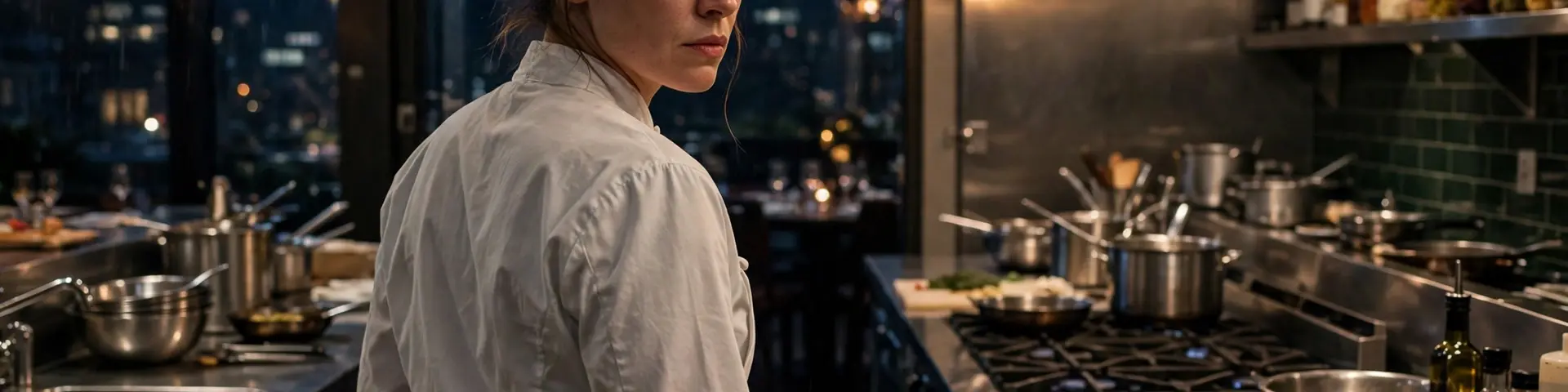
\I folded the apron once and placed it on the stainless-steel counter. Luis, working six feet away, stopped chopping. The entire line seemed to feel the shift, even before anyone understood what it meant.\
\Dad’s voice sharpened.\
\“You cannot walk out before this dinner.”\
\I looked at him.\
\“You just told me I’m not part of the meeting.”\
\“You’re responsible for the food.”\
\“I developed the concept Gerald is evaluating.”\
\“And now you need to execute.”\
\I nodded slowly. The answer was so revealing that I almost wished he had said something crueler. Cruelty would have been easier to dismiss. This was simply the way he understood my place in the world.\
\“So Camille gets the future.”\
\“I provide the proof.”\
\“That is not what I said.”\
\“No.” I looked at the presentation deck resting on a nearby shelf. “It’s what you printed.”\
\Dad followed my eyes. His face hardened.\
\“I am trying to protect this opportunity.”\
\“From what?”\
\He did not answer.\
\I did.\
\“From the chef looking too much like the reason the opportunity exists?”\
\Camille whispered, “That’s unfair.”\
\I turned to her.\
\“Then tell Dad I belong in the meeting.”\
\She said nothing.\
\There was my answer.\
\I picked up my bag. Dad stepped toward me, his shoes making a sharp sound against the kitchen floor.\
\“If you leave now, you are walking away from this family’s future.”\
\I opened the kitchen door.\
\“No.”\
\I looked back at him one last time.\
\“I’m walking away from being useful enough to build it and invisible enough not to share it.”\