\
The Kitchen Was Never the Insult\
\My father said it as casually as if he were reminding me to turn down the ovens before closing for the night.\
\“Stay in the kitchen tonight.”\
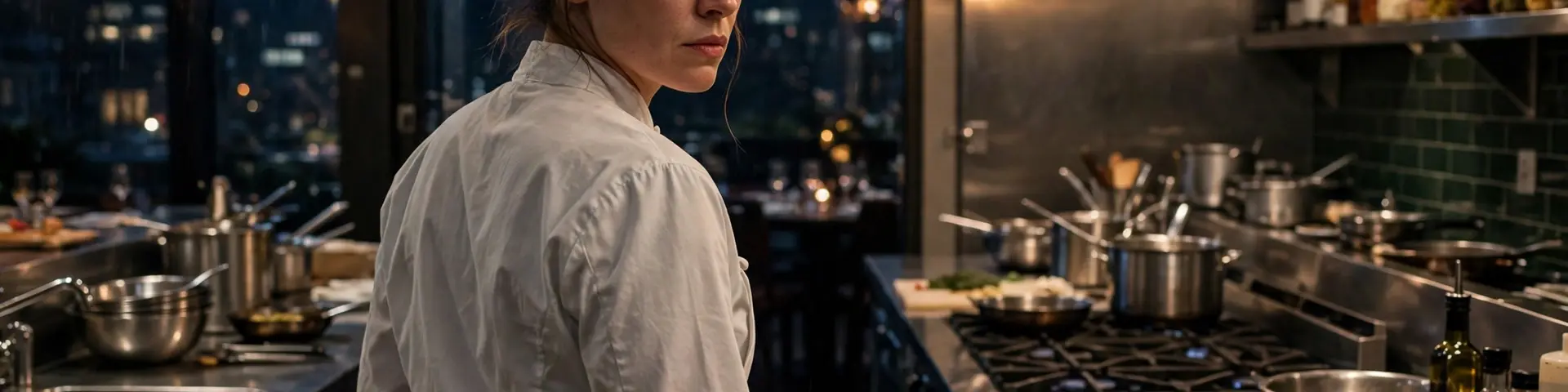
\I stood at the pass in my chef’s whites, a tasting spoon in one hand and a pan of reduced cherry jus simmering behind me. The kitchen was warm with the familiar smells of roasting meat, herbs, butter, and stock that had been reducing for hours. My team moved around me with the practiced rhythm we had spent three years developing. Knives tapped against cutting boards. A timer chimed near the pastry station. Someone checked the temperature of the trout.\
\Ninety minutes remained before the most important dinner our family restaurant had ever served. Everything had been planned down to the smallest detail, from the temperature of the plates to the timing between courses. We were preparing to host Gerald Foss, an investor whose potential commitment could transform the restaurant from a struggling family business into something none of us had dared imagine when I first came home.\
\I thought I had misheard my father.\
\“What?”\
\Dad adjusted the cuff of his new dress shirt, looking down at the fabric as though he had discovered a wrinkle that required his immediate attention.\
\“Camille will handle Gerald and his people.”\
\My older sister stood behind him in a black cocktail dress, already holding a glass of white wine. Her hair had been professionally blown out, every strand falling into place. She wore the pearl earrings Mom normally kept locked in her dresser, the ones reserved for weddings, anniversaries, and other occasions that supposedly mattered.\
\Camille did not look surprised.\
\That was when I realized the conversation had happened before I entered it. The decision had already been made. They had discussed it, agreed on it, and settled on how to tell me. I was the last person to know, even though the dinner depended on the work I had spent weeks preparing.\
\I set the tasting spoon on a folded towel.\
\“The investor asked to meet the chef.”\
\“He’s meeting the family,” Dad replied.\
\“I am the chef.”\
\He exhaled through his nose, the familiar sound he made when he believed I was turning something simple into an unnecessary problem.\
\“Mara, please don’t start.”\
\My name is Mara Bennett. I was twenty-six that year, and for three years I had been starting nearly everything that mattered inside Bennett House.\
\Before that, it was not called Bennett House. The sign over the strip-mall entrance read BENNETT FAMILY GRILL in red letters that had faded to pink on the western side. My parents had owned the place for eleven years. Eleven years of burgers, pot roast, meatloaf, chicken sandwiches, and lunch specials written on a chalkboard near the entrance. Eleven years of trying to keep the lights on, pay the suppliers, cover payroll, and earn just enough revenue to make closing the doors feel slightly more frightening than continuing to open them every morning.\
\My father believed the problem was location. He blamed the strip mall, the parking lot, the lack of foot traffic, and the newer restaurants that had opened along the main road. Mom blamed food costs. She could explain the rising price of cooking oil and beef with the precision of someone presenting evidence in court. My sister Camille believed the restaurant needed better branding, more polished social media, and a clearer identity.\
\The truth was simpler, and it was the one nobody wanted to hear.\
\The food was forgettable.\
\I could say that because I had grown up eating it. I had spent countless childhood evenings at a table in the corner, listening to my parents discuss bills while plates of ordinary food passed through the dining room. I knew the recipes by heart, and I knew their limitations just as well. There was nothing terrible about the food. That was part of the problem. Nothing was memorable enough to bring people back when they had other choices.\
\By twenty-three, I had graduated from culinary school near the top of my class. I had worked doubles in a serious downtown kitchen, learned to function through exhaustion, and spent nearly two years learning under chefs in New York who expected precision even when the entire kitchen seemed determined to fall apart. I had also completed one difficult season in Lyon, where I shared a tiny apartment with four other cooks and learned more in six months than I had in some entire years of school.\
\Those years had been exhausting, expensive, and occasionally miserable. They had also been mine. I had earned every opportunity through long hours, burned fingers, difficult corrections, and the willingness to start over when a dish was not good enough.\
\I had plans. They did not include going home to rescue a family restaurant in a strip mall.\
\Then Dad called.\
\I was standing outside a restaurant in Brooklyn at nearly one in the morning, eating staff meal from a plastic container because I had missed dinner again. The alley smelled of rain, old brick, and the faint sweetness of garbage waiting for collection. My feet hurt, my jacket was too thin for the weather, and I was already calculating how many hours of sleep I could get before my next shift.\
\“We’re going under,” Dad said.\
\My father was not a man who admitted weakness easily. He usually presented problems as temporary inconveniences, things that could be solved with a phone call, a better schedule, or a little more work.\
\“What does that mean?”\
\“Three months, maybe four.”\
\I leaned against the brick wall and looked down at the container in my hand.\
\“Have you talked to the landlord?”\
\“Yes.”\
\“The bank?”\
\“Yes.”\
\“The accountant?”\
\“Yes.”\
\Silence stretched between us. I could hear the faint sound of traffic beyond the alley and someone laughing on the other side of the building. Dad rarely called me just to talk, and he had never asked me for help without first explaining why he had everything under control.\
\Finally, he said, “I need you.”\
\He had never said those words to me before. Not like that. Not without a qualification or an explanation that made the request sound like an obligation rather than an admission.\
\So I came home.\
\At first, the agreement sounded clear. I would take over the kitchen. Dad would continue handling ownership and operations. Mom would keep the books. Camille, who worked in event marketing, would help with social media and special dinners. We would give the restaurant six months. If we could not turn it around, my parents would sell the equipment and walk away with whatever remained.\
\Six months sounded reasonable. It was long enough to change the food, rebuild the menu, and see whether customers would respond. It was short enough that I could return to my own career if the experiment failed.\
\I spent my savings on things the restaurant could not initially afford. New knives. A secondhand immersion blender. Smallwares and better storage containers. A vacuum sealer I bought from a restaurant that had closed across town. I kept every receipt in a folder because I knew the business was struggling, and I did not want to add expenses without understanding exactly where the money was going.\
\Then I changed the menu.\
\That created our first family fight.\
\Dad stood in the kitchen holding the old laminated menu as if I had insulted an ancestor.\
\“You’re removing the meatloaf?”\
\“Yes.”\
\“We’ve served that meatloaf eleven years.”\
\“That is not automatically an argument for continuing.”\
\He stared at me, apparently waiting for me to realize how unreasonable I sounded.\
\“People like it.”\
\“Six people like it.”\
\“We know all six by name.”\
\Mom laughed from the office doorway. Dad did not.\
\I kept the burger, but I changed the beef, found a better bun, and started making the pickles in-house. I cut the number of entrées almost in half so we could concentrate on fewer dishes and execute them properly. I bought local mushrooms from a farm forty minutes outside town and found a dairy that made cultured butter worth building an entire bread service around.\
\I also negotiated with a farmer named Elise, who arrived every Thursday before dawn with greens that still smelled like the field. Her produce had a freshness our old suppliers could not match, and she was willing to work with us on quantities as long as I paid her on time.\
\Those relationships mattered. They gave me ingredients I could trust, but they also forced me to understand the business beyond the kitchen. I learned how to forecast demand, calculate waste, manage invoices, and build menus around seasonal availability rather than wishful thinking.\
\I retrained the line. Two cooks quit because they did not want to learn new techniques or work under a different system. Three stayed. One of them, Luis Ortega, had worked for Dad almost nine years. He knew the kitchen’s old habits better than anyone, including which refrigerator door stuck in humid weather and which burner needed an extra minute to heat.\
\Nobody had ever shown Luis how to break down fish properly, but he learned faster than anyone I had trained in New York. He watched carefully, asked thoughtful questions, and practiced until his movements became clean and efficient.\
\“Why didn’t you tell us you could do this?” I asked him one morning.\
\He shrugged without looking up from the cutting board.\
\“Nobody asked.”\
\That sentence stayed with me. It was simple enough to forget, yet it captured something I was only beginning to understand about the restaurant and my family. People could have skills, ideas, and abilities that remained invisible simply because nobody had bothered to look for them.\
\Within four months, weekend sales doubled. Within eight, reservations became necessary on Fridays and Saturdays. The chalkboard lunch specials disappeared. In their place came a small dinner menu and, eventually, a six-course tasting option that Dad had called ridiculous until it began selling out.\
\Customers started traveling from neighboring towns. Some returned with friends. Others began celebrating anniversaries and birthdays with us because the restaurant had become a place where an ordinary dinner could feel like an occasion. The dining room was still modest, but the atmosphere changed as the food improved. People lingered. Servers talked about the dishes with genuine enthusiasm instead of reciting descriptions they had memorized.\
\A regional food critic came anonymously. None of us knew until the review appeared.\
\QUIETLY EXTRAORDINARY, the headline said.\
\I printed it and carried the page into the kitchen. I read the review twice, trying to absorb the fact that someone who had no reason to flatter me had noticed the work. Mom framed it. Dad bought twelve copies of the magazine. Camille posted the review online beneath a photograph of herself standing in the dining room, smiling toward the camera.\
\I noticed.\
\I said nothing.\
\That became a pattern. I developed. Camille presented.\
\At first, I did not mind. I had never wanted to be the public face of anything. The kitchen was where I felt comfortable, where the expectations were clear and the work had measurable results. There was order in prep lists and truth in ticket times. You either had enough sauce for service or you did not. A fish was cooked properly or it was not. A dish could not be rescued by a confident smile or an impressive title.\
\Dining rooms contained more ambiguity. Compliments. Status. People pretending to like something because somebody influential had ordered it first. Conversations in which the person speaking seemed more concerned with being seen than with understanding what was on the plate.\
\Camille loved that world, and she was good at it. She remembered names. She knew which local reporter preferred red wine and which business owner disliked being photographed without warning. She understood when to approach a table with a friendly question and when to leave people alone. She could make a room feel welcoming without appearing to work very hard at it.\
\There was room for both of us. At least, that was what I believed.\
\Then Gerald Foss called.\
\Gerald had built a reputation investing in independent restaurants before they became groups. He had financed three chef-driven concepts in different cities and exited two with enough success that my father started calling him “Mr. Foss” before they had ever met. To Dad, Gerald represented more than money. He represented the possibility that Bennett House could become something respected, something that might finally prove all those difficult years had been worth enduring.\
\Gerald did not contact Dad first. He contacted the magazine critic. Then Elise, our farmer. Then one of our suppliers. Finally, he emailed the restaurant asking for the chef.\
\Dad answered.\
\That should have bothered me. It did not. I was busy preparing for dinner service and trying to solve a problem with a supplier’s delivery schedule.\
\Gerald’s team visited twice without introducing themselves. They studied the room, ordered broadly, and asked the servers unusual questions about turnover and training. They wanted to know how often dishes changed, how much produce we discarded, how long our cooks stayed, and whether customers returned because of particular menu items.\
\Then a formal inquiry arrived.\
\Potential capital commitment: Up to $5 million.\
\The plan was ambitious. Renovate Bennett House. Expand the dining room. Create a private tasting space. Eventually open a second location if performance supported it. The money would provide the opportunity to build on what we had already accomplished instead of struggling every month to pay for the next improvement.\
\Five million dollars.\
\Dad printed the number and carried it into the kitchen. For the first time in years, he looked younger than he had the previous morning. He held the papers with both hands, as if the possibility might disappear if he set them down.\
\“Mara.”\
\I read the first page, then looked at him.\
\“This isn’t an offer yet.”\
\“It can become one.”\
\“It says due diligence.”\
\“I know what due diligence means.”\
\“Apparently not, because you’re holding this like a lottery ticket.”\
\He laughed. Then he hugged me.\
\That should have been one of the best moments of my life. Maybe it was. For a little while, I let myself believe that we were finally moving toward the same future, that my work and my family’s pride in it could exist together without either one threatening the other.\
\Gerald’s team requested financial statements, labor data, supplier contracts, reservation history, guest checks, press coverage, and a chef biography. That last item was where the trouble began.\
\I wrote my biography myself. I included my training, the restaurants where I had worked, my time in Lyon, and my philosophy about menus and seasonal ingredients. I avoided words like visionary and revolutionary because I had never found them useful. I described what I did and why I did it. Then I sent the document to Dad.\
\A week later, I walked into the small office behind the dining room and found a presentation deck sitting on the printer.\
\INVESTMENT SHOWCASE — BENNETT HOUSE.\