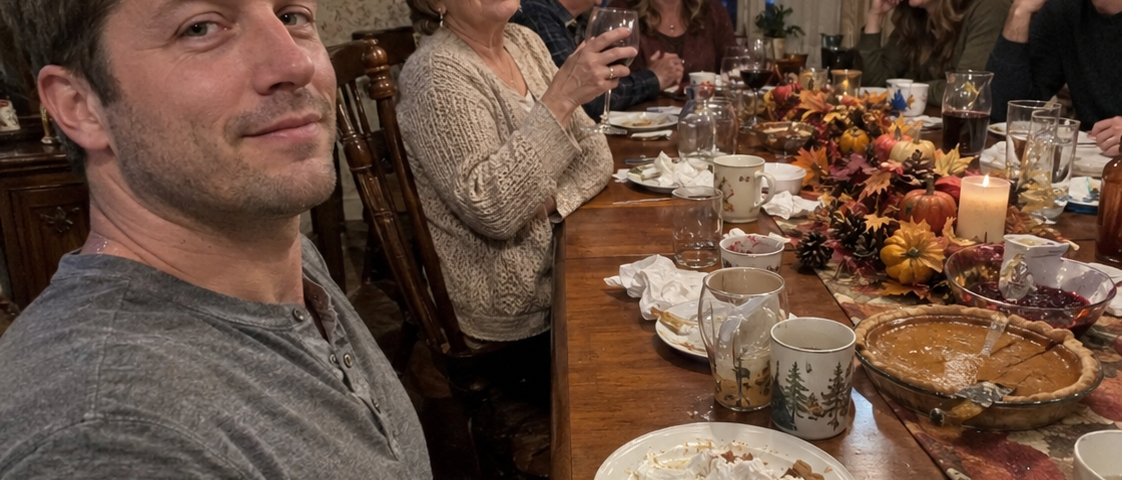
She was in her element, a hostess with an audience.
“Do you remember,” she said with a bright laugh, “when Ethan spilled that entire pot of soup across the kitchen floor? I thought we’d never get the stains out. Always so clumsy.”
A ripple of uncomfortable laughter moved through the room. Eyes flicked toward me with sympathy, amusement, or indifference.
I forced a smile, but the memory cut sharper than her words.
I had been eight years old, nervous and small, trying to carry a pot heavier than I was, my arms shaking with the effort while she watched instead of helping, and then the telling of it, the retelling of it, year after year, until the spilled soup became my origin story in her mouth.
What she didn’t mention was Emily, four years later, dropping an entire tray of glasses and being ushered into a hug, told not to worry, her mistake wrapped in tenderness and dissolved before it could become a story.
One mistake became a family legend. The other dissolved into silence.
I felt my face flush, though the fire was burning across the room, and I clenched my glass tighter, willing myself to stay steady, to not give her the satisfaction of seeing the crack.
A voice cleared from the corner. Aunt Carol, with her ever-watchful eyes, tilted her head.
“But Ethan, didn’t you also win the statewide debate championship that same year? I remember reading about it.”
I nodded once, keeping my voice measured. “Yes, I did.”
The spotlight shifted for a heartbeat, and warmth flickered in my chest, but my mother swooped in before it could take hold, quick and practiced as a magician’s hand.
“Of course, Emily had her recognition, too. Do you all know she was commended by her medical school just last month? Such dedication.”
The conversation rolled back into its well-worn tracks. Emily at the center, me fading out from the armchair near the window.
Uncle James adjusted his glasses. “I still remember Ethan in that swim meet,” he said clearly. “Local paper even put your photo on the front page, didn’t they? Not many teenagers can pull that off.”
The room stuttered for a second as though the script had been misplaced, a small gasp of genuine surprise rippling through the rehearsed air.
My chest lifted again, only to have my mother step in, quick as a tide sweeping sand.
“And Emily just got chosen to lead her research group,” she said with a triumphant smile, her words smothering his.
I sat back, quiet, watching the pattern repeat, the same choreography I’d watched my whole life, and I felt the strange grief of seeing it so clearly and still being unable to stop it.
Every time my name surfaced, it was redirected, replaced, diminished. My successes were footnotes in a book that always returned to the same heroine.
Inside, I felt myself sliding back, as though the years had folded, and I was again a boy at that table, hearing laughter at my expense, hearing silence when I needed someone to defend me.
The edges of the room blurred, and I heard Dr. Keane’s voice from our last session. “They will try to rewrite history, Ethan, but you own your truth. No one can take that unless you hand it over.”
I steadied my breathing, focusing on the glass in my hand, on the cool weight of it, on the present moment I could actually hold.
Let her tell the stories. I knew what really happened. And this year, I wasn’t going to let myself forget.
The fire crackled in the fireplace, throwing restless light across the mantel, and I watched the flames for a while, letting the warmth reach my face while the cold of the old stories worked its way out of my chest.
Outside the window, the sky had gone fully dark, and the glass reflected the room back at me: the guests, the laughter, my mother’s bright, commanding smile.
I saw myself in that reflection too, small in the corner armchair, and for the first time, I felt something other than shame looking at that small figure. I felt something like tenderness, like protectiveness, toward the boy I had been.
He had survived all of this, I thought. He was still here.
When the call for dinner came, we filed into the dining room, the procession as formal and ordered as everything else in that house.
The long table gleamed under the golden glow of the chandelier, polished silver glinting against white lace, every surface reflecting light in a way that felt less like welcome and more like surveillance.
A centerpiece of dried flowers and miniature pumpkins stretched down the middle, as though curated for a magazine shoot, beautiful and untouchable.
The scent of turkey and stuffing wafted up from the serving dishes, rich and heavy, filling the room until the air itself felt saturated.
We took our seats according to the place cards my mother had arranged with precision, each card a small verdict on where you stood in her world.
She sat at the head of the table, Emily on one side with Michael and their baby, me on the other end, a deliberate distance away, as far from the center of warmth as the table allowed.
My father lowered himself into the chair with the kind of careful silence that had always defined him, folding himself small, already retreating.
Before plates were served, my mother folded her hands. “Let’s continue our tradition,” she announced. “Each of us will share what we’re thankful for this year.”
I leaned back, anticipating the ritual. It was never about gratitude. It was about performance, about coded messages slipped between polite words.
She began first, as always, setting the terms before anyone else could.
“I am grateful for this family, for Emily and Michael, who bring so much joy with their visits and their devotion. They are a blessing in every way. It’s rare to have children who understand the importance of staying connected, of putting family first.”
Her eyes flicked toward me briefly, the implication sharp, a blade passed with a smile.
My father spoke next, voice calm and general. “I’m thankful for health, for safety, and for the chance to be together.”
His words floated above the table like smoke, never settling anywhere, committing to nothing.
Emily smiled sweetly, holding her baby’s hand. “I’m thankful for having a family that’s always supportive and loving.”
She angled her glance toward our mother, who beamed back as if it were scripted, and perhaps it was.
Michael followed, his tone warm but calculated. “I’m thankful for tradition, for being part of a family that has always been so strong and united.”
His eyes flicked briefly to me, and I recognized the gesture for what it was: a quiet alignment with my mother’s narrative, a new recruit pledging allegiance.
Then it was my turn. The silence pressed down, expectant.
I folded my hands on the table and kept my voice even. “I’m thankful that this year I’ve learned to grow and to understand the importance of setting boundaries.”
The words landed like a stone dropped into still water, ripples spreading outward in widening rings.
My mother’s mouth twitched into a smile that didn’t reach her eyes. “How succinct,” she said, a trace of mockery in her tone. “Not everyone has as much to be thankful for, I suppose.”
Polite laughter rippled around the table, brittle and brief, the sound of people obeying a cue.
Heat spread in my chest, but I didn’t break eye contact. Her gaze lingered on me, sharper than the carving knife by her plate.
For a second, the mask slipped, and I saw irritation flash beneath the surface. She had heard the challenge buried in my words, and she didn’t like it.
Conversation stumbled on, but the air felt heavier. Plates of turkey were passed, glasses refilled, yet beneath the clinking silverware and soft chatter, tension pulsed, steady and undeniable.
I lifted my fork and chewed deliberately, tasting sage and bitterness in equal measure.
Boundaries, I thought. I had spoken the word out loud, and though the table might have laughed, the truth had already shifted something inside me.
This dinner was far from over, and I could feel the storm gathering in the spaces between each polite exchange.
The turkey was carved with ceremony, thick slices fanned onto the good platter, and the dishes began their slow procession around the table, each handoff accompanied by murmured thanks that sounded thinner with every pass.
The baby babbled and grabbed at a roll, and everyone laughed with genuine warmth for once, the only unscripted moment of the evening so far.
I watched Emily soothe him with the easy competence of a mother, and I wondered what it felt like to be on the receiving end of my mother’s pride, whether it warmed you or only taught you to keep performing.
Michael refilled my mother’s wine glass before his own, and she touched his hand in thanks, and I filed the small gesture away: this was how you earned a place at her table, by serving the queen.
The meal stretched on. Plates passed down the table, glasses filled and refilled. Conversation lifting and dropping like waves.
From the outside, it might have looked like any Thanksgiving. Silverware clinking, polite laughter, the baby fussing and then quieting again.
But beneath it all was a tension so thick I could feel it in the back of my throat, sharp as vinegar.
When the first slices of pie were served, my mother leaned back in her chair, her glass of wine held elegantly in her hand.
The room was hers again, and she wielded it the way she always did: by slipping stories into the air, dressed in nostalgia, designed to cut.
“There was a time,” she said, smiling faintly, “when Ethan spilled gravy all over your grandmother’s tablecloth. Eight years old and still so clumsy. It ruined the whole meal.”