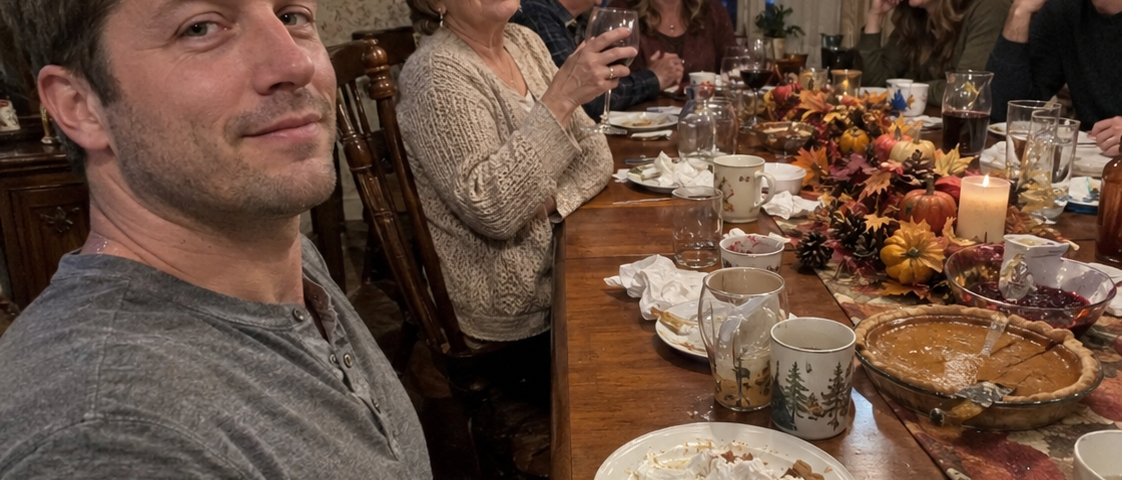
The laugh that followed wasn’t full. It was strained, pressed out of people who didn’t want to be rude.
My cheeks burned anyway, and I felt the old shame rise up like a tide, familiar and sickening.
I remembered that night in detail, when the heavy silver boat slid from my small hands, the stain blooming across the linen like a bruise spreading, the silence that followed, and then her voice, retelling it at every gathering for the next two decades.
But what no one mentioned was that Emily had dropped a glass that same evening, shards scattering across the floor, and she’d been swept into a hug, soothed with words about accidents.
My mistake became a family anecdote. Hers dissolved into thin air.
I forced myself to breathe evenly, but my skin felt hot, as if every eye in the room had turned toward me.
From across the table, Aunt Carol cleared her throat. “But I also recall Ethan winning the state swimming scholarship.”
She set her tone firm, as if daring anyone to contradict her. “Not everyone can manage that kind of discipline.”
For a flicker of a second, silence held, and something in my chest lifted, a small, startled hope.
I nodded, slightly grateful, but before the air could shift, my mother stepped in, her words smooth and decisive.
“Emily also earned an award for her medical research, and her paper was even featured in the university’s journal. Quite an achievement, really.”
Heads turned, nods followed, and once again the spotlight swung back to where she wanted it.
Uncle James, usually reserved, leaned forward this time. His voice cut through the chatter, steady and deliberate.
“I think we ought to recognize that this family has more than one talented child. Ethan has accomplishments plenty of people could only dream of.”
The air thickened. Knives paused over plates, forks hovered in midair.
My father shifted uncomfortably. Emily kept her eyes on her napkin, and Michael studied the turkey on his plate as though it were fascinating.
My mother’s hand tightened around the stem of her glass.
A warmth bloomed in my chest. For the first time in years, someone at that table had said it plainly, refusing to let my achievements be erased.
Yet, even as I felt that spark of recognition, fear traced the edges of it. I knew my mother. I knew the way she would tighten her grip when challenged.
She would not let this go unanswered.
As I looked around the table at the tense smiles and lowered gazes, a thought pressed against my ribs. This was only the beginning.
The real storm hadn’t broken yet. It was waiting just beyond the last bite of pie.
Coffee was poured into the good cups, the ones with the thin gold rims, and the pie plates were cleared with the same brisk efficiency, my mother’s kitchen running like a well-drilled machine.
I watched her move through it all, refilling, serving, directing, and I thought about how much energy it must take to maintain this level of control, to keep every plate and every person exactly where she wanted them.
For a flickering moment, I felt something almost like pity. Almost.
Then she settled back into her chair, lifted her wine glass, and I saw the particular gleam in her eye that I had learned to dread, the look of a woman about to say the thing she had been saving.
The plates were cleared, fresh cups of coffee poured, and slices of pie set down before each of us.
The chandelier glowed warmly overhead, but the heat in the room was heavier than the oven’s work, thick with everything unsaid.
I lifted my fork, tasted the sweetness of pumpkin and spice, and tried to steady the beat of my pulse.
My mother’s voice slipped back into the center, smooth and casual.
“Ethan was always difficult,” she said, as though she were commenting on the weather. “He cried through the nights, ruined our sleep, made us cancel so many plans.”
She dabbed her lips with her napkin, eyes sweeping the table, gathering her audience.
“We even had to cancel our trip to Europe because of him. Everything changed after that.”
The room dimmed around me, though the lights had not shifted, and I felt the floor tilt beneath my chair.
A few guests chuckled nervously and thinly, as though unsure whether they were supposed to laugh.
My chest tightened. My ears filled with a rushing sound, the roar of blood, of thirty-two years of holding still under fire.
Then her words dropped like a stone.
“Ethan was a mistake. Sometimes I wish he had never been born.”
For a moment, I thought I had misheard her. The words seemed too large, too final, to have come out of her mouth in that tone, in that room.
But the uneasy laughter that followed confirmed it. A handful of people chuckled along, perhaps thinking it was a joke, perhaps too afraid not to.
My fork froze midair. My heartbeat thundered so loud I felt it in my fingertips.
Slowly, deliberately, I set the utensil down beside my plate, aligning it neatly with the edge of the porcelain, my hands moving with a calm that surprised even me.
My lips curved into a smile that wasn’t polite, wasn’t forced. It was something steadier, carved from a place I hadn’t touched before.
I looked straight at her. “Now I understand,” I said, my voice calm and clear. “You never wanted to be my mother at all.”
The silence that fell was absolute.
My father’s face went pale, his eyes fixed on me as though seeing me for the first time.
Emily’s mouth opened slightly, her gaze darting between us, while Michael lowered his head, staring at his plate.
Aunt Carol pressed a napkin to her lips. Uncle James leaned back in his chair, a small, satisfied curve at the corner of his mouth.
And my mother, Linda Walker, sat frozen. Her knuckles white around the stem of her glass, her lips trembling, though no sound emerged.
The mask she had worn for decades cracked, and in that fracture was a silence louder than any word.
The room held its breath. For once, no one laughed.
For once, I hadn’t swallowed my anger or shrunk into the background. I had spoken the truth she had tried to bury for thirty-two years.
I knew as I looked at her across the table that something fundamental had snapped. Whatever held me chained to her approval had broken.
The silence was ice. The air sharp.
She would never forgive me for it. But in that moment, I didn’t care. I had cut the cord myself.
The silence after my words was unbearable, stretching so long I could hear the tick of the grandfather clock in the hallway, each second landing like a footstep.
Forks rested on plates. Steam rose faintly from untouched cups, but no one moved.
The air was thick with something that had no name. Equal parts shock and recognition.
My father cleared his throat, his voice awkward as it broke the stillness. “Maybe, maybe we could all use some more coffee.”
His attempt at normalcy fell flat. Not a single chair shifted. Not a hand reached for the pot.
I laid my napkin gently on the table, the gesture deliberate, a period at the end of a very long sentence.
“Thank you for dinner,” I said, my voice steady. “I think I should go.”
Emily’s voice caught from the other end of the table. “Ethan.”
She didn’t finish, eyes brimming with words she couldn’t say, and I saw in her face a flicker of something I hadn’t expected: not anger, not judgment, but a dawning recognition, as though she were seeing the machinery of our family for the first time too.
Then my mother’s voice cracked, the stillness stripped of her usual poise. “Your room is still upstairs. Why leave?”
Her tone trembled as though disbelief could pull me back, as though the room upstairs with its faded posters were a rope she could throw.
I met her eyes without flinching. “I booked a hotel. I need my own space.”