I scrolled past Emily’s worried note from the night before, past James’s short message of pride, past Carol’s gentle reminder to text when I arrived.
Then came the words from my father, sent long after I had turned the screen black.
“Your mother is very disappointed.”
It was exactly what I expected. No apology, no reflection, just the same cycle pressed onto me.
For years, those words would have crushed me, made me scramble to repair the damage, made me pick up the phone and perform contrition for a crime I hadn’t committed.
But this time, my fingers didn’t tremble.
I opened a new message, my hands calm as I typed.
“You spoke your truth. I spoke mine. I will not apologize for refusing silence. If one day you want a relationship built on honesty, I will be here. If not, I will still live well.”
I pressed send, then turned the phone face down.
A quiet finality filled the room, not sharp, but clean.
That was the end of it. The battle wasn’t about forcing her to admit fault. It was about me refusing to play the role of the child who always made peace by erasing himself.
I packed my bag, deliberately folding clothes with care, sliding my laptop into its sleeve, zipping the suitcase closed, each small act of order a quiet assertion that my life was mine to arrange.
At the front desk, I checked out with a polite nod. The clerk’s voice was cheerful as she wished me safe travels.
Outside, the cold air rushed against me, carrying the faint smell of frost and distant chimney smoke.
I paused on the sidewalk, drew a deep breath, and let it fill me from the inside out.
The sky was pale blue, strewn with white clouds, the kind of morning that promised clarity.
As I stepped toward my car, I knew the longest war of my life had ended, not with her surrender, but with mine.
I had surrendered the need for her approval. And in doing so, I had finally won.
A year later, the Cascade Mountains loomed outside my window, their peaks dusted in white under a crisp Washington sky.
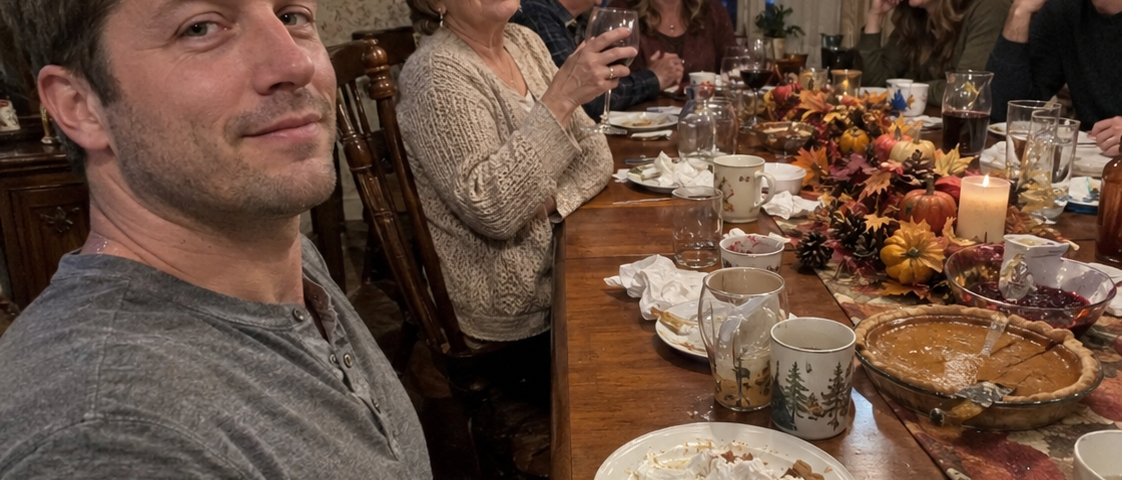
Inside my Seattle apartment, the oak table was set with a gray cloth, fresh flowers in a glass vase, and candles flickering soft light across simple plates.
The air smelled of roasted chicken and rosemary, laughter drifting in from the kitchen where friends and family stirred pots and poured wine.
Max lay stretched under the table, his head resting on my foot, his body warm and grounding.
He lifted his ears now and then when the oven timer beeped or someone called out, but mostly he stayed still, a steady presence.
The guests gathered slowly. Aunt Carol with her gentle smile. Uncle James with his steady handshake.
Emily, without Michael, carrying herself lighter than I had seen in years.
A couple of close friends filled the seats, their voices mingling easily with my family’s.
No sharp edges, no comparisons.
The room pulsed with something unfamiliar yet comforting. Ease.
Emily sat beside me, passing me the bread basket with a small grin. “It feels different here,” she said softly, almost to herself. “Like I don’t have to perform.”
I met her eyes. There was a quiet honesty there, a loosening of the grip our mother had held over her.
“You don’t,” I replied. “Not anymore.”
She nodded, her voice dropping even lower. “I spent years thinking being the favorite was a gift, but it was a cage, too. Mom always wanted me to shine in the way she chose. I’m tired of it. I want to live for myself now.”
I reached for her hand, briefly, squeezing once. “Then live for yourself. No one else.”
Around the table, the meal unfolded with laughter and easy conversation. No one was measured against another. No one’s story was cut short or redirected.
Plates were filled, glasses clinked, jokes landed without barbs.
For the first time, I realized a holiday dinner didn’t feel like a performance or a battlefield.
My father still called every few weeks, his voice quiet, careful, as though navigating a minefield he couldn’t name.
My mother had never sent another word. Her silence remained, but instead of bleeding, it had become a hollow space I could live with.
Some voids you learn not to fill.
As dessert was brought out, an apple tart my friend had baked, I looked around the table.
The candlelight reflected in every face. People who had chosen to be here, who showed up not out of obligation, but care.
Peace stole over me, not in a rush, but in a steady settling.
I understood then what I had been chasing for so long. Healing didn’t arrive when she changed, because she never would.
Healing came when I stopped asking for what she could not give.
I raised my glass, my voice steady and sure. “To family,” I said, pausing to let the word linger. “The kind we’re born into and the kind we build ourselves.”
Around me, glasses lifted. “To family,” they echoed, warmth filling the room.
I looked at them, Carol, James, Emily, and my friends, and felt something solid anchor inside me.
This was family. This was mine.
The old door I had walked out of was gone behind me. But in its place stood another, wide open, waiting.
And as the laughter rose again, I realized I had already stepped through it.
The evening wound down slowly, the way good evenings do, with no one in a hurry to leave and the candles burning lower and lower in their holders.
When the guests finally began to gather their coats, Emily lingered at the door and hugged me longer than she had in years, her cheek warm against mine.
“Thank you,” she whispered, and I didn’t ask her what for. I knew.
After everyone had gone, my friends and I cleared the table together, stacking plates and laughing over the last of the wine, and Max wove between our legs, hoping for dropped scraps.
Standing in my own kitchen, in my own home, surrounded by the easy mess of a dinner that had belonged to everyone at the table, I felt the last of the old weight lift off my shoulders and drift away like steam.
Looking back now, I see that the hardest part wasn’t walking out of that house. It was walking out of the role I had carried my entire life.
For years, I thought love meant silence. That family meant swallowing pain so others could stay comfortable.
But real love doesn’t erase you. Real family doesn’t demand you disappear.
I learned that freedom comes the moment you stop apologizing for simply existing.
If you’ve ever felt like the outsider in your own home, I want you to know you’re not alone.
There’s strength in setting boundaries, even when it feels terrifying. There’s peace on the other side of letting go.
Thank you for listening to my story and for sharing this space with me. It still feels raw, but it matters.
If any part of it resonates with you, I would love to hear your thoughts in the comments below — and follow along so more of these stories can keep finding the people who need them.
Your presence reminds me, and maybe others, too, that none of us have to walk this path alone.
Ethan Walker.
If you came here from Facebook because of this story, return to the Facebook post, tap Like, and comment exactly “Amazing” to support the storyteller. That small action means more than it seems and gives the writer genuine encouragement to keep sharing more stories about family pressure, firm boundaries, and protecting what you worked so hard to build.
Any resemblance to real persons, events, or places is coincidental. This story is a work of fiction created for entertainment purposes.