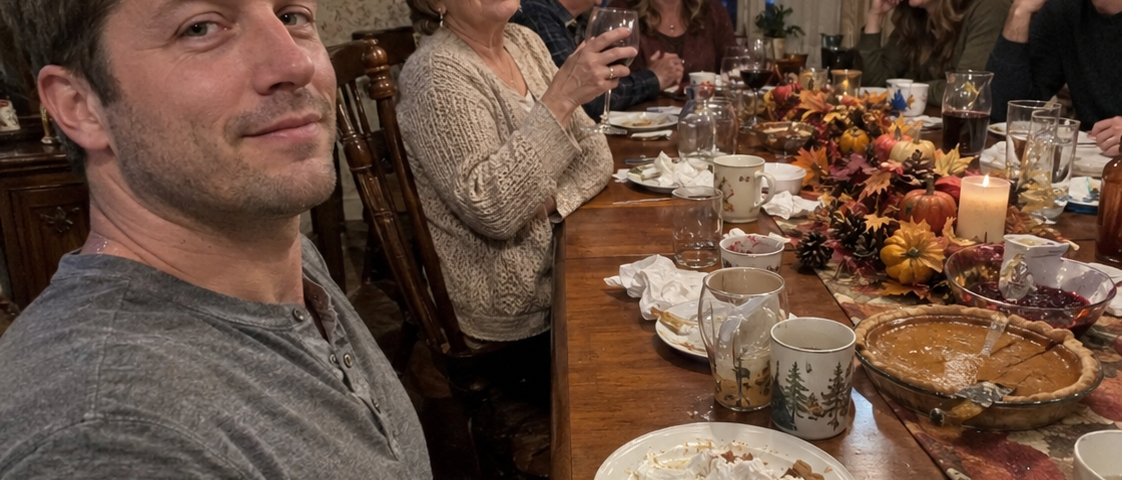
The words rang like a bell, sharp and clear, cutting through the old chains.
For the first time in my life, I wasn’t asking permission. I wasn’t bending.
The weight of it hit me as I rose from my chair, a lightness so sudden it nearly took my balance.
I walked toward the front hall, the polished wood floor creaking softly under my steps.
Behind me, the table sat frozen, a tableau of half-finished pie and unspoken tension.
At the door, Uncle James slipped after me, his voice low. “You just did what the rest of us have avoided for thirty-two years.”
His eyes shone with a mix of pride and sorrow, and I understood that he had been watching this happen for decades, helpless in his own way.
Aunt Carol joined, squeezing my arm firmly. “Text me when you get to your hotel safe. Don’t leave us wondering.”
I nodded, grateful, but unable to form more words. My chest felt too full.
Then I reached for the handle. The red paint of the front door glowed faintly in the warm light, but as I pulled it open, the cold night swept over me, sharp and cleansing.
I stepped across the threshold, leaving the suffocating room behind.
The November air burned my lungs, but inside, I felt lighter, as if invisible walls had fallen away.
I climbed into my car, the leather cold beneath me. I turned the key and heard the engine stir.
In the rearview mirror, the house stood immaculate, its windows glowing like watchful eyes.
But I didn’t look back again. I eased onto the road, knowing with certainty I had crossed into something new, something I couldn’t reverse.
The Maplewood Diner stood like a lone beacon off the highway, its neon sign flickering faintly against the night sky, a small island of warmth in the dark Wisconsin countryside.
Inside, the air smelled of coffee and fried potatoes, the honest, unpretentious smell of a place that asked nothing of you but an appetite.
Only a few truckers hunched at the counter, shoulders bent, silent except for the scrape of forks, each of them alone in his own weather.
I slid into a booth by the window, ordered black coffee and a slice of apple pie. I didn’t want just to have something in front of me.
Outside, the highway stretched into darkness, broken only by the occasional headlights cutting across the void.
My hands trembled until I wrapped them around the warm mug, and I held on, letting the heat seep into my palms, into my wrists, into the places that had gone cold years ago.
With each sip, my breath slowed, as though the walls of my chest were widening for the first time in years, as though I had been breathing through a straw my whole life and someone had finally removed it.
My phone buzzed against the tabletop, relentless, vibrating like an angry insect.
I turned it over.
Emily: “Are you okay? I’m still in shock over what she said.”
James: “Proud of you, kid. You did what needed to be done.”
Carol: “Please let me know when you’re safe at the hotel.”
Then another message. This one from my father’s number, though I knew whose words they were.
Linda: “You embarrassed your mother in front of everyone. You need to apologize.”
I stared at that last one until the letters blurred, until the screen went soft and the words lost their shape.
For thirty-two years, I had been the one to bend, to patch, to smooth things over. Even when the wound wasn’t mine, I had apologized for being too loud, too quiet, too independent, too weak, for existing.
And now, once again, the expectation was clear. Her cruelty could be dismissed, but my defiance could not.
I let out a breath, typed slowly, each word measured.
“I spoke the truth after hearing hers. I will not apologize.”
I hit send, then pressed the power button until the screen went black.
The silence from the phone was louder than the low hum of the diner, a silence that felt, for the first time, like mine.
I stirred sugar into my coffee, though I didn’t need it, listening to the quiet clink of the spoon against porcelain.
That sound, so ordinary, felt like the rhythm of freedom, a small, domestic music that belonged to no one but me.
A reminder that small things, choosing not to answer, choosing to stay silent, could break chains as effectively as shouting.
The tension in my shoulders drained, replaced by something fragile but real. Relief.
It was as if I had set down a backpack I didn’t know I’d been carrying, heavy with years of shame and half-swallowed anger.
When the waitress came by with the check, she gave me a kind look. “Holiday dinner?” she asked softly.
I gave a half smile. “Something like that.”
She nodded knowingly, as if she’d heard a hundred similar stories, then moved on, and I was grateful for the simplicity of it, for being a stranger in a booth with no role to play.
I slid out of the booth, left a tip on the table, and stepped back into the cold night.
The car’s engine hummed as I pulled onto the highway. Street signs flashed green in the headlights, pointing toward the hotel I had booked, toward a bed untouched by ghosts of childhood.
The road stretched ahead, empty and dark. But above it, the sky had cleared.
Stars scattered across the black like something infinite, indifferent, and honest.
The storm behind me had broken everything open, and though I didn’t know what tomorrow would bring, I knew one thing with absolute certainty. The sky in front of me was wide, and it was mine.
The drive to the hotel passed in a blur of dark highway and green signs, and I barely registered the turns, my body driving on instinct while my mind replayed the evening in fragments: her voice, the silence, my own steady words.
The hotel parking lot was nearly empty, the building squat and unremarkable against the night, and I sat in the car for a long moment before going in, listening to the engine tick as it cooled.
My room was small and plain, the way I had wanted it: a bed, a window, a door that locked.
I stood under the hot shower until the water ran lukewarm, letting the heat work the tension out of my shoulders, and when I finally lay down, the sheets were cool and clean, and the silence of the room asked nothing of me at all.
The first light of morning crept through the thin curtains of the small hotel room, laying soft stripes across the brown carpet.
I woke to silence, the kind that felt earned, not imposed, a quiet that belonged to me instead of being inflicted on me.
My body was heavy, but my mind rested startlingly clear.
For the first time in years, I had slept without the tight coil of dread in my chest, without rehearsing conversations in my dreams.
I stood in the bathroom, staring into the mirror.
My reflection was softer, less tense. The corners of my mouth were not pulled down by the weight of unspoken words.
The face looking back at me was my own, unguarded, and I held its gaze longer than I ever had before, as though meeting a person I had neglected for years.
I ran cool water across my skin and let it linger, washing off more than sleep.
Back in the room, I switched on the small coffee maker and let the bitter scent fill the air.
Steam curled upward as I pushed open the window a crack.
Outside, the streets of Madison were quiet after the holiday, the town moving slowly into the day.
A faint breeze carried the chill of late November, but instead of bracing against it, I breathed it in.
There was peace in my chest, fragile but steady, like the first thin ice on a lake.
On the desk, my phone lit up with the messages I had ignored.